Viewing as
Teaching this? The teacher view adds 2 files, the mark schemes and the model answers.
Physics · Atomic structure
Nuclear equations
Write balanced nuclear equations for alpha and beta decay by balancing atomic numbers and mass numbers.
Warm-up
Answer each one, then check.
-
1
What is the mass number?
Show answerHide answer
Protons plus neutrons
-
2
What is an alpha particle?
Show answerHide answer
Two protons and two neutrons
-
3
What is a beta particle?
Show answerHide answer
A fast electron from the nucleus
-
4
What is the atomic number?
Show answerHide answer
Number of protons
-
5
Does gamma change the nucleus's mass or charge?
Show answerHide answer
No
Learning Objectives
- 1Use the symbols for common nuclei and particles.
- 2Balance mass numbers and atomic numbers in alpha and beta decay equations.
- 3Describe the effect of alpha, beta and gamma emission on the nucleus.
NUCLEAR EQUATIONS
Alpha: \(^{4}_{2}\text{He}\). Beta: \(^{0}_{-1}\text{e}\). In a balanced nuclear equation the mass numbers and the atomic numbers are the same on both sides.
Alpha decay: mass number falls by 4, atomic number falls by 2. Beta decay: mass number unchanged, atomic number rises by 1. Gamma: no change to mass or charge.
Alpha and Beta Decay Equations
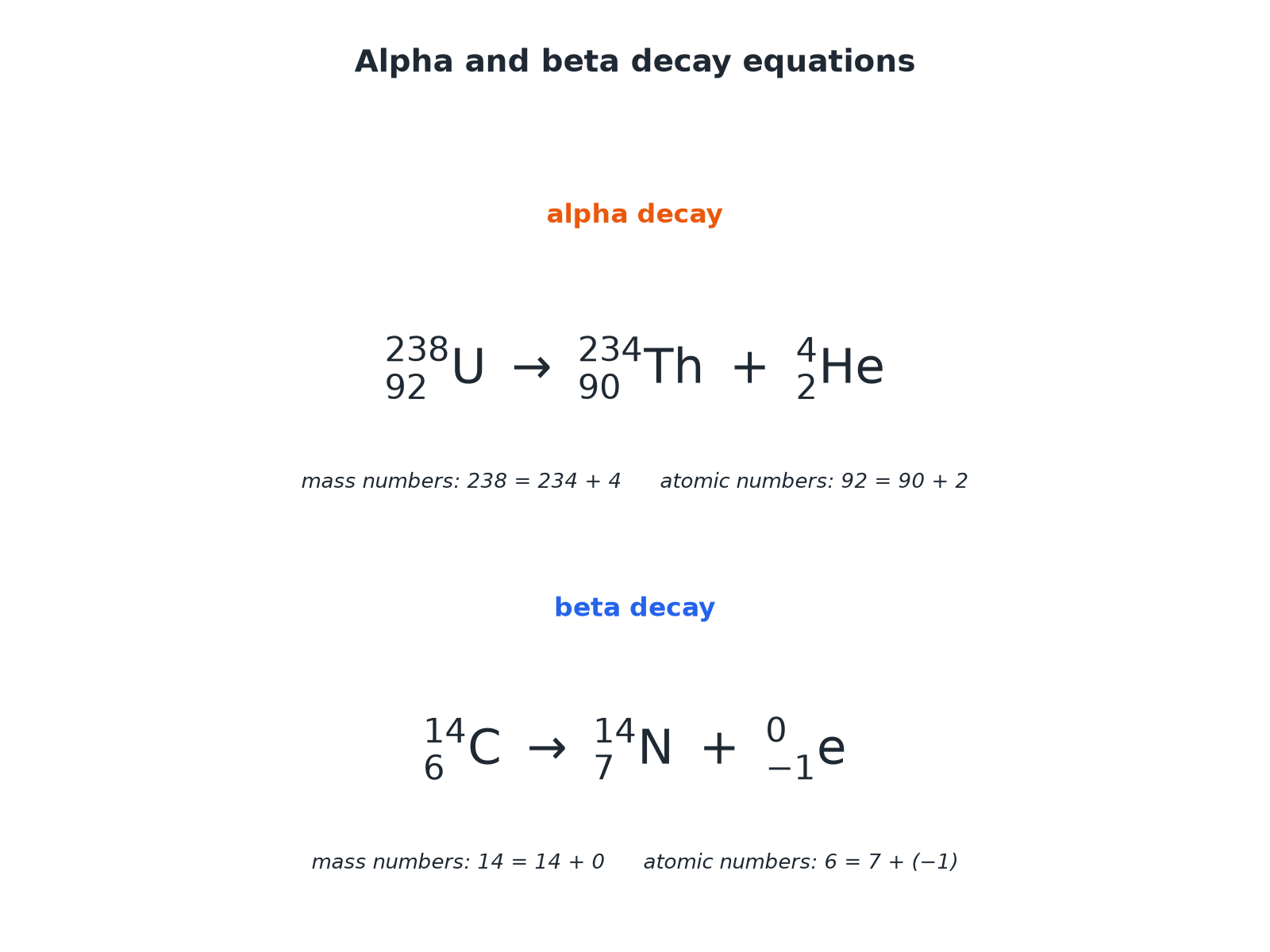
Add up the top numbers and the bottom numbers on each side.
Effects on the Nucleus
How the numbers change.
-
Alpha (α)
Mass number: Decreases by 4. Atomic number: Decreases by 2
-
Beta (β)
Mass number: Stays the same. Atomic number: Increases by 1
-
Gamma (γ)
Mass number: Stays the same. Atomic number: Stays the same
Alpha Decay
Radium-226 (\(^{226}_{88}\text{Ra}\)) decays by alpha emission. Complete: \(^{226}_{88}\text{Ra} \rightarrow\ ^{A}_{Z}\text{Rn} + ^{4}_{2}\text{He}\)
Show the solutionHide the solution
- 1 Mass numbers \(226 = A + 4\), so \(A = 222\)
- 2 Atomic numbers \(88 = Z + 2\), so \(Z = 86\)
Answer\(^{226}_{88}\text{Ra} \rightarrow\ ^{222}_{86}\text{Rn} + ^{4}_{2}\text{He}\)
Beta Decay
Carbon-14 decays by beta emission. Complete: \(^{14}_{6}\text{C} \rightarrow\ ^{14}_{Z}\text{N} + ^{0}_{-1}\text{e}\)
Show the solutionHide the solution
- 1 Mass numbers \(14 = 14 + 0\), so balanced
- 2 Atomic numbers \(6 = Z + (-1)\), so \(Z = 7\)
Answer\(^{14}_{6}\text{C} \rightarrow\ ^{14}_{7}\text{N} + ^{0}_{-1}\text{e}\)
Why It Works
Understand the changes.
-
Alpha
Two protons and two neutrons leave the nucleus.
-
Beta
A neutron turns into a proton and a fast electron is emitted.
-
Gamma
The nucleus loses energy only.
-
Checking
Add up the top numbers, then the bottom numbers, on each side.
Balance the Equation
Complete: (a) \(^{238}_{92}\text{U} \rightarrow\ ^{A}_{Z}\text{Th} + ^{4}_{2}\text{He}\) (b) \(^{90}_{38}\text{Sr} \rightarrow\ ^{90}_{Z}\text{Y} + ^{0}_{-1}\text{e}\)
1. Balance the top numbers.
2. Balance the bottom numbers.
A good answer shows: (a) \(A = 234\), \(Z = 90\). (b) \(Z = 39\).
Can I...?
- 1Write the symbol for alpha.
- 2Write the symbol for beta.
- 3Balance mass numbers.
- 4Balance atomic numbers.
- 5Complete an alpha decay equation.
- 6Complete a beta decay equation.
- 7State the effect of gamma emission.
- 8Explain beta decay.
Summary & Exam Focus
- Alpha decay: mass −4, atomic −2.
- Beta decay: mass unchanged, atomic +1.
- Gamma: no change.
- Balance both rows of numbers.
Exam focus
Complete \(^{226}_{88}\text{Ra} \rightarrow\ ^{A}_{Z}\text{Rn} + ^{4}_{2}\text{He}\). (2 marks) (2 marks)
Balance the top and bottom numbers.
Key terms
The vocabulary this lesson expects you to use. Each one is linked from the first place it appears above.
- Nuclear equation
- An equation showing what happens to a nucleus in radioactive decay.
- Balanced
- The same mass number total and atomic number total on both sides.
- Daughter nucleus
- The nucleus formed after decay.
- Alpha decay
- Emission of a helium nucleus.
- Beta decay
- A neutron changes to a proton and an electron is emitted.
- Gamma emission
- Release of energy from the nucleus as electromagnetic radiation.
Practice questions
Have a go at each one before you open its answer.
-
Question 1 Complete 2 marks
Radium-226 decays by emitting an alpha particle: \(^{226}_{88}\text{Ra} \rightarrow\ ^{A}_{Z}\text{Rn} + ^{4}_{2}\text{He}\). Write the values of A and Z.
Show answerHide answer
Model answer
\(A = 222\), \(Z = 86\)
Mark scheme
- A = 222 — 1 mark
- Z = 86 — 1 mark
-
Question 2 Complete 2 marks
Carbon-14 decays by beta emission: \(^{14}_{6}\text{C} \rightarrow\ ^{14}_{Z}\text{N} + ^{0}_{-1}\text{e}\). Write the value of Z.
Show answerHide answer
Model answer
\(6 = Z - 1\), so \(Z = 7\)
Mark scheme
- Balances atomic numbers — 1 mark
- Z = 7 — 1 mark
-
Question 3 Complete 3 marks
Complete the nuclear equation for the alpha decay of polonium: \(^{214}_{84}\text{Po} \rightarrow\ ^{A}_{82}\text{Pb} + ^{4}_{2}\text{He}\).
Show answerHide answer
Model answer
\(214 = A + 4\), so \(A = 210\). (Atomic numbers: \(84 = 82 + 2\).)
Mark scheme
- Mass number balance — 1 mark
- A = 210 — 1 mark
- Checks atomic numbers — 1 mark
-
Question 4 Explain 3 marks
Explain why the atomic number of a nucleus increases by 1 in beta decay but its mass number does not change.
Show answerHide answer
Model answer
In beta decay a neutron changes into a proton and a fast electron is emitted. The number of protons increases by 1, so the atomic number increases; the total number of protons and neutrons stays the same.
Mark scheme
- Neutron turns into a proton — 1 mark
- Atomic number increases by 1 because there is one more proton — 1 mark
- Number of nucleons unchanged — 1 mark
-
Question 5 State 2 marks
State what happens to the mass number and the atomic number when a nucleus emits a gamma ray.
Show answerHide answer
Model answer
Neither changes.
Mark scheme
- Mass number does not change — 1 mark
- Atomic number does not change — 1 mark
Quick check
-
An alpha particle is written as...
Show answerHide answer
B: \(^{4}_{2}\text{He}\)
Mass number 4, atomic number 2.
-
Alpha decay changes the mass number by...
Show answerHide answer
C: −4
It loses 2 protons and 2 neutrons.
-
Beta decay changes the atomic number by...
Show answerHide answer
D: +1
A neutron becomes a proton.
-
Gamma emission changes the mass number by...
Show answerHide answer
A: 0
Only energy is lost.
-
In a balanced equation the total mass number...
Show answerHide answer
B: is the same on both sides
Nucleons are conserved.
Downloads
Free to keep, print and annotate.
- Nuclear equations.pptx Built from the lesson script on 30 September 2026. View
- Nuclear equations - Completed Notes.docx The full notes for the lesson, to revise from. Built from the lesson script on 30 September 2026. View
- Nuclear equations - Exam Questions.docx Built from the lesson script on 30 September 2026. View
Something here looks wrong?
Tell us what and we will go and look. It goes to whoever writes these pages, nobody else, and we do not ask who you are — so there is nothing to sign and nothing comes back to you.