Viewing as
Teaching this? The teacher view adds 2 files, the mark schemes and the model answers.
Physics · Forces
Atmospheric pressure
Describe a simple model of the Earth's atmosphere and explain why atmospheric pressure decreases with height.
Warm-up
Answer each one, then check.
-
1
What is air made of?
Show answerHide answer
Gas molecules, mostly nitrogen and oxygen
-
2
What causes gas pressure?
Show answerHide answer
Collisions of particles with surfaces
-
3
What is pressure?
Show answerHide answer
Force per unit area
-
4
What is density?
Show answerHide answer
Mass per unit volume
-
5
What is altitude?
Show answerHide answer
Height above sea level
Learning Objectives
- 1Describe a simple model of the atmosphere.
- 2Explain how air molecules colliding with a surface create atmospheric pressure.
- 3Explain why atmospheric pressure decreases with increasing height.
ATMOSPHERIC PRESSURE
The atmosphere is a thin layer of air round the Earth that gets less dense with altitude. Air molecules colliding with a surface create atmospheric pressure.
As height increases there is less air above a surface, so the weight of air above falls and the atmospheric pressure decreases.
The Atmosphere
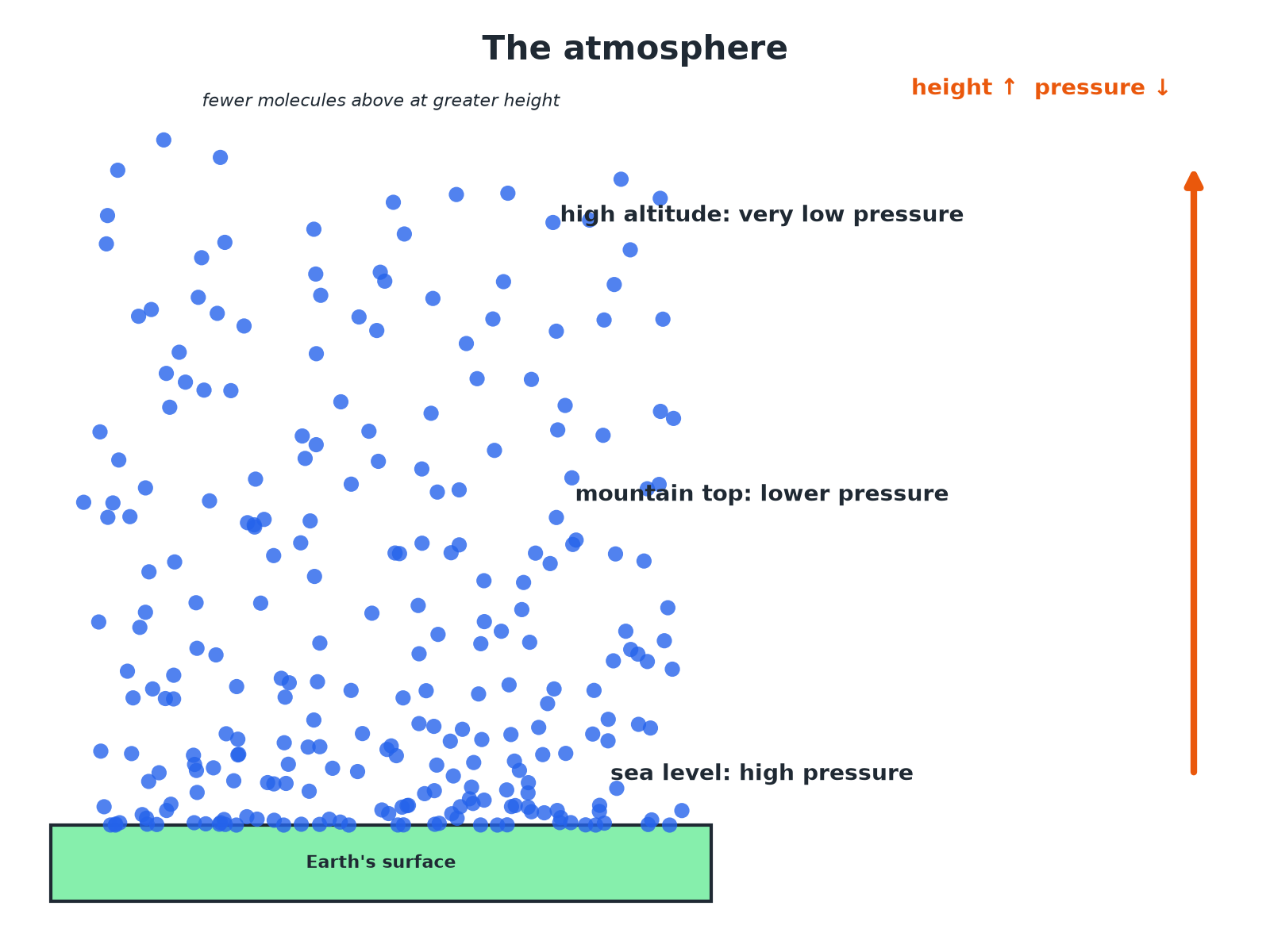
Less air above means lower pressure.
Why Pressure Falls with Height
Explain why atmospheric pressure is lower at the top of a mountain than at sea level.
Show the solutionHide the solution
- 1 Air above At the top there is less air above the surface
- 2 Weight So the weight of air pressing down is less
- 3 Molecules There are fewer molecules, so fewer collisions with a surface each second
AnswerFewer air molecules and less weight of air above lead to lower atmospheric pressure.
Using a Graph
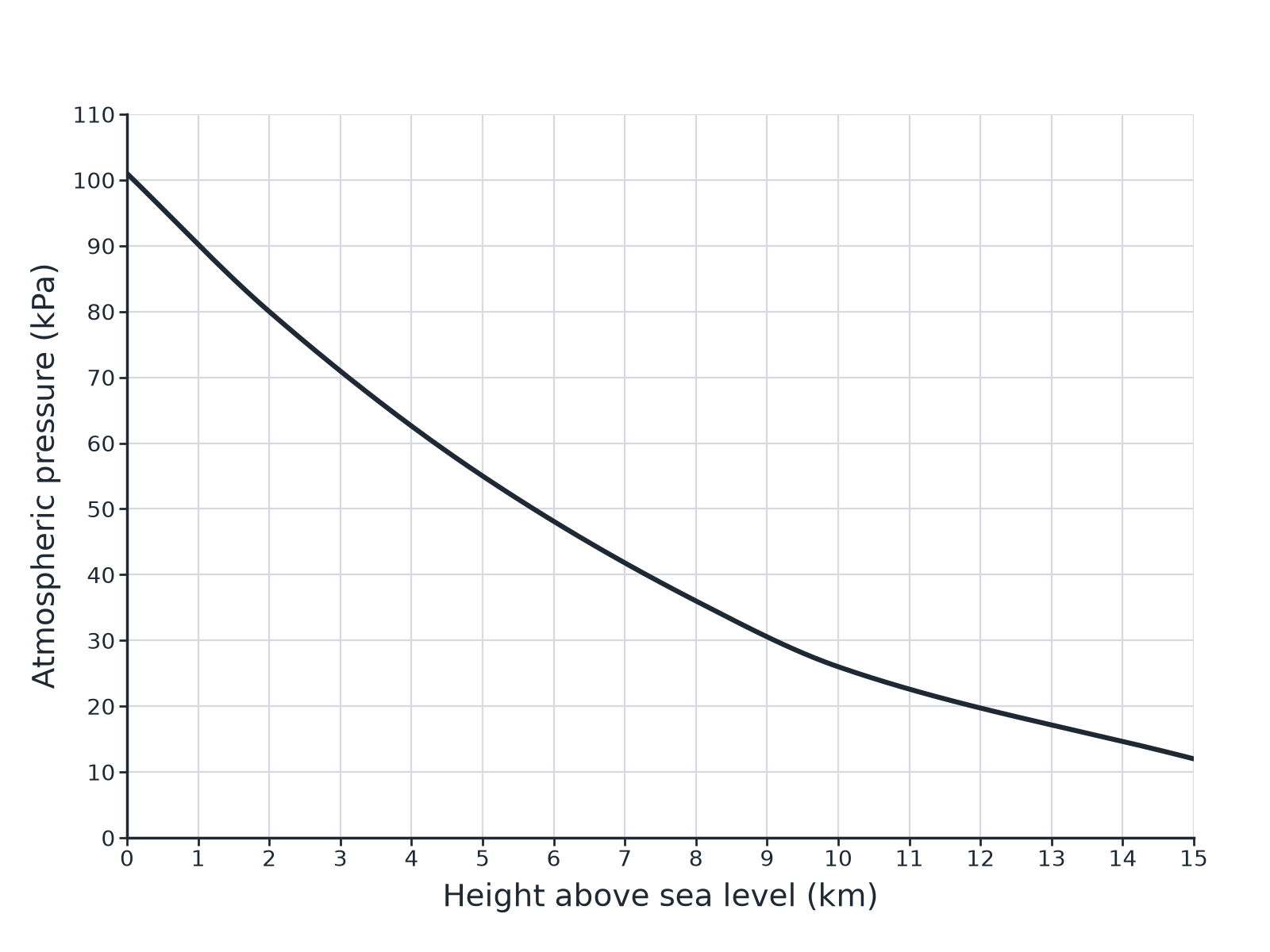
At sea level the atmospheric pressure is about 101 kPa. At 5 km it is about 55 kPa. Describe the trend.
Show the solutionHide the solution
- 1 Height increases 5 km above sea level
- 2 Pressure Falls from 101 kPa to 55 kPa
AnswerAtmospheric pressure decreases as height increases, at first quite quickly.
Key Points
Learn these.
-
Thin layer
The atmosphere is thin compared with the size of the Earth.
-
Density
The air gets less dense with altitude.
-
Collisions
Atmospheric pressure is caused by molecules colliding with surfaces.
-
No sharp edge
The pressure falls gradually to almost zero in space.
Mountain Pressure
Explain why a sealed bag of crisps bulges when taken up a mountain.
1. Compare inside and outside pressure.
2. Explain the bulge.
A good answer shows: The pressure outside falls with height, but the pressure inside the bag stays the same, so the bag expands.
Can I...?
- 1Describe the atmosphere.
- 2Say air gets less dense with height.
- 3Explain atmospheric pressure.
- 4Explain the fall in pressure with height.
- 5Read a graph of pressure.
- 6Use the particle model.
- 7Describe collisions.
- 8Explain a bulging bag.
Summary & Exam Focus
- The atmosphere gets less dense with altitude.
- Pressure: collisions of air molecules.
- Less air above means a smaller weight of air.
- Pressure decreases with height.
Exam focus
Explain why atmospheric pressure decreases as height above the ground increases. (3 marks) (3 marks)
Less air above, fewer collisions.
Key terms
The vocabulary this lesson expects you to use. Each one is linked from the first place it appears above.
- Atmosphere
- The layer of air around the Earth.
- Atmospheric pressure
- The pressure caused by air molecules colliding with a surface.
- Altitude
- Height above the ground or sea level.
- Air molecule
- A particle of nitrogen, oxygen or another gas.
- Less dense
- Fewer particles in each cubic metre.
- Collision
- Particles hitting a surface.
Practice questions
Have a go at each one before you open its answer.
-
Question 1 Explain 3 marks
Explain why atmospheric pressure decreases as the height above the ground increases.
Show answerHide answer
Model answer
The atmosphere is less dense at greater height, so there are fewer air molecules colliding with a surface. There is also less air above, so the weight of air pressing down is less.
Mark scheme
- Air less dense at greater height — 1 mark
- Fewer collisions with a surface — 1 mark
- Less weight of air above — 1 mark
-
Question 2 Use the graph 3 marks
The graph shows how atmospheric pressure changes with height above sea level. (a) Use the graph to find the atmospheric pressure at a height of 5 km. (b) Describe how the pressure changes as the height increases.
Show answerHide answer
Model answer
(a) About 55 kPa (accept 52 to 58). (b) The pressure decreases as the height increases; it falls more quickly at low heights.
Mark scheme
- 55 kPa — 1 mark
- Decreases — 1 mark
- Falls faster at first (curved) — 1 mark
-
Question 3 Describe 2 marks
Describe a simple model of the Earth's atmosphere.
Show answerHide answer
Model answer
A thin layer of air around the Earth that is densest at the ground and gets less dense with increasing height.
Mark scheme
- Thin layer of air around the Earth — 1 mark
- Less dense with height — 1 mark
-
Question 4 Explain 3 marks
A sealed bag of crisps is taken up a mountain and bulges. Explain why.
Show answerHide answer
Model answer
The atmospheric pressure outside the bag is lower at the top of the mountain, but the pressure of the air inside the bag is the same as at the bottom, so the bag expands.
Mark scheme
- Outside pressure is lower — 1 mark
- Pressure inside is greater than outside — 1 mark
- Bag expands — 1 mark
-
Question 5 Explain 2 marks
Explain what causes atmospheric pressure.
Show answerHide answer
Model answer
Air molecules collide with a surface and exert a force on it; the force per unit area is the pressure.
Mark scheme
- Collisions of air molecules with surfaces — 1 mark
- Force per unit area — 1 mark
Quick check
-
Atmospheric pressure is caused by...
Show answerHide answer
B: collisions of air molecules
Molecules hit surfaces.
-
As height increases, atmospheric pressure...
Show answerHide answer
C: decreases
Less air above.
-
The atmosphere is...
Show answerHide answer
D: a thin layer of air
Thin compared with the Earth.
-
Higher up the air is...
Show answerHide answer
A: less dense
Fewer molecules per cubic metre.
-
A sealed bag expands on a mountain because outside pressure is...
Show answerHide answer
B: lower
The inside pressure is greater.
Downloads
Free to keep, print and annotate.
- Atmospheric pressure.pptx Built from the lesson script on 30 September 2026. View
- Atmospheric pressure - Completed Notes.docx The full notes for the lesson, to revise from. Built from the lesson script on 30 September 2026. View
- Atmospheric pressure - Exam Questions.docx Built from the lesson script on 30 September 2026. View
Something here looks wrong?
Tell us what and we will go and look. It goes to whoever writes these pages, nobody else, and we do not ask who you are — so there is nothing to sign and nothing comes back to you.