Viewing as
Teaching this? The teacher view adds 2 files, the mark schemes and the model answers.
Physics · Forces
Newton's Second Law
Use \(F = ma\), investigate how force and mass affect acceleration (Required Practical 7), and explain inertial mass (Higher tier).
Warm-up
Answer each one, then check.
-
1
What is a resultant force?
Show answerHide answer
The single force with the same effect as all the forces
-
2
What is acceleration?
Show answerHide answer
Rate of change of velocity
-
3
What is the unit of force?
Show answerHide answer
Newton
-
4
What is proportional?
Show answerHide answer
Doubling one doubles the other
-
5
What does inversely proportional mean?
Show answerHide answer
Doubling one halves the other
Learning Objectives
- 1State Newton's Second Law.
- 2Recall and apply \(F = ma\).
- 3Describe how to investigate the effect of force and mass on acceleration (Required Practical 7).
- 4Explain inertial mass (Higher tier).
NEWTON'S SECOND LAW
resultant force \(=\) mass \(\times\) acceleration \(F = ma\)
The acceleration of an object is proportional to the resultant force and inversely proportional to its mass: \(a \propto F\) and \(a \propto \tfrac{1}{m}\).
Required Practical 7: Force, Mass and Acceleration
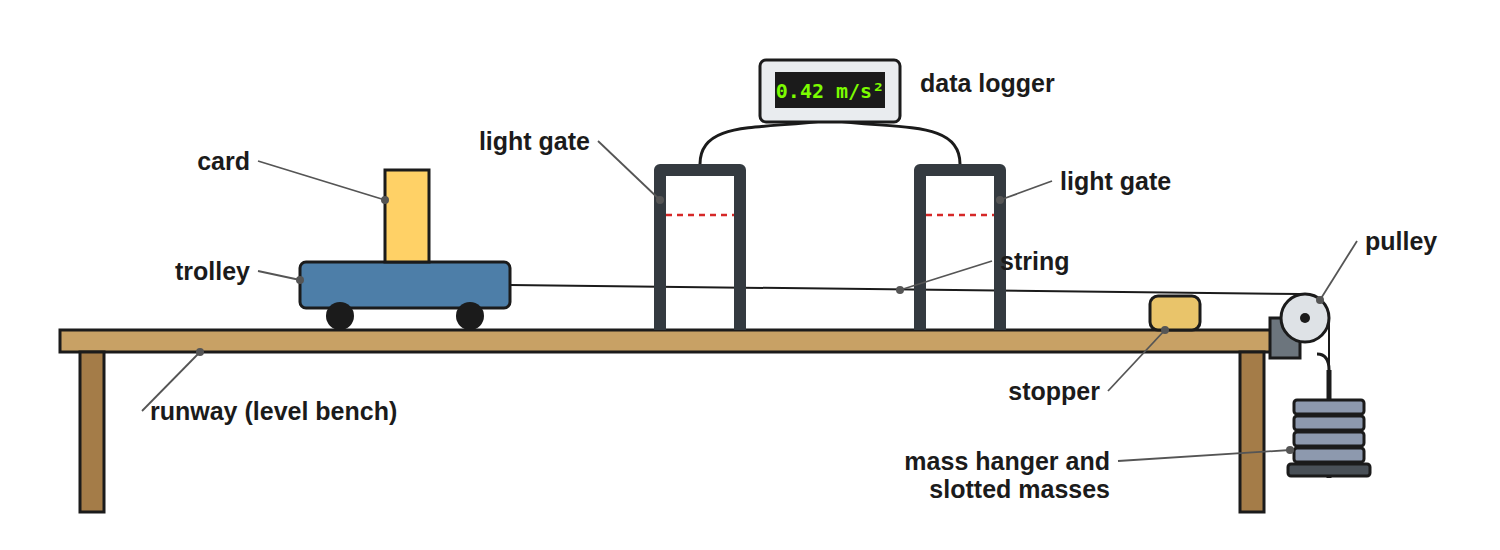
The weight of the hanging masses provides the force.
Required Practical 7: Method
Two investigations.
-
1
Force varied
Keep the total mass constant by moving masses from the trolley to the hanger; the force is the weight of the hanging masses.
-
2
Measure acceleration
From the light gates: a = (v − u) ÷ t.
-
3
Plot
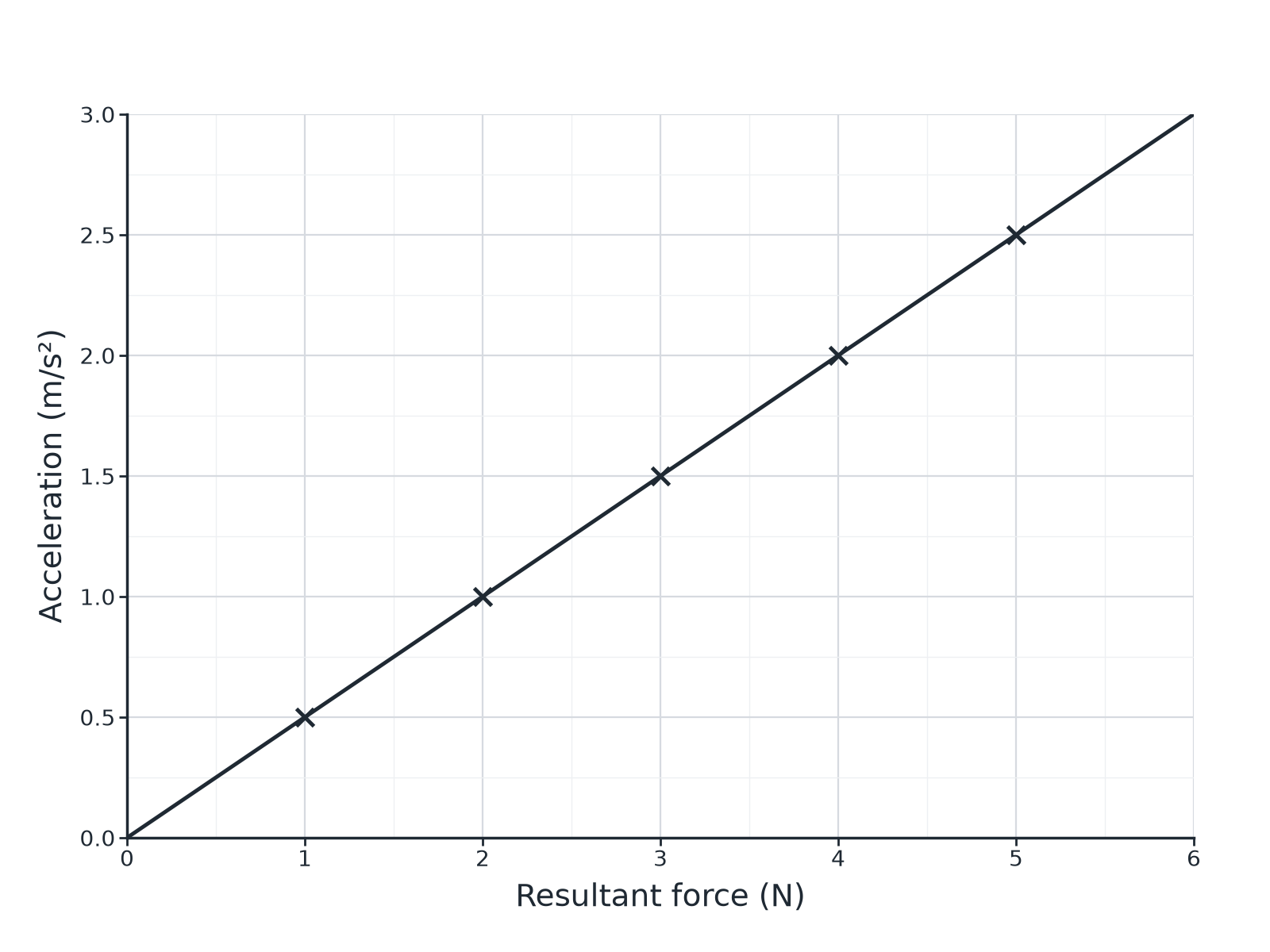
Acceleration against force: a straight line through the origin.
-
4
Mass varied
Keep the force constant and add masses to the trolley.
-
5
Plot
Acceleration against mass (a curve) or against 1/mass (a straight line).
-
6
Repeat
Take repeat readings and compensate for friction by slightly tilting the runway.
Finding Acceleration
A car of mass 1200 kg has a resultant force of 3000 N. Calculate its acceleration.
Show the solutionHide the solution
- 1 Rearrange \(a = F \div m\)
- 2 Substitute \(a = 3000 \div 1200\)
- 3 Answer \(a = 2.5\) m/s²
Answer2.5 m/s²
Finding the Force
A 0.50 kg trolley accelerates at 4.0 m/s². Calculate the resultant force.
Show the solutionHide the solution
- 1 Write the equation \(F = ma\)
- 2 Substitute \(F = 0.50 \times 4.0\)
- 3 Answer \(F = 2.0\) N
Answer2.0 N
Using a Graph
A graph of acceleration against force for a trolley is a straight line through (2.0 N, 1.0 m/s²). Find the mass.
Show the solutionHide the solution
- 1 Gradient \(a \div F = 1.0 \div 2.0 = 0.50\) kg⁻¹
- 2 Since a = F ÷ m Gradient = 1 ÷ m
- 3 Mass \(m = 1 \div 0.50 = 2.0\) kg
Answer2.0 kg
Inertial Mass (Higher)
Explain what is meant by inertial mass.
Show the solutionHide the solution
- 1 Definition The ratio of force to acceleration
- 2 Meaning A measure of how difficult it is to change the velocity of an object
AnswerInertial mass = force ÷ acceleration: how hard it is to change an object's velocity.
Estimating
Use sensible values.
-
Everyday values
A car accelerating from 0 to 27 m/s (60 mph) in 10 s has a ≈ 2.7 m/s².
-
Force
For a 1000 kg car: F = 1000 × 2.7 ≈ 2700 N.
-
Symbol ~
Means approximately.
-
Units
Mass in kg, a in m/s², F in N.
Predict the Acceleration
A trolley has a mass of 1.0 kg and accelerates at 2.0 m/s² under a resultant force. What acceleration would the same force give a 2.0 kg trolley? What force is needed for 2.0 kg to accelerate at 2.0 m/s²?
1. Use F = ma.
2. Compare the masses.
A good answer shows: Half the acceleration: 1.0 m/s². Force = 2.0 × 2.0 = 4.0 N.
Can I...?
- 1State Newton's second law.
- 2Recall F = ma.
- 3Rearrange for a or m.
- 4Describe Required Practical 7.
- 5Interpret a force–acceleration graph.
- 6Explain inertial mass.
- 7Estimate forces on a car.
- 8Use units.
Summary & Exam Focus
- \(F = ma\).
- Acceleration ∝ force; ∝ 1/mass.
- Inertial mass = force ÷ acceleration.
- Use light gates to measure acceleration.
Exam focus
A 1200 kg car has a resultant force of 3000 N. Calculate its acceleration. (2 marks) (2 marks)
a = F ÷ m.
Key terms
The vocabulary this lesson expects you to use. Each one is linked from the first place it appears above.
- Resultant force
- The net force acting on an object.
- Acceleration
- Rate of change of velocity.
- Inertial mass
- Force divided by acceleration.
- Proportional
- Increasing by the same factor.
- Inversely proportional
- One quantity halves as the other doubles.
- Light gate
- A sensor that times how long a card takes to pass.
Practice questions
Have a go at each one before you open its answer.
-
Question 1 Calculate 2 marks
A car has a mass of 1200 kg. The resultant force on the car is 3000 N. Calculate the acceleration of the car. Use the equation: resultant force = mass × acceleration
Show answerHide answer
Model answer
\(a = 3000 \div 1200 = 2.5\) m/s²
Mark scheme
- Rearranges to a = F ÷ m — 1 mark
- 2.5 m/s² — 1 mark
-
Question 2 Calculate 2 marks
A trolley of mass 0.50 kg accelerates at 4.0 m/s². Calculate the resultant force on the trolley.
Show answerHide answer
Model answer
\(F = 0.50 \times 4.0 = 2.0\) N
Mark scheme
- Correct substitution — 1 mark
- 2.0 N — 1 mark
-
Question 3 Use the graph 4 marks
A student investigates how the acceleration of a trolley depends on the resultant force. The graph shows the results. (a) Describe the relationship. (b) Use the graph to calculate the mass of the trolley.
Show answerHide answer
Model answer
(a) Acceleration is directly proportional to the resultant force (a straight line through the origin). (b) Gradient \(= 2.5 \div 5.0 = 0.50\); \(m = 1 \div 0.50 = 2.0\) kg
Mark scheme
- Straight line through the origin / directly proportional — 1 mark
- Uses the gradient — 1 mark
- Gradient = 1/m — 1 mark
- 2.0 kg — 1 mark
-
Question 4 Describe 6 marks
Describe an investigation to show how the acceleration of a trolley depends on the resultant force acting on it. Your answer should include the apparatus, the measurements and how you would use the results.
Show answerHide answer
Model answer
See levels-of-response scheme.
Mark scheme
- Level 3 (5 to 6 marks): a complete method (trolley, runway, pulley, hanging masses, light gates or ticker timer), keeping total mass constant, measuring acceleration for several forces, plotting acceleration against force and describing the expected straight line, with a precaution or repeat — 5 to 6 marks
- Level 2 (3 to 4 marks): a method with most apparatus and measurements but with gaps — 3 to 4 marks
- Level 1 (1 to 2 marks): simple statements about pulling a trolley — 1 to 2 marks
-
Question 5 Explain 2 marks
Explain what is meant by the inertial mass of an object.
Show answerHide answer
Model answer
Inertial mass is a measure of how difficult it is to change the velocity of an object; it is the ratio of force to acceleration.
Mark scheme
- How difficult it is to change velocity — 1 mark
- Force divided by acceleration — 1 mark
Quick check
-
Newton's second law is...
Show answerHide answer
D: \(F = ma\)
Force is mass times acceleration.
-
A 2 kg mass with a 10 N resultant force has an acceleration of...
Show answerHide answer
A: 5 m/s²
10 ÷ 2.
-
Doubling the force on an object doubles its...
Show answerHide answer
B: acceleration
a ∝ F.
-
Doubling the mass for the same force makes the acceleration...
Show answerHide answer
C: half
a ∝ 1/m.
-
Inertial mass is...
Show answerHide answer
D: force ÷ acceleration
It measures resistance to change in velocity.
Downloads
Free to keep, print and annotate.
- Newtons Second Law.pptx Built from the lesson script on 30 September 2026. View
- Newtons Second Law - Completed Notes.docx The full notes for the lesson, to revise from. Built from the lesson script on 30 September 2026. View
- Newtons Second Law - Exam Questions.docx Built from the lesson script on 30 September 2026. View
Something here looks wrong?
Tell us what and we will go and look. It goes to whoever writes these pages, nobody else, and we do not ask who you are — so there is nothing to sign and nothing comes back to you.