Viewing as
Teaching this? The teacher view adds 2 files, the mark schemes and the model answers.
Physics · Magnetism and electromagnetism
Transformers
Explain how a transformer works, and use \(\dfrac{V_p}{V_s} = \dfrac{n_p}{n_s}\) and \(V_s I_s = V_p I_p\) (Physics only; Higher tier only).
Warm-up
Answer each one, then check.
-
1
What is the National Grid?
Show answerHide answer
The network that transfers electrical power
-
2
Why is high voltage used in the grid?
Show answerHide answer
To reduce energy lost as heat
-
3
What is power?
Show answerHide answer
The rate of transfer of energy
-
4
What is a.c.?
Show answerHide answer
Alternating current
-
5
What is a coil?
Show answerHide answer
Loops of wire
Learning Objectives
- 1Describe the structure and function of a transformer.
- 2Explain how a step-up and a step-down transformer work.
- 3Use \(V_p / V_s = n_p / n_s\).
- 4Use \(V_s I_s = V_p I_p\) for a 100% efficient transformer.
- 5Explain why the National Grid uses transformers.
THE TRANSFORMER EQUATIONS
\(\dfrac{V_p}{V_s} = \dfrac{n_p}{n_s}\) and \(V_s \times I_s = V_p \times I_p\)
\(V_p\), \(I_p\), \(n_p\) are for the primary coil; \(V_s\), \(I_s\), \(n_s\) for the secondary. The second equation assumes 100% efficiency (power in = power out).
A Transformer
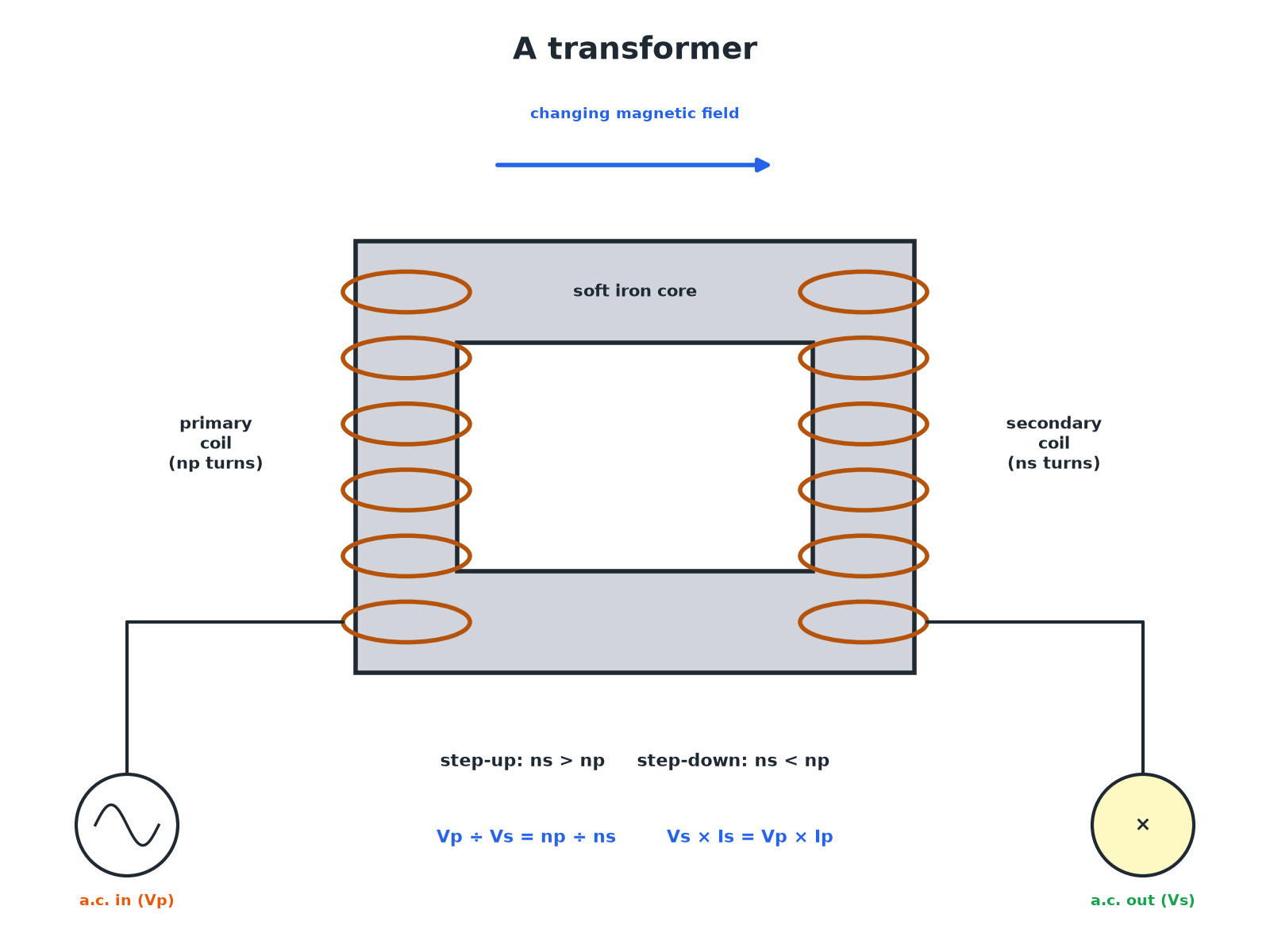
The iron core links the magnetic field between the coils.
How a Transformer Works
Follow the steps.
-
1
a.c. in the primary
An alternating current flows in the primary coil.
-
2
Changing field
It produces a changing magnetic field in the iron core.
-
3
Field through the secondary
The changing field passes through the secondary coil.
-
4
Generator effect
An alternating p.d. is induced in the secondary coil.
-
5
Turns ratio
The ratio of turns sets the ratio of potential differences.
Step-up or Step-down?
Step-up transformer
- More turns on the secondary coil.
- Increases the potential difference.
- Used at power stations before the grid.
Step-down transformer
- Fewer turns on the secondary coil.
- Decreases the potential difference.
- Used near homes to bring the p.d. down to 230 V.
Using the Turns Ratio
A transformer has 200 turns on its primary coil and 1000 on its secondary. The input is 12 V. Calculate the output potential difference.
Show the solutionHide the solution
- 1 Write the equation \(V_p / V_s = n_p / n_s\)
- 2 Rearrange \(V_s = V_p \times n_s \div n_p\)
- 3 Substitute \(V_s = 12 \times 1000 \div 200\)
- 4 Answer \(V_s = 60\) V
Answer60 V
Power In Equals Power Out
A 100% efficient transformer has a primary p.d. of 230 V and current of 2.0 A. The secondary p.d. is 11.5 V. Calculate the secondary current.
Show the solutionHide the solution
- 1 Write the equation \(V_s I_s = V_p I_p\)
- 2 Rearrange \(I_s = V_p I_p \div V_s\)
- 3 Substitute \(I_s = 230 \times 2.0 \div 11.5\)
- 4 Answer \(I_s = 40\) A
Answer40 A
Why the National Grid Uses Them
High voltage, low current.
-
Step-up at the power station
Raises the p.d. (up to 400 000 V) and lowers the current.
-
Lower current
Less energy is wasted as heat in the cables.
-
Step-down near homes
Reduces the p.d. to 230 V for safe use.
-
Efficiency
The grid is efficient because transformers waste little energy.
Transformer Sums
A transformer has \(n_p = 50\) and \(n_s = 500\). Input 10 V a.c. Find \(V_s\). If the input current is 2.0 A, find \(I_s\) assuming 100% efficiency.
1. Step-up: p.d. up, current down.
A good answer shows: Vs = 10 × 500 ÷ 50 = 100 V. Power in = 20 W, so Is = 20 ÷ 100 = 0.20 A.
Can I...?
- 1Name the parts.
- 2Explain the working.
- 3State step-up and step-down.
- 4Use the turns ratio.
- 5Use power in = power out.
- 6Explain why a.c. is needed.
- 7Explain the National Grid.
- 8Give typical voltages.
Summary & Exam Focus
- \(V_p / V_s = n_p / n_s\).
- \(V_s I_s = V_p I_p\) for 100% efficiency.
- Step-up increases the p.d. and decreases the current.
- a.c. is needed for a changing field.
Exam focus
A transformer has 200 primary turns and 1000 secondary turns. The input is 12 V. Calculate the output. (2 marks) (2 marks)
Vs = Vp × ns ÷ np.
Key terms
The vocabulary this lesson expects you to use. Each one is linked from the first place it appears above.
- Transformer
- A device that changes the potential difference of an alternating supply.
- Primary coil
- The input coil of a transformer.
- Secondary coil
- The output coil of a transformer.
- Step-up transformer
- A transformer that increases the potential difference.
- Step-down transformer
- A transformer that decreases the potential difference.
- Soft iron core
- A core that easily becomes magnetised and demagnetised, linking the coils.
Practice questions
Have a go at each one before you open its answer.
-
Question 1 Calculate 2 marks
A transformer has 200 turns on its primary coil and 1000 turns on its secondary coil. The input potential difference is 12 V. Calculate the output potential difference. Use the equation: Vp ÷ Vs = np ÷ ns
Show answerHide answer
Model answer
\(V_s = 12 \times 1000 \div 200 = 60\) V
Mark scheme
- Correct rearrangement and substitution — 1 mark
- 60 V — 1 mark
-
Question 2 Explain 4 marks
Explain how a transformer changes the potential difference of an alternating supply.
Show answerHide answer
Model answer
An alternating current in the primary coil produces a changing magnetic field in the iron core. This changing field passes through the secondary coil and induces an alternating potential difference in it. The ratio of the turns determines the ratio of the potential differences.
Mark scheme
- a.c. in the primary makes a changing magnetic field — 1 mark
- Field carried by the iron core to the secondary — 1 mark
- Induced p.d. in the secondary (generator effect) — 1 mark
- Turns ratio sets the p.d. ratio — 1 mark
-
Question 3 Calculate 3 marks
A transformer is 100% efficient. The primary p.d. is 230 V and the primary current is 2.0 A. The secondary p.d. is 11.5 V. Calculate the secondary current.
Show answerHide answer
Model answer
\(I_s = 230 \times 2.0 \div 11.5 = 40\) A
Mark scheme
- Vs Is = Vp Ip — 1 mark
- Correct substitution — 1 mark
- 40 A — 1 mark
-
Question 4 Explain 3 marks
Explain why a transformer does not work with a direct current.
Show answerHide answer
Model answer
A direct current gives a steady magnetic field in the core. No change in field passes through the secondary coil, so no potential difference is induced.
Mark scheme
- d.c. produces a constant field — 1 mark
- No change in field in the secondary — 1 mark
- No p.d. induced — 1 mark
-
Question 5 Explain 4 marks
Explain why electricity is transmitted in the National Grid at a very high potential difference.
Show answerHide answer
Model answer
A step-up transformer increases the potential difference and so, for the same power, the current is lower. A lower current means less energy is wasted as heat in the cables, so the transmission is more efficient. Step-down transformers then reduce the p.d. for use in homes.
Mark scheme
- Step-up transformer raises p.d. — 1 mark
- Current is lower for the same power — 1 mark
- Less energy wasted as heat — 1 mark
- Step-down near homes for safety — 1 mark
Quick check
-
A step-up transformer has...
Show answerHide answer
A: more turns on the secondary
It increases p.d.
-
A transformer needs...
Show answerHide answer
B: alternating current
A changing field.
-
Vp = 10 V, np = 100, ns = 500. Vs =
Show answerHide answer
C: 50 V
10 × 500 ÷ 100.
-
In a step-up transformer the current...
Show answerHide answer
D: decreases
Power is conserved.
-
The core of a transformer is...
Show answerHide answer
A: soft iron
Easily magnetised.
Downloads
Free to keep, print and annotate.
- Transformers.pptx Built from the lesson script on 30 September 2026. View
- Transformers - Completed Notes.docx The full notes for the lesson, to revise from. Built from the lesson script on 30 September 2026. View
- Transformers - Exam Questions.docx Built from the lesson script on 30 September 2026. View
Something here looks wrong?
Tell us what and we will go and look. It goes to whoever writes these pages, nobody else, and we do not ask who you are — so there is nothing to sign and nothing comes back to you.