Viewing as
Teaching this? The teacher view adds 2 files, the mark schemes and the model answers.
Physics · Space physics
Our solar system
Describe the structure of the solar system, the formation of the Sun and planets, and the orbits of planets, moons and artificial satellites (Physics only).
Warm-up
Answer each one, then check.
-
1
What force holds planets in orbit?
Show answerHide answer
Gravity
-
2
Name the star at the centre of our solar system.
Show answerHide answer
The Sun
-
3
Name the galaxy we live in.
Show answerHide answer
The Milky Way
-
4
Name three planets.
Show answerHide answer
For example Earth, Mars and Jupiter
-
5
What is a moon?
Show answerHide answer
A natural satellite of a planet
Learning Objectives
- 1Describe the structure of the solar system and our galaxy.
- 2Describe how the Sun and the planets formed.
- 3Describe the orbits of planets, moons and satellites.
- 4Describe the force that keeps an object in orbit.
- 5Explain the difference between natural and artificial satellites.
THE SOLAR SYSTEM
Our solar system is made up of the Sun at the centre, eight planets, dwarf planets, moons, asteroids and comets. It is part of the Milky Way galaxy. Gravity causes objects to orbit.
Our Sun is one of about 100 billion stars in the Milky Way galaxy.
The Solar System
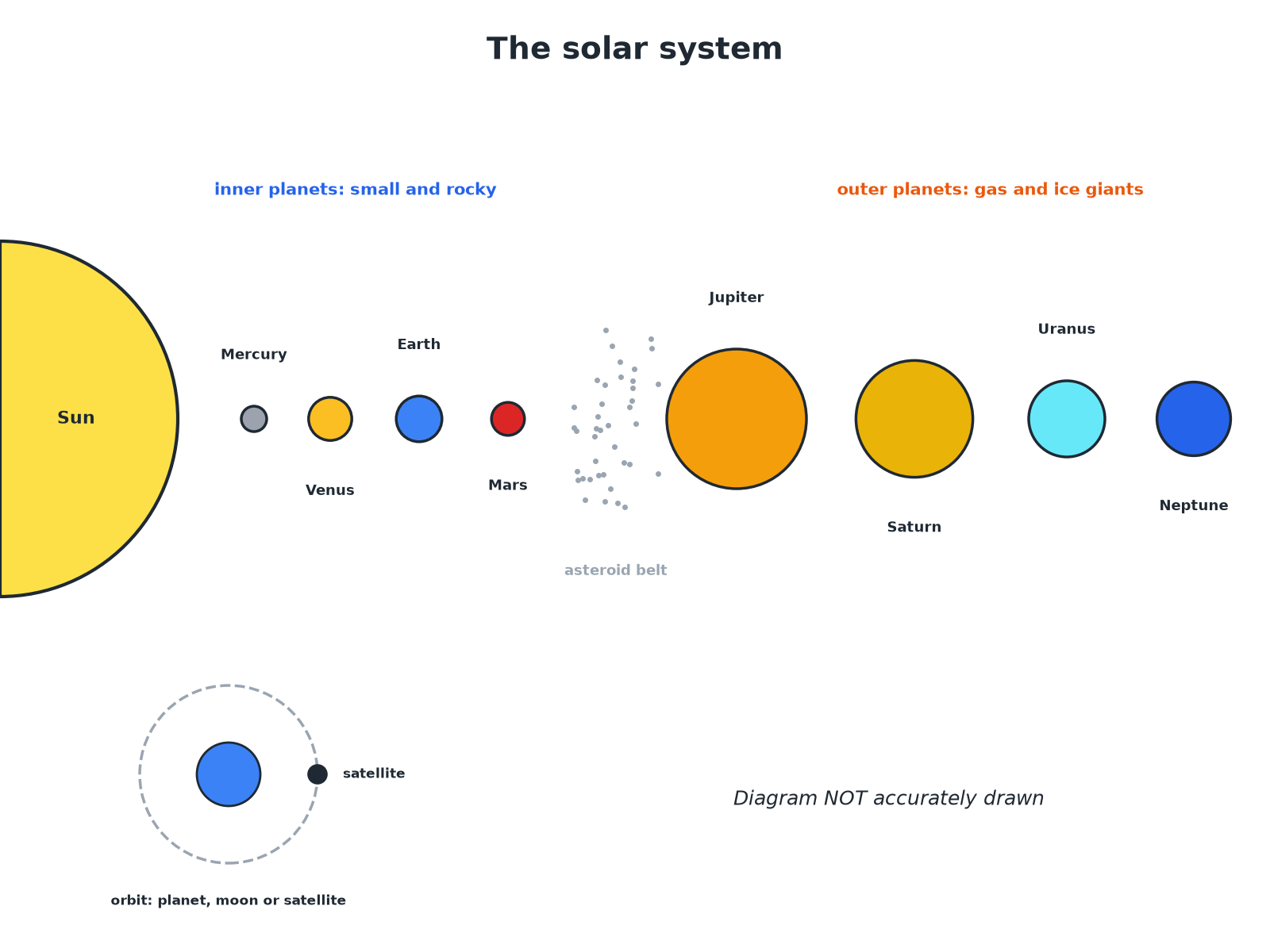
The four inner planets are rocky; the outer four are gas and ice giants.
How the Solar System Formed
Follow the steps.
-
1
A nebula
A huge cloud of dust and gas collapses under gravity.
-
2
Protostar
Gravity pulls the gas together. It gets hot and dense.
-
3
A star is born
Nuclear fusion begins; the Sun starts to shine.
-
4
Planets
Material left over clumps together to form planets and moons.
Orbits
Learn what orbits what.
-
Planets
Orbits: The Sun. Type: Natural
-
Moons
Orbits: A planet. Type: Natural satellites
-
Weather and communications satellites
Orbits: The Earth. Type: Artificial satellites
-
Comets
Orbits: The Sun. Type: Elliptical orbits
Orbits and Gravity
Explain why the Moon stays in orbit around the Earth.
Show the solutionHide the solution
- 1 Gravity The Earth's gravity pulls the Moon towards it
- 2 Centripetal force Gravity is the force towards the centre of the orbit
- 3 Result The Moon keeps changing direction so it follows a circular path
AnswerGravity acts as the force towards the centre.
Key Facts
Learn these.
-
Planets
Eight; Mercury, Venus, Earth, Mars, Jupiter, Saturn, Uranus and Neptune.
-
Galaxy
A huge collection of billions of stars, like the Milky Way.
-
Dwarf planets
Small bodies that orbit the Sun but have not cleared their path, such as Pluto.
-
Comets
Icy bodies on very elliptical orbits round the Sun.
Solar Order
Put the planets in order from the Sun. Make a mnemonic. Then state which are rocky and which are gas giants.
1. Inner four rocky, outer four giants.
A good answer shows: Mercury, Venus, Earth, Mars, Jupiter, Saturn, Uranus, Neptune. The first four are rocky; Jupiter and Saturn are gas giants; Uranus and Neptune are ice giants.
Can I...?
- 1Describe the solar system.
- 2Name the eight planets.
- 3Define a galaxy.
- 4Describe how a star forms.
- 5Describe how planets form.
- 6Name natural satellites.
- 7Name artificial satellites.
- 8Say what keeps orbits going.
Summary & Exam Focus
- Sun, eight planets, moons, asteroids and comets.
- Gravity pulls a cloud of dust and gas together to form the Sun.
- Moons are natural satellites; weather satellites are artificial.
- Gravity is the force towards the centre of an orbit.
Exam focus
Name the force that keeps the planets in orbit round the Sun. (1 mark) (1 marks)
Gravity.
Key terms
The vocabulary this lesson expects you to use. Each one is linked from the first place it appears above.
- Solar system
- The Sun and all the objects that orbit it.
- Galaxy
- A huge group of billions of stars held together by gravity.
- Natural satellite
- A moon that orbits a planet.
- Artificial satellite
- A human-made object that orbits a planet.
- Nebula
- A cloud of gas and dust in space.
- Orbit
- The curved path of an object round another because of gravity.
Practice questions
Have a go at each one before you open its answer.
-
Question 1 State 2 marks
Name the galaxy that contains our solar system and state what holds the galaxy together.
Show answerHide answer
Model answer
The Milky Way. Gravity.
Mark scheme
- Milky Way — 1 mark
- Gravity — 1 mark
-
Question 2 Describe 3 marks
Describe how the Sun and the planets in our solar system were formed.
Show answerHide answer
Model answer
A cloud of dust and gas (nebula) was pulled together by gravity. It became hot and dense and nuclear fusion began, forming the Sun. Material left over in orbit clumped together under gravity to form the planets.
Mark scheme
- Gravity pulls dust and gas together — 1 mark
- Fusion starts forming the Sun — 1 mark
- Planets form from the remaining material — 1 mark
-
Question 3 State 2 marks
Give one example of a natural satellite and one example of an artificial satellite.
Show answerHide answer
Model answer
Natural: the Moon (or any moon). Artificial: a weather, communications or GPS satellite.
Mark scheme
- Natural satellite — 1 mark
- Artificial satellite — 1 mark
-
Question 4 Explain 3 marks
Explain why the Moon stays in orbit around the Earth.
Show answerHide answer
Model answer
The Earth's gravity pulls the Moon towards the Earth. This force is always towards the centre of the orbit and continually changes the direction of the Moon's velocity, so it follows a curved path.
Mark scheme
- Gravitational attraction between Earth and Moon — 1 mark
- Force is towards the centre of the orbit — 1 mark
- Changes direction so a curved path is followed — 1 mark
-
Question 5 Explain 3 marks
Explain why the outer planets take longer to orbit the Sun than the inner planets.
Show answerHide answer
Model answer
The outer planets are further from the Sun, so they travel a longer orbit. Gravity is weaker further away, so they also move more slowly.
Mark scheme
- Longer orbit or further distance — 1 mark
- Weaker gravity further away — 1 mark
- Lower orbital speed — 1 mark
Quick check
-
The Earth orbits the...
Show answerHide answer
B: Sun
It is a planet.
-
Our galaxy is called the...
Show answerHide answer
C: Milky Way
The Milky Way.
-
A natural satellite is a...
Show answerHide answer
D: moon
It orbits a planet.
-
What forms planets from leftover material?
Show answerHide answer
A: gravity
It pulls material together.
-
Planets are held in orbit by...
Show answerHide answer
B: gravity
Gravity pulls them to the Sun.
Downloads
Free to keep, print and annotate.
- Our solar system.pptx Built from the lesson script on 30 September 2026. View
- Our solar system - Completed Notes.docx The full notes for the lesson, to revise from. Built from the lesson script on 30 September 2026. View
- Our solar system - Exam Questions.docx Built from the lesson script on 30 September 2026. View
Something here looks wrong?
Tell us what and we will go and look. It goes to whoever writes these pages, nobody else, and we do not ask who you are — so there is nothing to sign and nothing comes back to you.