Biology · Cell Structure
Viewing as
Teacher view: every answer and mark scheme set out in full.
Animal and Plant Cells
Animal and plant cells are eukaryotic, so they share a nucleus and several other structures. This lesson names each sub-cellular structure, says what it does, and shows what plant cells have that animal cells do not.
Learning Objectives
- 1Name the main sub-cellular structures in animal cells and plant cells.
- 2Explain how each structure is related to its function.
- 3Describe the differences between animal cells and plant cells.
- 4Explain why some cells contain more of a structure than others.
Retrieval practice
-
1
What is the main difference between a eukaryotic and a prokaryotic cell?
Show answerHide answer
A eukaryotic cell has its DNA in a nucleus. A prokaryotic cell does not.
-
2
What is 1 µm in metres?
Show answerHide answer
\(1 \times 10^{-6}\text{ m}\), one millionth of a metre.
-
3
Name the structure that surrounds the cytoplasm of every cell.
Show answerHide answer
The cell membrane.
-
4
Is a bacterium a eukaryote or a prokaryote?
Show answerHide answer
A prokaryote.
Sub-cellular structures in an animal cell
Most animal cells have these five structures. Each one has a job.
-
Nucleus
Contains the genetic material (DNA) and controls the activities of the cell.
-
Cytoplasm
A jelly-like liquid where most of the cell's chemical reactions take place.
-
Cell membrane
Controls which substances pass into and out of the cell.
-
Mitochondria
Where aerobic respiration takes place, releasing the energy the cell needs.
-
Ribosomes
Where proteins are made, by joining amino acids together.
An animal cell
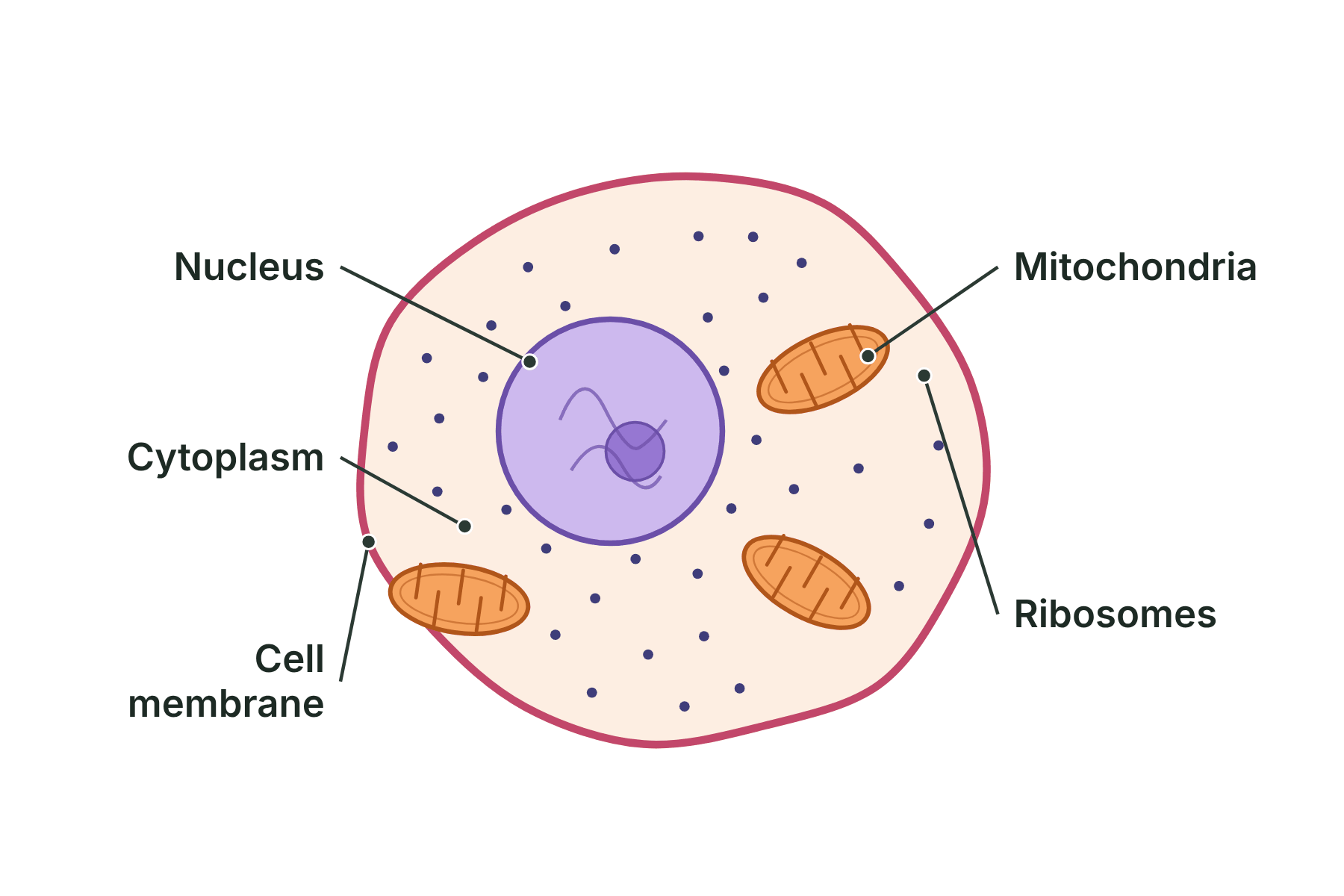
An animal cell, with its main sub-cellular structures labelled.
What plant cells have as well
Plant cells have everything an animal cell has, plus three more structures. Not every plant cell has all three: root cells have no chloroplasts, for example.
-
Cell wall
A rigid layer of cellulose outside the cell membrane. It strengthens the cell and supports the plant.
-
Chloroplasts
Contain the green pigment chlorophyll, which absorbs light for photosynthesis. Found in the green parts of a plant.
-
Permanent vacuole
A large space filled with cell sap, a solution of sugars and salts. It helps keep the cell firm.
A plant cell
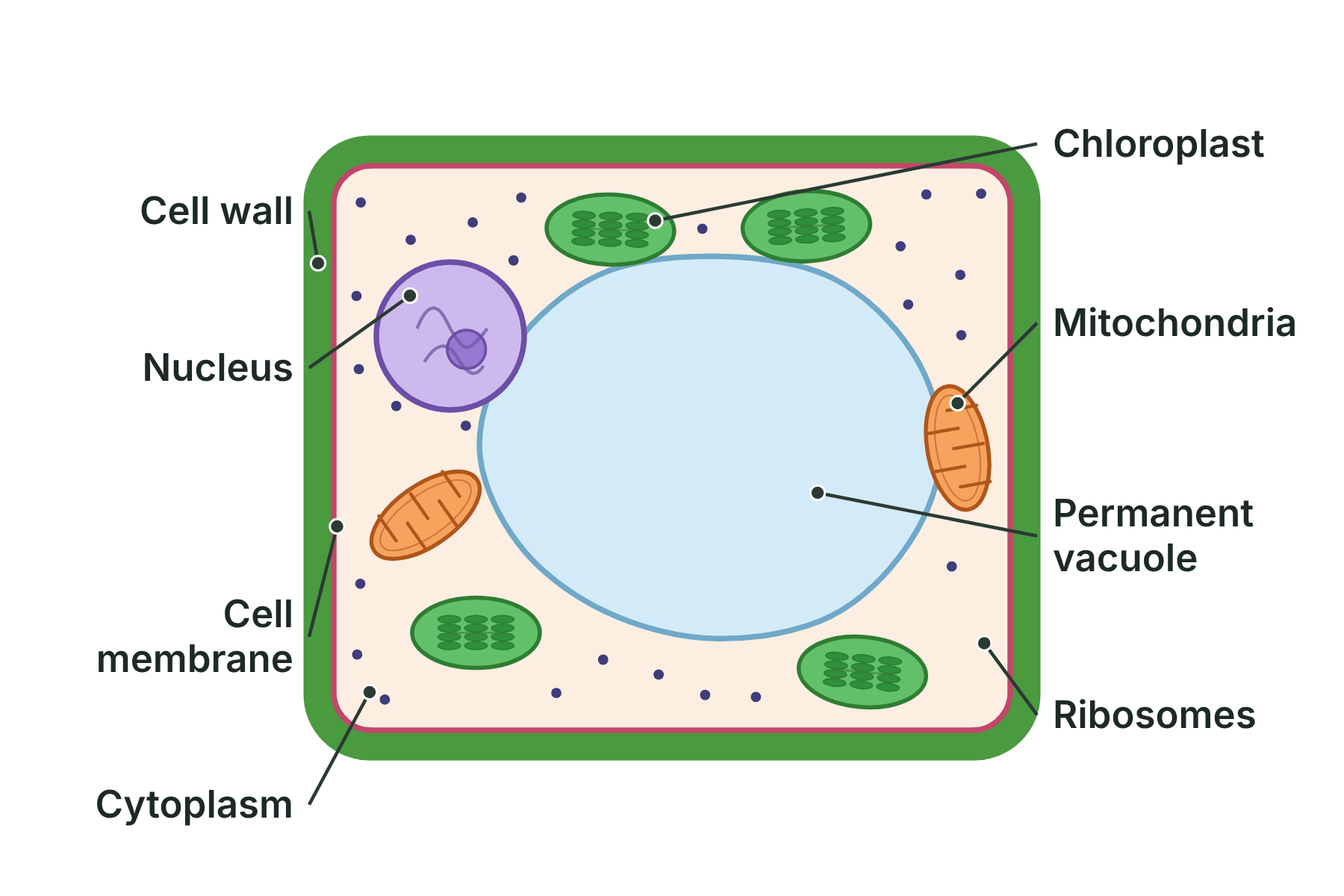
A plant cell. The structures that animal cells lack are the cell wall, chloroplasts and permanent vacuole.
Animal cells and plant cells compared
Animal cell
- Nucleus, cytoplasm, cell membrane, mitochondria, ribosomes
- No cell wall, so the shape can change
- No chloroplasts, so it cannot photosynthesise
- Usually no large permanent vacuole
Plant cell
- Has all of those structures too
- Cellulose cell wall gives a fixed shape
- Chloroplasts in the green parts, for photosynthesis
- Large permanent vacuole filled with cell sap
Case study
Palisade cells in a leaf
The palisade layer sits near the top of a leaf, where the most light arrives. Its tall, tightly packed cells contain a huge number of chloroplasts. That means each cell can absorb a lot of light for photosynthesis, which is exactly the job of the leaf. A cell in a root, which is underground in the dark, has no chloroplasts at all.
Link the structure to the job
In the exam you are often asked why a cell has lots of one structure.
-
Muscle cells
They contain many mitochondria, because contracting needs a lot of energy from respiration.
-
Cells making lots of protein
They contain many ribosomes, because ribosomes are where proteins are made.
-
Leaf cells
They contain many chloroplasts, because they carry out most of the plant's photosynthesis.
-
Storage cells in plants
They have a large permanent vacuole to hold cell sap.
Common mistakes to avoid
-
Mitochondria do not "make" energy
They release energy from glucose in respiration. Energy cannot be made, only transferred.
-
The cell wall is not the cell membrane
Plant cells have both. The wall is rigid and cellulose. The membrane is thin and controls what passes in and out.
-
Not every plant cell has chloroplasts
Only the cells exposed to light, such as leaf cells, have them.
-
Ribosomes are not the nucleus
The nucleus holds the instructions. Ribosomes use them to build proteins.
THE BIG IDEA
Structure always fits function: a cell has more of whatever its job needs most.
Animal and plant cells
Animal and plant cells
-
Nucleus
- contains DNA
- controls the cell
-
Cytoplasm
- chemical reactions happen here
-
Cell membrane
- controls what moves in and out
-
Mitochondria
- aerobic respiration
- release energy
-
Ribosomes
- make proteins
-
Plant only
- cell wall
- chloroplasts
- permanent vacuole
Summary and exam focus
- Animal cells have a nucleus, cytoplasm, cell membrane, mitochondria and ribosomes.
- Plant cells also have a cell wall, chloroplasts and a permanent vacuole.
- Mitochondria are the site of aerobic respiration, and ribosomes make proteins.
- Chloroplasts absorb light for photosynthesis, and only some plant cells have them.
- Cells have more of the structures their job needs.
Exam focus
Explain why a muscle cell contains many mitochondria. (2 marks) (2 marks)
Link the structure to its function in two steps: say what mitochondria do, then why that matters for a muscle. Do not say mitochondria "produce energy".
Key terms
The words this lesson expects you to use. Each one is linked from the first place it appears above.
- Sub-cellular structure
- A structure inside a cell, such as the nucleus or a mitochondrion.
- Mitochondria
- Structures where aerobic respiration takes place, releasing energy for the cell.
- Ribosome
- A tiny structure where proteins are made.
- Chloroplast
- A structure in plant cells that contains chlorophyll and carries out photosynthesis.
- Chlorophyll
- The green pigment that absorbs light energy for photosynthesis.
- Permanent vacuole
- A space in a plant cell filled with cell sap.
- Cell sap
- A solution of sugars and salts stored in the permanent vacuole.
- Cellulose
- The strong material that plant cell walls are made of.
- Aerobic respiration
- A chemical reaction that uses oxygen to release energy from glucose.
- Photosynthesis
- The process in which plants use light to make glucose.
Questions and answers
15 questions set on this lesson, with the mark schemes and model answers open.
State the function of the nucleus.
Mark scheme — 1 mark available
- Contains DNA / controls the cell's activities — 1 mark
Model answer
It contains the genetic material (DNA) and controls the activities of the cell.
State two structures that are found in plant cells but not in animal cells.
Mark scheme — 2 marks available
- Cell wall — 1 mark
- Chloroplasts — 1 mark
- Permanent vacuole — 1 mark (maximum 2 marks)
Model answer
Any two from: cell wall, chloroplasts, permanent vacuole.
Figure 1 shows a plant cell. Name the structures labelled A, B, C and D.
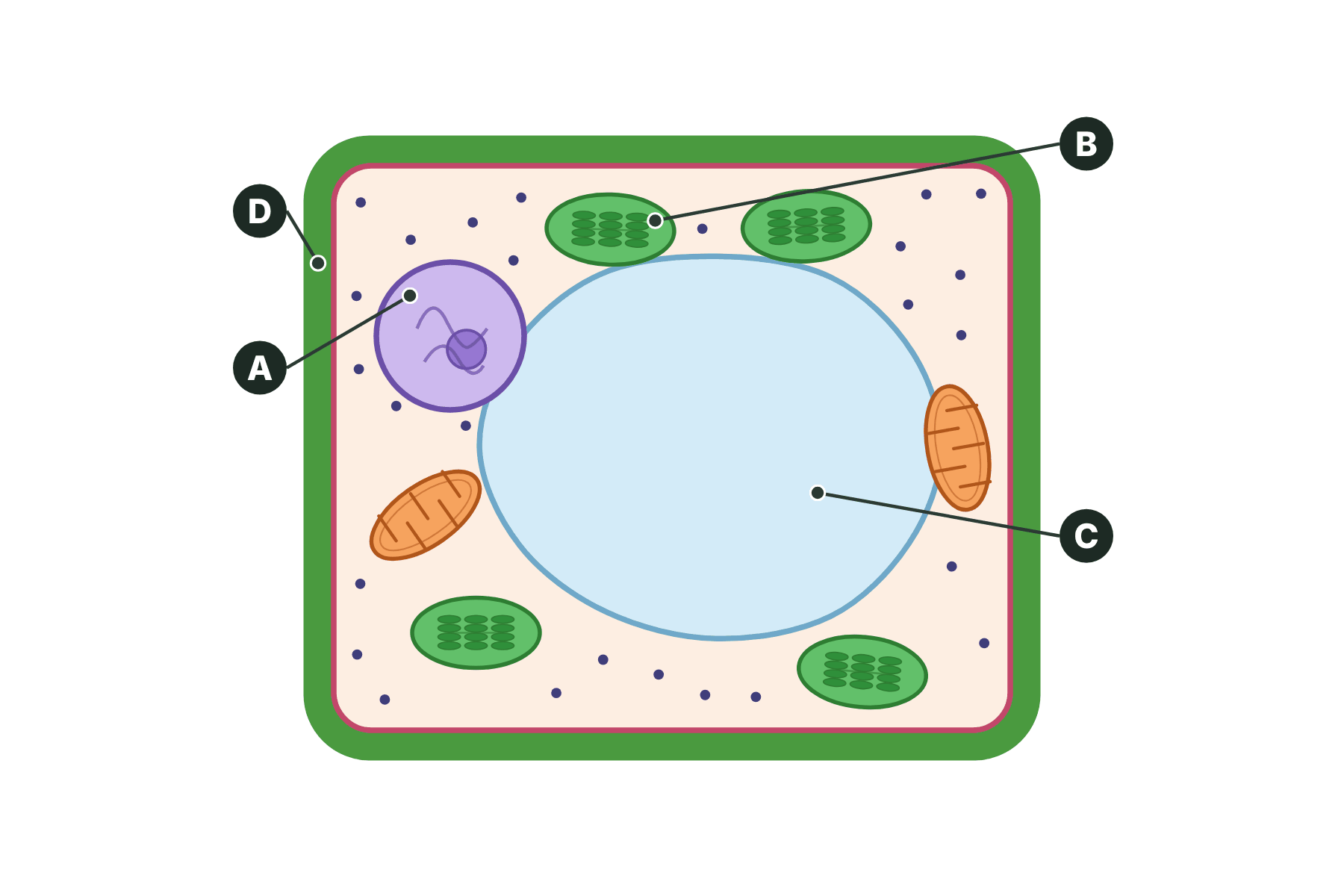
Mark scheme — 4 marks available
- A: nucleus — 1 mark
- B: chloroplast — 1 mark
- C: (permanent) vacuole — 1 mark
- D: cell wall — 1 mark
Model answer
A is the nucleus. B is a chloroplast. C is the (permanent) vacuole. D is the cell wall.
Muscle cells contain many mitochondria. Explain why.
Mark scheme — 2 marks available
- Mitochondria release energy in (aerobic) respiration — 1 mark
- Muscle cells need a lot of energy to contract — 1 mark
Model answer
Mitochondria are where aerobic respiration takes place, which releases energy. Muscle cells contract, and contraction needs a lot of energy.
Palisade cells in a leaf contain many chloroplasts. Explain why.
Mark scheme — 3 marks available
- Chloroplasts contain chlorophyll that absorbs light — 1 mark
- Light is needed for photosynthesis — 1 mark
- More chloroplasts means more photosynthesis / more glucose made — 1 mark
Model answer
Chloroplasts contain chlorophyll, which absorbs light. Light is needed for photosynthesis. Palisade cells carry out most of the leaf's photosynthesis, so more chloroplasts means more light absorbed and more glucose made.
Describe the functions of the cell membrane, the cytoplasm, the cell wall and the ribosomes.
Mark scheme — 4 marks available
- Cell membrane controls what enters and leaves — 1 mark
- Cytoplasm is where chemical reactions happen — 1 mark
- Cell wall strengthens / supports — 1 mark
- Ribosomes make proteins — 1 mark
Model answer
The cell membrane controls what passes into and out of the cell. Most chemical reactions take place in the cytoplasm. The cell wall (in plants) strengthens the cell and supports the plant. Ribosomes are where proteins are made.
Compare the structure of an animal cell with the structure of a plant cell.
What the examiner wants: Use the names of the structures, and make sure you say which cell has which. Writing about only one cell is a common reason for losing marks.
Mark scheme — 6 marks available
- Both have a nucleus, cytoplasm, cell membrane, mitochondria and ribosomes — 1 mark
- Plant cells have a cell wall; animal cells do not — 1 mark
- The plant cell wall is made of cellulose — 1 mark
- Plant cells have chloroplasts; animal cells do not — 1 mark
- Plant cells have a permanent vacuole; animal cells do not — 1 mark
- Links a structure to its function (for example chloroplasts absorb light for photosynthesis) — 1 mark
Model answer
Both cells have a nucleus, cytoplasm, a cell membrane, mitochondria and ribosomes. A plant cell also has a cellulose cell wall, which gives it a fixed shape, but an animal cell has no cell wall. A plant cell often has chloroplasts, which absorb light for photosynthesis, but an animal cell has none. A plant cell has a large permanent vacuole filled with cell sap, whereas an animal cell does not.
Which structure is the site of aerobic respiration?
Why: Aerobic respiration takes place in the mitochondria, where energy is released from glucose.
Which structure makes proteins?
Why: Ribosomes join amino acids together to make proteins.
Which of these is found in a plant cell but not in an animal cell?
Why: Chloroplasts are found only in plant cells (and some other organisms). Animal cells have a nucleus, mitochondria and a cell membrane.
What is the cell wall of a plant cell made from?
Why: Plant cell walls are made of cellulose, which is strong and rigid.
Why do root cells not have chloroplasts?
Why: Chloroplasts absorb light for photosynthesis, and there is no light underground.
What is the permanent vacuole filled with?
Why: The permanent vacuole contains cell sap, a solution of sugars and salts.
A cell needs to release a great deal of energy. Which structure would you expect it to contain a lot of?
Why: Mitochondria release energy in aerobic respiration, so cells with a high energy demand have many of them.
Which statement about mitochondria is correct?
Why: Mitochondria release energy from glucose in respiration. Energy cannot be made or destroyed, only transferred.