Biology · Cell Structure
Viewing as
Teacher view: every answer and mark scheme set out in full.
Cell Specialisation and Differentiation
A human body has about 200 different types of cell, and each is built for its own job. This lesson looks at how specialised cells are adapted, and how a cell becomes specialised through differentiation.
Learning Objectives
- 1Explain how the structure of sperm cells, nerve cells, muscle cells, root hair cells, xylem and phloem relates to their functions.
- 2Describe what is meant by differentiation and why it is important.
- 3Compare differentiation in animals with differentiation in plants.
- 4Describe how specialised cells are organised into tissues, organs and organ systems.
Retrieval practice
-
1
What do mitochondria do?
Show answerHide answer
They are the site of aerobic respiration, releasing energy for the cell.
-
2
What does the cell wall of a plant cell do?
Show answerHide answer
It strengthens the cell and supports the plant.
-
3
Which sub-cellular structure controls the activities of a cell?
Show answerHide answer
The nucleus.
-
4
Why do muscle cells have many mitochondria?
Show answerHide answer
Contraction needs a lot of energy released by respiration.
One body, many kinds of cell
A fertilised egg is one cell, yet it grows into an organism with many different types of cell. A specialised cell is one that has a structure that suits its particular job. In an exam, the skill is always the same: name an adaptation, then explain how it helps the cell do its job.
Specialised animal cells
Each of these cells does one job, and its structure is built around that job.
-
Sperm cells
Carry the father's genetic information to the egg and fertilise it.
-
Nerve cells
Carry electrical impulses from one part of the body to another.
-
Muscle cells
Contract to produce movement.
A sperm cell
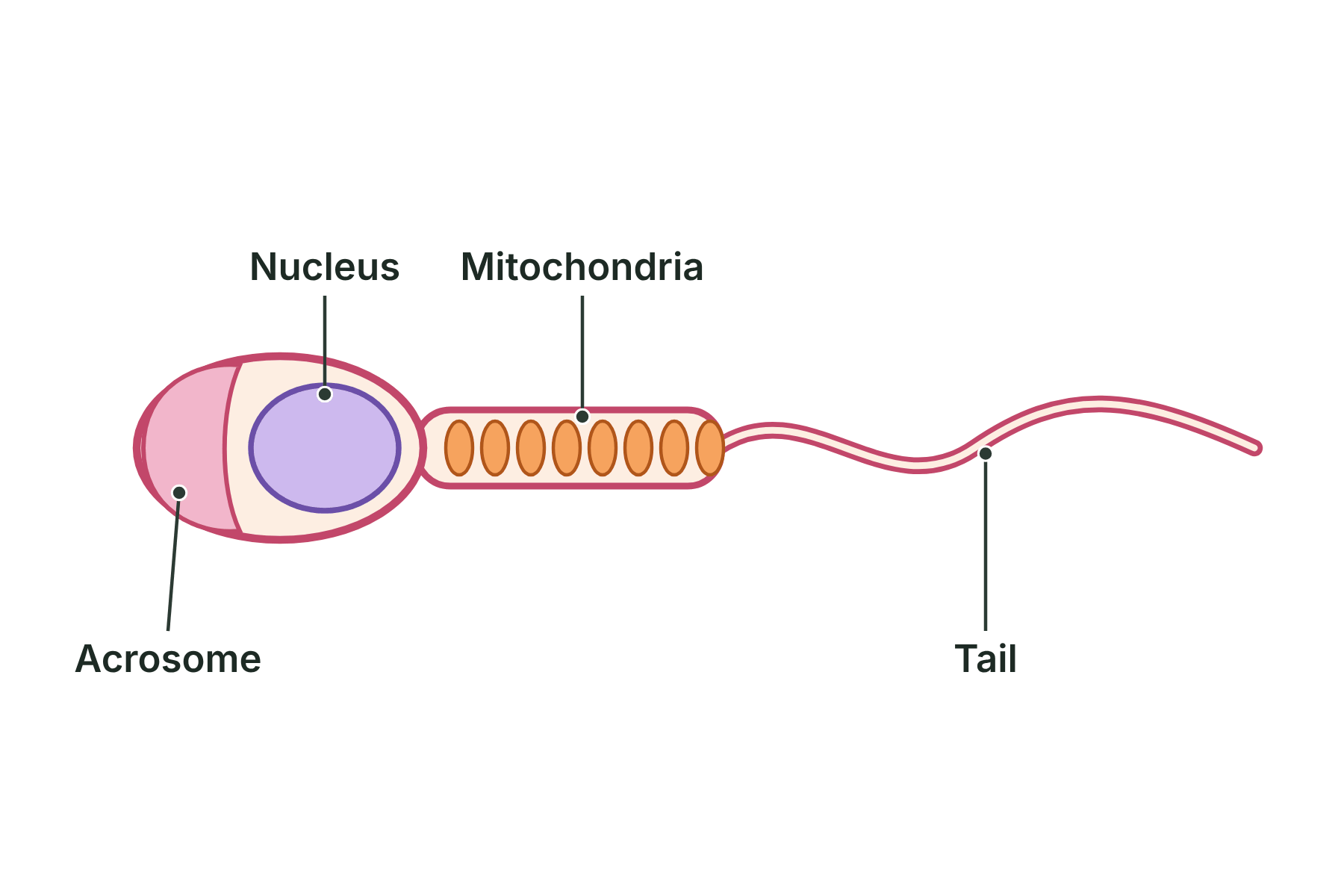
Every part of a sperm cell has a job that helps it reach and fertilise an egg.
How a sperm cell is adapted
A sperm cell has one job: to reach an egg and deliver its nucleus.
-
Tail
Lashes from side to side so the cell can swim to the egg.
-
Mitochondria
Packed into the middle section to release energy for swimming.
-
Acrosome
Contains digestive enzymes that break down the outer layer of the egg.
-
Nucleus
Contains half the genetic information needed to make a new individual.
A nerve cell
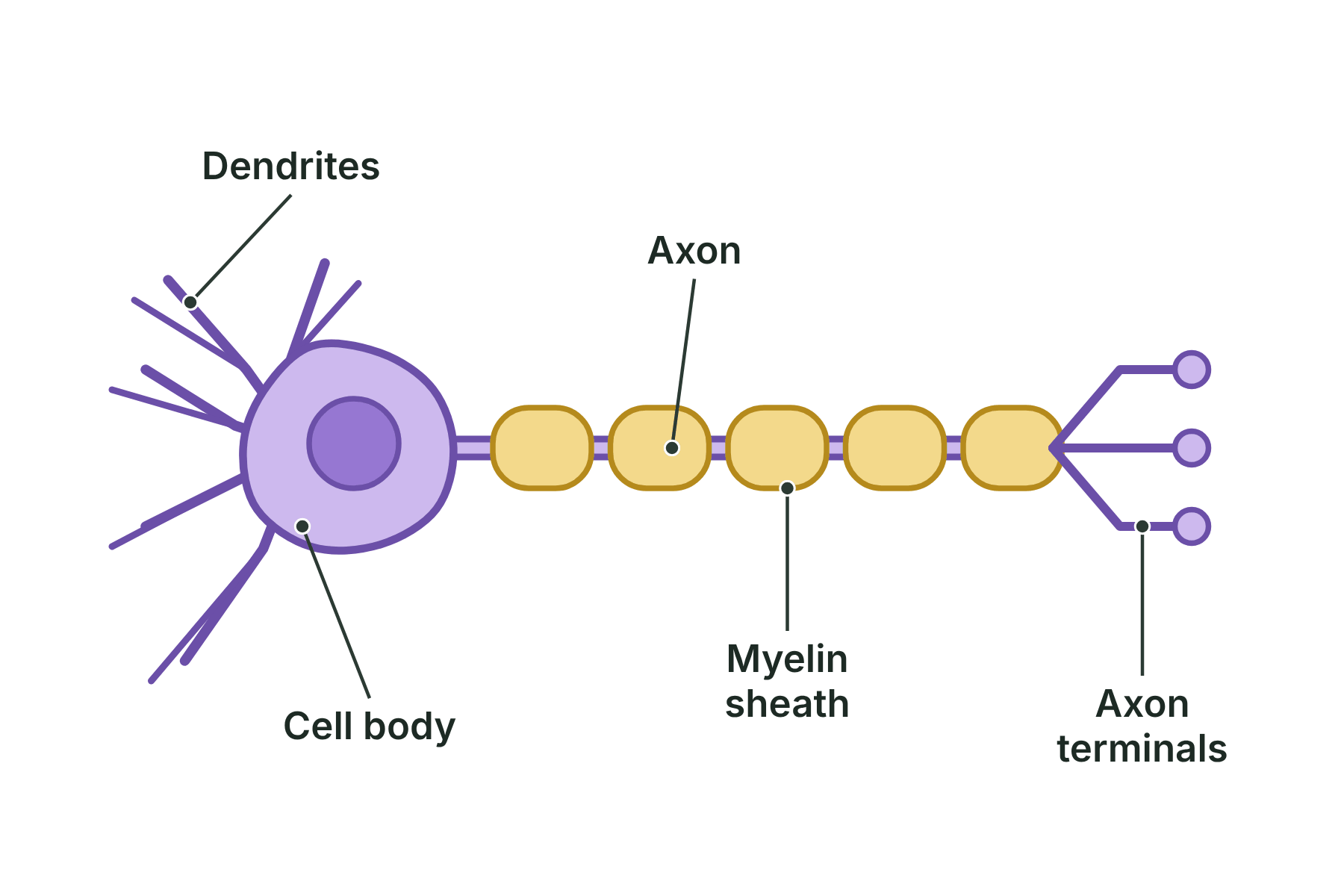
A nerve cell is long, so it can carry impulses a long way, and branched, so it can connect to other nerve cells.
How a nerve cell is adapted
A nerve cell is built to carry electrical signals quickly over long distances.
-
Long axon
Carries the impulse from one part of the body to another, sometimes over a metre.
-
Myelin sheath
A fatty layer that insulates the axon and speeds up the impulse.
-
Dendrites and axon terminals
Branched ends that connect to many other nerve cells.
How a muscle cell is adapted
A muscle cell is built to shorten, and so pull on the bone or organ it is attached to.
-
Protein fibres
Special proteins slide over each other, which makes the cell contract (get shorter).
-
Many mitochondria
Contraction needs a lot of energy, which the mitochondria release by respiration.
-
Joined together
Muscle cells can join to form long fibres, so that many cells contract together.
Specialised plant cells
Plant cells are specialised too, mostly for taking in and carrying water and food.
-
Root hair cells
Found on the surface of roots, where they absorb water and mineral ions from the soil.
-
Xylem
Tubes that carry water and mineral ions up from the roots to the leaves.
-
Phloem
Tubes that carry dissolved sugars from the leaves to every part of the plant.
A root hair cell
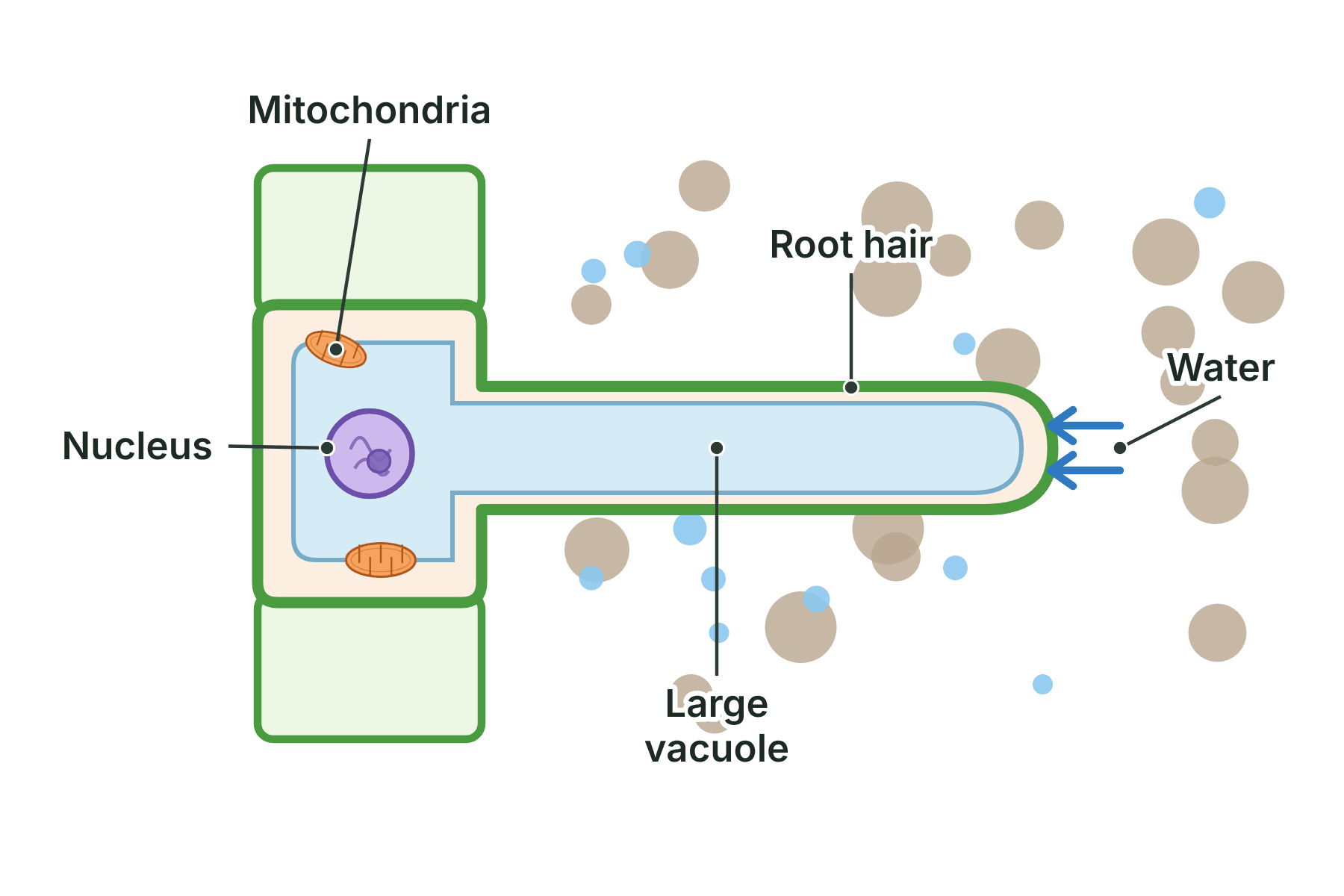
The long root hair gives the cell a large surface area for absorbing water and minerals.
How a root hair cell is adapted
A root hair cell takes up water and mineral ions from the soil.
-
Long projection
Gives a large surface area so more water and minerals can be absorbed.
-
Large permanent vacuole
Speeds up the movement of water into the cell by osmosis.
-
Mitochondria
Release energy for the active transport of mineral ions into the cell.
Xylem and phloem
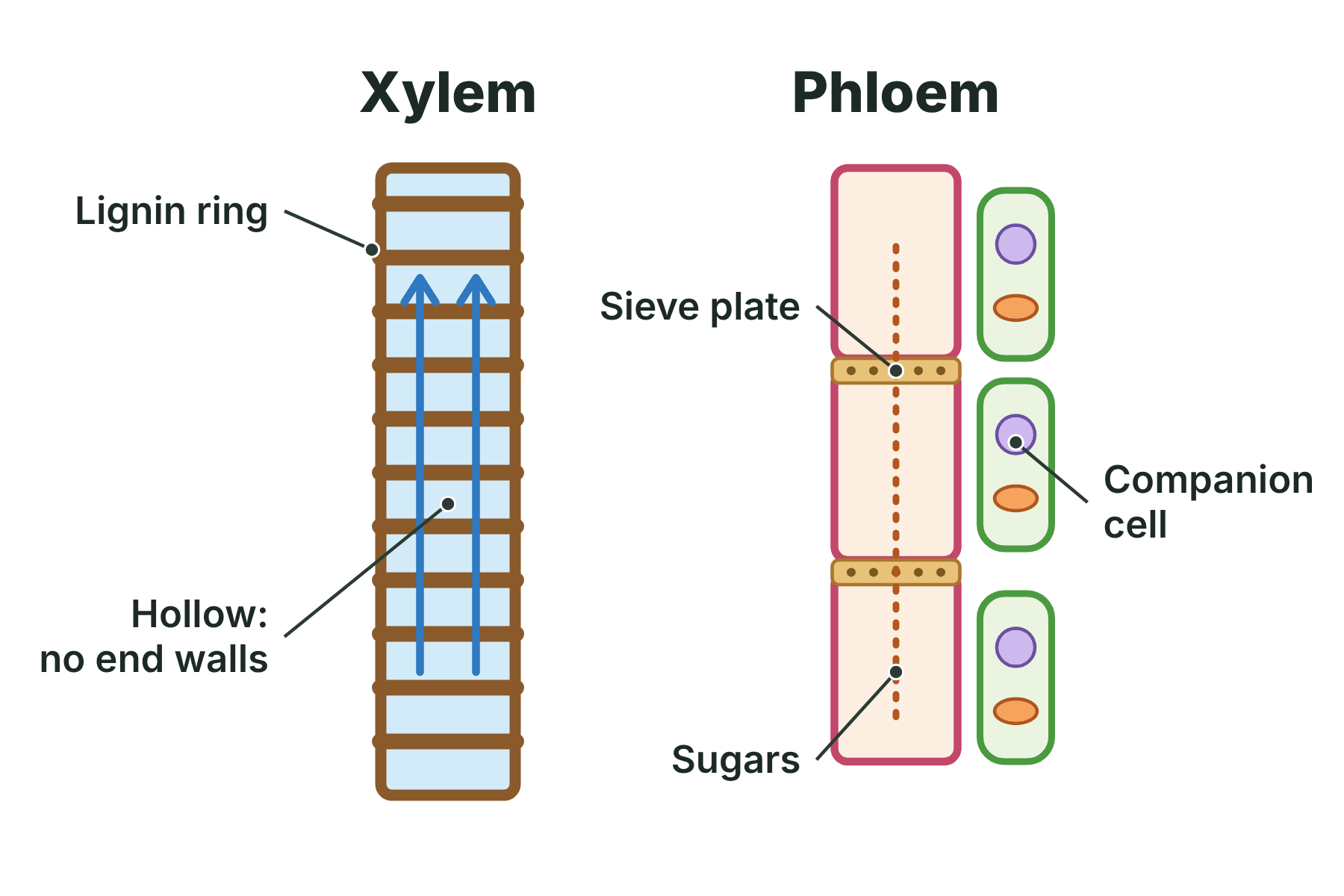
Xylem carries water up. Phloem carries sugars around the plant.
Xylem and phloem compared
Xylem
- Carries water and mineral ions from the roots upwards
- Made of dead cells with no end walls, so it is a hollow tube
- Walls strengthened with rings of lignin
Phloem
- Carries dissolved sugars to where they are needed, in both directions
- Made of living cells with sieve plates between them
- Companion cells with mitochondria supply the energy
Differentiation
Differentiation is the process by which a cell changes to become specialised for its job.
-
What happens
As a cell differentiates, it develops the sub-cellular structures it needs, such as a tail, a long axon or chloroplasts, so that it can do its particular job.
-
In animals
Most animal cells differentiate at an early stage of development. In a mature animal, cell division is mainly for repair and replacement.
-
In plants
Many plant cells keep the ability to differentiate throughout life, which is why a cutting can grow into a whole new plant.
-
Why it matters
Differentiation makes it possible for a multicellular organism to have different cell types working together, instead of a lump of identical cells.
From one cell to many
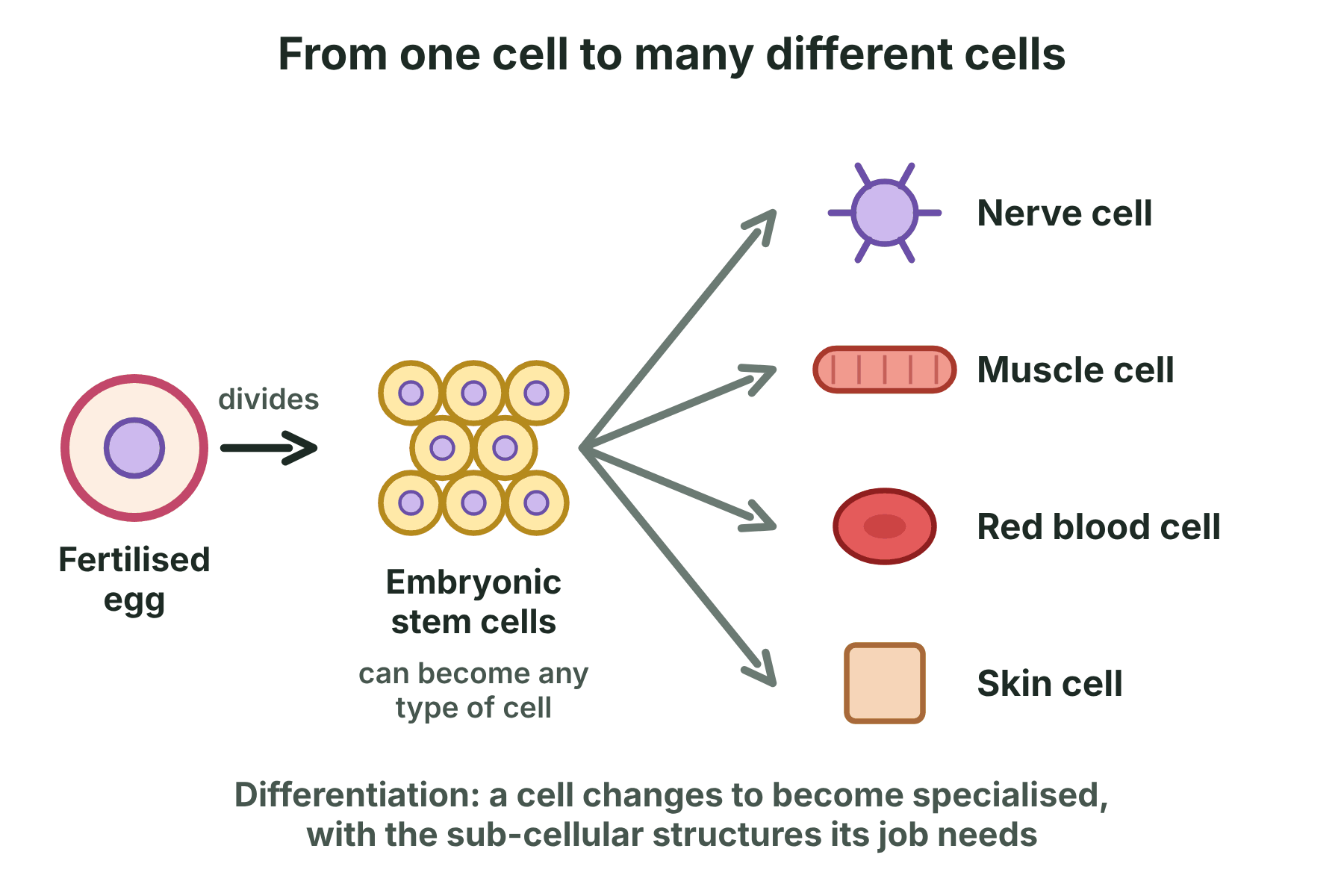
Embryonic stem cells can become any type of cell. Differentiation makes each one specialised.
Levels of organisation
Specialised cells do not work alone. They are grouped into larger units.
-
1
Cell
The basic unit, for example a muscle cell.
-
2
Tissue
A group of similar cells working together, for example muscular tissue.
-
3
Organ
A group of different tissues doing a job, for example the heart.
-
4
Organ system
A group of organs working together, for example the circulatory system.
-
5
Organism
All the organ systems together make a whole living thing.
The exam skill
Every adaptation of a specialised cell helps it do its job.
Name the adaptation, then explain how it helps. For example, "many mitochondria, to release energy for swimming".
Specialised cells
Specialised cells
-
Sperm
- tail to swim
- mitochondria
- acrosome enzymes
-
Nerve
- long axon
- myelin sheath
- dendrites
-
Muscle
- protein fibres that contract
- many mitochondria
-
Root hair
- long projection
- large vacuole
- mitochondria
-
Xylem
- hollow tube
- lignin rings
-
Phloem
- sieve plates
- companion cells
Summary and exam focus
- A specialised cell has a structure that suits its function.
- Sperm cells have a tail, many mitochondria and an acrosome.
- Nerve cells have a long axon, a myelin sheath and branched ends.
- Root hair cells have a long projection and a large vacuole to take up water.
- Xylem is hollow and strengthened with lignin. Phloem has sieve plates and companion cells.
- Differentiation is how a cell becomes specialised, and most animal cells do it early on.
Exam focus
Describe how a root hair cell is adapted to its function. (3 marks) (3 marks)
For each adaptation write "has... which...". A mark is awarded for the adaptation and one for the benefit, so never list features without explaining them.
Key terms
The words this lesson expects you to use. Each one is linked from the first place it appears above.
- Specialised cell
- A cell that has a structure suited to its particular job.
- Differentiation
- The process by which a cell changes to become specialised.
- Adaptation
- A feature of a cell that helps it carry out its function.
- Acrosome
- The part of a sperm cell that contains enzymes to break into the egg.
- Axon
- The long extension of a nerve cell that carries impulses.
- Myelin sheath
- A fatty layer around a nerve cell's axon that insulates it and speeds up impulses.
- Root hair cell
- A cell on the surface of a root with a long projection that absorbs water and minerals.
- Xylem
- Tubes made of dead cells that carry water and mineral ions up a plant.
- Phloem
- Living tubes that carry dissolved sugars around a plant.
- Tissue
- A group of similar cells that work together to do a particular job.
Questions and answers
16 questions set on this lesson, with the mark schemes and model answers open.
Give two ways in which a sperm cell is adapted to its function.
Mark scheme — 2 marks available
- Tail, to swim to the egg — 1 mark
- Many mitochondria, for energy — 1 mark
- Acrosome with enzymes to digest the egg — 1 mark (maximum 2 marks)
Model answer
Any two from: a tail to swim; many mitochondria to release energy for swimming; an acrosome containing enzymes to digest the egg's outer layer.
Figure 1 shows a sperm cell. Name the structures labelled A, B and C.
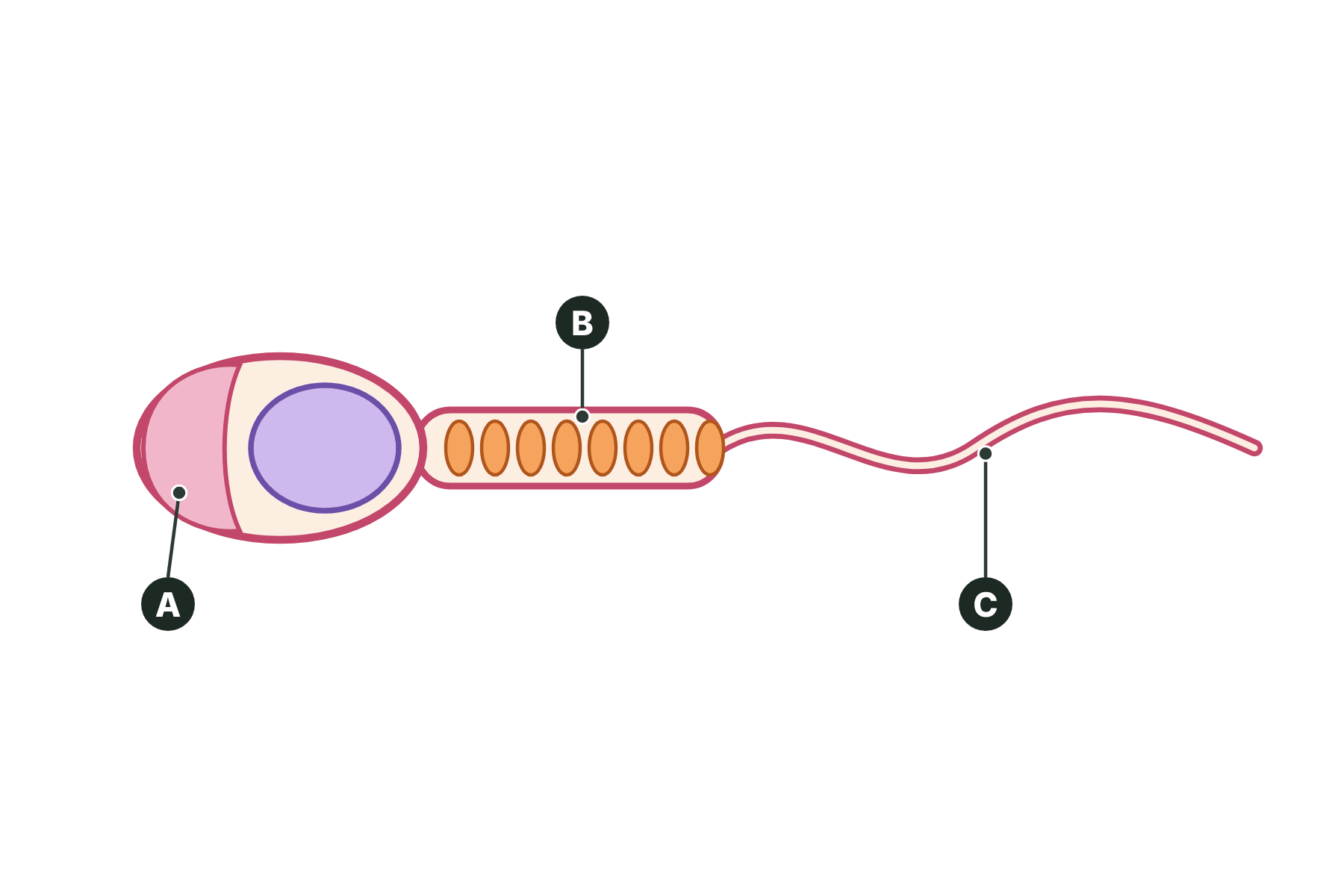
Mark scheme — 3 marks available
- A: acrosome — 1 mark
- B: mitochondria — 1 mark
- C: tail — 1 mark
Model answer
A is the acrosome. B is the mitochondria (the middle section). C is the tail.
Muscle cells contain many mitochondria. Explain why this adaptation helps them to do their job.
Mark scheme — 2 marks available
- Mitochondria release energy / respiration — 1 mark
- Muscle cells need energy to contract — 1 mark
Model answer
Muscle cells contract, and contraction needs energy. Mitochondria release that energy in respiration.
Describe how a root hair cell is adapted to its function.
Mark scheme — 3 marks available
- Long projection / root hair, giving a large surface area — 1 mark
- Large permanent vacuole speeds up water uptake — 1 mark
- Many mitochondria release energy for active transport — 1 mark
Model answer
The root hair cell has a long, thin projection, which gives a large surface area for absorbing water and mineral ions. It has a large permanent vacuole, which speeds up the movement of water into the cell. It has many mitochondria, which release energy for the active transport of mineral ions.
Describe how xylem vessels are adapted to carry water up a plant.
Mark scheme — 3 marks available
- Hollow / no cytoplasm / no end walls — 1 mark
- Cells are dead — 1 mark
- Walls strengthened with lignin — 1 mark
Model answer
Xylem vessels are hollow tubes because the cells are dead and have no end walls, so water can flow through easily. Their walls are strengthened with rings of lignin, which stops them collapsing.
Explain how the structure of a nerve cell is related to its function.
Mark scheme — 4 marks available
- Function: carries electrical impulses — 1 mark
- Long axon carries impulses over long distances — 1 mark
- Myelin sheath insulates / speeds up the impulse — 1 mark
- Branched ends connect to other nerve cells — 1 mark
Model answer
A nerve cell carries electrical impulses from one part of the body to another. The long axon allows the impulse to travel a long distance. The myelin sheath insulates the axon and speeds up the impulse. The branched dendrites and axon terminals connect the cell to many other nerve cells.
Explain why differentiation is important in a multicellular organism.
Mark scheme — 3 marks available
- Cells become specialised / have different structures — 1 mark
- Each can do a particular job efficiently — 1 mark
- Specialised cells work together to keep the organism alive — 1 mark
Model answer
Differentiation produces cells with different structures. Each type of cell can carry out its own particular function efficiently, such as contracting or carrying impulses. Different types of cell working together makes it possible for a complex organism to survive.
Compare differentiation in mature animals with differentiation in plants.
Mark scheme — 2 marks available
- Most animal cells differentiate early / division for repair and replacement — 1 mark
- Many plant cells can differentiate throughout life — 1 mark
Model answer
Most animal cells differentiate early on, and cell division in mature animals is mainly for repair and replacement. Many plant cells keep the ability to differentiate throughout life.
What is differentiation?
Why: Differentiation is the process by which a cell changes to become specialised for a particular job.
Which part of a sperm cell contains enzymes to digest the egg's outer layer?
Why: The acrosome at the front of the sperm head holds the digestive enzymes.
Why does a nerve cell have a long axon?
Why: A long axon lets the cell carry electrical impulses from one part of the body to another.
Which cell contains special protein fibres that slide over each other?
Why: Muscle cells contain protein fibres that slide together, shortening the cell so that it contracts.
How does the shape of a root hair cell help it?
Why: The long projection increases the surface area, so more water and mineral ions can be absorbed.
Which tissue carries dissolved sugars around a plant?
Why: Phloem carries dissolved sugars. Xylem carries water and mineral ions.
Why is xylem strengthened with lignin?
Why: Lignin rings make the walls strong so the hollow tube does not collapse as water is pulled up.
Which of these is the correct order of organisation, smallest first?
Why: Specialised cells form tissues, tissues form organs, and organs make up organ systems.