Biology · Mitosis, Growth and Stem Cells
Viewing as
Teaching this? The teacher view opens every answer and mark scheme.
Stem Cells
A stem cell has not yet decided what to become. This lesson explains what makes a cell a stem cell, where stem cells are found in embryos, in adult animals and in plants, and what each kind can turn into.
Learning Objectives
- 1Describe what a stem cell is, using the terms undifferentiated and differentiation.
- 2Describe the function of stem cells in embryos, in adult animals and in the meristems of plants.
- 3Compare the cells that embryonic stem cells and adult bone marrow stem cells can become.
- 4Name the places in a plant where the meristems are found.
Retrieval practice
-
1
What is differentiation?
Show answerHide answer
The process by which a cell changes to become specialised for its job.
-
2
Name one specialised animal cell and say how it is adapted.
Show answerHide answer
For example a sperm cell has a tail to swim and many mitochondria for energy.
-
3
What does mitosis produce?
Show answerHide answer
Two genetically identical cells.
-
4
Why must the DNA be copied before mitosis?
Show answerHide answer
So that each new cell gets a full set of chromosomes.
Cells with a choice
In the last lesson you saw that mitosis makes more cells. In an adult, most body cells are specialised: a nerve cell can carry impulses and a red blood cell can carry oxygen, but neither can become anything else. Some cells have not yet specialised, and they are the source of new specialised cells. They are called stem cells.
What a stem cell is
A stem cell is an undifferentiated cell of an organism which is capable of giving rise to many more cells of the same type, and from which certain other cells can arise by differentiation.
-
Undifferentiated
A stem cell is not specialised for any one job. It has no special shape or structures, such as the tail of a sperm cell.
-
Divides to make more
A stem cell can divide by mitosis to make many more stem cells, so a supply of them is always there.
-
Can differentiate
Some of the new cells can change into specialised cells, such as nerve cells or blood cells, and then stop dividing.
A stem cell and what it can become
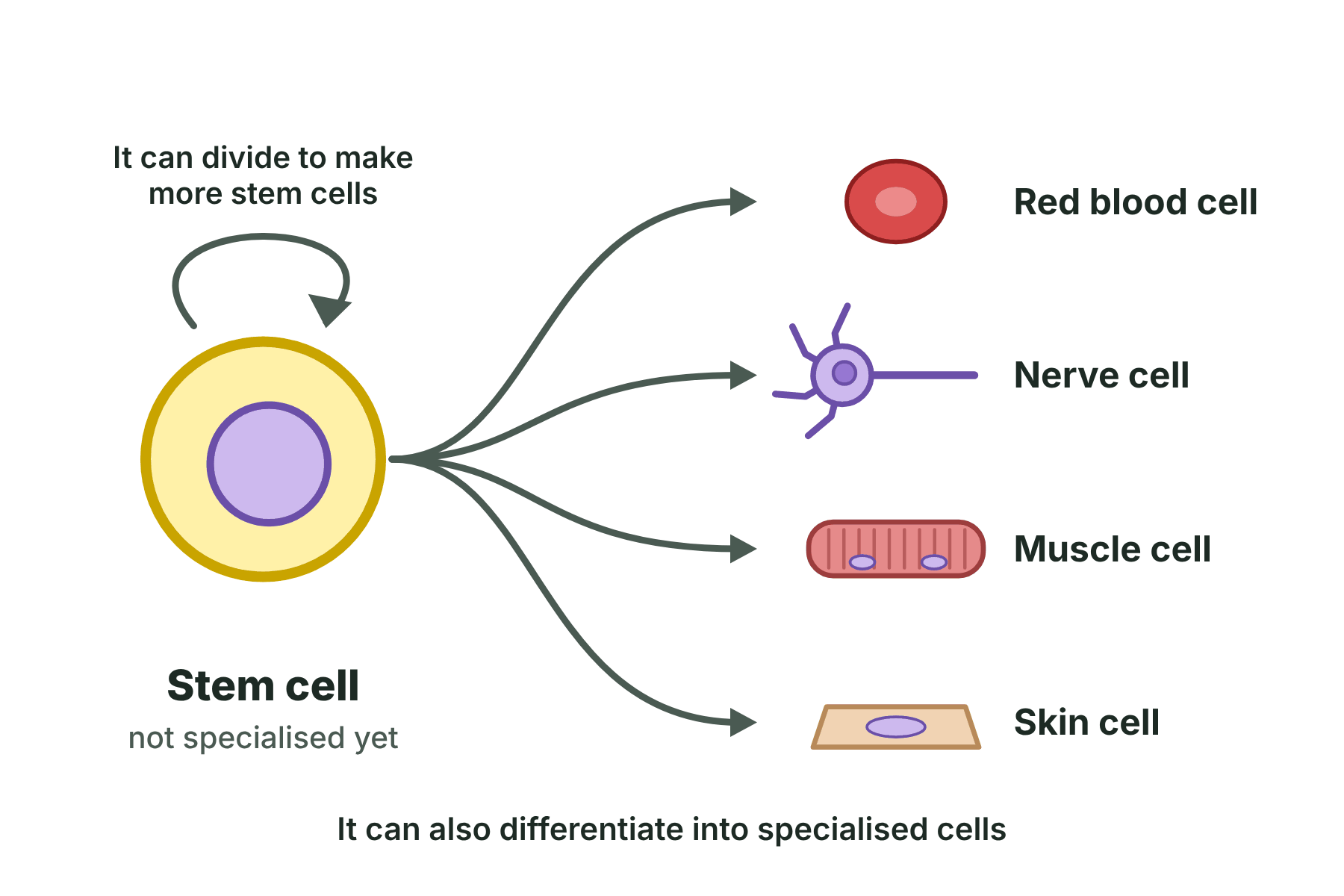
A stem cell can make more stem cells or differentiate into specialised cells.
Where stem cells are found
Stem cells are found in embryos, in adult animals and in plants, and the kinds of cell they can become are different.
-
Human embryos
Stem cells from human embryos can be cloned and made to differentiate into most different types of human cell.
-
Adult bone marrow
Stem cells in adult bone marrow can form many types of cell, including blood cells. They are found in the soft tissue inside bones.
-
Plant meristems
Meristem tissue in plants can differentiate into any type of plant cell, throughout the life of the plant.
Three places to find stem cells
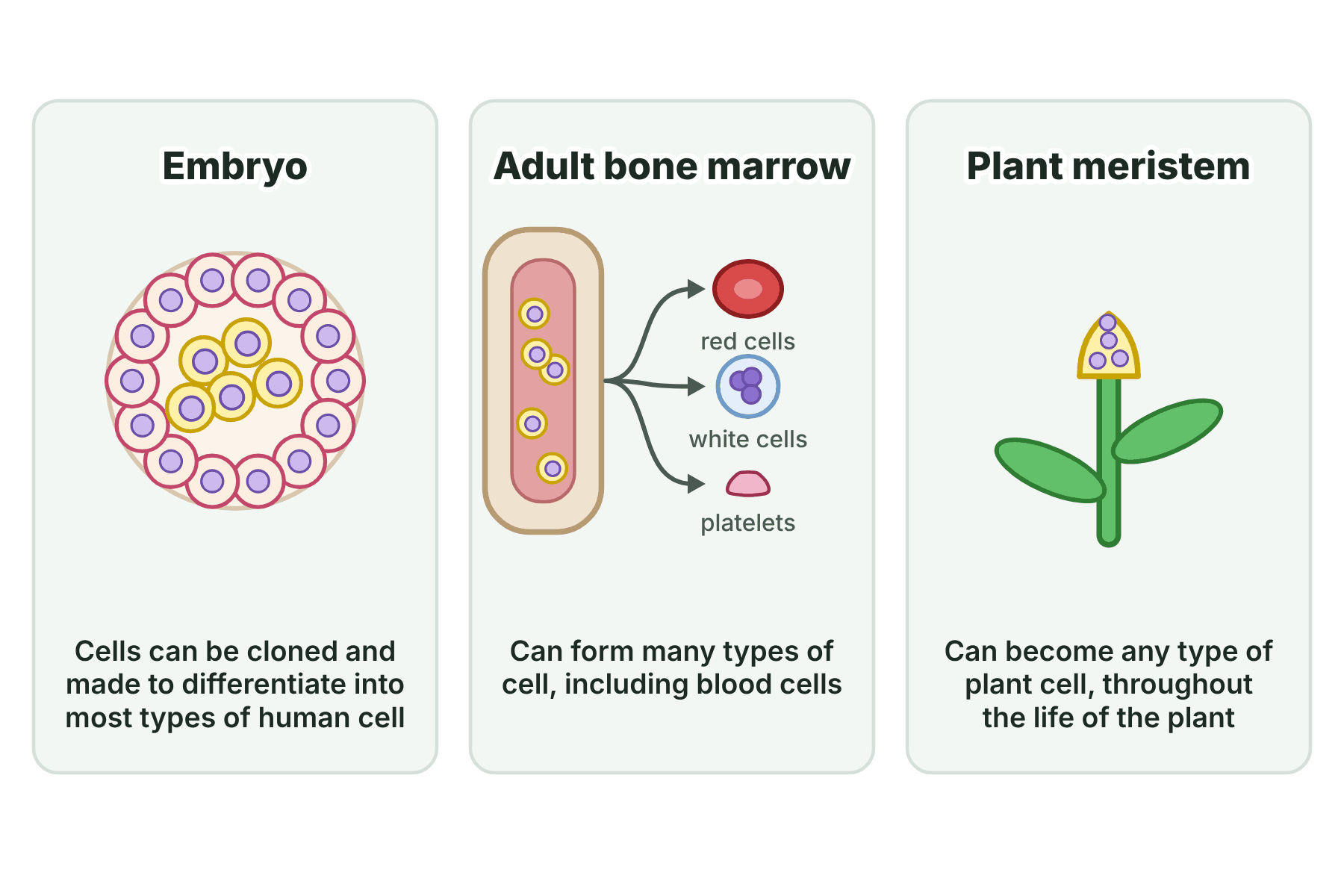
Where stem cells are found and what they can make.
What stem cells do
What a stem cell is used for depends on where in the organism it is.
-
In an embryo
An early embryo is a ball of stem cells. As it grows they divide and differentiate to form every kind of specialised cell the body needs, such as nerve, muscle and blood cells.
-
In an adult animal
Some stem cells stay behind, for example in bone marrow. They divide to replace cells that wear out and to repair damage, but they can become fewer kinds of cell than embryonic stem cells.
-
In a plant
Meristems divide and differentiate throughout the life of the plant, so it can keep growing taller and its roots keep growing longer.
Meristems in a plant
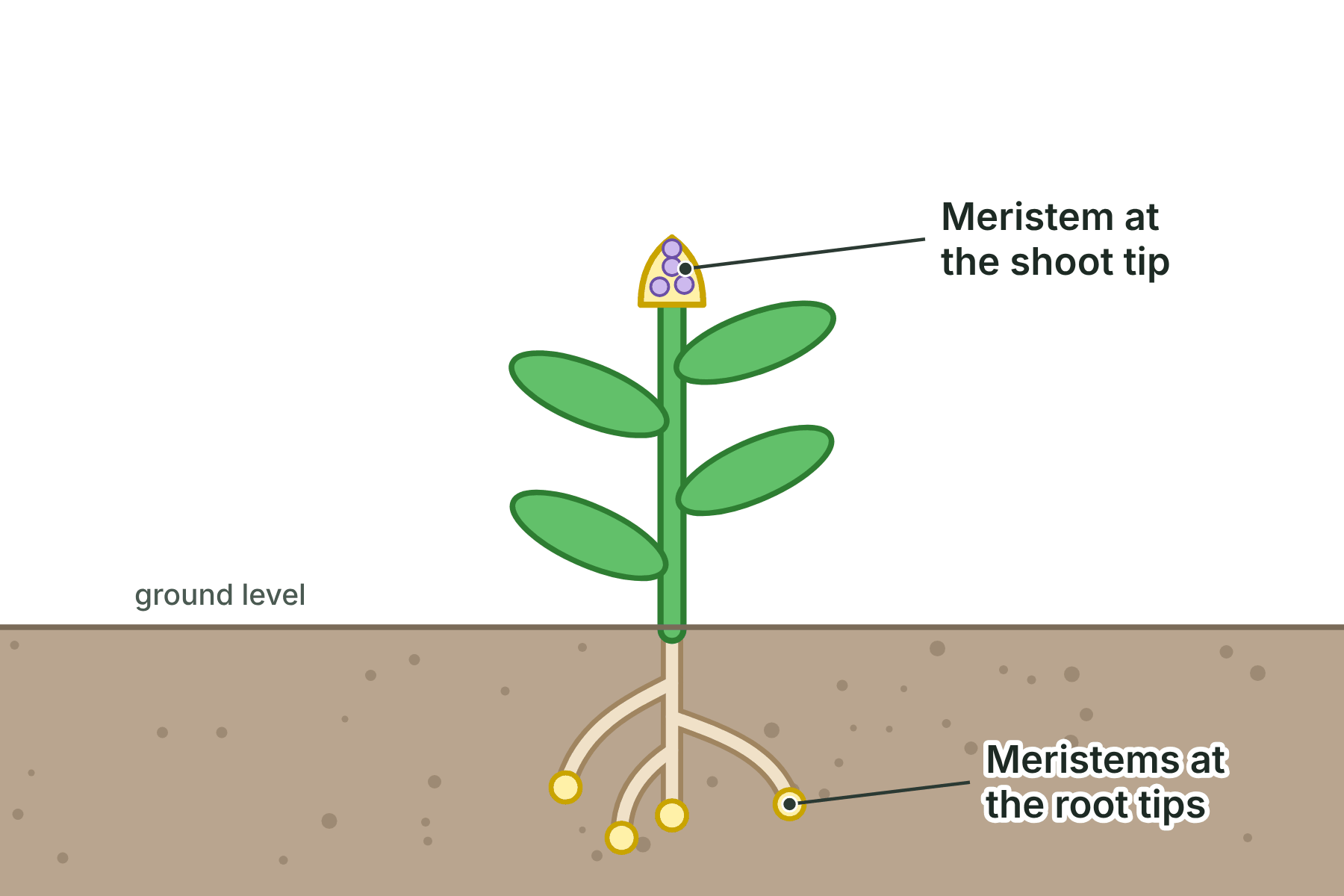
A meristem is found at the tip of each shoot and each root, where the plant grows.
Embryonic and adult stem cells
Embryonic stem cells
- Found in human embryos
- Can be cloned and made to differentiate into most types of human cell
- Can make almost any specialised cell
- Using them involves using an embryo, which some people object to
Adult stem cells (bone marrow)
- Found in the bone marrow of adults
- Can form many types of cell, including blood cells
- Can make fewer types of cell than embryonic stem cells
- Do not need an embryo, so there are fewer objections
Case study
Making blood from bone marrow
Blood cells do not last long, so the body has to keep making them. Stem cells in the bone marrow inside your bones divide again and again, and some of the new cells differentiate into red blood cells, white blood cells and platelets. Without these stem cells the body would run out of blood cells.
Definition to learn
A stem cell can divide to make more cells, and it can differentiate into specialised cells.
Undifferentiated is the key word: a stem cell has not yet specialised.
Stem cells
Stem cells
-
Definition
- undifferentiated
- divide
- can differentiate
-
Embryos
- most types of human cell
- growth and development
-
Adult bone marrow
- many types of cell, including blood cells
- repair and replacement
-
Plant meristems
- any type of plant cell
- whole life of the plant
-
Differentiation
- stem cell becomes a specialised cell
Summary and exam focus
- A stem cell is an undifferentiated cell that can divide to make more cells and differentiate into specialised cells.
- Stem cells from human embryos can be made into most types of human cell.
- Stem cells in adult bone marrow can form many types of cell, including blood cells.
- Meristem tissue in plants can differentiate into any type of plant cell, throughout the life of the plant.
- Meristems are found at the tips of the shoots and roots.
Exam focus
Describe what is meant by a stem cell. (2 marks) (2 marks)
Use the word undifferentiated and give both parts of the idea: it can divide to make more cells, and it can differentiate into specialised cells. Saying "a cell that can become anything" is too vague to earn both marks.
Key terms
The words this lesson expects you to use. Each one is linked from the first place it appears above.
- Stem cell
- An undifferentiated cell that can divide to make more cells of the same type and can differentiate into specialised cells.
- Undifferentiated
- Not yet specialised for any particular job.
- Differentiation
- The process by which a cell changes to become specialised for its job.
- Specialised cell
- A cell with structures that suit it to doing one job, such as a nerve cell or a red blood cell.
- Embryo
- An organism in the earliest stage of development, before it is born or hatched. A human embryo begins as a ball of cells.
- Embryonic stem cell
- A stem cell from an early embryo, able to become most types of human cell.
- Bone marrow
- The soft tissue inside bones, where stem cells make blood cells.
- Meristem
- Plant tissue at the tips of shoots and roots that contains stem cells and can become any type of plant cell.
You've finished the notes
Check your understanding
Test yourself while it is fresh. Start with the flashcards, then try the exam questions.
Something here looks wrong?
Tell us what and we will go and look. It goes to whoever writes these pages, nobody else, and we do not ask who you are — so there is nothing to sign and nothing comes back to you.