Biology · Digestion and Enzymes
Viewing as
Teaching this? The teacher view opens every answer and mark scheme.
Levels of Organisation and the Digestive System
A human body is not a big bag of identical cells. This lesson builds up from cells to tissues, organs and organ systems, uses the digestive system as the main example, and ends with why food has to be digested at all.
Learning Objectives
- 1Describe the levels of organisation in a multicellular organism: cell, tissue, organ, organ system and organism.
- 2Explain that an organ is made of several tissues, using the stomach as an example.
- 3Name the organs of the digestive system and describe the job of each.
- 4Explain why large food molecules must be digested before they can be absorbed.
- 5Use units of length to estimate how many cells fit along a structure.
Retrieval practice
-
1
What is a specialised cell?
Show answerHide answer
A cell with a structure that suits the particular job it does.
-
2
What is differentiation?
Show answerHide answer
The process by which a cell becomes specialised for a job.
-
3
What is a stem cell?
Show answerHide answer
An undifferentiated cell that can divide and become specialised.
-
4
What is diffusion?
Show answerHide answer
The net movement of particles from a higher to a lower concentration.
Why bodies need organisation
A single-celled organism such as an amoeba does everything inside one cell. A human is made of trillions of cells and cannot work like that. Instead, the cells are specialised, and the specialised cells are organised into groups that cooperate. Each level of organisation can do a more complex job than the level below it. Once you understand the levels, the rest of biology is easier, because the digestive system, the heart and the lungs all follow the same pattern.
The levels of organisation
Living things are built up in stages, and each level is made from the one before.
-
Cell
The basic building block of all living things. A muscle cell, for example, is specialised to contract.
-
Tissue
A group of similar cells that work together to do a particular job. Muscular tissue is made of many muscle cells that contract together.
-
Organ
A group of different tissues that work together to do a particular job. The stomach is an organ.
-
Organ system
A group of organs that work together to do a particular job. The digestive system is an organ system.
-
Organism
Organ systems working together make a whole living thing, such as a human.
From cell to organism
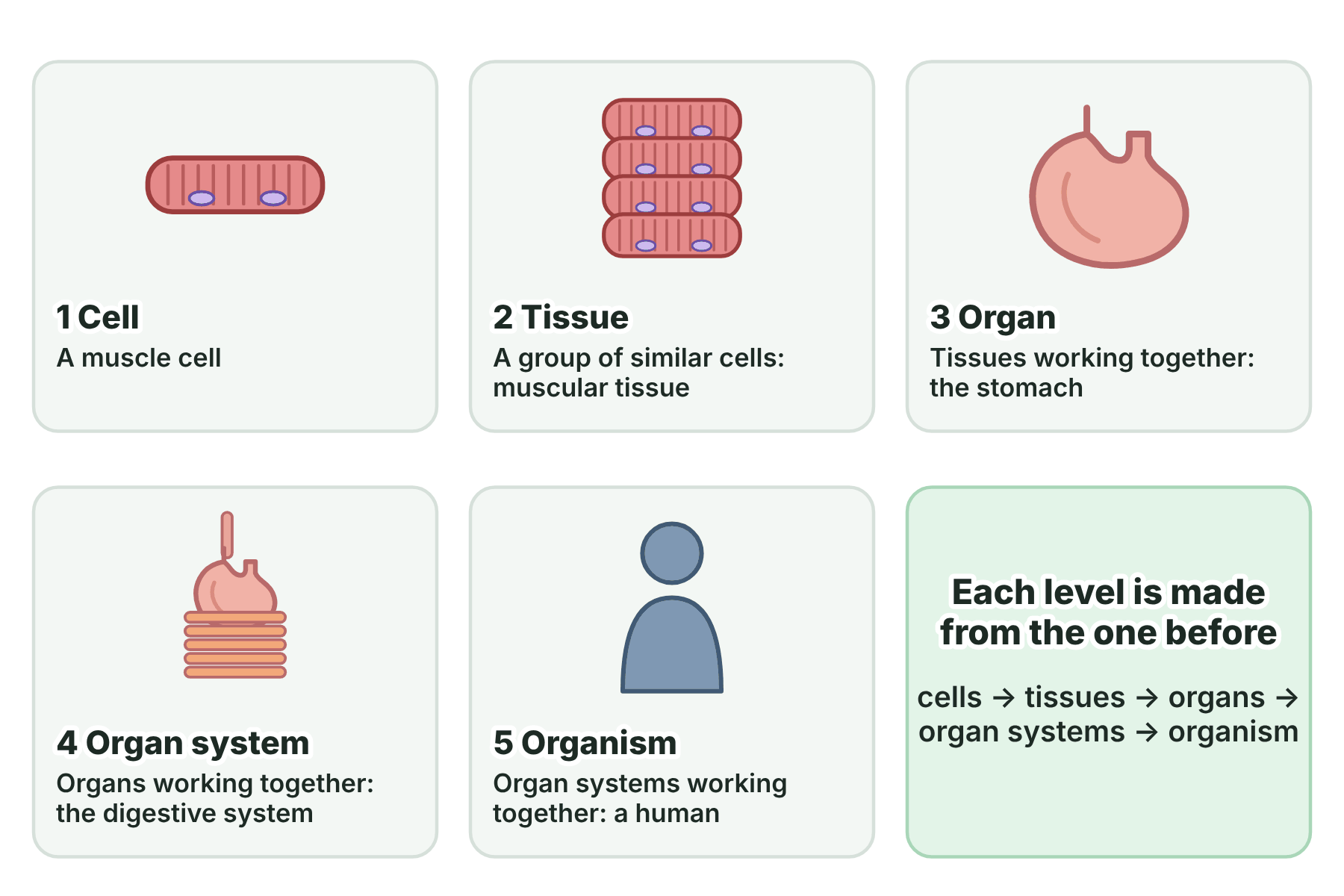
Each level is made from the one before it, so a muscle cell is one small part of a whole human.
One organ, several tissues
An organ is never made of just one kind of tissue. The stomach contains at least three, and they work together to digest food.
-
Muscular tissue
Contracts and relaxes to churn the food and mix it with the digestive juices.
-
Glandular tissue
Makes digestive juices, including hydrochloric acid and the enzyme that digests protein.
-
Epithelial tissue
Covers the inside and outside surfaces of the organ.
-
Working together
None of the three could digest food alone. It is their combined action that makes the stomach an organ.
The tissues in the wall of the stomach
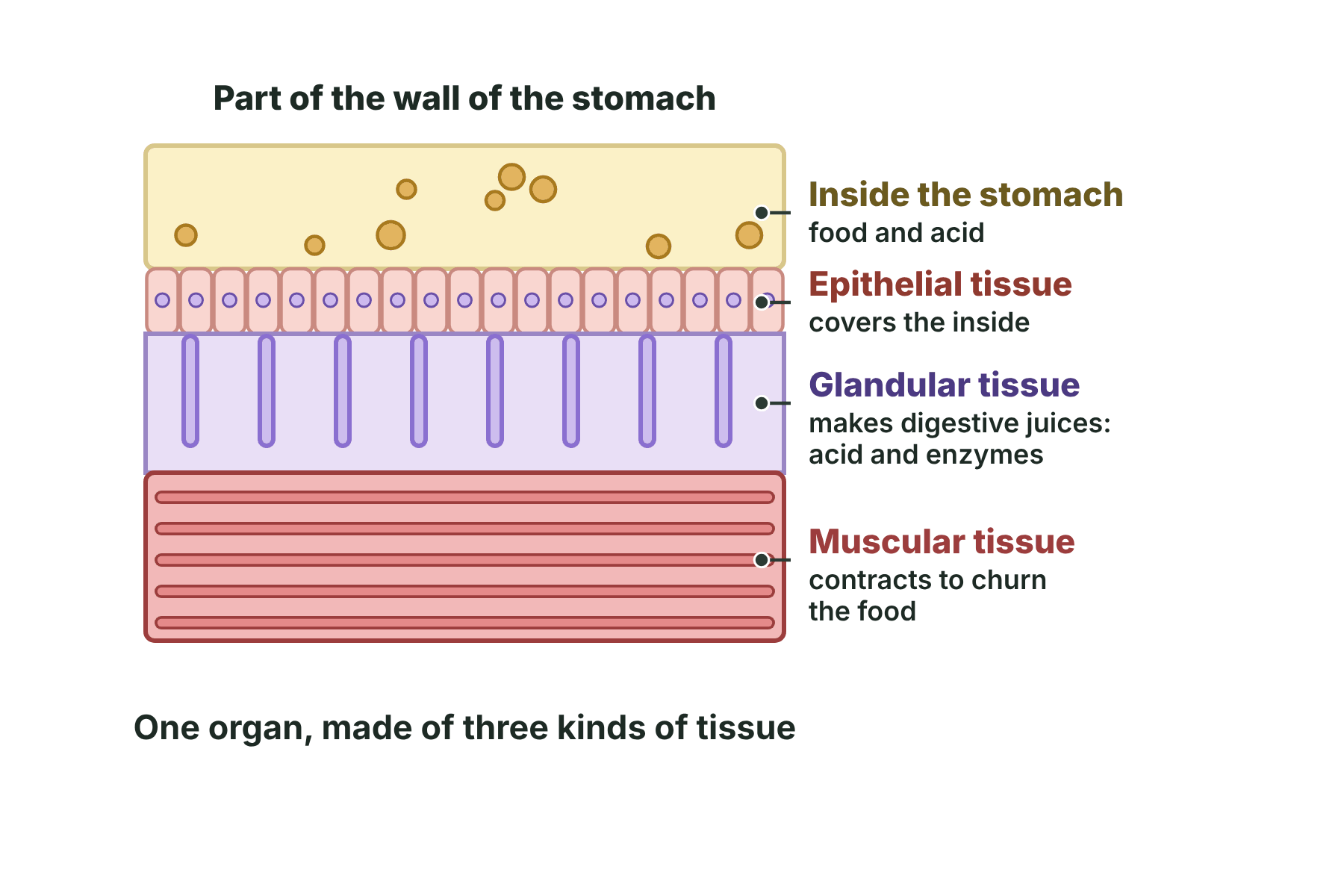
The stomach is an organ because it contains several tissues that work together.
The digestive system
The digestive system is an organ system. Its job is to break food down into small molecules and to absorb them into the blood. It is a long tube, with glands attached that add digestive juices.
-
Mouth and salivary glands
Teeth break the food into smaller pieces. The salivary glands release saliva, which moistens the food and contains the enzyme amylase.
-
Oesophagus
A muscular tube that squeezes food down to the stomach.
-
Stomach
A bag of muscle that churns the food and mixes it with acid and protease. The acid also kills many bacteria that came in with the food.
-
Liver
Makes bile, which helps to digest fat.
-
Gall bladder
Stores the bile until it is needed.
-
Pancreas
A gland that makes digestive enzymes and releases them into the small intestine.
-
Small intestine
Where digestion is finished, and where the digested food is absorbed into the blood.
-
Large intestine
Absorbs water from the undigested food that is left. The rest leaves the body as faeces.
The organs of the digestive system
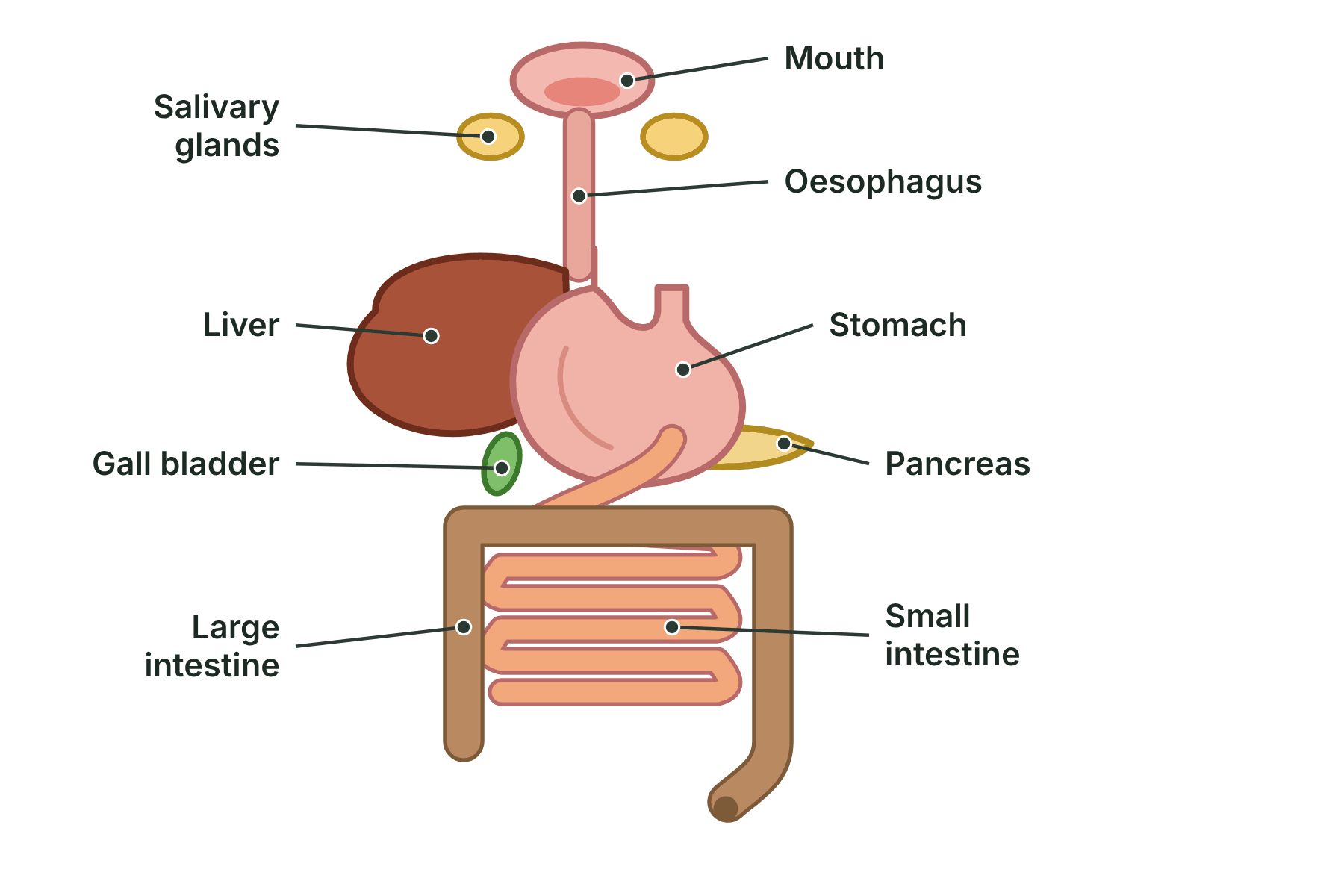
The glands, the liver and the pancreas are not part of the tube that food passes through, but they all add to digestion.
The journey of a meal
Food passes through the digestive tube in a fixed order. Some organs add digestive juices on the way.
-
1
Mouth
Teeth cut and grind the food. Saliva wets it and starts to digest starch.
-
2
Oesophagus
Muscles squeeze the food down to the stomach.
-
3
Stomach
The food is churned with acid and protease, which starts to digest protein.
-
4
Small intestine
Bile from the liver and enzymes from the pancreas and the small intestine finish the digestion. The small molecules are absorbed into the blood.
-
5
Large intestine
Water is absorbed from the remaining food.
-
6
Anus
The undigested food leaves the body as faeces.
Why food has to be digested
Food contains large molecules, and your body cannot use them in that form.
-
Too big
Starch, proteins and fats are large molecules. Most are insoluble, so they cannot pass through the wall of the gut into the blood.
-
Digestion
Digestion breaks the large molecules into small, soluble ones: sugars, amino acids, and fatty acids and glycerol.
-
Absorption
The small molecules pass through the wall of the small intestine into the blood, which carries them round the body.
-
Use
Cells use them to build new carbohydrates, lipids and proteins, and to release energy by respiration. The next lessons explain how the breakdown is done.
Estimating how many cells fit along a muscle
A muscle cell in the wall of the stomach is about 100 micrometres (µm) long. A strip of stomach muscle is 10 cm long. Estimate how many cells would fit end to end along the strip.
Show the solutionHide the solution
- 1 Use the same units 1 cm is 10 000 µm, so 10 cm is 100 000 µm.
- 2 Divide by the length of one cell 100 000 ÷ 100 = 1000.
- 3 Give the answer as an estimate About 1000 cells. It is only an estimate, because real cells overlap and vary in length.
AnswerAbout 1000 cells.
Case study
Why the stomach does not digest itself
The stomach makes hydrochloric acid and an enzyme that digests protein. The wall of the stomach is made of protein, so you might expect it to be digested too. It is protected because cells in its lining make a layer of mucus that coats the surface, and the lining is replaced regularly. This is another way in which different tissues in one organ work together.
The key idea
An organ is made of different tissues, and an organ system is made of different organs, all working together to do a job.
Cell, tissue, organ, organ system, organism: each level is made from the one before.
Organisation
Organisation
-
Cells
- specialised to do one job
-
Tissues
- groups of similar cells
- such as muscular tissue
-
Organs
- groups of tissues
- such as the stomach
-
Organ systems
- groups of organs
- such as the digestive system
-
Digestion
- breaks large molecules into small soluble ones that can be absorbed
Summary and exam focus
- Cells form tissues, tissues form organs, organs form organ systems and organ systems form an organism.
- An organ is made of several tissues. The stomach has muscular, glandular and epithelial tissue.
- The digestive system is an organ system that breaks down food and absorbs the products.
- The liver makes bile, the gall bladder stores it, and the pancreas makes digestive enzymes.
- Food molecules must be digested into small soluble molecules before they can pass into the blood.
Exam focus
Explain why the stomach is called an organ, and describe the job of the three tissues in it. (4 marks) (4 marks)
Say that an organ is made of different tissues working together, then name each tissue with its job: muscular tissue churns the food, glandular tissue makes digestive juices, and epithelial tissue covers the surfaces.
Key terms
The words this lesson expects you to use. Each one is linked from the first place it appears above.
- Tissue
- A group of similar cells that work together to do a particular job.
- Organ
- A group of different tissues that work together to do a particular job.
- Organ system
- A group of organs that work together to do a particular job.
- Organism
- A whole living thing, made of organ systems working together.
- Muscular tissue
- Tissue that contracts to produce movement, such as the churning of food in the stomach.
- Glandular tissue
- Tissue that makes and releases substances such as digestive juices.
- Epithelial tissue
- Tissue that covers the surfaces of the body and of organs.
- Digestive system
- The organ system that breaks down food and absorbs the products into the blood.
- Gland
- An organ or tissue that makes and releases a substance such as an enzyme or hormone.
- Digestion
- The breakdown of large, insoluble food molecules into small, soluble ones.
You've finished the notes
Check your understanding
Test yourself while it is fresh. Start with the flashcards, then try the exam questions.
Something here looks wrong?
Tell us what and we will go and look. It goes to whoever writes these pages, nobody else, and we do not ask who you are — so there is nothing to sign and nothing comes back to you.