Biology · Digestion and Enzymes
Viewing as
Teaching this? The teacher view opens every answer and mark scheme.
Enzymes
Almost every reaction in your body is sped up by an enzyme. This lesson explains what enzymes are, how the lock and key model explains why each one is specific, and what temperature and pH do to them.
Learning Objectives
- 1Describe enzymes as biological catalysts, made of protein, that are not used up in a reaction.
- 2Explain the lock and key model, using the terms active site, substrate and enzyme-substrate complex.
- 3Explain how temperature and pH affect enzyme activity, and what denaturing means.
- 4Interpret graphs of enzyme activity against temperature and pH.
- 5Calculate the rate of a reaction from the amount of product and from the time taken.
Retrieval practice
-
1
What is digestion?
Show answerHide answer
The breakdown of large, insoluble food molecules into small, soluble ones.
-
2
Name the small molecules that food is broken down into.
Show answerHide answer
Sugars, amino acids, and fatty acids and glycerol.
-
3
What does a catalyst do?
Show answerHide answer
It speeds up a chemical reaction without being used up.
-
4
Which organs make digestive enzymes?
Show answerHide answer
The pancreas and the small intestine, along with the salivary glands and the stomach.
Speeding up the body's chemistry
A cell carries out thousands of chemical reactions, such as respiration, making proteins and digesting food. Left alone at body temperature, most of these reactions would be far too slow to keep you alive. Heating the body up to speed them up would kill your cells. Instead, cells use enzymes. An enzyme makes a reaction go much faster at body temperature, so the body gets the speed it needs without the heat.
What is an enzyme?
Enzymes are the body's catalysts, and almost all of them are proteins.
-
Catalyst
A substance that speeds up a chemical reaction without being used up in the reaction.
-
Biological catalyst
An enzyme is a catalyst that is made by a living thing.
-
Protein
Enzymes are large protein molecules that are folded into a particular shape. The shape is what makes them work.
-
Not used up
An enzyme is unchanged at the end of the reaction, so one enzyme molecule can be used again and again.
-
Substrate and products
The substance that an enzyme acts on is its substrate. The substances that are made are the products.
-
Where they work
Some enzymes work inside cells, for example in respiration. Digestive enzymes work outside cells, in the gut.
The active site and the lock and key model
Every enzyme has a small region on its surface with a very particular shape. This is where the reaction happens.
-
Active site
The region of the enzyme into which the substrate fits.
-
Specific
The shape of the active site matches just one kind of substrate, so each enzyme works on only one substance. Amylase breaks down starch, but it does nothing to proteins.
-
Enzyme-substrate complex
When the substrate fits into the active site, the two join briefly to form this complex, and the reaction takes place.
-
Products leave
The products no longer fit the active site, so they are released. The enzyme is unchanged and is ready to work again.
-
Lock and key
In this model, the substrate is the key and the active site is the lock. Only the right key fits the lock.
How an enzyme works: the lock and key model
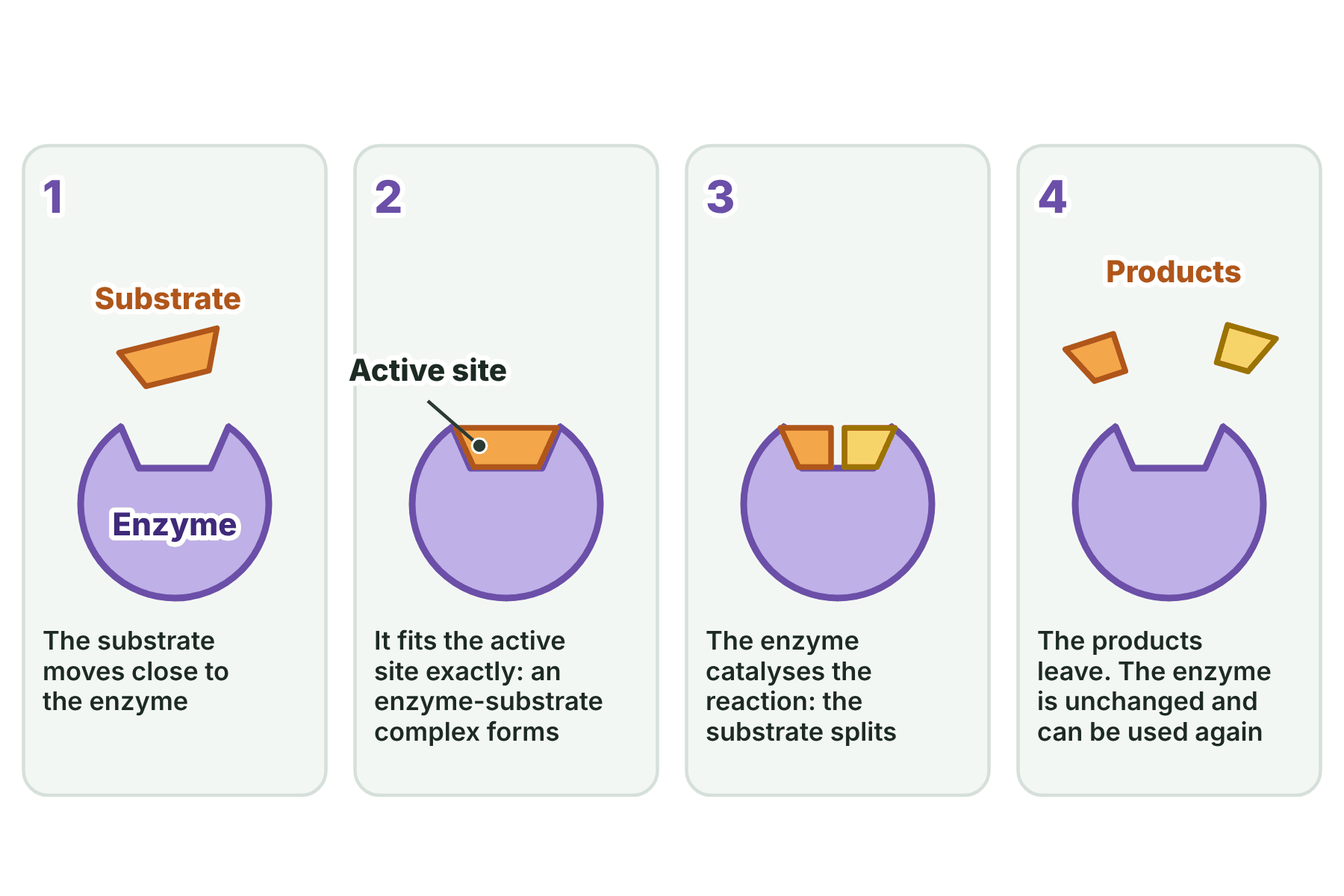
The substrate fits the active site like a key in a lock. After the reaction the enzyme is unchanged and can be used again.
Using the lock and key model
The model is simple, but it explains a lot.
-
Why enzymes are specific
Only a substrate with the right shape fits the active site. A different molecule does not fit, so the enzyme does nothing to it.
-
Why shape matters
If the active site changes shape, the substrate no longer fits and the enzyme stops working.
-
A simplified model
Real enzymes are not completely rigid. More detailed models show the active site adjusting slightly as the substrate arrives. At GCSE you use the lock and key model, because it is good enough to explain everything you are asked.
How temperature changes enzyme activity
Enzymes are very sensitive to temperature. The rate of an enzyme-controlled reaction rises, reaches a peak, then drops rapidly.
-
Cold
The particles move slowly, so the substrate and the enzyme meet less often. The reaction is slow.
-
Getting warmer
The particles have more energy and move faster. The substrate collides with active sites more often and with more energy, so the rate goes up.
-
The optimum temperature
The temperature at which the enzyme works fastest. For enzymes in the human body this is around 37 to 40 °C.
-
Too hot
Above the optimum the rate falls quickly, because the enzyme is denatured. At about 55 to 60 °C the reaction stops altogether.
Denaturing
When an enzyme is denatured, its shape is destroyed, and it cannot do its job.
-
What happens
At a high temperature the enzyme molecule vibrates so much that the bonds holding its shape break. The molecule changes shape, including the active site.
-
The result
The substrate no longer fits the active site, so the reaction stops.
-
It is permanent
A denatured enzyme cannot go back to its original shape when it cools down.
-
Cold is different
A cold enzyme is not denatured. It is just slow, and it speeds up again when it warms up.
What denaturing does to an enzyme
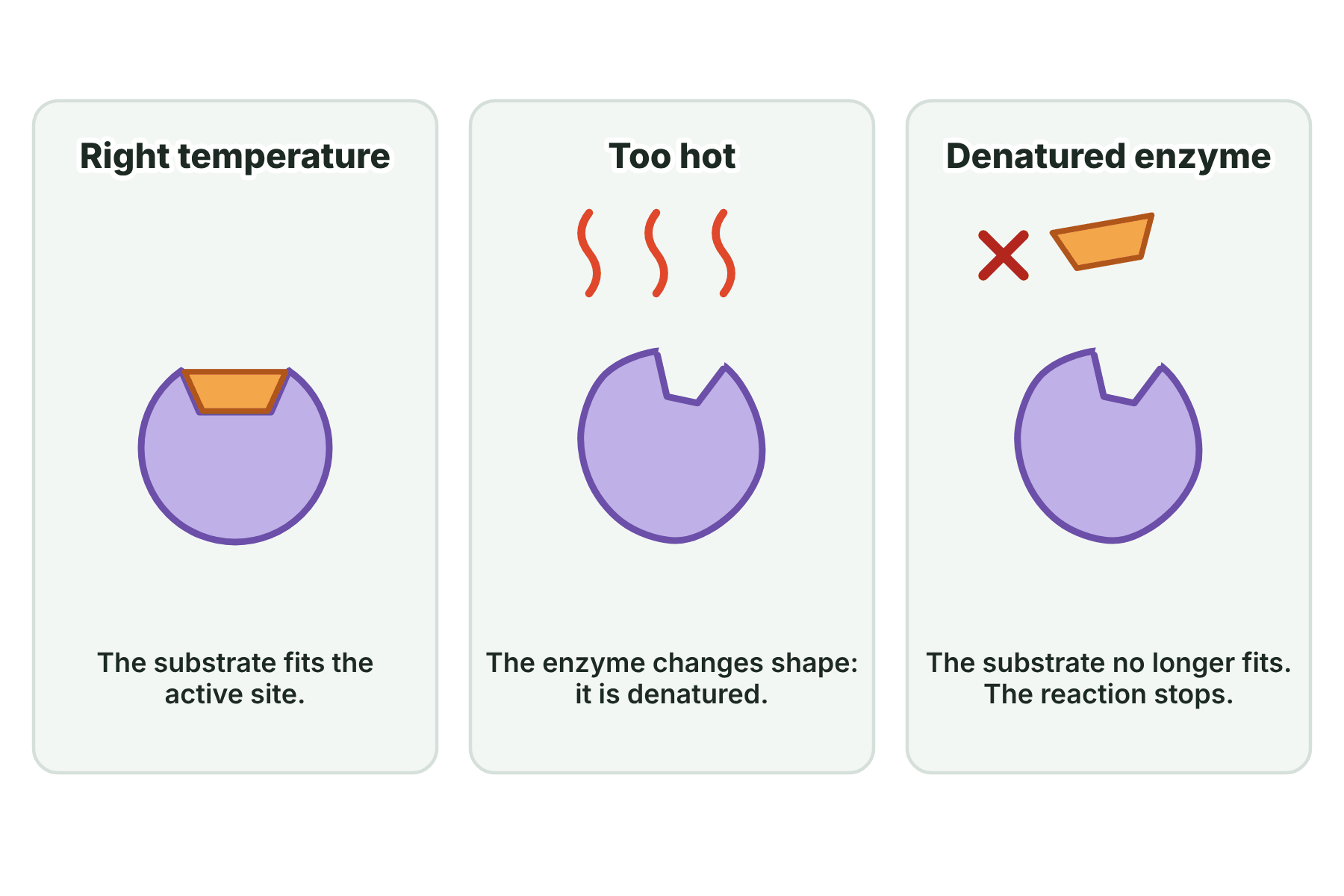
A denatured enzyme has a different shape, so its substrate cannot fit into the active site.
How pH changes enzyme activity
The pH of the solution matters just as much as the temperature.
-
Optimum pH
Each enzyme works fastest at one particular pH.
-
Away from the optimum
If the solution is too acidic or too alkaline, the bonds that hold the enzyme in shape are affected. The active site changes shape and the rate falls. At extreme values the enzyme is denatured.
-
Different enzymes, different pH
Amylase in the mouth works best at about pH 7. Pepsin, a protease in the stomach, works best at about pH 2, which is very acidic.
-
Why this matters
Each enzyme is suited to the place where it works. Pepsin is made for the acid of the stomach, but amylase would be denatured there.
Enzyme activity against temperature and pH
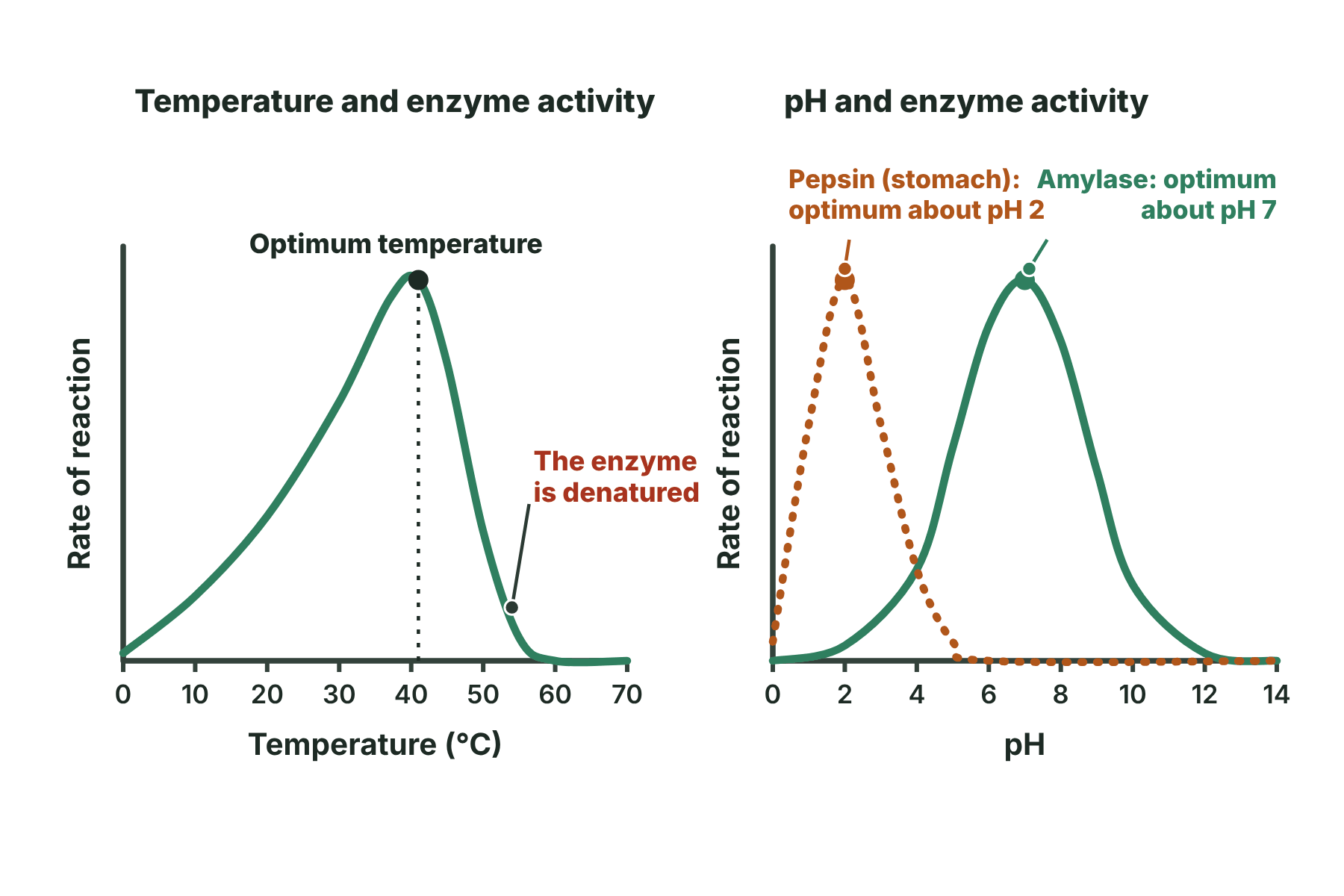
Both graphs rise to an optimum and then fall away. The optimum pH depends on the enzyme.
Below and above the optimum temperature
Below the optimum
- The rate rises as the temperature rises
- The particles move faster and collide more often
- The enzyme keeps its shape
- Cooling it down slows it, but does not harm it
Above the optimum
- The rate falls as the temperature rises
- Bonds in the enzyme break
- The active site changes shape: the enzyme is denatured
- The change is permanent
Calculating the rate of a reaction
The rate tells you how fast a reaction is going. There are two ways to work it out.
-
From the amount of product
Rate = amount of product formed ÷ time taken. The units might be cm³ per minute.
-
From the time taken
When you time how long a reaction takes to finish, rate = 1 ÷ time. Using 1000 ÷ time gives easier numbers. A shorter time means a faster rate.
-
Comparing rates
Divide the larger rate by the smaller one to say how many times faster it is.
Rate from the amount of product
An enzyme produces 24 cm³ of gas in 8 minutes. Calculate the mean rate of the reaction in cm³ per minute.
Show the solutionHide the solution
- 1 Write the equation Rate = amount of product formed ÷ time taken.
- 2 Substitute Rate = 24 ÷ 8.
- 3 Give the answer with its unit 3 cm³ per minute.
Answer3 cm³ per minute.
Rate from the time taken
An enzyme digests all the starch in a mixture in 80 seconds at 20 °C, and in 40 seconds at 30 °C. Use rate = 1000 ÷ time to calculate the rate at each temperature, and compare them.
Show the solutionHide the solution
- 1 Rate at 20 °C 1000 ÷ 80 = 12.5 (arbitrary units).
- 2 Rate at 30 °C 1000 ÷ 40 = 25.
- 3 Compare 25 ÷ 12.5 = 2, so the rate doubled as the temperature rose by 10 °C.
AnswerThe rate at 20 °C is 12.5 and at 30 °C is 25, so the reaction is twice as fast at 30 °C.
Case study
Why body temperature matters
Your body keeps its core temperature at about 37 °C. This is close to the optimum for most of its enzymes, so they work quickly. If the temperature rose much higher, enzymes would start to be denatured, and cells could no longer carry out their reactions. This is one reason why the body has careful temperature controls, and why a very high fever is dangerous.
The key idea
An enzyme is a biological catalyst. Its active site fits only its own substrate, and a denatured enzyme cannot catalyse the reaction.
Temperature and pH change the shape of the active site, and shape is everything for an enzyme.
Enzymes
Enzymes
-
Biological catalysts
- speed up reactions and are not used up
-
Active site
- fits one substrate only: lock and key
-
Temperature
- rate rises to an optimum
- then the enzyme denatures
-
pH
- each enzyme has an optimum pH
-
Rate
- amount of product ÷ time
- or 1 ÷ time
Summary and exam focus
- Enzymes are biological catalysts. They are proteins and are not used up.
- The substrate fits the active site, like a key in a lock, and forms an enzyme-substrate complex.
- Enzymes are specific, because each active site fits only one substrate.
- Above the optimum temperature, and away from the optimum pH, the active site changes shape and the enzyme is denatured.
- Rate = amount of product ÷ time, or 1 ÷ time when you time a reaction.
Exam focus
Explain why the rate of an enzyme-controlled reaction falls when the temperature is raised above the optimum. (3 marks) (3 marks)
Use the word denatured and say what changes: the active site changes shape, so the substrate no longer fits. Do not say that the enzyme dies or is killed, because an enzyme is not alive.
Key terms
The words this lesson expects you to use. Each one is linked from the first place it appears above.
- Enzyme
- A biological catalyst, made of protein, that speeds up a reaction in a living thing.
- Catalyst
- A substance that speeds up a chemical reaction and is not used up.
- Substrate
- The substance that an enzyme acts on.
- Product
- A substance that is made in a reaction.
- Active site
- The region of an enzyme, with a particular shape, into which the substrate fits.
- Enzyme-substrate complex
- The enzyme and its substrate joined together while the reaction takes place.
- Lock and key model
- A model in which the substrate fits the active site as a key fits a lock.
- Specific
- Working on one particular substrate only.
- Denatured
- Having lost its normal shape, so that the active site no longer fits the substrate.
- Optimum
- The temperature or pH at which an enzyme works fastest.
- Rate of reaction
- A measure of how fast a reaction goes.
You've finished the notes
Check your understanding
Test yourself while it is fresh. Start with the flashcards, then try the exam questions.
Something here looks wrong?
Tell us what and we will go and look. It goes to whoever writes these pages, nobody else, and we do not ask who you are — so there is nothing to sign and nothing comes back to you.