Biology · Digestion and Enzymes
Viewing as
Teaching this? The teacher view opens every answer and mark scheme.
Food Tests
How do you find out what is in a food? This lesson covers the required practical on food tests: the reagents for starch, sugar, protein and lipids, what a positive and a negative result look like, and how to carry the tests out safely.
Learning Objectives
- 1State the reagent used to test for starch, sugars, proteins and lipids.
- 2Describe the colour change that gives a positive result for each test.
- 3Describe a method for each food test, including how to prepare a food sample.
- 4Interpret the results of food tests to say which food groups are present.
- 5Describe the safety precautions and the controls used in the tests.
Retrieval practice
-
1
Name the three types of large molecule in food.
Show answerHide answer
Carbohydrates, proteins and lipids.
-
2
What is starch broken down into?
Show answerHide answer
Simple sugars.
-
3
What are proteins broken down into?
Show answerHide answer
Amino acids.
-
4
What is the name of the enzyme that digests starch?
Show answerHide answer
Amylase.
Finding out what is in your food
The labels on food packets tell you what they contain, but how would you find out for yourself? A food test uses a chemical, called a reagent, that changes colour or appearance when a particular type of molecule is present. These are qualitative tests: they tell you whether a substance is present or not, and they only give a rough idea of how much. This lesson covers the four tests you have to know. Three of them are about the large molecules from lesson 3: starch, protein and lipids. The fourth is for sugars, which are the products of digesting carbohydrates.
Preparing the food sample
Most of the tests need the food to be in a solution, so the first job is to prepare a sample.
-
Break up the food
Use a pestle and mortar to grind a small amount of the food with a little distilled water.
-
Make a solution
Transfer the mixture to a beaker and stir it with more distilled water, so that some of the food dissolves.
-
Filter
Filter the mixture, so that the solid pieces are left behind. The liquid that passes through is the sample to test.
-
The lipid test is different
For lipids, the food is shaken with ethanol, not water, because lipids dissolve in ethanol.
-
Keep it clean
Use clean apparatus for each test, so that one test does not contaminate the next.
The four food tests
Each test uses a different reagent, and each gives a positive result that you can recognise.
-
Starch: iodine
Add a few drops of iodine solution to the sample. The colour changes from orange-brown to blue-black if starch is present.
-
Sugars: Benedict's reagent
Add Benedict's reagent, which is blue, and heat the mixture in a water bath. If sugar is present the colour changes from blue to green, yellow, orange or brick red.
-
Protein: Biuret reagent
Add Biuret reagent, which is blue, to the sample. The colour changes from blue to purple if protein is present. No heating is needed.
-
Lipids: ethanol emulsion test
Shake the food with ethanol, then pour the liquid into water. A cloudy white emulsion forms if lipid is present.
-
A negative result
If the food group is absent, the reagent stays its original colour, or the mixture stays clear.
The colour changes in the four food tests
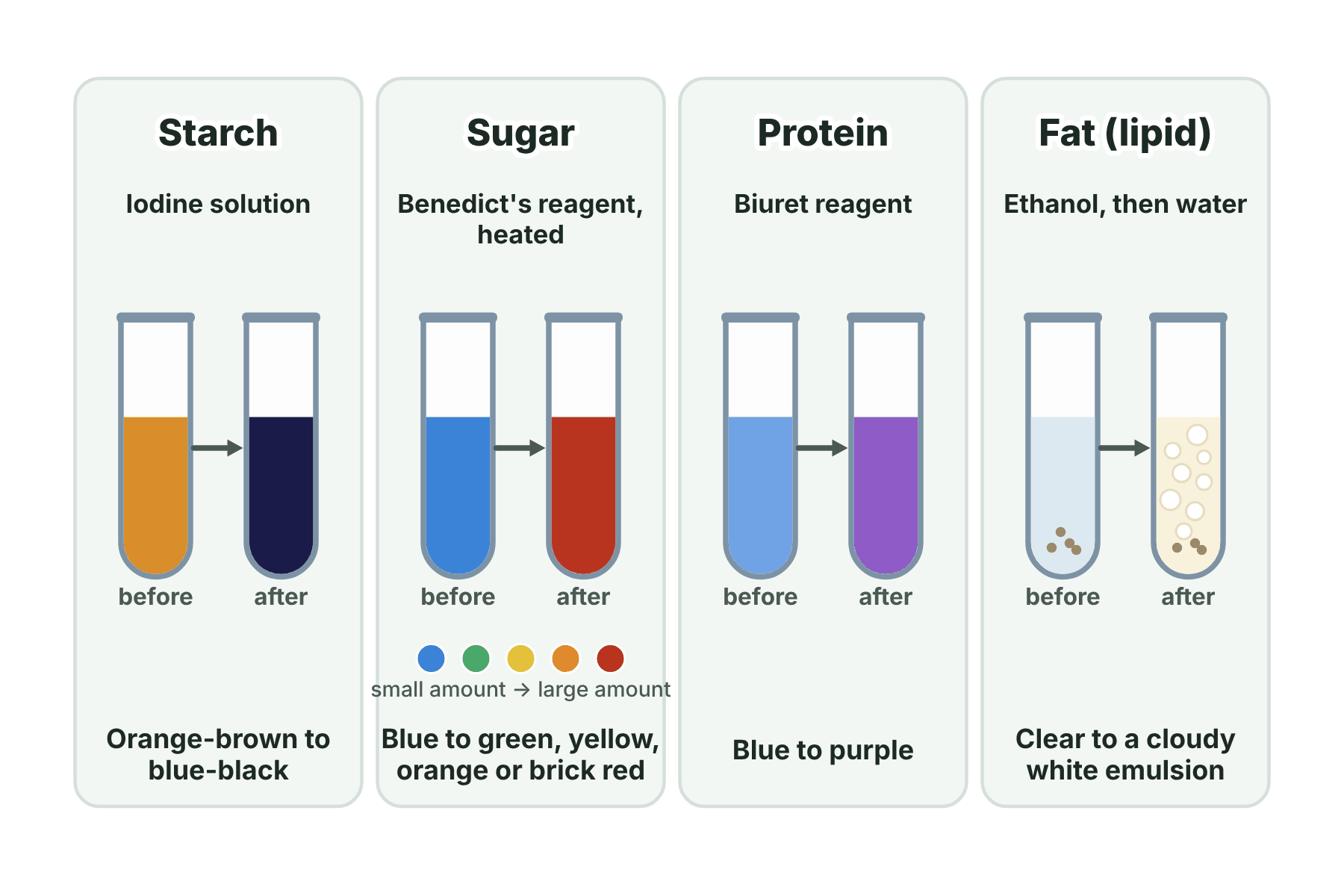
A positive result is a change from the original colour. A negative result is no change.
Carrying out Benedict's test for sugar
Benedict's test is the only one of the four that needs heat, so it needs most care.
-
1
Add the sample
Put about 2 cm³ of the food sample into a test tube.
-
2
Add the reagent
Add about 10 drops of Benedict's reagent. The mixture is blue.
-
3
Heat it safely
Put the test tube in a hot water bath, at about 75 °C, for about five minutes. Do not use a flame.
-
4
Watch for a colour change
If there is sugar the mixture goes green, yellow, orange or brick red. If there is none it stays blue.
-
5
Compare
The further the colour moves towards brick red, the more sugar there is in the sample.
The other three tests
These tests are simpler, and none of them needs heating.
-
Iodine test for starch
Put about 2 cm³ of the sample in a test tube, or in a well on a spotting tile. Add a few drops of iodine solution and look at the colour straight away.
-
Biuret test for protein
Put about 2 cm³ of the sample in a test tube. Add Biuret reagent, or sodium hydroxide followed by a few drops of copper sulfate solution. Shake gently and look for a colour change.
-
Emulsion test for lipids
Shake a small amount of the food with about 2 cm³ of ethanol, so that any lipid dissolves. Pour the clear liquid into a test tube of water. If there is lipid, it forms tiny droplets, and the water turns cloudy white.
-
Sudan III
Some courses test for lipids with Sudan III stain instead. It forms a red layer on top of the mixture if lipid is present.
Safety and good practice
Some of the reagents are harmful, and you may be using hot water. Think about the risks before you start.
-
Eye protection
Wear goggles. Biuret reagent contains sodium hydroxide, which is corrosive, and Benedict's reagent contains copper sulfate, which is harmful.
-
Hot water
Use a water bath, not a flame, so that the liquid cannot boil over. Handle hot tubes with a holder and point the open end away from people.
-
Ethanol
Ethanol is flammable. Keep it away from flames.
-
Iodine
Iodine solution stains skin and clothes.
-
Controls
Test distilled water with each reagent, to show what a negative result looks like. Test a food that you know contains the substance, such as glucose, starch or egg white, to show what a positive result looks like.
Interpreting food test results
A student tests a sample of food. The iodine stays orange-brown. Benedict's reagent turns brick red after heating. Biuret reagent turns purple. In the emulsion test the water stays clear. Which food groups does the sample contain?
Show the solutionHide the solution
- 1 Iodine stayed orange-brown There is no starch.
- 2 Benedict's turned brick red Sugar is present, and the colour suggests a large amount.
- 3 Biuret turned purple Protein is present.
- 4 The water stayed clear There is no lipid.
AnswerThe sample contains sugar and protein, but no starch and no lipid.
Case study
Testing urine for sugar
In the past, Benedict's reagent was used to test urine for glucose, because a high level of glucose in the urine can be a sign of diabetes. A patient's urine was heated with the reagent, and the colour showed roughly how much sugar there was. Today people use test strips and blood glucose meters, which are quicker and more accurate, but they work on the same idea as the food tests: a reagent that changes in the presence of one particular substance.
The four tests to learn
Iodine turns blue-black with starch. Benedict's reagent, heated, turns from blue to brick red with sugar. Biuret reagent turns purple with protein. Ethanol then water gives a cloudy white emulsion with lipids.
Name the reagent, say whether you heat it, and give the colour before and after.
Food tests
Food tests
-
Starch
- iodine
- orange-brown to blue-black
-
Sugar
- Benedict's
- heat
- blue to brick red
-
Protein
- Biuret
- blue to purple
-
Lipid
- ethanol then water
- cloudy white emulsion
-
Safe and fair
- goggles
- water bath
- and controls
Summary and exam focus
- Starch: iodine solution, orange-brown to blue-black.
- Sugar: Benedict's reagent, heated in a water bath, blue to green, yellow, orange or brick red.
- Protein: Biuret reagent, blue to purple.
- Lipids: ethanol then water, a cloudy white emulsion.
- Wear goggles, use a water bath instead of a flame, and test controls so you know what a result looks like.
Exam focus
Describe how you would test a food sample for sugar, and what you would see if the result is positive. (3 marks) (3 marks)
Give the reagent, the condition (heat it in a water bath) and the colour change, from blue to green, yellow, orange or brick red. Saying that it turns red is not enough: say brick red, and say that it is from blue.
Key terms
The words this lesson expects you to use. Each one is linked from the first place it appears above.
- Reagent
- A chemical used to detect another substance because it changes colour or appearance.
- Qualitative test
- A test that shows whether a substance is present, but does not measure how much.
- Iodine solution
- The reagent that turns blue-black when starch is present.
- Benedict's reagent
- The blue reagent that turns green, yellow, orange or brick red when heated with sugar.
- Biuret reagent
- The blue reagent that turns purple when protein is present.
- Emulsion test
- The test for lipids using ethanol and water, which makes a cloudy white emulsion.
- Starch
- A carbohydrate made of many sugar molecules joined together.
- Positive result
- A result showing that the substance being tested for is present.
- Negative result
- A result showing that the substance being tested for is not present.
- Control
- A test that shows what a result looks like when nothing is present, or when it definitely is.
- Water bath
- A container of warm or hot water used to heat things gently and evenly.
You've finished the notes
Check your understanding
Test yourself while it is fresh. Start with the flashcards, then try the exam questions.
Something here looks wrong?
Tell us what and we will go and look. It goes to whoever writes these pages, nobody else, and we do not ask who you are — so there is nothing to sign and nothing comes back to you.