Viewing as
Teacher view: planning notes, the answers to every question, and the teacher copies of the files.
Business · Making the business effective
The marketing mix
The marketing mix is the four Ps - product, price, promotion and place. A small business succeeds when all four fit together for its target market, and when it changes the mix as customer needs, technology and competition change.
Teacher resources
The teacher copies: slides with the questions built in, the answers, and anything else attached to this lesson for whoever is teaching it.
- The marketing mix - Teacher Slides.pptx Teacher The lesson slides with the teacher's notes on each slide, and every question and mark scheme built in. Built from the lesson script on 25 September 2026. View
- The marketing mix - Teacher Notes.docx Teacher The complete notes with the teacher's notes and every model answer in full. Built from the lesson script on 25 September 2026. View
Student handouts
The same files the students see, to print or hand out.
- The marketing mix.pptx Built from the lesson script on 25 September 2026. View
- The marketing mix - Completed Notes.docx The full notes for the lesson, to revise from. Built from the lesson script on 25 September 2026. View
- The marketing mix - Exam Questions.docx Built from the lesson script on 25 September 2026. View
Last Lesson
Answer from memory before the answers appear.
-
Name the four location factors.
Proximity to the market, labour, materials and competitors.
-
What is e-commerce?
Buying and selling goods and services online.
-
Give one advantage of selling online instead of from a shop.
Lower costs, reaching more customers, or being open 24 hours.
-
Why does a hairdresser still need fixed premises?
Customers must visit in person.
Learning Objectives
- 1Explain what the marketing mix is.
- 2Explain the importance of each of the four Ps: product, price, promotion and place.
- 3Explain how the elements of the marketing mix work together.
- 4Explain how changing customer needs, technology and competition affect the marketing mix.
THE BIG IDEA
The right product, at the right price, promoted in the right way, in the right place.
That is the whole of the marketing mix - and all four have to be right at once.
The marketing mix
The marketing mix
-
Product
- what the business sells
- its features, quality and appearance
- how it meets customer needs
-
Price
- how much customers pay
- must suit the target market
- must cover costs
-
Promotion
- how customers find out about it
- social media, leaflets, adverts, special offers
-
Place
- where and how customers buy it
- shop, market stall, website, app
Product
The good or service the business sells.
-
What it includes
What the product does, its quality, how it looks, its size and its packaging.
-
Why it matters
If the product does not meet customer needs, no amount of promotion will make customers keep buying it.
-
Standing out
A small business often needs something that makes its product different from competitors' - a unique selling point.
-
Example
A bakery's product is not just bread: it is fresh, baked on site each morning, with local ingredients.
Price
The amount customers pay for the product.
-
Cover costs
The price must be high enough to cover costs and make a profit.
-
Suit the target market
It must be a price the target customers are willing and able to pay.
-
Match the product
Customers expect a high-quality product to cost more; a very low price can make them doubt the quality.
-
Look at competitors
Customers compare prices, so a business charging more than rivals must give them a reason to pay it.
Product and Price on Show
A customer looking at this table judges the product and the price together. Handmade, attractively displayed products suggest quality, so customers expect - and accept - a higher price than for mass-produced versions in a supermarket.
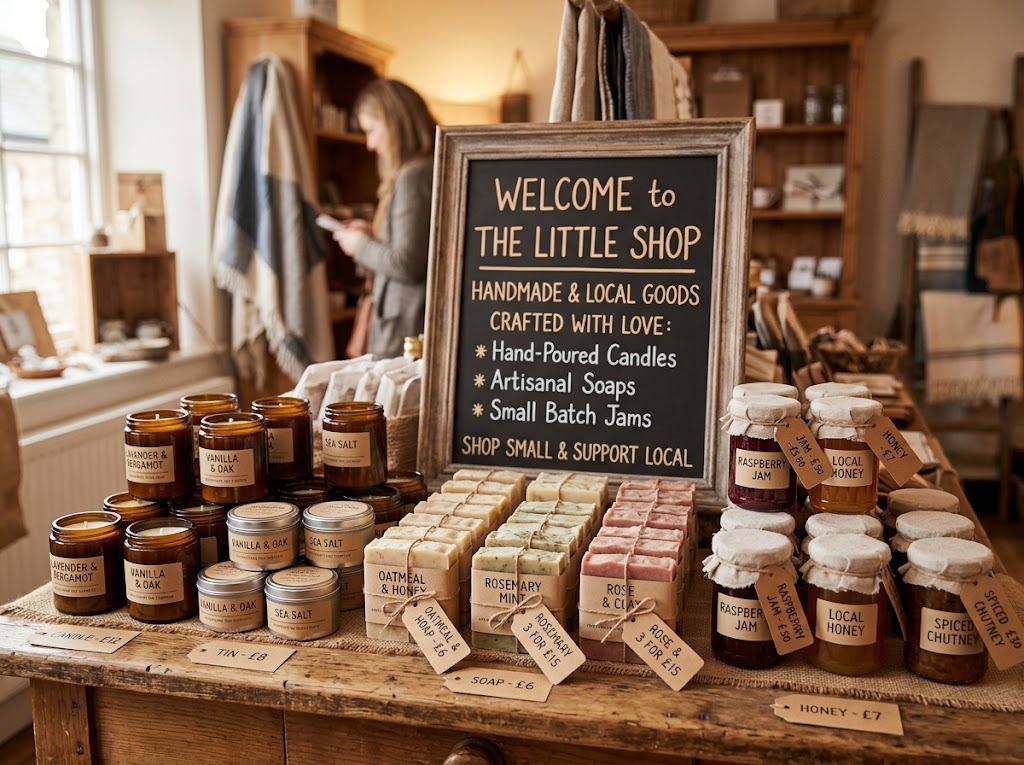
Product and price: the first two Ps, side by side on the shelf.
Promotion
How the business tells customers about its product and persuades them to buy.
-
Why it matters
Customers cannot buy a product they have never heard of.
-
Reaching the target market
Promotion must appear where the target customers will see it.
-
Small-business options
Social media posts, a website, leaflets, local newspapers, word of mouth and special offers.
-
Cost
Small businesses have small budgets, so they choose cheap methods that reach the right people.
Place
Where and how customers can buy the product.
-
Why it matters
Customers need to be able to buy the product easily, when and where they want.
-
Options for a small business
Its own shop, a market stall, other shops that stock its products, its own website or an online marketplace.
-
Match the customer
Place must suit how the target market likes to shop - older customers may prefer a shop; younger customers may prefer an app.
-
Convenience
The easier it is to buy, the more customers will buy.
An Integrated Marketing Mix
The four Ps must support each other and suit the same target market.
-
Consistency
Each P sends the same message. A luxury product needs a high price, stylish promotion and an upmarket place to sell.
-
Mismatches confuse customers
A premium chocolate brand sold cheaply in a discount shop, with cheap-looking adverts, would not be believed.
-
Changing one P affects the others
Improving the product's quality may mean raising the price and promoting the new quality.
-
Balancing the mix
A small business may not be able to afford everything, so it balances the four - for example a good product sold at a fair price, with cheap social media promotion.
One Café, Two Target Markets
-
Product
Budget student café: Simple coffee, toasties, big portions. Upmarket brunch café: Speciality coffee, fresh brunch dishes
-
Price
Budget student café: Low - £2 coffee, meal deals. Upmarket brunch café: High - £4 coffee, £14 brunch
-
Promotion
Budget student café: Student discount, Instagram, flyers on campus. Upmarket brunch café: Food bloggers, a stylish website, local magazines
-
Place
Budget student café: Near the university, fast takeaway counter. Upmarket brunch café: Quiet, stylish street with table service
Changing Customer Needs
When customers want something different, the mix has to change.
-
Product
Businesses add new products as tastes change - vegan options, low-sugar drinks, eco-friendly packaging.
-
Price
If customers have less money to spend, a business may offer smaller, cheaper versions or value deals.
-
Promotion
The message changes to show the business meets the new need, such as "plastic-free" or "locally sourced".
-
Place
As more customers shop online, small businesses add websites, delivery and click-and-collect.
The Impact of Technology
E-commerce and digital communication have changed every P for small businesses.
-
Place: e-commerce
A small business can sell online to customers anywhere, through its own website or an online marketplace.
-
Promotion: digital communication
Social media, email and websites let a small business promote itself cheaply and target exactly the right customers.
-
Price
Customers can compare prices online in seconds, so businesses must keep their prices competitive.
-
Product
Customers leave online reviews, so product quality matters even more - one bad review can put off many buyers.
Promotion on a Small Budget
Why social media suits small businesses
- Cheap Posting is free; paid adverts can start from a few pounds.
- Targeted Adverts can be shown only to the right age, location and interests.
- Two-way Customers comment and share, spreading word of mouth.
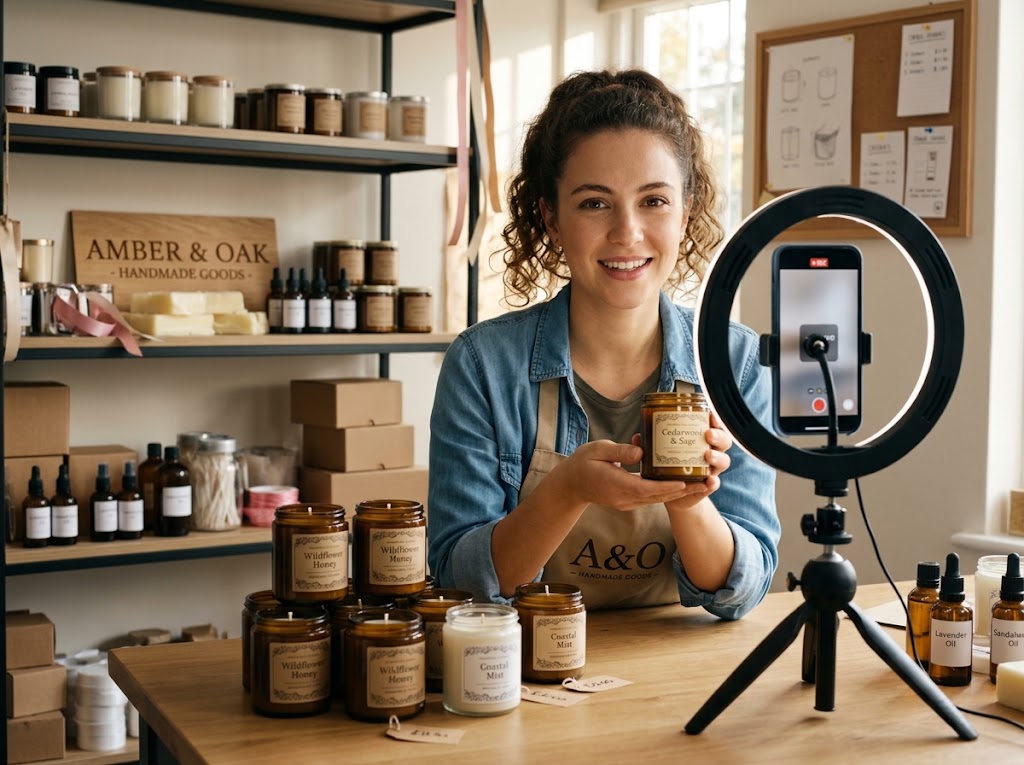
Digital communication: promotion that costs almost nothing.
The Mix in a Competitive Market
When there are many competitors, the mix must give customers a reason to choose this business.
-
Product
Make it different - better quality, a unique feature or better service.
-
Price
Keep it close to competitors, unless the product is clearly better.
-
Promotion
Tell customers what makes the business different, not just that it exists.
-
Place
Be easier to buy from than rivals - open longer, deliver faster or sell online.
Build a Mix
You are launching a small business selling healthy smoothies to secondary school students. Plan all four Ps, making sure they fit together for your target market. Then explain one change you would make if a rival smoothie bar opened next door.
1. Describe your product.
2. Set a price and explain it.
3. Choose how to promote it.
4. Choose where to sell it.
5. Plan your response to the new competitor.
A good answer shows: A product, price, promotion and place that all suit teenage students and support each other, plus a response to competition linked to one of the Ps.
Can I...?
- 1Name the four Ps.
- 2Explain why product matters.
- 3Explain why price matters.
- 4Explain why promotion matters.
- 5Explain why place matters.
- 6Explain what an integrated marketing mix is.
- 7Explain how changing customer needs affect the mix.
- 8Explain how technology affects the mix.
- 9Explain how competition affects the mix.
Summary & Exam Focus
- The marketing mix is product, price, promotion and place.
- Each element matters, and all four must fit together for the target market.
- The mix changes as customer needs change.
- E-commerce and digital communication have changed every P, especially for small businesses.
Exam focus
Explain one way that digital communication can help a small business promote its products. (3 marks) (3 marks)
Name the method (social media, email, a website), then explain the benefit for a small business specifically - low cost, targeting the right customers, reaching more people.
Key terms
The vocabulary this lesson expects you to use. Each one is linked from the first place it appears above.
- Marketing mix
- The four elements a business uses to market its product: product, price, promotion and place.
- Product
- The good or service a business sells.
- Price
- The amount customers pay for a product.
- Promotion
- How a business tells customers about its product and persuades them to buy.
- Place
- Where and how customers can buy a product.
- Integrated marketing mix
- A marketing mix in which the four Ps fit together and suit the same target market.
- Digital communication
- Promoting a business and talking to customers online, e.g. through social media, email and websites.
Questions and answers
9 questions set on this lesson, with the mark schemes and model answers open.
Define the term 'marketing mix'.
Mark scheme — 1 mark available
- The four Ps / product, price, promotion and place — 1 mark
Model answer
The combination of product, price, promotion and place that a business uses to sell its product.
State one element of the marketing mix.
Mark scheme — 1 mark available
- Any one of: product; price; promotion; place — 1 mark
Model answer
Promotion.
Outline one way e-commerce has affected the place element of the marketing mix.
Mark scheme — 2 marks available
- A way identified, e.g. selling online / reaching customers anywhere / no need for a shop — 1 mark
- Developed: the effect on the business or its customers — 1 mark
Model answer
Businesses can sell their products online (1), so customers can buy from anywhere at any time without visiting a shop (1).
Explain one way that digital communication can help a small business promote its products.
Mark scheme — 3 marks available
- A way identified, e.g. social media / email / website — 1 mark
- First linked point of explanation — 1 mark
- Second linked point of explanation — 1 mark
Model answer
A small business can use social media to promote its products (1). Posting is free and paid adverts can be shown only to people of the right age, location and interests (1). This means the business reaches its target market for much less money than traditional advertising, which suits its small budget (1).
Source: Kai runs a small shop selling handmade leather wallets and bags. His products are high quality and take many hours to make, but he prices them only slightly above mass-produced wallets in the high street. He promotes the shop with leaflets through local letterboxes. Most of his customers are young professionals aged 25 to 40, and sales are lower than he hoped. Analyse the importance to Kai of having an integrated marketing mix.
Mark scheme — 6 marks available
- AO2 (Application, 3 marks): uses the context - handmade leather, low price, leaflets, young professionals — Level 1-3
- AO3a (Analysis, 3 marks): chains of reasoning showing why the four Ps must fit together — Level 1-3
Model answer
Kai's product is high quality and handmade, but his price is only slightly above mass-produced wallets. This sends a mixed message: customers may doubt that the product is really special if it is priced like a cheaper one, and Kai earns too little on each item to cover the many hours it takes to make. If he raised his price to match the quality, his price and product would support each other and his profit per item would rise. His promotion also does not fit his target market. Young professionals aged 25 to 40 are more likely to see social media than leaflets through the door, so his leaflets may be reaching the wrong people. If Kai promoted his handmade quality online, where his target customers are, all four Ps would work together, which should increase his sales.
Which one of the following is one of the four Ps?
Why: The four Ps are product, price, promotion and place.
A small bakery starts posting videos of its cakes on social media. Which element of the marketing mix is it using?
Why: Telling customers about the product and persuading them to buy it is promotion.
What is an integrated marketing mix?
Why: In an integrated mix the four Ps support each other and suit the same target market.
Customers can now compare prices online in seconds. What effect does this most likely have on small businesses?
Why: Easy price comparison means customers quickly spot a business charging more than its rivals, so prices must be competitive.