Viewing as
Teaching this? The teacher view adds 2 files, the mark schemes and the model answers.
Business · Putting a business idea into practice
Revenue, costs and profit
Revenue is the money coming in from sales; costs are the money going out. Profit is what is left when costs are taken from revenue. This lesson covers every calculation you need, including interest on loans.
Last Lesson
Answer from memory before the answers appear.
-
What is the difference between an aim and an objective?
An aim is a general long-term goal; an objective is a specific, measurable target.
-
Name three financial aims.
Any three of: survival, profit, sales, market share, financial security.
-
Name two non-financial aims.
Any two of: social objectives, personal satisfaction, challenge, independence and control.
-
How do you calculate market share?
(Business's sales ÷ total market sales) × 100.
Learning Objectives
- 1Calculate revenue.
- 2Explain and calculate fixed costs, variable costs and total costs.
- 3Calculate profit and loss.
- 4Calculate interest on a loan as a percentage.
THE BIG IDEA
Profit = revenue - costs. Everything else in this lesson is about getting those two numbers right.
Revenue
Revenue is the money a business receives from selling its products.
-
Formula
Revenue = sales price × quantity sold.
-
Also called
Sales revenue, turnover or income.
-
Not the same as profit
Revenue is all the money coming in, before any costs are paid.
-
Example
A café sells 3,000 coffees at £4 each: revenue = £4 × 3,000 = £12,000.
Every Sale Is Revenue
Every time a customer pays, the business's revenue goes up. But revenue alone says nothing about whether the business is doing well - that depends on how much it cost to make and sell the product.

Price × quantity: every sale adds to revenue.
Fixed or Variable Costs?
Fixed costs
- Do not change with the number of products made or sold.
- Must be paid even if nothing is sold.
- Examples: rent, salaries, insurance, loan repayments, advertising.
- Can change over time, e.g. when the rent goes up.
Variable costs
- Change directly with the number of products made or sold.
- Are zero if nothing is made.
- Examples: raw materials, ingredients, packaging, stock.
- Total variable costs = variable cost per unit × quantity.
Fixed and Variable Costs
Rent must be paid whatever happens. Ingredients are only needed for every cup sold.

Rent: a fixed cost.
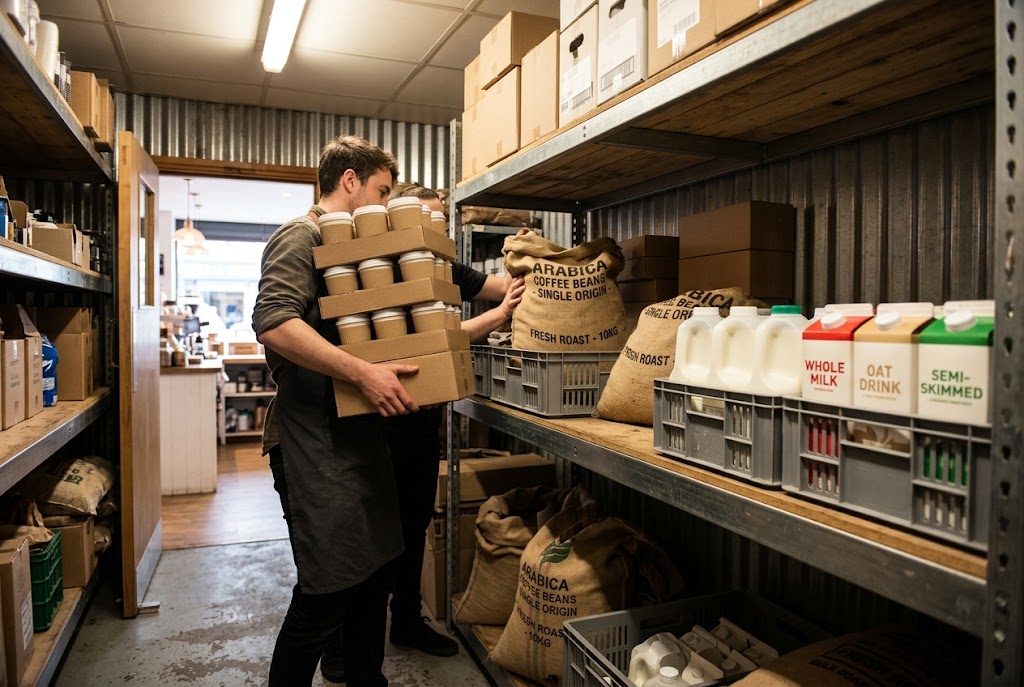
Ingredients: a variable cost.
Total Costs
Total costs are everything a business spends to make and sell its products.
-
Formula
Total costs = fixed costs + total variable costs.
-
Total variable costs
Variable cost per unit × quantity sold.
-
Example
The café's fixed costs are £6,000 a month and each coffee costs £1.50 to make. Selling 3,000 coffees: total variable costs = £1.50 × 3,000 = £4,500. Total costs = £6,000 + £4,500 = £10,500.
Profit and Loss
Profit = total revenue - total costs.
-
Profit
When revenue is greater than total costs, the business makes a profit.
-
Loss
When total costs are greater than revenue, the business makes a loss. A loss is shown as a negative number or in brackets, e.g. -£500 or (£500).
-
Why it matters
Profit rewards the owner and can be reinvested; losses cannot go on for ever, or the business will fail.
-
Example
The café's revenue is £12,000 and its total costs are £10,500, so its profit = £12,000 - £10,500 = £1,500.
The Café's Month in Numbers
Work through it in order, and show every step.
A café sells 3,000 coffees at £4 each. Its fixed costs are £6,000 a month and each coffee costs £1.50 to make. Calculate its profit.
- 1 Revenue £4 × 3,000 = £12,000
- 2 Total variable costs £1.50 × 3,000 = £4,500
- 3 Total costs £6,000 + £4,500 = £10,500
- 4 Profit £12,000 - £10,500 = £1,500
AnswerProfit = £1,500
The Café's Month at a Glance
-
£12,000
Revenue
-
£6,000
Fixed costs
-
£4,500
Total variable costs
-
£1,500
Profit
Interest on Loans
Interest is the extra money a business pays back on top of what it borrowed.
-
What it is
The cost of borrowing - the reward the lender gets for lending the money.
-
Formula
Interest (%) = (total repayment - borrowed amount) ÷ borrowed amount × 100.
-
A fixed cost
Interest must be paid whatever the business sells, so it adds to fixed costs and reduces profit.
-
Why it matters
A high interest rate makes borrowing expensive, so a business may borrow less or look for cheaper finance.
Calculating Interest as a Percentage
Edexcel asks for interest as a percentage of the amount borrowed.
A business borrows £5,000 and repays £5,600 in total. Calculate the rate of interest.
- 1 Find the interest paid £5,600 - £5,000 = £600
- 2 Divide by the amount borrowed £600 ÷ £5,000 = 0.12
- 3 Multiply by 100 0.12 × 100 = 12%
AnswerInterest = 12%
Case study
When Fixed Costs Rise
In 2022 wholesale energy prices rose sharply across the UK. Many small bakeries, which run ovens for hours every day, saw their energy bills rise several times over. Energy is largely a fixed cost for a bakery - the ovens must be heated whether it sells 100 loaves or 1,000 - so higher bills cut straight into profit. Some bakeries raised their prices to protect their profit, some cut their opening hours, and some were forced to close.
Fixed or Variable?
Match each cost to its type.
-
Rent for the shop
Fixed
-
Flour for each loaf
Variable
-
The manager's salary
Fixed
-
Packaging for each order
Variable
-
Insurance
Fixed
-
Stock bought to sell
Variable
Run the Numbers
A phone case business sells 500 cases a month at £12 each. Its fixed costs are £2,000 a month and each case costs £5 to make. Calculate its revenue, total costs and profit. Then work out what happens to its profit if it sells only 250 cases.
1. Calculate revenue.
2. Calculate total variable costs, then total costs.
3. Calculate profit.
4. Repeat for 250 cases.
A good answer shows: Revenue £6,000, total costs £4,500 and profit £1,500 at 500 cases; revenue £3,000, total costs £3,250 and a loss of £250 at 250 cases.
Can I...?
- 1Calculate revenue.
- 2Explain fixed costs, with examples.
- 3Explain variable costs, with examples.
- 4Calculate total variable costs.
- 5Calculate total costs.
- 6Calculate profit or loss.
- 7Calculate interest as a percentage.
Summary & Exam Focus
- Revenue = price × quantity.
- Total costs = fixed costs + total variable costs.
- Profit = total revenue - total costs.
- Interest (%) = (total repayment - borrowed amount) ÷ borrowed amount × 100.
Exam focus
Calculate the profit a business makes if it sells 800 units at £8 each, with fixed costs of £2,000 and variable costs of £3 per unit. (2 marks) (2 marks)
Write the formula first, then the numbers, then the answer with its unit (£ or %). A correct method can earn a mark even if the final answer is wrong.
Key terms
The vocabulary this lesson expects you to use. Each one is linked from the first place it appears above.
- Revenue
- The money a business receives from sales. Price × quantity sold.
- Fixed costs
- Costs that do not change with the number of products made or sold, such as rent.
- Variable costs
- Costs that change directly with the number of products made or sold, such as raw materials.
- Total costs
- Fixed costs + total variable costs.
- Profit
- Total revenue minus total costs, when revenue is greater.
- Loss
- When total costs are greater than total revenue.
- Interest
- The cost of borrowing money, paid on top of the amount borrowed.
Downloads
Free to keep, print and annotate.
- Revenue costs and profit.pptx Built from the lesson script on 25 September 2026. View
- Revenue costs and profit - Completed Notes.docx The full notes for the lesson, to revise from. Built from the lesson script on 25 September 2026. View
- Revenue costs and profit - Exam Questions.docx Built from the lesson script on 25 September 2026. View
Something here looks wrong?
Tell us what and we will go and look. It goes to whoever writes these pages, nobody else, and we do not ask who you are — so there is nothing to sign and nothing comes back to you.