Viewing as
Teacher view: planning notes, the answers to every question, and the teacher copies of the files.
Business · Spotting a business opportunity
Market research
Market research is how a business finds out what customers need and what competitors offer. It can be primary or secondary, produce qualitative or quantitative data, and is only as useful as it is reliable.
Teacher resources
The teacher copies: slides with the questions built in, the answers, and anything else attached to this lesson for whoever is teaching it.
- Market research - Teacher Slides.pptx Teacher The lesson slides with the teacher's notes on each slide, and every question and mark scheme built in. Built from the lesson script on 24 September 2026. View
- Market research - Teacher Notes.docx Teacher The complete notes with the teacher's notes and every model answer in full. Built from the lesson script on 24 September 2026. View
Student handouts
The same files the students see, to print or hand out.
- Market research.pptx Built from the lesson script on 24 September 2026. View
- Market research - Completed Notes.docx The full notes for the lesson, to revise from. Built from the lesson script on 24 September 2026. View
- Market research - Exam Questions.docx Built from the lesson script on 24 September 2026. View
Last Lesson
Answer from memory before the answers appear.
-
Name the four customer needs.
Price, quality, choice and convenience.
-
What is the difference between a customer and a consumer?
The customer buys the product; the consumer uses it.
-
Why does meeting customer needs help a business survive?
It generates sales and revenue to cover costs.
-
How might a business find out what customers need?
By asking them - market research.
Learning Objectives
- 1Explain the purpose of market research.
- 2Compare primary and secondary market research and their methods.
- 3Explain the difference between qualitative and quantitative data.
- 4Explain the role of social media in collecting market research.
- 5Explain how sample size and bias affect the reliability of market research.
What Is Market Research?
Market research is the process of collecting information about customers, competitors and the market.
-
To identify and understand customer needs
Find out what customers want, how much they will pay and where they want to buy.
-
To identify gaps in the market
Spot needs that no business is currently meeting.
-
To reduce risk
Check that there is demand before spending money on a new product, so the business is less likely to fail.
-
To inform decisions
Help the business decide on price, product, location and promotion using evidence instead of guesswork.
Primary or Secondary?
Primary research
- New information collected first-hand by the business itself.
- Also called field research.
- Specific to the business's own questions.
- Up to date, and competitors do not have it.
- Expensive and time-consuming to collect.
Secondary research
- Information that already exists, collected by someone else.
- Also called desk research.
- Quick and cheap, often free.
- May be out of date or not quite what the business needs.
- Competitors can see it too.
Methods of Primary Research
-
Survey and questionnaire
A set of questions answered by customers, in person, by phone, by post or online. Can reach lots of people cheaply.
-
Focus group
A small group of customers discuss a product in depth, led by a researcher. Gives detailed opinions, but only from a few people.
-
Observation
Watching how customers behave - for example counting how many people walk past a shop at lunchtime.
-
Interviews and product testing
Asking customers one to one, or letting them try a product and give feedback.
Asking the Customers
A street survey is one of the simplest kinds of primary research. The business writes its own questions, so every answer is about exactly what it needs to know - but it takes time to collect enough answers to rely on.
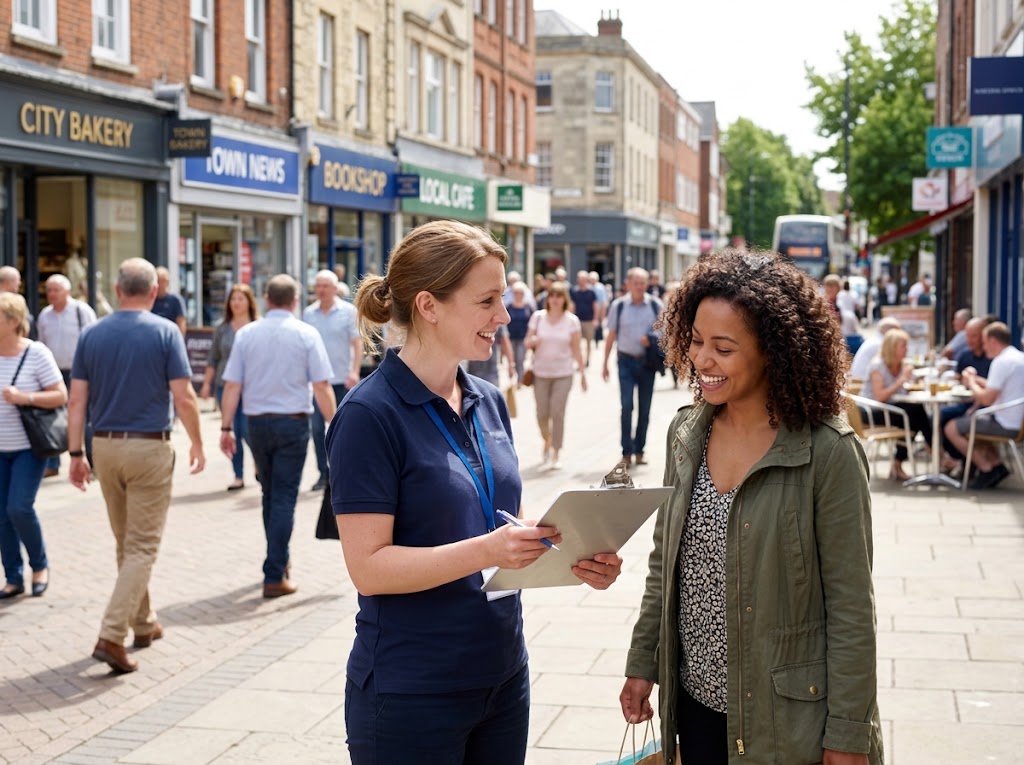
A street survey: primary research, collected first-hand.
Methods of Secondary Research
-
The internet
Competitors' websites, prices and customer reviews, and news articles about the market.
-
Market reports
Detailed reports on a market written by specialist research companies. Useful, but often expensive to buy.
-
Government publications
Free statistics, for example from the Office for National Statistics and the census, about population, incomes and spending.
-
Newspapers and trade magazines
Articles about trends, new products and changes in an industry.
Digging Deeper
Focus groups
- Strength Detailed opinions and reasons, not just ticks in boxes.
- Weakness A small group may not represent all customers.
- Weakness One loud person can sway the rest of the group.

A focus group gives detailed opinions - but only from a handful of people.
Quantitative or Qualitative?
Quantitative data
- Numerical data that can be counted and measured.
- Comes from closed questions, e.g. "How many times a week do you buy coffee?"
- Easy to put into graphs, charts and percentages.
- Easy to compare and analyse.
- Does not explain why customers think or behave as they do.
Qualitative data
- Opinions, feelings and reasons, in words.
- Comes from open questions and focus groups, e.g. "What do you like about our coffee?"
- Explains why customers behave as they do.
- Gives detail and new ideas.
- Hard to analyse and compare, and can be interpreted differently.
The Role of Social Media
Social media gives even the smallest business a cheap way to research its market.
-
Quick polls
Businesses can run polls and questions on Instagram, TikTok or Facebook and get answers within hours.
-
Comments and reviews
Customers say what they think in comments, messages and reviews, which the business can read for free.
-
Following trends
Businesses can see what customers are talking about and what competitors are doing.
-
Limitation
Only followers reply, so the answers may not represent all customers, and some comments are not honest.
Reliability, Sample Size and Bias
Reliable research gives results the business can trust to make decisions.
-
Sample
The group of people who take part in the research, chosen to represent the whole market.
-
Sample size
The bigger the sample, the more reliable the results usually are - asking 10 people tells you far less than asking 500. But larger samples cost more time and money.
-
Bias
Research is biased when the results are pushed in one direction - for example asking only friends and family, or asking a leading question such as "Don't you agree our cakes are delicious?"
-
Representative
The sample should reflect the business's real customers in age, gender, location and income. An online survey only reaches people who choose to answer.
-
Out of date
Secondary data may no longer be true, especially in a fast-changing market.
Working Out a Percentage from a Survey
Edexcel "Calculate" questions often use survey results. Show your working.
A café asked 250 customers whether they would buy a new vegan breakfast. 90 said yes. What percentage of customers said yes?
- 1 Write the formula Percentage = (number who said yes ÷ total asked) × 100
- 2 Put in the numbers = (90 ÷ 250) × 100
- 3 Work it out = 0.36 × 100 = 36%
Answer36% of customers said yes.
Case study
Tesco Clubcard: Research Every Time You Shop
Tesco launched its Clubcard loyalty scheme in 1995. Every time a customer scans the card, Tesco records what they buy, when and where. This gives Tesco a huge amount of quantitative data about its customers' needs, which it uses to decide what to stock in each store, which offers to send each customer and which new products to develop. Customers get points and lower Clubcard prices in return - and Tesco gets market research on millions of shoppers without having to ask a single question.
Design a Survey
A new juice bar wants to open near your school. Write five questions for a survey of students. Include at least three closed questions (for quantitative data) and one open question (for qualitative data). Then explain how you would choose your sample to avoid bias.
1. Write three closed questions.
2. Write at least one open question.
3. Check none of them is a leading question.
4. Explain who you would ask, and how many.
A good answer shows: Five clear, non-leading questions labelled closed or open, and a sampling plan that explains its size and why it represents the juice bar's customers.
Can I...?
- 1Explain the purpose of market research.
- 2Give methods of primary research.
- 3Give methods of secondary research.
- 4Compare primary and secondary research.
- 5Explain qualitative and quantitative data.
- 6Explain the role of social media.
- 7Explain how sample size affects reliability.
- 8Explain what bias is and how to avoid it.
- 9Calculate a percentage from survey results.
Summary & Exam Focus
- Market research finds out about customers, competitors and the market, to reduce risk.
- Primary research is new and specific but costly; secondary research is cheap but may be out of date.
- Quantitative data is numerical; qualitative data is opinions and reasons.
- Social media is a cheap way to research, but may not be representative.
- A large, unbiased sample makes research more reliable.
Exam focus
Explain one disadvantage to a business of using primary market research. (3 marks) (3 marks)
Name one disadvantage, then link two steps of explanation. Always finish by saying what it means for the business - its costs, its decisions or its risk.
Key terms
The vocabulary this lesson expects you to use. Each one is linked from the first place it appears above.
- Market research
- Collecting information about customers, competitors and the market to help make business decisions.
- Primary research
- New information collected first-hand by the business. Also called field research.
- Secondary research
- Information that already exists, collected by someone else. Also called desk research.
- Quantitative data
- Numerical data that can be counted and measured.
- Qualitative data
- Data about opinions, feelings and reasons.
- Focus group
- A small group of customers who discuss a product in depth.
- Sample
- The group of people chosen to take part in market research.
- Bias
- When research results are distorted, so they do not give a true picture of the market.
- Reliability
- How far the results of market research can be trusted.
Questions and answers
10 questions set on this lesson, with the mark schemes and model answers open.
Define the term 'secondary market research'.
Mark scheme — 1 mark available
- Using existing data / data collected by others — 1 mark
Model answer
Research using information that already exists, which has been collected by someone else.
State one method of primary market research.
Mark scheme — 1 mark available
- Any one of: survey / questionnaire; focus group; observation; interview; product testing — 1 mark
Model answer
A focus group.
A gym surveyed 400 people. 120 said they would join if the gym opened 24 hours a day. Calculate the percentage of people who said they would join. You are advised to show your working.
Mark scheme — 2 marks available
- Correct method: (120 ÷ 400) × 100 — 1 mark
- Correct answer: 30% — 1 mark (award 2 marks for the correct answer with no working)
Model answer
(120 ÷ 400) × 100 = 30%
Outline one benefit to a business of using social media for market research.
Mark scheme — 2 marks available
- A benefit identified, e.g. cheap / quick / reaches many customers / real-time feedback — 1 mark
- Developed: why this helps the business — 1 mark
Model answer
It is cheap (1), because the business can run polls and read customers' comments for free instead of paying a research company (1).
Explain one disadvantage to a business of using primary market research.
Mark scheme — 3 marks available
- A disadvantage identified, e.g. expensive / time-consuming / risk of bias with a small sample — 1 mark
- First linked point of explanation — 1 mark
- Second linked point of explanation — 1 mark
Model answer
It is expensive (1). The business must pay for staff time or a research company to design, carry out and analyse surveys or focus groups (1). This increases the business's costs, which a small business with limited finance may not be able to afford (1).
Explain one reason why the size of a sample affects the reliability of market research.
Mark scheme — 3 marks available
- A reason identified, e.g. small samples are less representative — 1 mark
- First linked point of explanation — 1 mark
- Second linked point of explanation — 1 mark
Model answer
A small sample may not represent the whole market (1). The views of a few people could be very different from those of most customers (1). This means the business could make the wrong decision, such as launching a product that few customers actually want (1).
Which one of the following is an example of primary market research?
Why: A focus group collects new information first-hand, so it is primary research. The others use data that already exists.
"72% of customers rated our service as good." What kind of data is this?
Why: It is a number that can be measured and compared, so it is quantitative data.
A business asks only its own staff whether they like its new product. What is the main problem with this research?
Why: Staff are not typical customers and may not want to criticise their employer, so the results are biased.
Which one of the following would make market research MORE reliable?
Why: A larger sample that reflects the real customers gives results the business can trust more.