Viewing as
Teaching this? The teacher view adds 2 files, the mark schemes and the model answers.
Business · Understanding external influences on business
Technology and business
E-commerce, social media, digital communication and new payment systems have changed how even the smallest business sells, what it costs to run, and every part of its marketing mix.
Last Lesson
Answer from memory before the answers appear.
-
What is a stakeholder?
Anyone who affects, or is affected by, a business.
-
Name two external stakeholders.
Any two of: customers, suppliers, the local community, pressure groups, the government.
-
What do employees usually want?
Fair pay, job security and good working conditions.
-
Give one example of a stakeholder conflict.
Owners want profit; employees want higher pay - or owners want higher prices; customers want lower prices.
Learning Objectives
- 1Explain the types of technology used by small businesses: e-commerce, social media, digital communication and payment systems.
- 2Explain how technology affects a business's sales.
- 3Explain how technology affects a business's costs.
- 4Explain how technology affects the marketing mix.
Technology Used by Businesses
-
E-commerce
Buying and selling online, through a business's own website, an app or an online marketplace.
-
Social media
Platforms such as Instagram, TikTok and Facebook, used to promote products and talk to customers.
-
Digital communication
Email, messaging apps, video calls and websites, used to keep in touch with customers, staff and suppliers.
-
Payment systems
Ways customers pay: contactless cards, mobile phone payments, card readers and online payment services.
E-commerce
Selling online, twenty-four hours a day.
-
Reach
A small business can sell to customers anywhere in the country, not just those who walk past.
-
Always open
Customers can order at any time, even while the owner sleeps.
-
Online marketplaces
Sites such as Etsy, eBay and Amazon let a tiny business sell without building its own website - in return for a fee on each sale.
-
Challenges
Delivery, returns and strong online competition, with customers comparing prices in seconds.
Social Media and Digital Communication
Cheap, fast ways to reach customers and keep in touch.
-
Promotion
Posts, videos and adverts reach large numbers of people for little or no cost.
-
Targeting
Paid adverts can be shown only to people of the right age, location and interests.
-
Two-way contact
Customers message, comment and review - giving feedback, but also airing complaints in public.
-
Working with others
Email, messaging and video calls make it quick to order from suppliers and organise staff.
Payment Systems
How customers pay has changed completely in a few years.
-
Contactless
Customers tap a card or phone to pay in seconds, which speeds up queues.
-
Mobile card readers
Small, cheap card readers that connect to a phone let market stalls, food vans and tradespeople take card payments anywhere.
-
Online payments
Secure online payment services let customers pay on a website without the business handling card details itself.
-
Fewer lost sales
Customers who carry no cash can still buy - a stall that only takes cash turns them away.
Tap to Pay
A few years ago, taking card payments meant renting an expensive machine from a bank. Now a small card reader that links to a phone costs little to buy, so even a market stall or a food van can accept cards and phone payments - and stop losing customers who carry no cash.
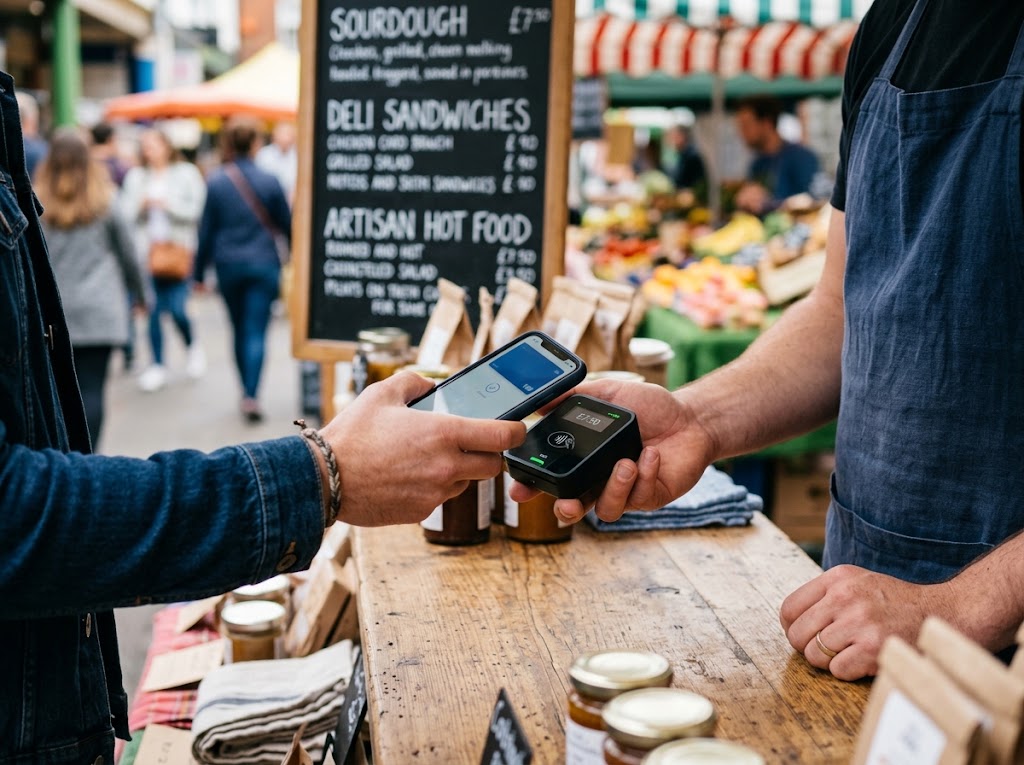
A cheap card reader lets even a market stall take card payments.
Then and Now
The same small shop counter, ten years apart.

Then: cash only, sales counted by hand.
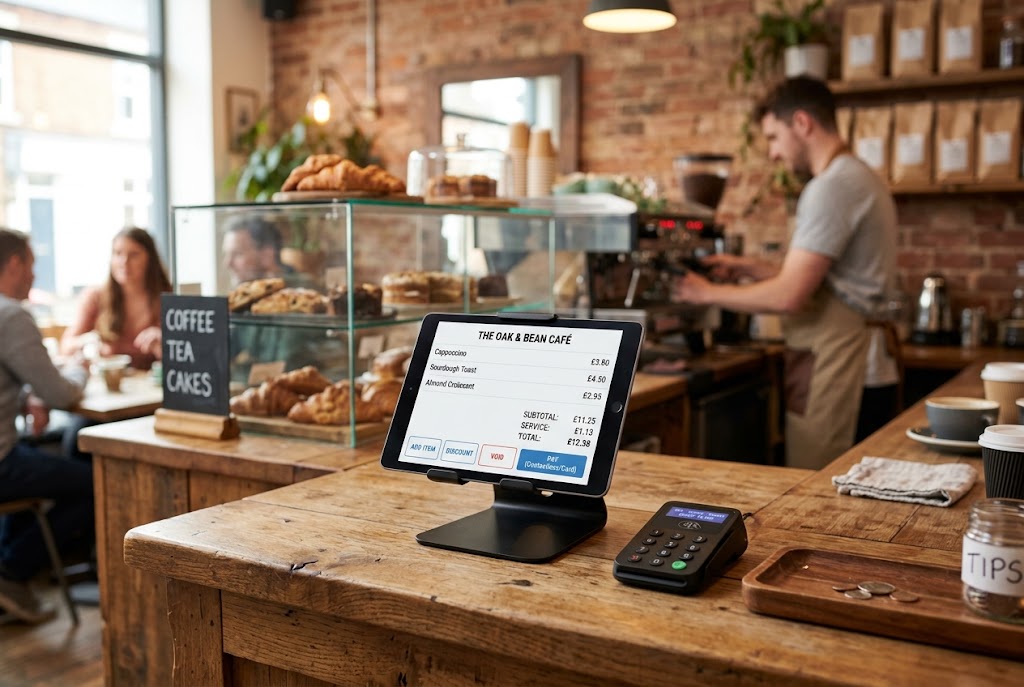
Now: card payments, with every sale recorded automatically.
The Impact on Sales
Technology can increase sales - but it also increases competition.
-
More customers
E-commerce reaches customers far beyond the local area.
-
More sales per customer
Easy payment and one-click ordering make buying quicker, so customers buy more.
-
Reviews
Good online reviews attract new customers; bad ones drive them away.
-
More competition
Customers can find and compare rivals online in seconds, so sales can be lost as easily as won.
The Impact on Costs
Technology can cut some costs while adding others.
-
Lower costs
Selling online avoids high-street rent; social media promotion is cheap; digital records save staff time.
-
New costs
Buying equipment and software, building a website, fees on card payments and online marketplaces.
-
Training
Staff may need training to use new systems.
-
Keeping up
Technology changes quickly, so equipment and websites need updating.
Technology and the Marketing Mix
-
Product
How technology changes it: New products become possible, and online reviews make quality more visible
-
Price
How technology changes it: Customers compare prices online, so prices must be competitive
-
Promotion
How technology changes it: Social media and digital communication make promotion cheap and targeted
-
Place
How technology changes it: E-commerce lets customers buy online, anywhere, at any time
Case study
Contactless: A Payment Revolution
Contactless card payments began in the UK in 2007, with a limit of £10 per payment. As customers came to trust it, the limit rose - to £20, then £30, then £45 in 2020 - and in October 2021 it reached £100. For small businesses, cheap mobile card readers mean that a market stall, a food van or a window cleaner can now take contactless payments as easily as a supermarket. A business that still takes only cash risks losing the growing number of customers who rarely carry any.
Bring the Business Up to Date
A family-run fish and chip shop takes orders only over the counter, accepts only cash, and promotes itself with a sign in the window. Recommend three technologies it should use. For each, explain the likely effect on its sales and on its costs.
1. Choose three technologies.
2. Explain the effect on sales.
3. Explain the effect on costs.
A good answer shows: Three technologies from the four types, each with a specific effect on sales and a specific cost, such as card fees or delivery-app commission.
Can I...?
- 1Explain e-commerce.
- 2Explain how small businesses use social media.
- 3Explain digital communication.
- 4Explain modern payment systems.
- 5Explain how technology affects sales.
- 6Explain how technology affects costs.
- 7Explain how technology affects the marketing mix.
Summary & Exam Focus
- Four types of technology: e-commerce, social media, digital communication and payment systems.
- Technology can increase sales, but makes competition fiercer.
- It cuts some costs and adds others.
- It has changed every element of the marketing mix.
Exam focus
Explain one way that new payment systems could increase the sales of a small business. (3 marks) (3 marks)
Name the technology, then take the chain all the way to sales, costs or profit. "Customers can pay by card" is only the first step.
Key terms
The vocabulary this lesson expects you to use. Each one is linked from the first place it appears above.
- E-commerce
- Buying and selling goods and services online.
- Social media
- Websites and apps that let users share content and talk to each other.
- Digital communication
- Communicating electronically, e.g. by email, messaging, video calls and websites.
- Payment system
- A way for customers to pay, such as contactless cards, mobile phones or online payment services.
- Online marketplace
- A website where many businesses sell their products, usually paying a fee on each sale.
Downloads
Free to keep, print and annotate.
- Technology and business.pptx Built from the lesson script on 25 September 2026. View
- Technology and business - Completed Notes.docx The full notes for the lesson, to revise from. Built from the lesson script on 25 September 2026. View
- Technology and business - Exam Questions.docx Built from the lesson script on 25 September 2026. View
Something here looks wrong?
Tell us what and we will go and look. It goes to whoever writes these pages, nobody else, and we do not ask who you are — so there is nothing to sign and nothing comes back to you.