Viewing as
Teaching this? The teacher view adds 2 files, the mark schemes and the model answers.
Business · Making operational decisions
Business operations
Businesses make products in one of three ways - job, batch or flow production - depending on how many they make and how different each one is. Technology is changing all three, affecting costs, productivity, quality and flexibility.
From Making Marketing Decisions
Answer from memory before the answers appear.
-
Name the three parts of the design mix.
Function, aesthetics and cost.
-
What is an extension strategy?
An action taken to extend a product's life.
-
What is cost-plus pricing?
Adding a percentage mark-up to the cost of a product.
-
What is competitive advantage?
Anything that makes a business more attractive to customers than its rivals.
Learning Objectives
- 1Explain the purpose of business operations.
- 2Explain job, batch and flow production, with their advantages and disadvantages.
- 3Explain what productivity is.
- 4Explain the impact of technology on production: costs, productivity, quality and flexibility.
What Are Business Operations?
Operations are the activities that turn inputs into the goods and services a business sells.
-
Inputs
Raw materials, components, labour, machinery and energy.
-
The process
Making, assembling, preparing or delivering the product or service.
-
Outputs
Finished goods or services, sold to customers.
-
The aim
To produce products of the right quality, at the right cost, in the right quantity, at the right time.
Three Production Processes
-
Job production
One product made at a time, usually to a customer's individual order. Every product is unique - a wedding dress, a bespoke kitchen, a building.
-
Batch production
A group of identical products made together, then the process switches to a different batch - loaves of bread, then rolls; a batch of red paint, then blue.
-
Flow production
Identical products made continuously on a production line, often by machines - cars, cans of drink, chocolate bars.
One at a Time, or Thousands a Day?
The two extremes of production.

Job production: every suit is unique.
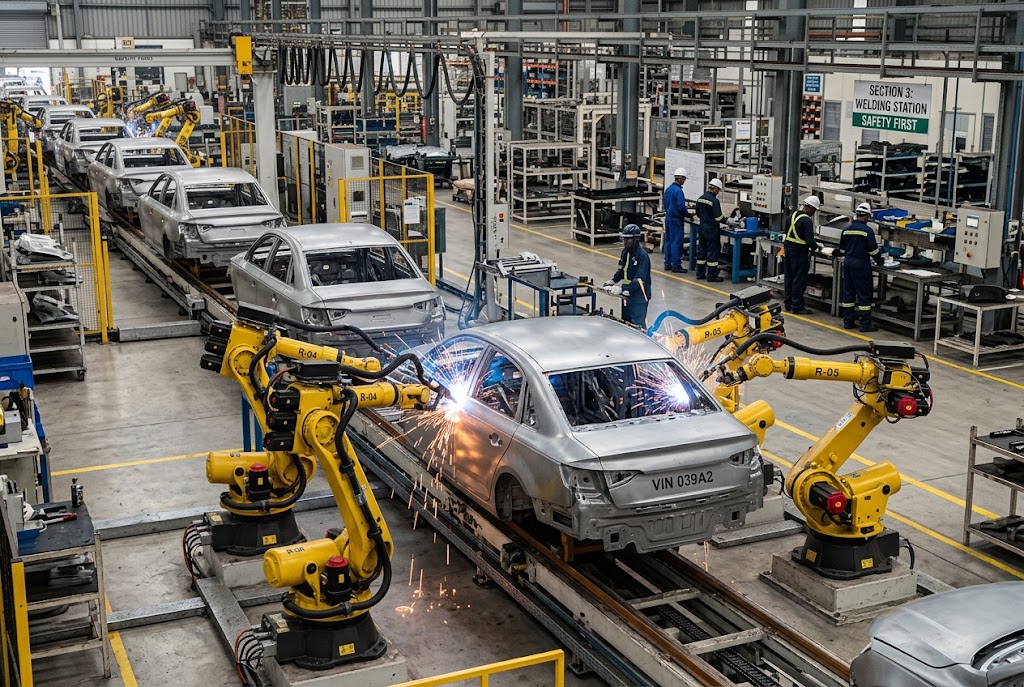
Flow production: identical cars, non-stop.
Comparing Production Processes
-
Number made
Job: One at a time. Batch: Groups of identical items. Flow: Huge numbers, continuously
-
Product
Job: Unique, made to order. Batch: Same within a batch. Flow: Identical
-
Cost per unit
Job: High. Batch: Medium. Flow: Low
-
Workers
Job: Highly skilled. Batch: Semi-skilled. Flow: Mostly machines, less skilled
-
Flexibility
Job: Very high. Batch: Some. Flow: Very low
-
Example
Job: Wedding dress. Batch: Bread. Flow: Cars
Batch by Batch
A bakery is the classic example of batch production. It makes a batch of rolls, then switches to croissants, then to loaves. Each batch is identical, but the business can still offer variety - at the cost of time lost changing over between batches.
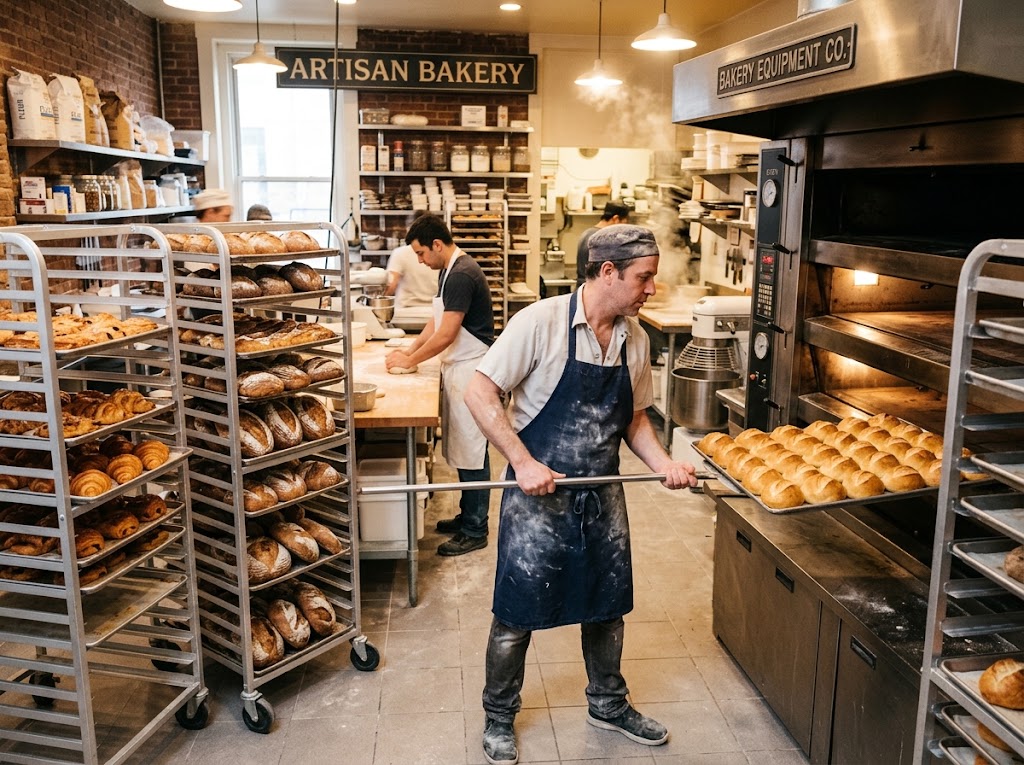
Batch production: one batch of rolls, then a batch of croissants.
Flexibility or Low Cost?
Job and batch production
- Flexible: products can be changed or customised.
- Suits small orders and variety.
- Customers get what they want.
- But: higher cost per unit.
- Skilled staff are expensive.
Flow production
- Very low cost per unit through economies of scale.
- Consistent quality from machines.
- Huge output.
- But: expensive to set up.
- Inflexible: hard to change the product, and boring, repetitive work.
Productivity
Productivity is the output produced per worker, or per machine, in a period of time.
-
Example
A bakery worker who makes 400 loaves a day is more productive than one who makes 300.
-
Why it matters
Higher productivity means more output for the same cost, so the cost of each unit falls.
-
How to raise it
Better technology, training, and motivated staff.
The Impact of Technology on Production
-
Costs
Machines are expensive to buy, but reduce labour costs and waste, so cost per unit falls over time.
-
Productivity
Robots and automated machines work faster and non-stop, producing far more output.
-
Quality
Computer-controlled machines make every product to exactly the same standard, with fewer mistakes.
-
Flexibility
Modern computer-aided machines can be reprogrammed quickly, so even flow production can offer some variety.
Case study
Morgan: Still Built by Hand
The Morgan Motor Company has made cars in Malvern, Worcestershire, since 1910. While most car makers use flow production with thousands of robots, Morgan still builds its cars largely by hand, using skilled craftspeople and, on many models, a frame made partly of ash wood. Customers can choose colours, leather and details for their own car. Output is tiny compared with a mass-market factory and each car costs far more - but customers pay for a hand-built, personalised car that flow production could never offer.
Which Process?
Choose the best production process for each and explain why: a custom-built garden shed; 50,000 identical cans of cola a day; 200 birthday cards in each of 20 designs; a portrait painting; frozen pizzas in six flavours.
1. Choose job, batch or flow.
2. Explain your choice.
A good answer shows: Job for the shed and the portrait, flow for the cola, batch for the cards and the pizzas, each with a reason about quantity, variety and cost.
Can I...?
- 1Explain what operations are.
- 2Explain job production.
- 3Explain batch production.
- 4Explain flow production.
- 5Compare the three processes.
- 6Explain productivity.
- 7Explain how technology affects costs and productivity.
- 8Explain how technology affects quality and flexibility.
Summary & Exam Focus
- Job production: unique products, high cost, very flexible.
- Batch production: groups of identical products, some flexibility.
- Flow production: identical products continuously, low unit cost, inflexible.
- Technology affects costs, productivity, quality and flexibility.
Exam focus
Explain one impact on a business of introducing automated machinery into its production. (3 marks) (3 marks)
Technology questions have two sides: high set-up costs now, lower unit costs and better quality later. Use the business's context to decide which matters more.
Key terms
The vocabulary this lesson expects you to use. Each one is linked from the first place it appears above.
- Operations
- The activities that turn inputs into goods and services.
- Job production
- Making one unique product at a time, usually to order.
- Batch production
- Making a group of identical products together before switching to another batch.
- Flow production
- Making identical products continuously on a production line.
- Productivity
- Output per worker or per machine in a period of time.
- Automation
- Using machines and computers to carry out tasks with little human input.
Downloads
Free to keep, print and annotate.
- Business operations.pptx Built from the lesson script on 28 September 2026. View
- Business operations - Completed Notes.docx The full notes for the lesson, to revise from. Built from the lesson script on 28 September 2026. View
- Business operations - Exam Questions.docx Built from the lesson script on 28 September 2026. View
Something here looks wrong?
Tell us what and we will go and look. It goes to whoever writes these pages, nobody else, and we do not ask who you are — so there is nothing to sign and nothing comes back to you.