Exam questions · Biology · Cell Structure
Animal and Plant Cells
- 7 exam questions
- 22 marks
- 8 quick checks
-
1 State [1 mark]
State the function of the nucleus.
Show answerHide answer
Model answer
It contains the genetic material (DNA) and controls the activities of the cell.
Mark scheme
- Contains DNA / controls the cell's activities — 1 mark
-
2 State [2 marks]
State two structures that are found in plant cells but not in animal cells.
Show answerHide answer
Model answer
Any two from: cell wall, chloroplasts, permanent vacuole.
Mark scheme
- Cell wall — 1 mark
- Chloroplasts — 1 mark
- Permanent vacuole — 1 mark (maximum 2 marks)
-
3 Name [4 marks]
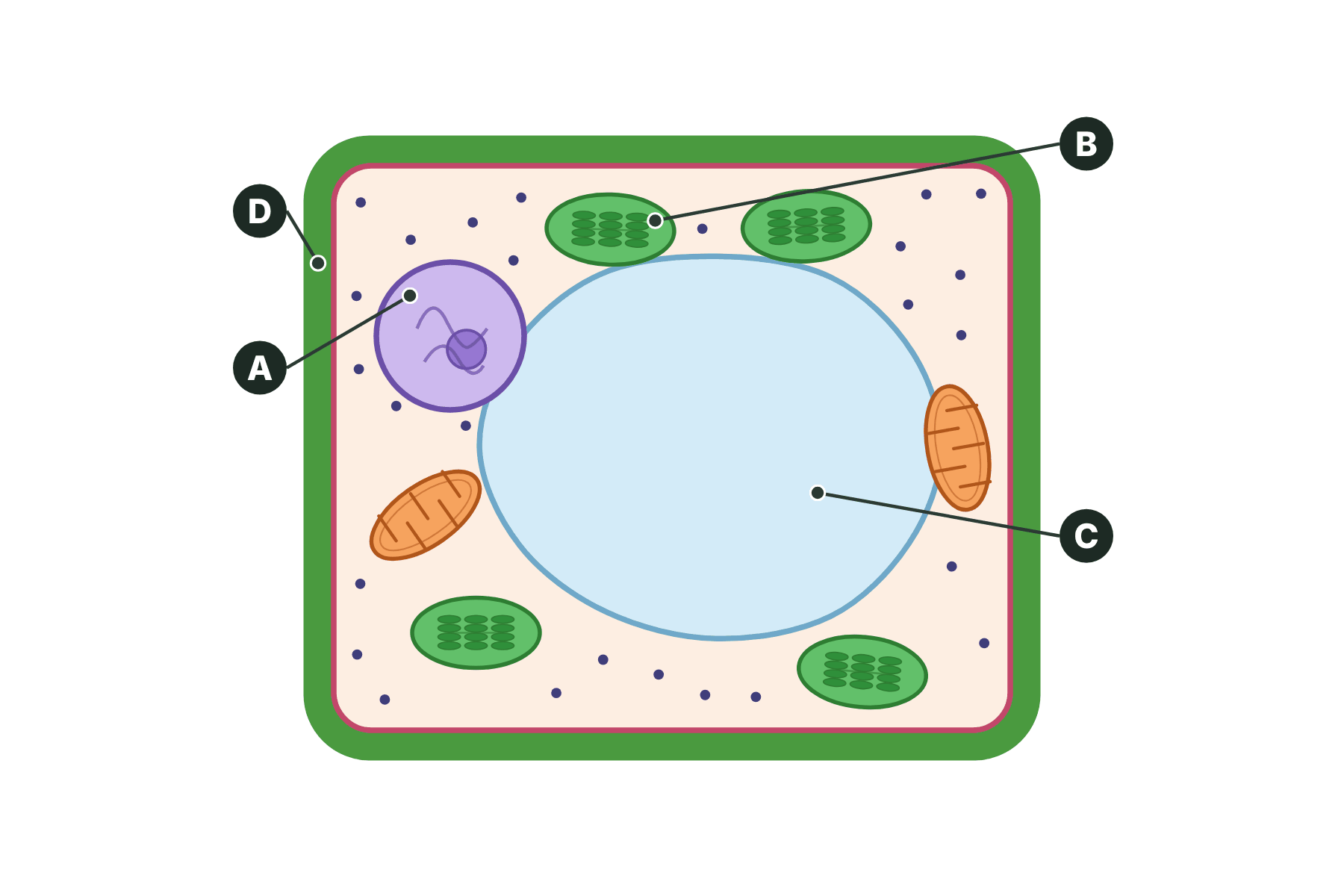
Figure 1 shows a plant cell. Name the structures labelled A, B, C and D.
Show answerHide answer
Model answer
A is the nucleus. B is a chloroplast. C is the (permanent) vacuole. D is the cell wall.
Mark scheme
- A: nucleus — 1 mark
- B: chloroplast — 1 mark
- C: (permanent) vacuole — 1 mark
- D: cell wall — 1 mark
-
4 Explain [2 marks]
Muscle cells contain many mitochondria. Explain why.
Show answerHide answer
Model answer
Mitochondria are where aerobic respiration takes place, which releases energy. Muscle cells contract, and contraction needs a lot of energy.
Mark scheme
- Mitochondria release energy in (aerobic) respiration — 1 mark
- Muscle cells need a lot of energy to contract — 1 mark
-
5 Explain [3 marks]
Palisade cells in a leaf contain many chloroplasts. Explain why.
Show answerHide answer
Model answer
Chloroplasts contain chlorophyll, which absorbs light. Light is needed for photosynthesis. Palisade cells carry out most of the leaf's photosynthesis, so more chloroplasts means more light absorbed and more glucose made.
Mark scheme
- Chloroplasts contain chlorophyll that absorbs light — 1 mark
- Light is needed for photosynthesis — 1 mark
- More chloroplasts means more photosynthesis / more glucose made — 1 mark
-
6 Describe [4 marks]
Describe the functions of the cell membrane, the cytoplasm, the cell wall and the ribosomes.
Show answerHide answer
Model answer
The cell membrane controls what passes into and out of the cell. Most chemical reactions take place in the cytoplasm. The cell wall (in plants) strengthens the cell and supports the plant. Ribosomes are where proteins are made.
Mark scheme
- Cell membrane controls what enters and leaves — 1 mark
- Cytoplasm is where chemical reactions happen — 1 mark
- Cell wall strengthens / supports — 1 mark
- Ribosomes make proteins — 1 mark
-
7 Compare [6 marks]
Compare the structure of an animal cell with the structure of a plant cell.
Show answerHide answer
Model answer
Both cells have a nucleus, cytoplasm, a cell membrane, mitochondria and ribosomes. A plant cell also has a cellulose cell wall, which gives it a fixed shape, but an animal cell has no cell wall. A plant cell often has chloroplasts, which absorb light for photosynthesis, but an animal cell has none. A plant cell has a large permanent vacuole filled with cell sap, whereas an animal cell does not.
Mark scheme
- Both have a nucleus, cytoplasm, cell membrane, mitochondria and ribosomes — 1 mark
- Plant cells have a cell wall; animal cells do not — 1 mark
- The plant cell wall is made of cellulose — 1 mark
- Plant cells have chloroplasts; animal cells do not — 1 mark
- Plant cells have a permanent vacuole; animal cells do not — 1 mark
- Links a structure to its function (for example chloroplasts absorb light for photosynthesis) — 1 mark
Quick check
-
1
Which structure is the site of aerobic respiration?
Show answerHide answer
B: Mitochondrion
Aerobic respiration takes place in the mitochondria, where energy is released from glucose.
-
2
Which structure makes proteins?
Show answerHide answer
C: Ribosome
Ribosomes join amino acids together to make proteins.
-
3
Which of these is found in a plant cell but not in an animal cell?
Show answerHide answer
D: Chloroplast
Chloroplasts are found only in plant cells (and some other organisms). Animal cells have a nucleus, mitochondria and a cell membrane.
-
4
What is the cell wall of a plant cell made from?
Show answerHide answer
A: Cellulose
Plant cell walls are made of cellulose, which is strong and rigid.
-
5
Why do root cells not have chloroplasts?
Show answerHide answer
C: There is no light underground for photosynthesis
Chloroplasts absorb light for photosynthesis, and there is no light underground.
-
6
What is the permanent vacuole filled with?
Show answerHide answer
B: Cell sap
The permanent vacuole contains cell sap, a solution of sugars and salts.
-
7
A cell needs to release a great deal of energy. Which structure would you expect it to contain a lot of?
Show answerHide answer
A: Mitochondria
Mitochondria release energy in aerobic respiration, so cells with a high energy demand have many of them.
-
8
Which statement about mitochondria is correct?
Show answerHide answer
D: They release energy by aerobic respiration
Mitochondria release energy from glucose in respiration. Energy cannot be made or destroyed, only transferred.