Exam questions · Biology · Enzymes and Digestion
Digestive Enzymes and Bile
- 9 exam questions
- 27 marks
- 10 quick checks
-
1 Name [1 mark]
Name the enzyme that breaks down starch into simple sugars.
Show answerHide answer
Model answer
Amylase.
Mark scheme
- Amylase — 1 mark
-
2 Name [3 marks]
Name the small molecules produced by the digestion of (a) protein, (b) fat and (c) starch.
Show answerHide answer
Model answer
(a) Amino acids. (b) Fatty acids and glycerol. (c) Simple sugars, such as glucose.
Mark scheme
- (a) Amino acids — 1 mark
- (b) Fatty acids and glycerol — 1 mark
- (c) Simple sugars / glucose — 1 mark
-
3 State [3 marks]
Amylase is made in three places in the body. Name the three places.
Show answerHide answer
Model answer
The salivary glands, the pancreas and the small intestine.
Mark scheme
- Salivary glands — 1 mark
- Pancreas — 1 mark
- Small intestine — 1 mark
-
4 Explain [3 marks]
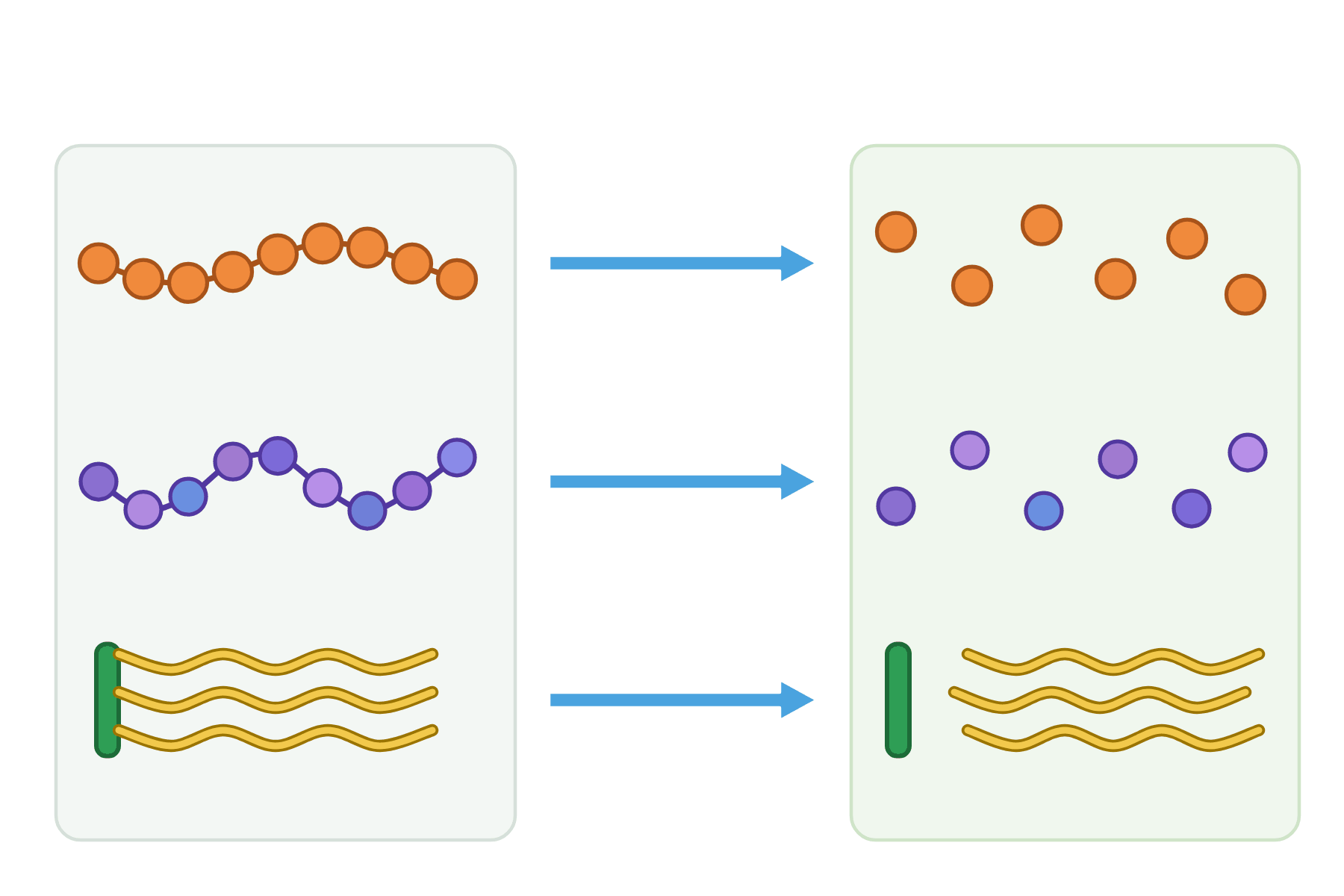
Figure 1 shows three large food molecules being broken into smaller molecules by enzymes. (a) State what the enzymes do to the large molecules. (b) Explain why the small molecules can be absorbed but the large molecules cannot.
Show answerHide answer
Model answer
(a) They break the large molecules down into small molecules. (b) The small molecules are soluble and small enough to pass through the wall of the small intestine into the blood. The large molecules are too big to pass through.
Mark scheme
- (a) Break down large molecules into small ones — 1 mark
- (b) Small molecules are soluble and can pass through the gut wall — 1 mark
- Large molecules are too big to pass through — 1 mark
-
5 Explain [2 marks]
Explain why the body needs different enzymes to digest starch, protein and fat.
Show answerHide answer
Model answer
Each enzyme is specific. The active site of an enzyme has a shape that fits only one type of molecule, and starch, protein and fat have different shapes.
Mark scheme
- Enzymes are specific / the active site fits one type of substrate — 1 mark
- Starch, protein and fat have different shapes — 1 mark
-
6 Describe [2 marks]
Describe where bile is made and where it is stored.
Show answerHide answer
Model answer
It is made in the liver and stored in the gall bladder.
Mark scheme
- Made in the liver — 1 mark
- Stored in the gall bladder — 1 mark
-
7 Explain [4 marks]
Explain the role of bile in the digestion of fat.
Show answerHide answer
Model answer
Bile is alkaline, so it neutralises the acid from the stomach. This gives the right pH for the enzymes in the small intestine to work. Bile also emulsifies the fat into small droplets. This increases the surface area, so lipase can digest the fat faster.
Mark scheme
- Bile is alkaline / neutralises stomach acid — 1 mark
- Gives the right pH for the enzymes — 1 mark
- Emulsifies fat into small droplets — 1 mark
- Larger surface area, so lipase works faster — 1 mark
-
8 Calculate [3 marks]
A cube of fat has sides of 3 cm. It is emulsified into 27 cubes with sides of 1 cm. Calculate the total surface area of the fat before and after emulsification, and say how many times bigger it became.
Show answerHide answer
Model answer
Before: 6 × 3 × 3 = 54 cm². After: each small cube has 6 × 1 × 1 = 6 cm², so 27 × 6 = 162 cm². 162 ÷ 54 = 3, so the surface area became 3 times bigger.
Mark scheme
- 54 cm² before — 1 mark
- 162 cm² after — 1 mark
- 3 times bigger — 1 mark
-
9 Describe [6 marks]
A student eats a cheese sandwich, which contains starch, protein and fat. Describe how each of these is digested. Name the enzyme and the products in each case.
Show answerHide answer
Model answer
The starch is digested by amylase, which breaks it down into simple sugars such as glucose. The protein is digested by protease, which breaks it down into amino acids. The fat is digested by lipase, which breaks it down into glycerol and fatty acids.
Mark scheme
- Starch digested by amylase — 1 mark
- To simple sugars / glucose — 1 mark
- Protein digested by protease — 1 mark
- To amino acids — 1 mark
- Fat digested by lipase — 1 mark
- To glycerol and fatty acids — 1 mark
Quick check
-
1
Which enzyme breaks down fat?
Show answerHide answer
B: Lipase
Lipase breaks down lipids (fats and oils) into glycerol and fatty acids.
-
2
Which enzyme breaks down protein into amino acids?
Show answerHide answer
D: Protease
Proteases break down proteins into amino acids.
-
3
Starch is digested into which product?
Show answerHide answer
A: Simple sugars
Starch is a carbohydrate and is broken down into simple sugars by amylase.
-
4
Which organs make lipase?
Show answerHide answer
C: The pancreas and the small intestine
Lipase is made in the pancreas and the small intestine.
-
5
Where is protease made?
Show answerHide answer
B: The stomach
Protease is made in the stomach, the pancreas and the small intestine.
-
6
What is bile?
Show answerHide answer
D: An alkaline fluid that helps to digest fat
Bile is an alkaline fluid made in the liver. It is not an enzyme.
-
7
Why must bile be alkaline?
Show answerHide answer
A: To neutralise the acid that comes from the stomach
The food from the stomach is acidic. Bile neutralises the acid, so the enzymes in the small intestine work properly.
-
8
How does emulsification make fat digestion faster?
Show answerHide answer
C: It increases the surface area of the fat
Breaking the fat into small droplets increases its surface area, so lipase has more surface to work on.
-
9
A cube of fat is cut into eight smaller cubes. What happens to the total surface area?
Show answerHide answer
B: It increases
Cutting a cube into smaller cubes increases the total surface area, and the volume stays the same.
-
10
A student says that bile digests fat because it is an enzyme. What is wrong with this?
Show answerHide answer
D: Bile is not an enzyme: it emulsifies the fat so lipase can digest it faster
Bile is not an enzyme. It emulsifies fat to give a larger surface area, and the digesting is done by lipase.