Exam questions · Biology
Transport In and Out of Cells
- 39 exam questions
- 106 marks
- 40 quick checks
Diffusion
Just this lesson-
1 Name [1 mark]
Name the waste product that diffuses from cells into the blood plasma, to be excreted by the kidneys.
Show answerHide answer
Model answer
Urea.
Mark scheme
- Urea — 1 mark
-
2 Describe [2 marks]
Describe what is meant by diffusion.
Show answerHide answer
Model answer
The spreading out of particles (of a gas or of a substance in solution), resulting in a net movement from an area of higher concentration to an area of lower concentration.
Mark scheme
- Particles spread out / move randomly — 1 mark
- Net movement from higher to lower concentration — 1 mark
-
3 Name [3 marks]
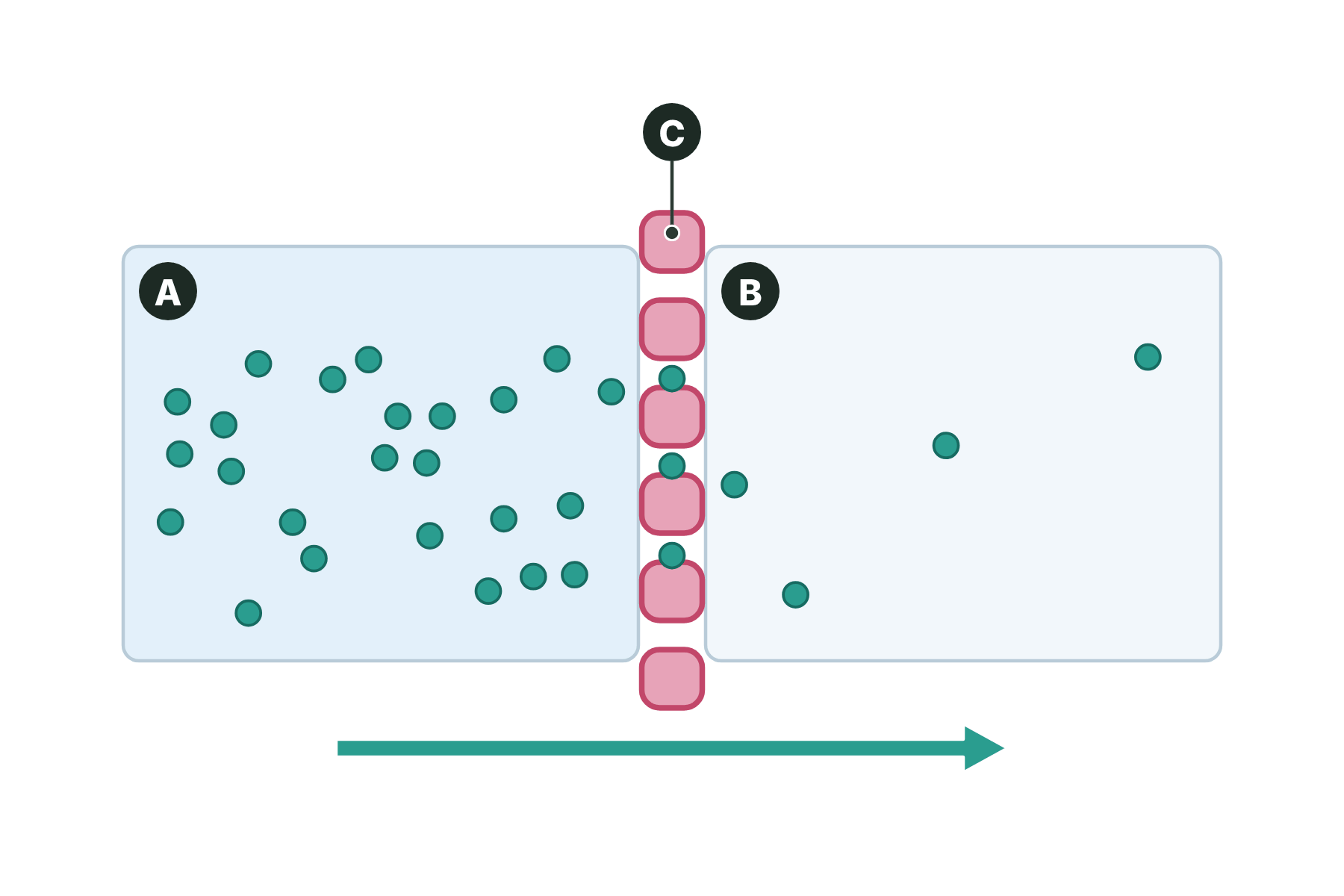
Figure 1 shows particles on both sides of a cell membrane. Name the parts labelled A, B and C.
Show answerHide answer
Model answer
A is the region of higher concentration. B is the region of lower concentration. C is the cell membrane.
Mark scheme
- A: higher concentration — 1 mark
- B: lower concentration — 1 mark
- C: (cell) membrane — 1 mark
-
4 Give [2 marks]
Give two substances that move into or out of cells by diffusion.
Show answerHide answer
Model answer
Any two from: oxygen, carbon dioxide, urea.
Mark scheme
- Oxygen — 1 mark
- Carbon dioxide — 1 mark
- Urea — 1 mark
-
5 State [3 marks]
State three factors that affect the rate of diffusion.
Show answerHide answer
Model answer
The concentration gradient (difference in concentration); the temperature; the surface area of the membrane.
Mark scheme
- Concentration gradient — 1 mark
- Temperature — 1 mark
- Surface area (of the membrane) — 1 mark
-
6 Explain [2 marks]
Explain why diffusion is faster at a higher temperature.
Show answerHide answer
Model answer
At a higher temperature the particles have more energy, so they move faster and spread out more quickly.
Mark scheme
- Particles have more energy — 1 mark
- So they move faster / spread out faster — 1 mark
-
7 Calculate [2 marks]
A cell takes in 36 micrograms of a substance by diffusion in 9 minutes. Calculate the mean rate of uptake, in micrograms per minute.
Show answerHide answer
Model answer
36 ÷ 9 = 4 micrograms per minute.
Mark scheme
- 36 ÷ 9 — 1 mark
- 4 micrograms per minute (unit needed) — 1 mark
-
8 Explain [3 marks]
Explain why oxygen diffuses from the air in the alveoli into the blood.
Show answerHide answer
Model answer
The concentration of oxygen is higher in the air in the alveoli than in the blood. So there is a net movement of oxygen from the alveoli into the blood, down the concentration gradient.
Mark scheme
- Higher concentration of oxygen in the alveoli — 1 mark
- Lower concentration of oxygen in the blood — 1 mark
- Net movement down the concentration gradient — 1 mark
-
9 Explain [6 marks]
Explain how the concentration gradient, the temperature and the surface area of the membrane each affect the rate of diffusion.
Show answerHide answer
Model answer
The greater the concentration difference between the two sides, the faster the rate of diffusion, because more particles move down the gradient than back against it. The higher the temperature, the faster the rate of diffusion, because the particles have more energy and move faster. The larger the surface area of the membrane, the faster the rate of diffusion, because more particles can cross at the same time.
Mark scheme
- Bigger concentration difference gives faster diffusion — 1 mark
- Because more particles move down the gradient — 1 mark
- Higher temperature gives faster diffusion — 1 mark
- Because particles have more energy / move faster — 1 mark
- Larger surface area gives faster diffusion — 1 mark
- Because more particles can cross at once — 1 mark
Quick check
-
1
Which statement describes diffusion?
Show answerHide answer
C: Net movement of particles from high to low concentration
Diffusion is the net movement of particles from a region of higher concentration to a region of lower concentration.
-
2
Which of these moves into cells by diffusion?
Show answerHide answer
B: Oxygen
Oxygen diffuses into respiring cells. Urea and carbon dioxide diffuse out of them.
-
3
What happens to the rate of diffusion if the temperature is increased?
Show answerHide answer
A: It increases
The particles have more energy and move faster, so diffusion is faster.
-
4
Which change would make diffusion across a membrane slower?
Show answerHide answer
D: A smaller membrane
A smaller surface area lets fewer particles cross at once, so the rate falls.
-
5
A cell takes in 50 units of a substance in 10 minutes. What is the rate of uptake?
Show answerHide answer
B: 5 units per minute
Rate = 50 ÷ 10 = 5 units per minute.
-
6
Where does urea diffuse to from the cells?
Show answerHide answer
C: Into the blood plasma
Urea diffuses from the cells into the blood plasma, and the kidneys then excrete it.
-
7
Does diffusion need energy from respiration?
Show answerHide answer
A: No
No. The particles move on their own, so the cell does not have to use energy.
-
8
Why does carbon dioxide diffuse out of respiring cells?
Show answerHide answer
D: Its concentration is higher inside the cell
Respiration makes carbon dioxide, so its concentration is higher inside the cell than outside, and it moves down the gradient.
-
9
What does a steeper concentration gradient do to the rate of diffusion?
Show answerHide answer
B: It makes it faster
A bigger difference in concentration means more particles move down the gradient, so diffusion is faster.
-
10
Once the particles are evenly spread out, what is true?
Show answerHide answer
C: There is no net movement
The particles are still moving, but as many move one way as the other, so there is no net movement.
Osmosis
Just this lesson-
1 Name [1 mark]
Name the type of membrane through which osmosis takes place.
Show answerHide answer
Model answer
A partially permeable membrane.
Mark scheme
- Partially permeable (membrane) — 1 mark
-
2 State [2 marks]
State what is meant by osmosis.
Show answerHide answer
Model answer
The diffusion of water from a dilute solution to a concentrated solution through a partially permeable membrane.
Mark scheme
- Diffusion of water from a dilute to a concentrated solution — 1 mark
- Through a partially permeable membrane — 1 mark
-
3 Name [3 marks]
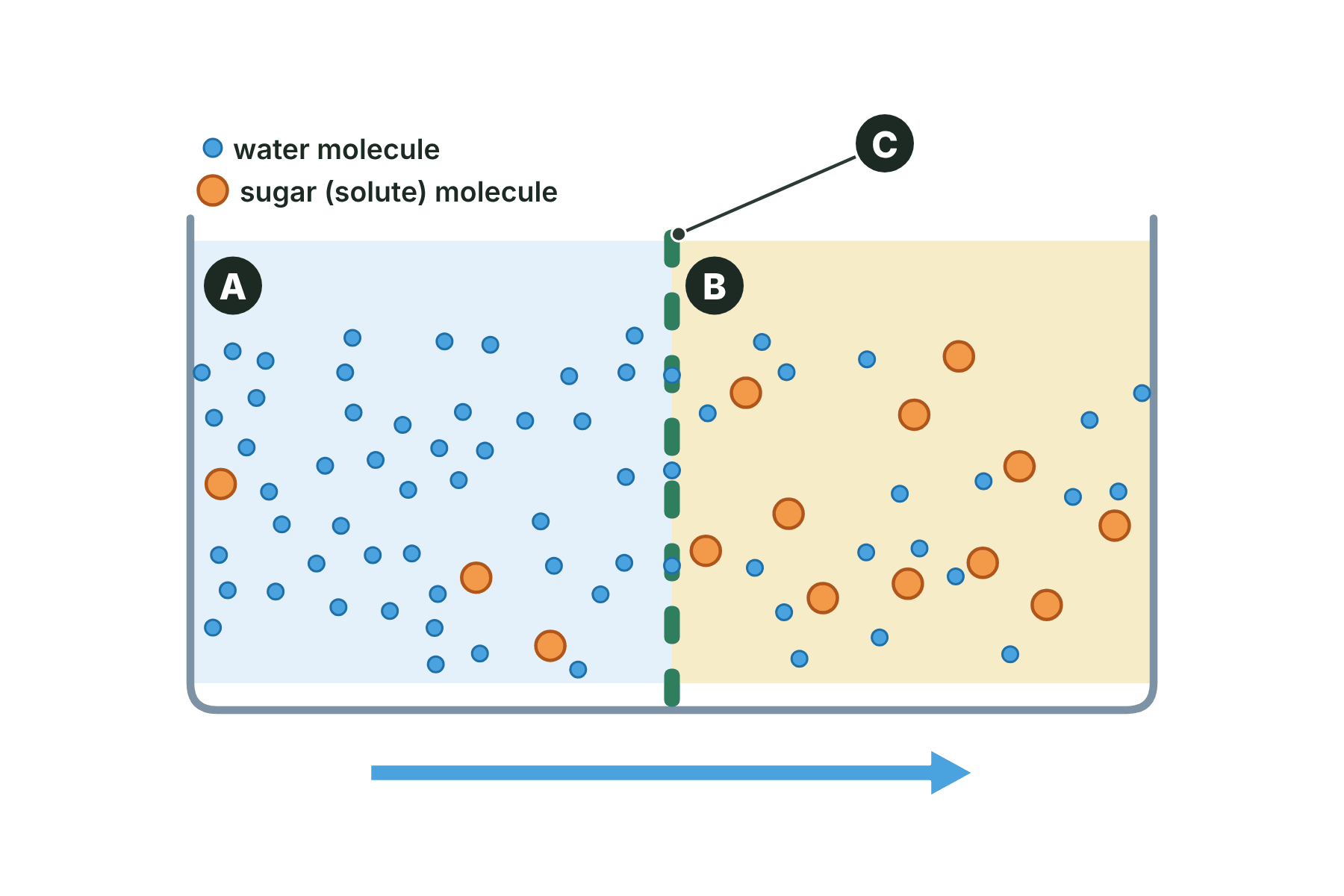
Figure 1 shows two solutions separated by a membrane. Name the parts labelled A, B and C.
Show answerHide answer
Model answer
A is the dilute solution. B is the concentrated solution. C is the partially permeable membrane.
Mark scheme
- A: dilute solution — 1 mark
- B: concentrated solution — 1 mark
- C: partially permeable membrane — 1 mark
-
4 Explain [2 marks]
In Figure 1, the sugar molecules do not move across the membrane. Explain why.
Show answerHide answer
Model answer
The membrane is only partially permeable. The sugar molecules are too large to pass through its tiny holes, but the small water molecules can.
Mark scheme
- Membrane is partially permeable — 1 mark
- Sugar molecules are too big to pass through — 1 mark
-
5 Describe [2 marks]
A plant cell is placed in pure water. Describe what happens to the cell.
Show answerHide answer
Model answer
Water enters the cell by osmosis, and the cell becomes turgid (swollen and firm).
Mark scheme
- Water enters by osmosis — 1 mark
- Cell becomes turgid / swollen and firm — 1 mark
-
6 Explain [3 marks]
Explain why a red blood cell placed in pure water may burst, but a plant cell does not.
Show answerHide answer
Model answer
Water enters both cells by osmosis. A red blood cell has no cell wall, so nothing stops it swelling, and it may burst. A plant cell has a strong cell wall, which stops it bursting.
Mark scheme
- Water enters by osmosis — 1 mark
- Red blood cell has no cell wall, so it may burst — 1 mark
- Plant cell wall prevents bursting — 1 mark
-
7 Explain [3 marks]
A plant that has not been watered for several days wilts. Use ideas about osmosis to explain why.
Show answerHide answer
Model answer
The soil water becomes more concentrated, so water leaves the plant cells by osmosis. The cells lose water and go flaccid, so they can no longer hold the leaves and stems up and the plant wilts.
Mark scheme
- Water leaves the cells by osmosis — 1 mark
- Cells become flaccid / lose firmness — 1 mark
- So stems and leaves are no longer supported (wilting) — 1 mark
-
8 Explain [2 marks]
Solution P has a concentration of 0.2 mol/dm³ and solution Q has a concentration of 0.6 mol/dm³. They are separated by a partially permeable membrane. State the direction in which water moves and explain why.
Show answerHide answer
Model answer
Water moves from P to Q. P is the more dilute solution, and water moves from a dilute solution to a concentrated solution by osmosis.
Mark scheme
- From P to Q (into the more concentrated solution) — 1 mark
- Water moves from dilute to concentrated by osmosis — 1 mark
-
9 Explain [4 marks]
A student puts a red blood cell into a very concentrated salt solution. Describe and explain what happens to the cell.
Show answerHide answer
Model answer
The salt solution is more concentrated than the cytoplasm of the red blood cell. Water leaves the cell by osmosis, moving from the more dilute cytoplasm to the more concentrated solution. The cell loses water, so it shrinks and shrivels.
Mark scheme
- Solution is more concentrated than the cell — 1 mark
- Water leaves the cell by osmosis — 1 mark
- From dilute (cell) to concentrated (outside) — 1 mark
- Cell shrinks / shrivels — 1 mark
-
10 Describe and explain [6 marks]
Describe and explain what happens to plant cells when they are placed in (a) a dilute solution and (b) a concentrated solution.
Show answerHide answer
Model answer
In a dilute solution, the solution outside is more dilute than the cell sap, so water enters the cells by osmosis. The vacuole swells and the cell becomes turgid. The cell wall stops it bursting. In a concentrated solution, the solution outside is more concentrated than the cell sap, so water leaves the cells by osmosis. The vacuole shrinks and the cell becomes flaccid. If a lot of water is lost, the membrane pulls away from the cell wall.
Mark scheme
- Dilute: water enters by osmosis — 1 mark
- Cell becomes turgid / swollen and firm — 1 mark
- Cell wall prevents bursting — 1 mark
- Concentrated: water leaves by osmosis — 1 mark
- Cell becomes flaccid / soft — 1 mark
- Reason: outside solution is more concentrated than the cell sap — 1 mark
Quick check
-
1
Osmosis is the movement of which substance?
Show answerHide answer
A: Water
Osmosis is the diffusion of water through a partially permeable membrane.
-
2
In which direction does water move by osmosis?
Show answerHide answer
C: From a dilute solution to a concentrated solution
Water moves from a dilute solution to a concentrated solution through a partially permeable membrane.
-
3
A plant cell is placed in a very dilute solution. What happens?
Show answerHide answer
B: It becomes turgid
Water enters by osmosis and the cell becomes turgid. The cell wall stops it bursting.
-
4
What does flaccid mean?
Show answerHide answer
D: Soft and limp from losing water
A flaccid cell has lost water and is soft and limp.
-
5
Why does a red blood cell burst in pure water, but a plant cell does not?
Show answerHide answer
C: A red blood cell has no cell wall
A red blood cell has no cell wall, so it cannot resist the pressure as water enters. A plant cell has a strong cell wall.
-
6
Two solutions of 0.1 and 0.5 mol/dm³ are separated by a partially permeable membrane. Which way does water move?
Show answerHide answer
A: From 0.1 into 0.5
Water moves from the more dilute solution (0.1) to the more concentrated one (0.5).
-
7
A cell is in a solution of the same concentration as its contents. What happens to the water?
Show answerHide answer
B: There is no net movement
There is no net movement of water. Water molecules still move both ways, but equally.
-
8
Why does a plant wilt when it is short of water?
Show answerHide answer
D: Its cells become flaccid
Its cells lose water by osmosis and become flaccid, so they no longer hold the plant up.
-
9
What does a partially permeable membrane do?
Show answerHide answer
A: Lets some substances through but not others
It lets small molecules such as water through but stops larger molecules.
-
10
A student says: "Water moves by osmosis to where there is more water." What is wrong with this?
Show answerHide answer
C: It is the wrong way round: water moves from more water to less
Water moves from where there is more water (a dilute solution) to where there is less (a concentrated solution).
Investigating Osmosis in Plant Tissue
Just this lesson-
1 State [2 marks]
State two variables that should be controlled in the investigation.
Show answerHide answer
Model answer
Any two from: the length (and width) of the potato cylinders; the volume of the solutions; the time the cylinders are left in the solutions; the temperature; the type of potato.
Mark scheme
- Size / length of cylinder — 1 mark
- Volume of solution — 1 mark
- Time in solution — 1 mark
- Temperature / type of potato — 1 mark
-
2 Explain [2 marks]
Explain why the potato cylinders are blotted dry before their final mass is measured.
Show answerHide answer
Model answer
To remove solution from the surface of the cylinder. Any left on the surface would add mass, so the result would not be due only to osmosis.
Mark scheme
- To remove liquid from the surface — 1 mark
- Because it would add extra mass / give an inaccurate result — 1 mark
-
3 Calculate [2 marks]
A potato cylinder has a mass of 2.50 g at the start and 2.85 g at the end. Calculate the percentage change in mass.
Show answerHide answer
Model answer
(2.85 − 2.50) ÷ 2.50 × 100 = +14%.
Mark scheme
- 0.35 ÷ 2.50 — 1 mark
- +14 (%) — 1 mark
-
4 Calculate [3 marks]
A potato cylinder has a mass of 3.20 g at the start and 2.72 g at the end. Calculate the percentage change in mass.
Show answerHide answer
Model answer
(2.72 − 3.20) ÷ 3.20 × 100 = −15%.
Mark scheme
- Change = −0.48 g — 1 mark
- −0.48 ÷ 3.20 × 100 — 1 mark
- −15 (%) — 1 mark
-
5 Explain [3 marks]
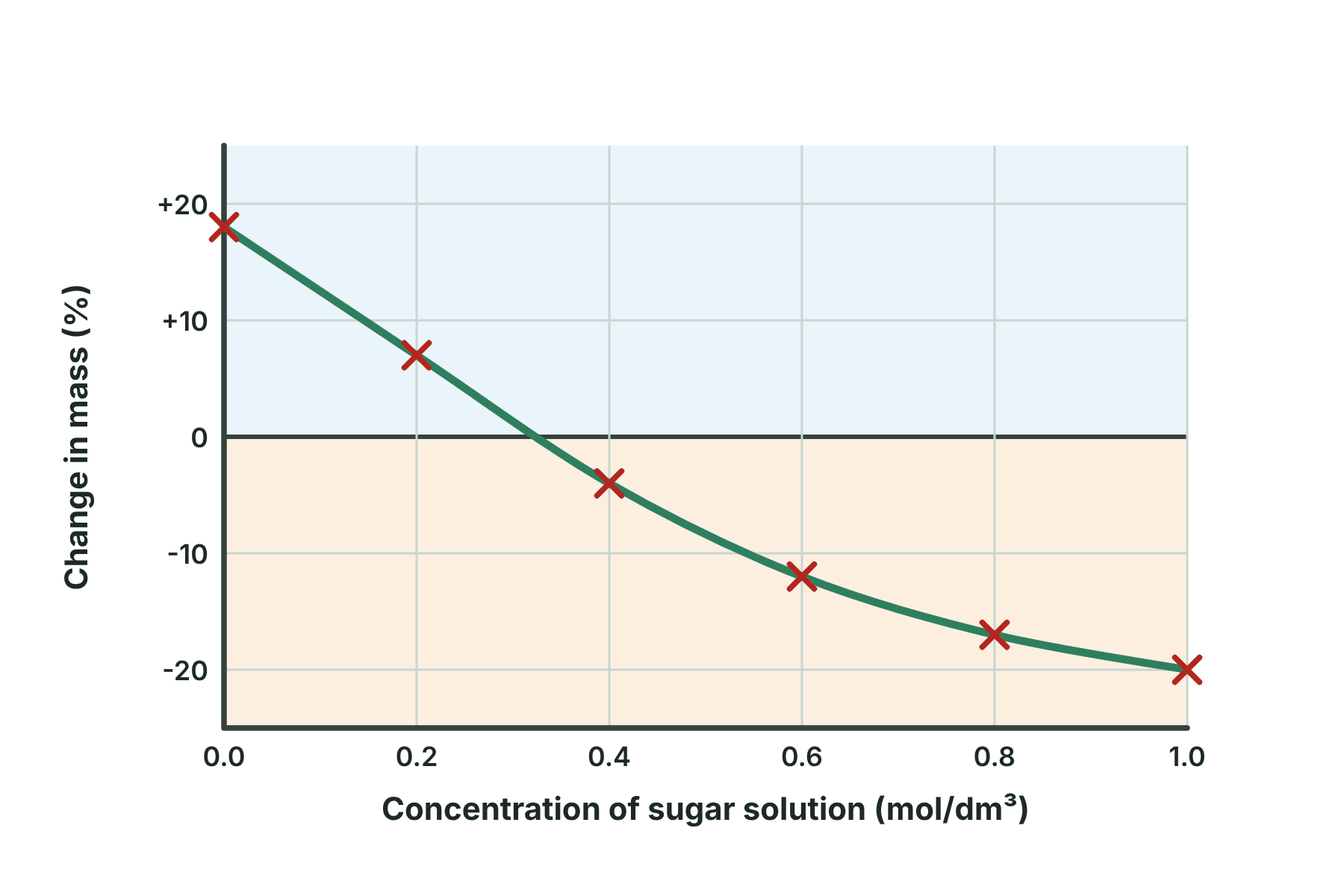
Figure 1 shows the results of an investigation into the effect of sugar concentration on potato cylinders. Estimate the concentration at which there is no change in mass, and explain what this tells you.
Show answerHide answer
Model answer
About 0.33 mol/dm³ (accept 0.30 to 0.35), where the line crosses 0% change. At this concentration the solution is the same as the concentration of the potato cells, so there is no net movement of water.
Mark scheme
- 0.30 to 0.35 mol/dm³ — 1 mark
- Same concentration as the potato cells — 1 mark
- So no net movement of water by osmosis — 1 mark
-
6 Use the graph [2 marks]
Use Figure 1 to give the percentage change in mass in the solution of concentration 0.6 mol/dm³, and say what this shows about the movement of water.
Show answerHide answer
Model answer
−12% (accept −11 to −13). A loss of mass shows that water moved out of the potato by osmosis.
Mark scheme
- −12% — 1 mark
- Water left the potato (by osmosis) — 1 mark
-
7 Explain [2 marks]
The potato cylinders in the most concentrated solutions lost mass. Explain why.
Show answerHide answer
Model answer
The solution was more concentrated than the cell sap in the potato. Water moved out of the potato cells into the solution by osmosis, so the mass fell.
Mark scheme
- Solution more concentrated than the potato cell sap — 1 mark
- Water left the cells by osmosis — 1 mark
-
8 Explain [2 marks]
A student calculates the percentage change in mass for each cylinder instead of just the change in mass. Explain why.
Show answerHide answer
Model answer
The cylinders do not all start with exactly the same mass, so a percentage of the starting mass allows a fair comparison.
Mark scheme
- Cylinders have different starting masses — 1 mark
- Percentage change allows a fair comparison — 1 mark
-
9 Suggest [2 marks]
Suggest two ways in which the student could make the results more reliable.
Show answerHide answer
Model answer
Repeat the investigation with several cylinders in each solution and calculate a mean; check for anomalous results; keep the control variables the same each time.
Mark scheme
- Repeat and calculate a mean — 1 mark
- Spot and deal with any anomalous results / control variables carefully — 1 mark
-
10 Describe [6 marks]
Describe how you would carry out an investigation into the effect of sugar concentration on the mass of potato cylinders.
Show answerHide answer
Model answer
Cut cylinders of potato of the same length with a cork borer. Measure the mass of each cylinder. Put the same volume of different concentrations of sugar solution into test tubes, including pure water. Put one cylinder in each tube and leave them for the same length of time at the same temperature. Take the cylinders out, blot them dry and measure the mass of each again. Calculate the percentage change in mass for each, and repeat the investigation to calculate a mean.
Mark scheme
- Cut identical cylinders of potato — 1 mark
- Measure the starting mass — 1 mark
- Same volume of different concentrations of solution — 1 mark
- Same time (and temperature) in the solutions — 1 mark
- Blot dry and measure the final mass — 1 mark
- Calculate the percentage change / repeat and take a mean — 1 mark
Quick check
-
1
What is the independent variable in the potato investigation?
Show answerHide answer
B: The concentration of the solution
The independent variable is the one you change: the concentration of the solution.
-
2
What is the dependent variable?
Show answerHide answer
A: The percentage change in mass
The dependent variable is what you measure: the percentage change in mass of the potato.
-
3
A potato cylinder gains mass in a solution. What does this show?
Show answerHide answer
C: The solution was more dilute than the cell sap
The potato gained water by osmosis, so the solution was more dilute than the potato cell sap.
-
4
A cylinder goes from 2.00 g to 1.80 g. What is the percentage change in mass?
Show answerHide answer
D: −10%
The change is −0.20 g. Dividing by the start mass gives −0.1, so the change is −10%.
-
5
Why is the surface of each cylinder blotted dry?
Show answerHide answer
B: To remove liquid that would add extra mass
Solution left on the surface would add mass and affect the result.
-
6
On the graph, where does the line cross zero change?
Show answerHide answer
A: At the concentration of the potato cell sap
This is the concentration at which the solution matches the potato cell sap, so there is no net movement of water.
-
7
Which would make the results more reliable?
Show answerHide answer
C: Repeating and calculating a mean
Repeating the test and calculating a mean reduces the effect of random errors and anomalies.
-
8
Which of these is a control variable?
Show answerHide answer
D: The volume of the solution
The volume of the solution has to be the same in every tube. The concentration is what is changed, and the mass is what is measured.
-
9
Why is pure water used as one of the solutions?
Show answerHide answer
A: It is the most dilute solution and gives the zero concentration
Pure water is the most dilute solution, so it shows the biggest gain in mass, and gives a zero point on the concentration scale.
-
10
A student finds the line crosses zero at 0.3 mol/dm³ and wants a more accurate value. What should they do?
Show answerHide answer
B: Use extra solutions with concentrations close to 0.3
Using more solutions close to 0.3, such as 0.25, 0.30 and 0.35 mol/dm³, narrows down where the line crosses zero.
Active Transport
Just this lesson-
1 State [1 mark]
State what is needed for active transport.
Show answerHide answer
Model answer
Energy (from respiration).
Mark scheme
- Energy from respiration — 1 mark
-
2 Describe [2 marks]
Describe what is meant by active transport.
Show answerHide answer
Model answer
The movement of substances from a more dilute solution to a more concentrated solution (against a concentration gradient), using energy from respiration.
Mark scheme
- Movement from dilute to concentrated / against a concentration gradient — 1 mark
- Needs energy from respiration — 1 mark
-
3 Name [4 marks]
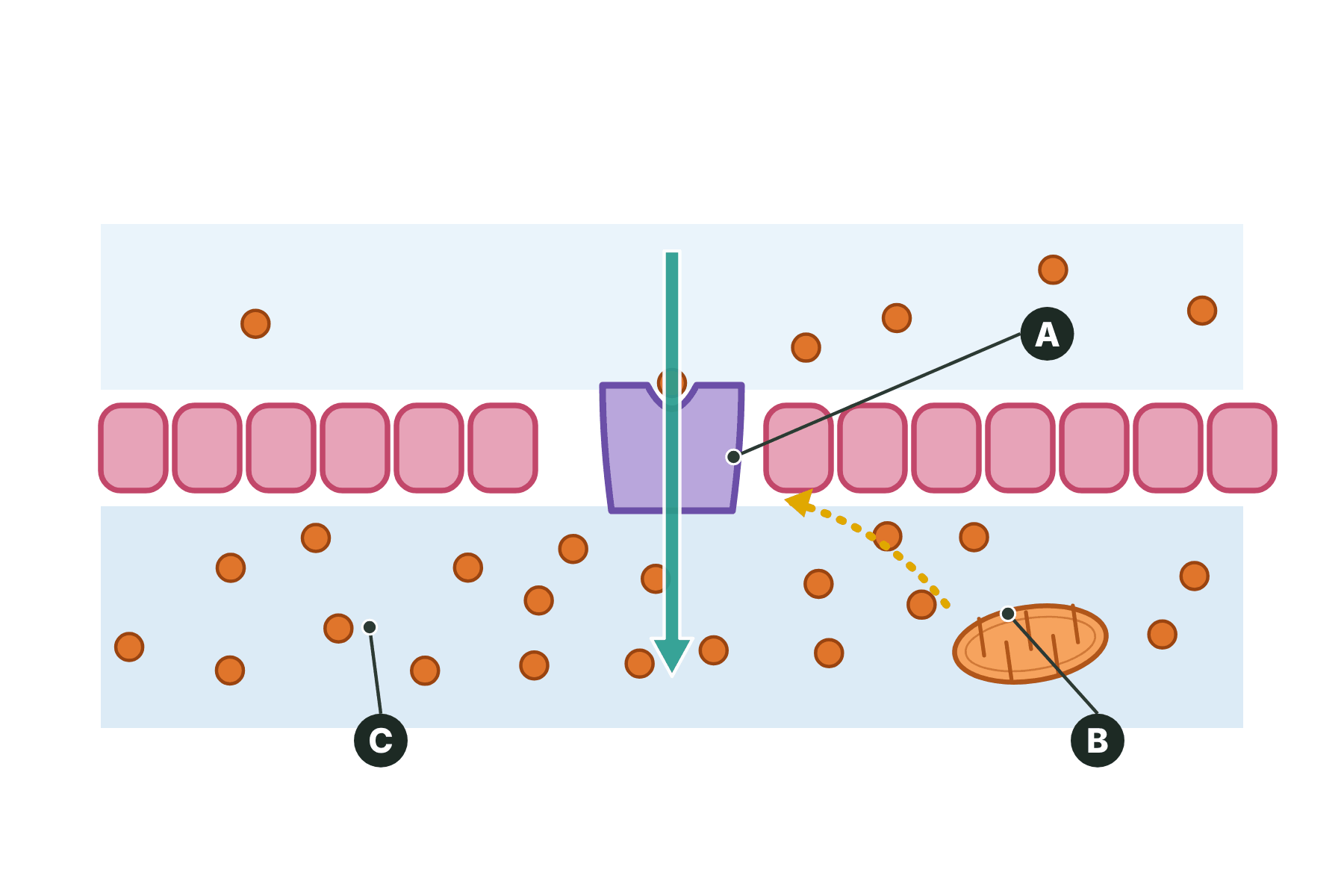
Figure 1 shows ions being taken into a cell. A is a carrier protein. Name the structure B, name the process shown, and explain how you know it is that process.
Show answerHide answer
Model answer
B is a mitochondrion. The process is active transport. The ions move from a lower to a higher concentration, which is against the concentration gradient, and the mitochondrion supplies energy from respiration, which diffusion would not need.
Mark scheme
- B: mitochondrion — 1 mark
- Active transport — 1 mark
- Ions move from lower to higher concentration / against the gradient — 1 mark
- Needs energy from respiration — 1 mark
-
4 Give [1 mark]
Give one example of active transport in a plant.
Show answerHide answer
Model answer
Mineral ions being taken into root hair cells from the soil.
Mark scheme
- Mineral ions into root hair cells — 1 mark
-
5 Explain [3 marks]
Explain why root hair cells take up mineral ions by active transport and not by diffusion.
Show answerHide answer
Model answer
The concentration of mineral ions in the soil solution is lower than in the root hair cell. Diffusion only moves substances from a higher to a lower concentration. Active transport can move ions against the concentration gradient, using energy.
Mark scheme
- Lower concentration of ions in the soil than in the cell — 1 mark
- Diffusion would not move ions into the cell / only goes down the gradient — 1 mark
- Active transport moves them against the gradient using energy — 1 mark
-
6 Explain [2 marks]
Sugar is absorbed from the gut into the blood by active transport. Explain why the sugar must be absorbed.
Show answerHide answer
Model answer
Sugar molecules are used for cell respiration, so the body needs to absorb them.
Mark scheme
- Sugar is used for respiration — 1 mark
- To release energy for the body's cells — 1 mark
-
7 Explain [3 marks]
Root hair cells contain large numbers of mitochondria. Explain why.
Show answerHide answer
Model answer
Mitochondria release energy by respiration. Root hair cells take up mineral ions by active transport, which needs energy. So they need many mitochondria to supply it.
Mark scheme
- Mitochondria release energy / respiration — 1 mark
- Active transport needs energy — 1 mark
- Root hair cells take in ions by active transport — 1 mark
-
8 Explain [3 marks]
A farmer notices that plants in waterlogged soil take up fewer mineral ions, although the soil contains plenty. Use ideas about active transport to explain why.
Show answerHide answer
Model answer
Waterlogged soil contains little oxygen, so the root cells respire less. They release less energy, and active transport of mineral ions needs energy. So fewer ions are taken up.
Mark scheme
- Little oxygen in the waterlogged soil, so less respiration — 1 mark
- Less energy released — 1 mark
- Active transport of ions needs energy, so less uptake — 1 mark
-
9 Compare [3 marks]
Give three differences between diffusion and active transport.
Show answerHide answer
Model answer
Diffusion moves substances from a higher to a lower concentration, but active transport moves them from a lower to a higher concentration. Diffusion does not need energy, but active transport needs energy from respiration. Diffusion goes down the concentration gradient, but active transport goes against it.
Mark scheme
- Direction: high to low (diffusion) compared with low to high (active transport) — 1 mark
- Diffusion needs no energy, active transport does — 1 mark
- Down the gradient compared with against the gradient — 1 mark
-
10 Compare [6 marks]
Compare diffusion, osmosis and active transport.
Show answerHide answer
Model answer
Diffusion is the net movement of particles from a higher to a lower concentration, down the concentration gradient, and needs no energy. Osmosis is the diffusion of water only, from a dilute solution to a concentrated solution through a partially permeable membrane, and needs no energy. Active transport moves substances from a more dilute to a more concentrated solution, against a concentration gradient, and needs energy from respiration.
Mark scheme
- Diffusion: particles from high to low concentration — 1 mark
- Diffusion needs no energy — 1 mark
- Osmosis: water only — 1 mark
- Osmosis: dilute to concentrated through a partially permeable membrane — 1 mark
- Active transport: dilute to concentrated (against the gradient) — 1 mark
- Active transport needs energy from respiration — 1 mark
Quick check
-
1
What does active transport need?
Show answerHide answer
C: Energy from respiration
Active transport needs energy from respiration, because it moves substances against a concentration gradient.
-
2
In which direction does active transport move substances?
Show answerHide answer
A: From low concentration to high concentration
Active transport moves substances from a more dilute to a more concentrated solution, against the concentration gradient.
-
3
Which structures supply the energy for active transport?
Show answerHide answer
D: Mitochondria
Mitochondria release energy from respiration, so cells that do a lot of active transport have many of them.
-
4
Which of these is an example of active transport?
Show answerHide answer
B: Mineral ions moving into root hair cells
Root hair cells take in mineral ions from the very dilute soil solution by active transport.
-
5
Why do plants need mineral ions?
Show answerHide answer
A: For healthy growth
Plants need ions for healthy growth, for example nitrate to make proteins and magnesium to make chlorophyll.
-
6
Sugar concentration is lower in the gut than in the blood. How does sugar move into the blood?
Show answerHide answer
C: By active transport
It has to move against the concentration gradient, so it is absorbed by active transport.
-
7
Which process needs no energy from the cell?
Show answerHide answer
D: Diffusion and osmosis
Diffusion and osmosis are passive processes, which move things down a gradient without energy from the cell.
-
8
What happens to active transport if respiration in a cell stops?
Show answerHide answer
B: It stops or slows down
Active transport needs energy from respiration, so it stops or slows down.
-
9
Which statement about osmosis is correct?
Show answerHide answer
A: It needs no energy and moves only water
Osmosis is the diffusion of water from a dilute solution to a concentrated solution through a partially permeable membrane. It needs no energy.
-
10
A cell takes in a substance from a place where it is at a lower concentration. Which is the most likely process?
Show answerHide answer
C: Active transport
Moving a substance from a lower to a higher concentration is against the gradient, so it must be active transport.