Exam questions · Biology · Transport In and Out of Cells
Osmosis
- 10 exam questions
- 28 marks
- 10 quick checks
-
1 Name [1 mark]
Name the type of membrane through which osmosis takes place.
Show answerHide answer
Model answer
A partially permeable membrane.
Mark scheme
- Partially permeable (membrane) — 1 mark
-
2 State [2 marks]
State what is meant by osmosis.
Show answerHide answer
Model answer
The diffusion of water from a dilute solution to a concentrated solution through a partially permeable membrane.
Mark scheme
- Diffusion of water from a dilute to a concentrated solution — 1 mark
- Through a partially permeable membrane — 1 mark
-
3 Name [3 marks]
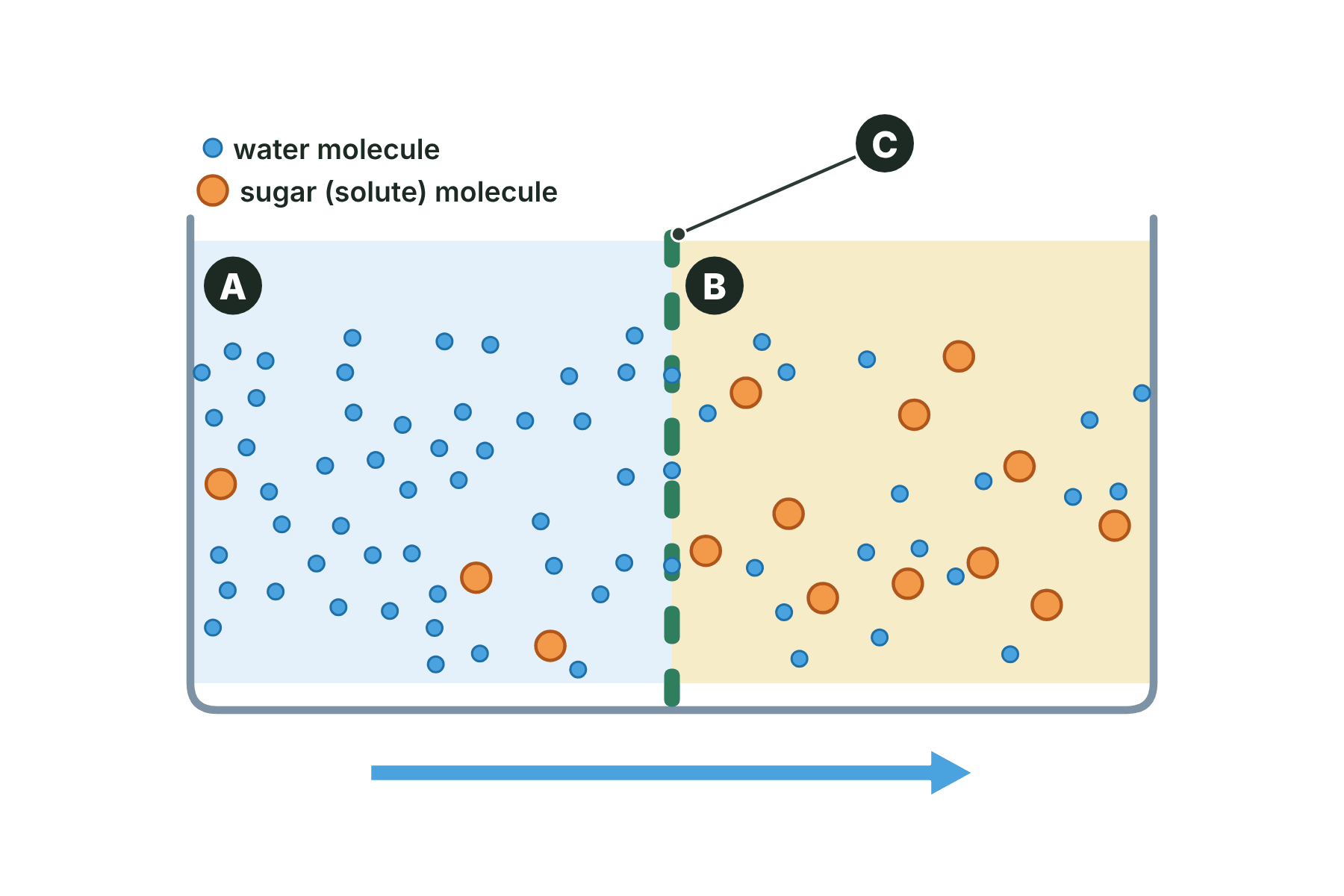
Figure 1 shows two solutions separated by a membrane. Name the parts labelled A, B and C.
Show answerHide answer
Model answer
A is the dilute solution. B is the concentrated solution. C is the partially permeable membrane.
Mark scheme
- A: dilute solution — 1 mark
- B: concentrated solution — 1 mark
- C: partially permeable membrane — 1 mark
-
4 Explain [2 marks]
In Figure 1, the sugar molecules do not move across the membrane. Explain why.
Show answerHide answer
Model answer
The membrane is only partially permeable. The sugar molecules are too large to pass through its tiny holes, but the small water molecules can.
Mark scheme
- Membrane is partially permeable — 1 mark
- Sugar molecules are too big to pass through — 1 mark
-
5 Describe [2 marks]
A plant cell is placed in pure water. Describe what happens to the cell.
Show answerHide answer
Model answer
Water enters the cell by osmosis, and the cell becomes turgid (swollen and firm).
Mark scheme
- Water enters by osmosis — 1 mark
- Cell becomes turgid / swollen and firm — 1 mark
-
6 Explain [3 marks]
Explain why a red blood cell placed in pure water may burst, but a plant cell does not.
Show answerHide answer
Model answer
Water enters both cells by osmosis. A red blood cell has no cell wall, so nothing stops it swelling, and it may burst. A plant cell has a strong cell wall, which stops it bursting.
Mark scheme
- Water enters by osmosis — 1 mark
- Red blood cell has no cell wall, so it may burst — 1 mark
- Plant cell wall prevents bursting — 1 mark
-
7 Explain [3 marks]
A plant that has not been watered for several days wilts. Use ideas about osmosis to explain why.
Show answerHide answer
Model answer
The soil water becomes more concentrated, so water leaves the plant cells by osmosis. The cells lose water and go flaccid, so they can no longer hold the leaves and stems up and the plant wilts.
Mark scheme
- Water leaves the cells by osmosis — 1 mark
- Cells become flaccid / lose firmness — 1 mark
- So stems and leaves are no longer supported (wilting) — 1 mark
-
8 Explain [2 marks]
Solution P has a concentration of 0.2 mol/dm³ and solution Q has a concentration of 0.6 mol/dm³. They are separated by a partially permeable membrane. State the direction in which water moves and explain why.
Show answerHide answer
Model answer
Water moves from P to Q. P is the more dilute solution, and water moves from a dilute solution to a concentrated solution by osmosis.
Mark scheme
- From P to Q (into the more concentrated solution) — 1 mark
- Water moves from dilute to concentrated by osmosis — 1 mark
-
9 Explain [4 marks]
A student puts a red blood cell into a very concentrated salt solution. Describe and explain what happens to the cell.
Show answerHide answer
Model answer
The salt solution is more concentrated than the cytoplasm of the red blood cell. Water leaves the cell by osmosis, moving from the more dilute cytoplasm to the more concentrated solution. The cell loses water, so it shrinks and shrivels.
Mark scheme
- Solution is more concentrated than the cell — 1 mark
- Water leaves the cell by osmosis — 1 mark
- From dilute (cell) to concentrated (outside) — 1 mark
- Cell shrinks / shrivels — 1 mark
-
10 Describe and explain [6 marks]
Describe and explain what happens to plant cells when they are placed in (a) a dilute solution and (b) a concentrated solution.
Show answerHide answer
Model answer
In a dilute solution, the solution outside is more dilute than the cell sap, so water enters the cells by osmosis. The vacuole swells and the cell becomes turgid. The cell wall stops it bursting. In a concentrated solution, the solution outside is more concentrated than the cell sap, so water leaves the cells by osmosis. The vacuole shrinks and the cell becomes flaccid. If a lot of water is lost, the membrane pulls away from the cell wall.
Mark scheme
- Dilute: water enters by osmosis — 1 mark
- Cell becomes turgid / swollen and firm — 1 mark
- Cell wall prevents bursting — 1 mark
- Concentrated: water leaves by osmosis — 1 mark
- Cell becomes flaccid / soft — 1 mark
- Reason: outside solution is more concentrated than the cell sap — 1 mark
Quick check
-
1
Osmosis is the movement of which substance?
Show answerHide answer
A: Water
Osmosis is the diffusion of water through a partially permeable membrane.
-
2
In which direction does water move by osmosis?
Show answerHide answer
C: From a dilute solution to a concentrated solution
Water moves from a dilute solution to a concentrated solution through a partially permeable membrane.
-
3
A plant cell is placed in a very dilute solution. What happens?
Show answerHide answer
B: It becomes turgid
Water enters by osmosis and the cell becomes turgid. The cell wall stops it bursting.
-
4
What does flaccid mean?
Show answerHide answer
D: Soft and limp from losing water
A flaccid cell has lost water and is soft and limp.
-
5
Why does a red blood cell burst in pure water, but a plant cell does not?
Show answerHide answer
C: A red blood cell has no cell wall
A red blood cell has no cell wall, so it cannot resist the pressure as water enters. A plant cell has a strong cell wall.
-
6
Two solutions of 0.1 and 0.5 mol/dm³ are separated by a partially permeable membrane. Which way does water move?
Show answerHide answer
A: From 0.1 into 0.5
Water moves from the more dilute solution (0.1) to the more concentrated one (0.5).
-
7
A cell is in a solution of the same concentration as its contents. What happens to the water?
Show answerHide answer
B: There is no net movement
There is no net movement of water. Water molecules still move both ways, but equally.
-
8
Why does a plant wilt when it is short of water?
Show answerHide answer
D: Its cells become flaccid
Its cells lose water by osmosis and become flaccid, so they no longer hold the plant up.
-
9
What does a partially permeable membrane do?
Show answerHide answer
A: Lets some substances through but not others
It lets small molecules such as water through but stops larger molecules.
-
10
A student says: "Water moves by osmosis to where there is more water." What is wrong with this?
Show answerHide answer
C: It is the wrong way round: water moves from more water to less
Water moves from where there is more water (a dilute solution) to where there is less (a concentrated solution).