Exam questions · Maths
Further Trigonometry
- 30 exam questions
- 97 marks
- 45 quick checks
Trigonometric Graphs and Exact Values
Just this lesson-
1 Solve [2 marks]
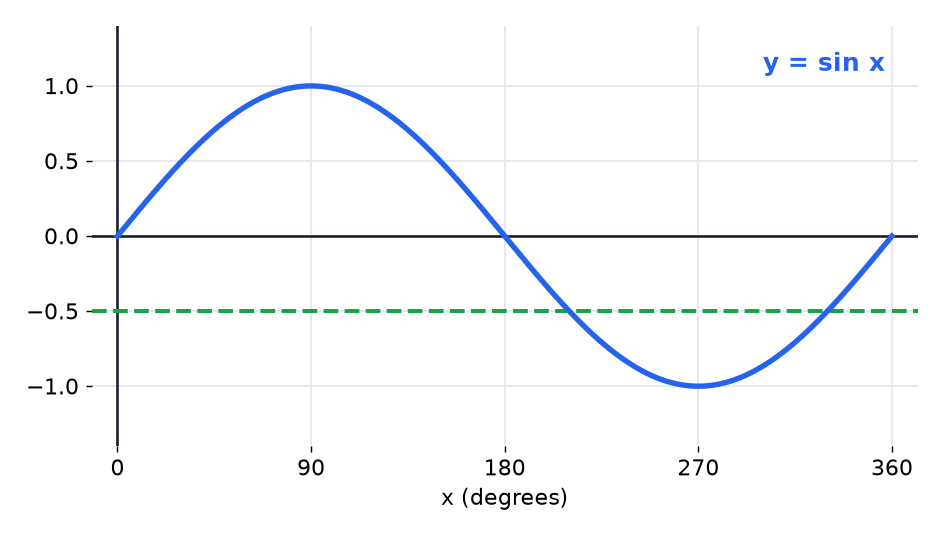
The diagram shows the graph of \(y = \sin x\) for \(0^\circ \le x \le 360^\circ\), and the line \(y = -0.5\). Solve \(\sin x = -0.5\) for \(0^\circ \le x \le 360^\circ\). [2 marks]
Show answerHide answer
Model answer
\(\sin 30^\circ = 0.5\). Sine is negative between \(180^\circ\) and \(360^\circ\), so \(x = 180 + 30 = 210^\circ\) or \(x = 360 - 30 = 330^\circ\).
Mark scheme
- \(210\) — M1
- \(330\) — A1
-
2 Write down [3 marks]
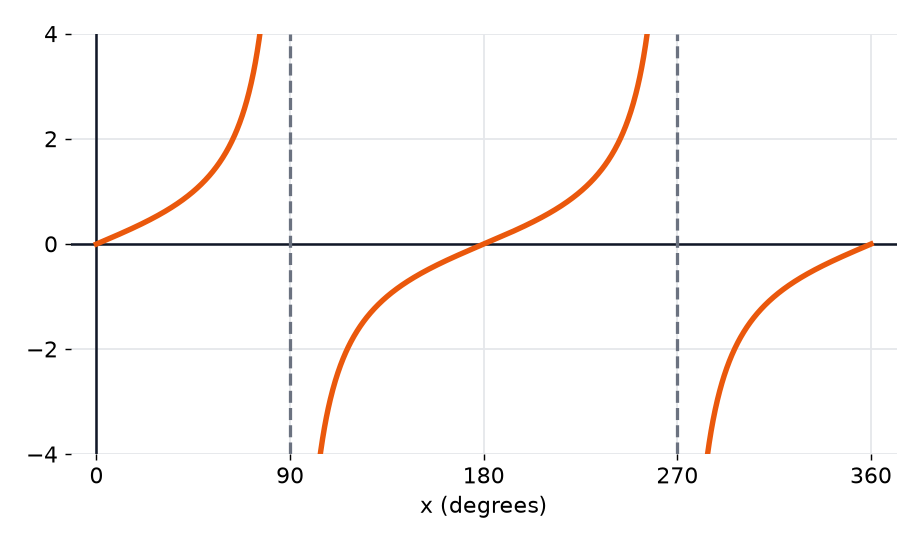
The diagram shows a graph for \(0^\circ \le x \le 360^\circ\). The dashed lines are asymptotes. (a) Write down the equation of the graph. [1 mark] (b) Write down the equations of the asymptotes. [1 mark] (c) Write down the values of \(x\) where the graph crosses the \(x\)-axis. [1 mark]
Show answerHide answer
Model answer
(a) \(y = \tan x\). (b) \(x = 90\) and \(x = 270\). (c) \(x = 0\), \(180\) and \(360\).
Mark scheme
- (a) \(y = \tan x\) — B1
- (b) \(x = 90\) and \(x = 270\) — B1
- (c) \(0, 180, 360\) — B1
-
3 Write down [3 marks]
Write down the exact value of (a) \(\cos 150^\circ\) [1 mark] (b) \(\sin 210^\circ\) [1 mark] (c) \(\tan 120^\circ\) [1 mark]
Show answerHide answer
Model answer
(a) \(-\dfrac{\sqrt{3}}{2}\). (b) \(-\dfrac{1}{2}\). (c) \(-\sqrt{3}\).
Mark scheme
- (a) \(-\dfrac{\sqrt{3}}{2}\) — B1
- (b) \(-\dfrac{1}{2}\) — B1
- (c) \(-\sqrt{3}\) — B1
-
4 Solve [3 marks]
Solve \(2\sin x = \sqrt{2}\) for \(0^\circ \le x \le 360^\circ\). [3 marks]
Show answerHide answer
Model answer
\(\sin x = \dfrac{\sqrt{2}}{2}\), so \(x = 45^\circ\) or \(x = 180 - 45 = 135^\circ\).
Mark scheme
- \(\sin x = \dfrac{\sqrt{2}}{2}\) — M1
- \(45\) — A1
- \(135\) — A1
-
5 Solve [3 marks]
Solve \(\tan x = \sqrt{3}\) for \(0^\circ \le x \le 360^\circ\). [3 marks]
Show answerHide answer
Model answer
\(\tan 60^\circ = \sqrt{3}\), and the tangent graph repeats every \(180^\circ\), so \(x = 60^\circ\) or \(x = 60 + 180 = 240^\circ\).
Mark scheme
- \(60\) as the first solution — M1
- \(240\) — A1
- No other solutions in the range — A1
-
6 Write down [2 marks]
(a) How many solutions does \(\sin x = 1\) have for \(0^\circ \le x \le 360^\circ\)? [1 mark] (b) How many solutions does \(\sin x = -1\) have for \(0^\circ \le x \le 360^\circ\)? [1 mark]
Show answerHide answer
Model answer
(a) One solution, \(x = 90^\circ\). (b) One solution, \(x = 270^\circ\).
Mark scheme
- (a) 1, which is \(x = 90^\circ\) — B1
- (b) 1, which is \(x = 270^\circ\) — B1
Quick check
-
1
What is the maximum value of \(y = \sin x\)?
Show answerHide answer
B: 1
The sine graph is a wave between \(-1\) and \(1\).
-
2
What is \(\cos 0^\circ\)?
Show answerHide answer
A: 1
The cosine graph starts at its maximum, 1.
-
3
Where are the asymptotes of \(y = \tan x\) between \(0^\circ\) and \(360^\circ\)?
Show answerHide answer
D: \(x = 90^\circ\) and \(x = 270^\circ\)
The tangent is undefined at \(90^\circ\) and \(270^\circ\).
-
4
How many solutions does \(\sin x = \dfrac{1}{2}\) have for \(0^\circ \le x \le 360^\circ\)?
Show answerHide answer
C: 2
The line \(y = \dfrac{1}{2}\) crosses the sine curve twice, at \(30^\circ\) and \(150^\circ\).
-
5
If \(\sin 30^\circ = \dfrac{1}{2}\), what is the other solution of \(\sin x = \dfrac{1}{2}\) between \(0^\circ\) and \(360^\circ\)?
Show answerHide answer
B: \(150^\circ\)
The second solution is \(180^\circ - 30^\circ = 150^\circ\).
-
6
What is the period of \(y = \tan x\)?
Show answerHide answer
A: \(180^\circ\)
The tangent graph repeats every \(180^\circ\).
-
7
Solve \(\cos x = \dfrac{1}{2}\) for \(0^\circ \le x \le 360^\circ\).
Show answerHide answer
D: \(60^\circ\) and \(300^\circ\)
\(\cos 60^\circ = \dfrac{1}{2}\), and the second solution is \(360^\circ - 60^\circ = 300^\circ\).
-
8
Solve \(\sin x = -\dfrac{1}{2}\) for \(0^\circ \le x \le 360^\circ\).
Show answerHide answer
C: \(210^\circ\) and \(330^\circ\)
Sine is negative between \(180^\circ\) and \(360^\circ\), so the solutions are \(180 + 30 = 210\) and \(360 - 30 = 330\).
-
9
Which equation has no solutions?
Show answerHide answer
B: \(\sin x = 1.5\)
Sine and cosine are never greater than 1, so \(\sin x = 1.5\) has no solution.
The Sine Rule
Just this lesson-
1 Work out [3 marks]
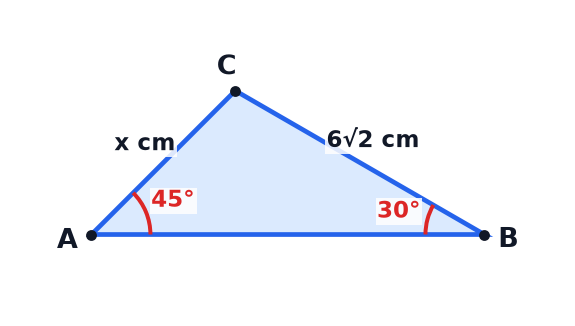
Not drawn accurately. Work out the length of \(AC\). [3 marks]
Show answerHide answer
Model answer
\(\dfrac{x}{\sin 30^\circ} = \dfrac{6\sqrt{2}}{\sin 45^\circ}\), so \(x = \dfrac{6\sqrt{2} \times \frac{1}{2}}{\frac{\sqrt{2}}{2}} = 6\) cm.
Mark scheme
- \(\dfrac{x}{\sin 30^\circ} = \dfrac{6\sqrt{2}}{\sin 45^\circ}\) — M1
- Uses \(\sin 30^\circ = \dfrac{1}{2}\) and \(\sin 45^\circ = \dfrac{\sqrt{2}}{2}\) — M1
- \(6\) — A1
-
2 Work out [3 marks]
In triangle \(ABC\), angle \(A = 60^\circ\), \(a = 6\) cm and \(b = 2\sqrt{3}\) cm. Angle \(B\) is acute. Work out the size of angle \(B\). [3 marks]
Show answerHide answer
Model answer
\(\dfrac{\sin B}{2\sqrt{3}} = \dfrac{\sin 60^\circ}{6}\), so \(\sin B = \dfrac{2\sqrt{3} \times \frac{\sqrt{3}}{2}}{6} = \dfrac{3}{6} = \dfrac{1}{2}\). So \(B = 30^\circ\).
Mark scheme
- \(\dfrac{\sin B}{2\sqrt{3}} = \dfrac{\sin 60^\circ}{6}\) or equivalent — M1
- \(\sin B = \dfrac{1}{2}\) — M1
- \(30\) — A1
-
3 Work out [3 marks]
In triangle \(ABC\), angle \(A = 30^\circ\), angle \(B = 30^\circ\) and \(a = 9\) cm. Work out the length of \(c\). Give your answer in surd form. [3 marks]
Show answerHide answer
Model answer
Angle \(C = 120^\circ\). \(\dfrac{c}{\sin 120^\circ} = \dfrac{9}{\sin 30^\circ}\), so \(c = \dfrac{9 \times \frac{\sqrt{3}}{2}}{\frac{1}{2}} = 9\sqrt{3}\) cm.
Mark scheme
- Angle \(C = 120^\circ\) — M1
- \(\dfrac{c}{\sin 120^\circ} = \dfrac{9}{\sin 30^\circ}\) — M1
- \(9\sqrt{3}\) — A1
-
4 Work out [3 marks]
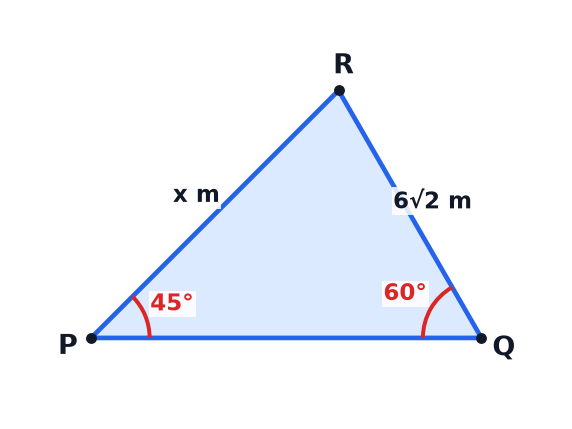
Not drawn accurately. The diagram shows a triangular park \(PQR\). Work out the length of \(PR\). Give your answer in surd form. [3 marks]
Show answerHide answer
Model answer
\(\dfrac{x}{\sin 60^\circ} = \dfrac{6\sqrt{2}}{\sin 45^\circ}\), so \(x = \dfrac{6\sqrt{2} \times \frac{\sqrt{3}}{2}}{\frac{\sqrt{2}}{2}} = 6\sqrt{3}\) m.
Mark scheme
- \(\dfrac{x}{\sin 60^\circ} = \dfrac{6\sqrt{2}}{\sin 45^\circ}\) — M1
- Uses the exact values of \(\sin 60^\circ\) and \(\sin 45^\circ\) — M1
- \(6\sqrt{3}\) — A1
-
5 Work out [3 marks]
In triangle \(ABC\), angle \(A = 30^\circ\), \(a = 6\) cm and \(b = 6\sqrt{3}\) cm. There are two possible sizes of angle \(B\). Work out both of them. [3 marks]
Show answerHide answer
Model answer
\(\sin B = \dfrac{6\sqrt{3} \times \frac{1}{2}}{6} = \dfrac{\sqrt{3}}{2}\). So \(B = 60^\circ\) or \(B = 180 - 60 = 120^\circ\).
Mark scheme
- \(\sin B = \dfrac{\sqrt{3}}{2}\) — M1
- \(60\) — A1
- \(120\) — A1
-
6 Show that [3 marks]
In triangle \(ABC\), angle \(A = 30^\circ\), angle \(B = 45^\circ\) and \(a = 3\sqrt{2}\) cm. Show that \(b = 6\) cm. [3 marks]
Show answerHide answer
Model answer
\(\dfrac{b}{\sin 45^\circ} = \dfrac{3\sqrt{2}}{\sin 30^\circ}\), so \(b = \dfrac{3\sqrt{2} \times \frac{\sqrt{2}}{2}}{\frac{1}{2}} = \dfrac{3}{\frac{1}{2}} = 6\).
Mark scheme
- \(\dfrac{b}{\sin 45^\circ} = \dfrac{3\sqrt{2}}{\sin 30^\circ}\) — M1
- \(b = \dfrac{3\sqrt{2} \times \frac{\sqrt{2}}{2}}{\frac{1}{2}}\) — M1
- \(\dfrac{3}{\frac{1}{2}} = 6\), with the working shown to the end — Q1
Quick check
-
1
In triangle \(ABC\), which side is opposite angle \(A\)?
Show answerHide answer
C: \(a\)
Each side is opposite the angle with the same letter.
-
2
Which is the sine rule for finding a side?
Show answerHide answer
B: \(\dfrac{a}{\sin A} = \dfrac{b}{\sin B}\)
The sine rule says that side over the sine of its opposite angle is constant.
-
3
What do you need to use the sine rule?
Show answerHide answer
A: A side and its opposite angle, plus one more side or angle
The sine rule needs a matching pair.
-
4
What is \(\sin 45^\circ\)?
Show answerHide answer
D: \(\dfrac{\sqrt{2}}{2}\)
This is one of the exact values.
-
5
In triangle \(ABC\), \(A = 30^\circ\), \(B = 90^\circ\) and \(a = 5\). What is \(b\)?
Show answerHide answer
C: 10
\(\dfrac{b}{\sin 90^\circ} = \dfrac{5}{\sin 30^\circ}\), so \(b = \dfrac{5}{\frac{1}{2}} = 10\).
-
6
In triangle \(ABC\), \(A = 30^\circ\), \(B = 45^\circ\) and \(a = 4\). What is \(b\)?
Show answerHide answer
B: \(4\sqrt{2}\)
\(b = \dfrac{4\sin 45^\circ}{\sin 30^\circ} = \dfrac{4 \times \frac{\sqrt{2}}{2}}{\frac{1}{2}} = 4\sqrt{2}\).
-
7
In triangle \(ABC\), \(a = 6\), \(b = 6\sqrt{2}\) and \(A = 30^\circ\). What is \(\sin B\)?
Show answerHide answer
A: \(\dfrac{\sqrt{2}}{2}\)
\(\sin B = \dfrac{b\sin A}{a} = \dfrac{6\sqrt{2} \times \frac{1}{2}}{6} = \dfrac{\sqrt{2}}{2}\).
-
8
In triangle \(ABC\), \(A = 60^\circ\) and \(B = 45^\circ\). What is angle \(C\)?
Show answerHide answer
D: \(75^\circ\)
\(180 - 60 - 45 = 75\).
-
9
In triangle \(ABC\), \(A = 60^\circ\), \(B = 45^\circ\) and \(a = 3\sqrt{3}\). What is \(b\)?
Show answerHide answer
C: \(3\sqrt{2}\)
\(b = \dfrac{3\sqrt{3} \times \frac{\sqrt{2}}{2}}{\frac{\sqrt{3}}{2}} = 3\sqrt{2}\).
The Cosine Rule
Just this lesson-
1 Work out [3 marks]
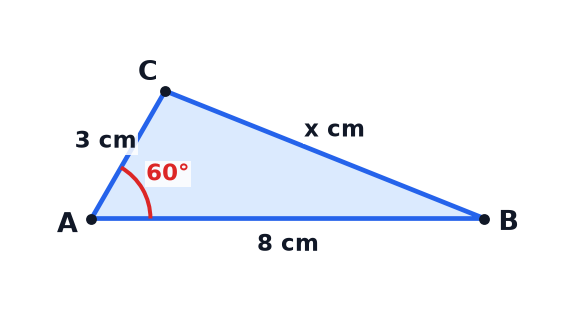
Not drawn accurately. Work out the length of \(BC\). [3 marks]
Show answerHide answer
Model answer
\(x^2 = 3^2 + 8^2 - 2 \times 3 \times 8 \times \cos 60^\circ = 9 + 64 - 24 = 49\), so \(x = 7\) cm.
Mark scheme
- \(x^2 = 3^2 + 8^2 - 2 \times 3 \times 8 \times \cos 60^\circ\) — M1
- \(9 + 64 - 24 = 49\) — M1
- \(7\) — A1
-
2 Work out [3 marks]
A triangle has sides of length 3 cm, 5 cm and 7 cm. Work out the size of the largest angle. [3 marks]
Show answerHide answer
Model answer
\(\cos A = \dfrac{3^2 + 5^2 - 7^2}{2 \times 3 \times 5} = \dfrac{-15}{30} = -\dfrac{1}{2}\), so \(A = 120^\circ\).
Mark scheme
- \(\cos A = \dfrac{3^2 + 5^2 - 7^2}{2 \times 3 \times 5}\) — M1
- \(-\dfrac{1}{2}\) — A1
- \(120\) — A1
-
3 Work out [3 marks]
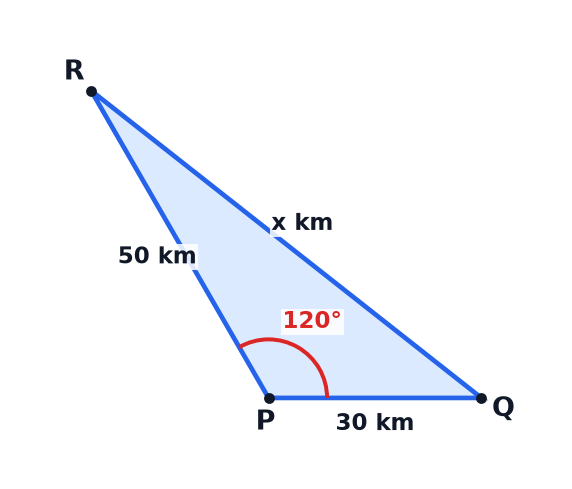
Not drawn accurately. Two ships leave a port \(P\) at the same time. Ship \(Q\) sails 30 km and ship \(R\) sails 50 km. The angle between their paths is \(120^\circ\). Work out the distance \(QR\) between the ships. [3 marks]
Show answerHide answer
Model answer
\(x^2 = 30^2 + 50^2 - 2 \times 30 \times 50 \times \cos 120^\circ = 900 + 2500 + 1500 = 4900\), so \(x = 70\) km.
Mark scheme
- \(x^2 = 30^2 + 50^2 - 2 \times 30 \times 50 \times \cos 120^\circ\) — M1
- \(900 + 2500 + 1500 = 4900\) — M1
- \(70\) — A1
-
4 Work out [3 marks]
In triangle \(ABC\), \(AB = AC = 9\) cm and angle \(A = 120^\circ\). Work out the length of \(BC\). Give your answer as a surd in its simplest form. [3 marks]
Show answerHide answer
Model answer
\(BC^2 = 9^2 + 9^2 - 2 \times 9 \times 9 \times \cos 120^\circ = 81 + 81 + 81 = 243\), so \(BC = \sqrt{243} = 9\sqrt{3}\) cm.
Mark scheme
- \(BC^2 = 9^2 + 9^2 - 2 \times 9 \times 9 \times \cos 120^\circ\) — M1
- \(243\) — M1
- \(9\sqrt{3}\) — A1
-
5 Work out [5 marks]
A triangle has sides of length 7 cm, 8 cm and 13 cm. (a) Work out the size of the largest angle. [3 marks] (b) Work out the exact area of the triangle. [2 marks]
Show answerHide answer
Model answer
(a) \(\cos A = \dfrac{7^2 + 8^2 - 13^2}{2 \times 7 \times 8} = \dfrac{-56}{112} = -\dfrac{1}{2}\), so \(A = 120^\circ\). (b) Area \(= \dfrac{1}{2} \times 7 \times 8 \times \sin 120^\circ = 28 \times \dfrac{\sqrt{3}}{2} = 14\sqrt{3}\) cm\(^2\).
Mark scheme
- (a) \(\cos A = \dfrac{7^2 + 8^2 - 13^2}{2 \times 7 \times 8}\) — M1
- (a) \(-\dfrac{1}{2}\) — A1
- (a) \(120\) — A1
- (b) \(\dfrac{1}{2} \times 7 \times 8 \times \sin 120^\circ\) — M1
- (b) \(14\sqrt{3}\) — A1
-
6 Work out [3 marks]
A triangle has sides of length 5 cm, 5 cm and \(5\sqrt{3}\) cm. Work out the size of the largest angle. [3 marks]
Show answerHide answer
Model answer
\(\cos A = \dfrac{5^2 + 5^2 - (5\sqrt{3})^2}{2 \times 5 \times 5} = \dfrac{25 + 25 - 75}{50} = -\dfrac{1}{2}\), so \(A = 120^\circ\).
Mark scheme
- \(\cos A = \dfrac{5^2 + 5^2 - (5\sqrt{3})^2}{2 \times 5 \times 5}\) — M1
- \(-\dfrac{1}{2}\) — A1
- \(120\) — A1
Quick check
-
1
Which is the cosine rule for the side \(a\)?
Show answerHide answer
D: \(a^2 = b^2 + c^2 - 2bc\cos A\)
The cosine rule takes \(2bc\cos A\) away from the sum of the squares.
-
2
When do you use the cosine rule to find a side?
Show answerHide answer
C: When you know two sides and the angle between them
Two sides and the included angle is the cosine rule situation.
-
3
What is \(\cos 60^\circ\)?
Show answerHide answer
B: \(\dfrac{1}{2}\)
This is an exact value.
-
4
What does the cosine rule become when \(A = 90^\circ\)?
Show answerHide answer
A: Pythagoras' theorem
\(\cos 90^\circ = 0\), so \(a^2 = b^2 + c^2\).
-
5
In triangle \(ABC\), \(b = 3\), \(c = 8\) and \(A = 60^\circ\). What is \(a^2\)?
Show answerHide answer
D: 49
\(a^2 = 9 + 64 - 2 \times 3 \times 8 \times \frac{1}{2} = 73 - 24 = 49\).
-
6
In triangle \(ABC\), \(b = 6\), \(c = 10\) and \(A = 120^\circ\). What is \(a\)?
Show answerHide answer
C: 14
\(a^2 = 36 + 100 - 120 \times (-\frac{1}{2}) = 136 + 60 = 196\), so \(a = 14\).
-
7
A triangle has sides 5, 7 and 8. What is \(\cos\) of the angle opposite the side of length 7?
Show answerHide answer
B: \(\dfrac{1}{2}\)
\(\cos A = \dfrac{5^2 + 8^2 - 7^2}{2 \times 5 \times 8} = \dfrac{40}{80} = \dfrac{1}{2}\).
-
8
A triangle has sides 3, 5 and 7. What is the largest angle?
Show answerHide answer
A: \(120^\circ\)
\(\cos A = \dfrac{9 + 25 - 49}{30} = -\dfrac{1}{2}\), so \(A = 120^\circ\).
-
9
A triangle has sides 7, 8 and 13. What is the angle opposite the longest side?
Show answerHide answer
D: \(120^\circ\)
\(\cos A = \dfrac{49 + 64 - 169}{112} = \dfrac{-56}{112} = -\dfrac{1}{2}\), so \(A = 120^\circ\).
Area of a Triangle and Segments
Just this lesson-
1 Work out [2 marks]
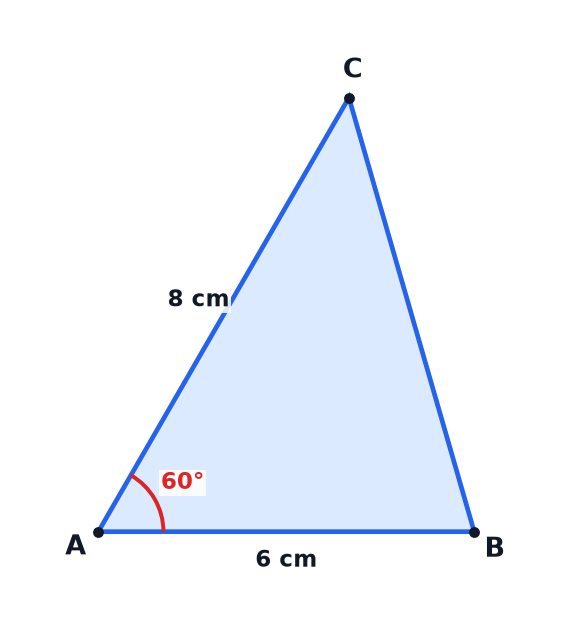
Not drawn accurately. Work out the exact area of triangle \(ABC\). [2 marks]
Show answerHide answer
Model answer
Area \(= \dfrac{1}{2} \times 6 \times 8 \times \sin 60^\circ = 24 \times \dfrac{\sqrt{3}}{2} = 12\sqrt{3}\) cm\(^2\).
Mark scheme
- \(\dfrac{1}{2} \times 6 \times 8 \times \sin 60^\circ\) — M1
- \(12\sqrt{3}\) — A1
-
2 Work out [3 marks]
A triangle has two sides of length 8 cm and 6 cm. Its area is \(12\sqrt{3}\) cm\(^2\). The angle between the two sides is acute. Work out the size of this angle. [3 marks]
Show answerHide answer
Model answer
\(12\sqrt{3} = \dfrac{1}{2} \times 8 \times 6 \times \sin C = 24\sin C\), so \(\sin C = \dfrac{\sqrt{3}}{2}\) and \(C = 60^\circ\).
Mark scheme
- \(12\sqrt{3} = \dfrac{1}{2} \times 8 \times 6 \times \sin C\) — M1
- \(\sin C = \dfrac{\sqrt{3}}{2}\) — M1
- \(60\) — A1
-
3 Work out [3 marks]
In triangle \(ABC\), \(b = 10\) cm and angle \(C = 60^\circ\). The area of the triangle is \(15\sqrt{3}\) cm\(^2\). Work out the length of \(a\). [3 marks]
Show answerHide answer
Model answer
\(15\sqrt{3} = \dfrac{1}{2} \times a \times 10 \times \sin 60^\circ = \dfrac{5\sqrt{3}a}{2}\), so \(a = 15\sqrt{3} \times \dfrac{2}{5\sqrt{3}} = 6\) cm.
Mark scheme
- \(15\sqrt{3} = \dfrac{1}{2} \times a \times 10 \times \sin 60^\circ\) — M1
- \(15\sqrt{3} = \dfrac{5\sqrt{3}a}{2}\) or equivalent — M1
- \(6\) — A1
-
4 Work out [3 marks]
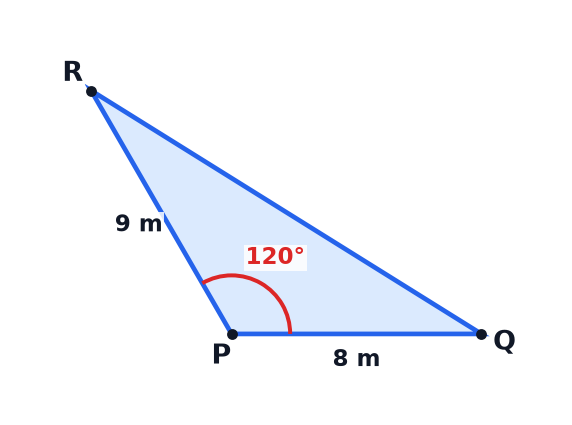
Not drawn accurately. The diagram shows a triangular plot of land \(PQR\). Work out the exact area of the plot. [3 marks]
Show answerHide answer
Model answer
Area \(= \dfrac{1}{2} \times 8 \times 9 \times \sin 120^\circ = 36 \times \dfrac{\sqrt{3}}{2} = 18\sqrt{3}\) m\(^2\).
Mark scheme
- \(\dfrac{1}{2} \times 8 \times 9 \times \sin 120^\circ\) — M1
- \(\sin 120^\circ = \dfrac{\sqrt{3}}{2}\) — M1
- \(18\sqrt{3}\) — A1
-
5 Work out [5 marks]
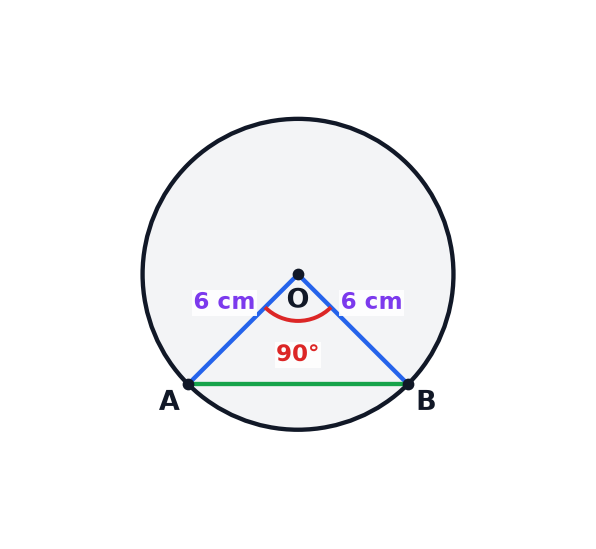
Not drawn accurately. The diagram shows a circle, centre \(O\), with radius 6 cm. \(A\) and \(B\) are points on the circle and angle \(AOB = 90^\circ\). Work out the exact area of the segment bounded by the chord \(AB\) and the minor arc \(AB\). [5 marks]
Show answerHide answer
Model answer
Sector \(= \dfrac{90}{360} \times \pi \times 6^2 = 9\pi\). Triangle \(= \dfrac{1}{2} \times 6 \times 6 \times \sin 90^\circ = 18\). Segment \(= 9\pi - 18\) cm\(^2\).
Mark scheme
- \(\dfrac{90}{360} \times \pi \times 6^2\) — M1
- \(9\pi\) — A1
- \(\dfrac{1}{2} \times 6 \times 6 \times \sin 90^\circ\) — M1
- \(18\) — A1
- \(9\pi - 18\) — A1
-
6 Show that [3 marks]
An equilateral triangle has sides of length 10 cm. Show that its area is \(25\sqrt{3}\) cm\(^2\). [3 marks]
Show answerHide answer
Model answer
Area \(= \dfrac{1}{2} \times 10 \times 10 \times \sin 60^\circ = 50 \times \dfrac{\sqrt{3}}{2} = 25\sqrt{3}\) cm\(^2\).
Mark scheme
- \(\dfrac{1}{2} \times 10 \times 10 \times \sin 60^\circ\) — M1
- \(50 \times \dfrac{\sqrt{3}}{2}\) — M1
- \(25\sqrt{3}\), with a clear conclusion — Q1
Quick check
-
1
What is the formula for the area of a triangle using a sine?
Show answerHide answer
A: \(\dfrac{1}{2}ab\sin C\)
The area is half the product of two sides and the sine of the angle between them.
-
2
Which angle is used in \(\dfrac{1}{2}ab\sin C\)?
Show answerHide answer
D: The angle between sides \(a\) and \(b\)
\(C\) is the included angle.
-
3
What is \(\sin 90^\circ\)?
Show answerHide answer
C: 1
This is on the sine graph at its maximum.
-
4
A triangle has sides 8 cm and 5 cm with an angle of \(30^\circ\) between them. What is the area?
Show answerHide answer
B: 10 cm\(^2\)
\(\dfrac{1}{2} \times 8 \times 5 \times \dfrac{1}{2} = 10\).
-
5
A triangle has sides 6 cm and 8 cm with an angle of \(60^\circ\) between them. What is the exact area?
Show answerHide answer
A: \(12\sqrt{3}\) cm\(^2\)
\(\dfrac{1}{2} \times 6 \times 8 \times \dfrac{\sqrt{3}}{2} = 12\sqrt{3}\).
-
6
A triangle has sides of 10 cm and 8 cm and an area of 20 cm\(^2\). The included angle is acute. What is it?
Show answerHide answer
D: \(30^\circ\)
\(20 = 40\sin C\), so \(\sin C = \dfrac{1}{2}\) and \(C = 30^\circ\).
-
7
What is the area of a segment of a circle?
Show answerHide answer
C: Area of the sector minus area of the triangle
The segment is the sector with the triangle removed.
-
8
A sector of a circle with radius 6 cm has an angle of \(60^\circ\). What is the area of the sector?
Show answerHide answer
B: \(6\pi\) cm\(^2\)
\(\dfrac{60}{360} \times \pi \times 36 = 6\pi\).
-
9
A triangle has two sides of 4 cm and 6 cm and an area of 6 cm\(^2\). What could the included angle be?
Show answerHide answer
A: \(30^\circ\) or \(150^\circ\)
\(6 = 12\sin C\), so \(\sin C = \dfrac{1}{2}\), which gives \(30^\circ\) or \(150^\circ\).
Trigonometry in 3D and Mixed Problems
Just this lesson-
1 Work out [3 marks]
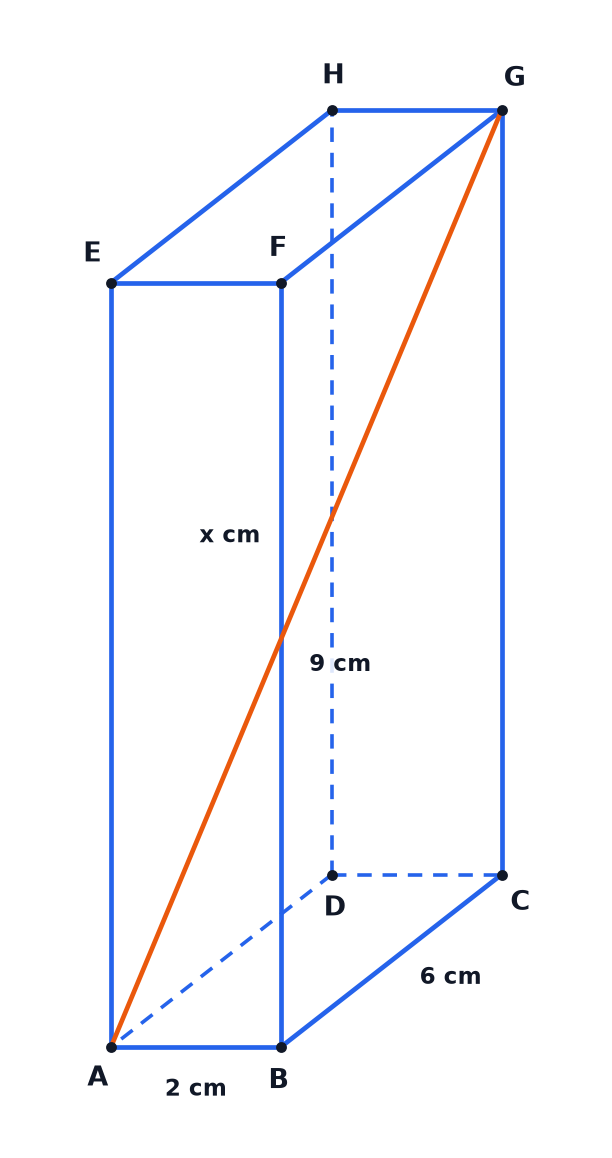
Not drawn accurately. The diagram shows a cuboid. Work out the length of the diagonal \(AG\). [3 marks]
Show answerHide answer
Model answer
\(AG^2 = 2^2 + 6^2 + 9^2 = 4 + 36 + 81 = 121\), so \(AG = 11\) cm.
Mark scheme
- \(2^2 + 6^2 + 9^2\), or a base diagonal \(AC^2 = 2^2 + 6^2\) then \(AG^2 = AC^2 + 9^2\) — M1
- \(121\) — M1
- \(11\) — A1
-
2 Work out [4 marks]
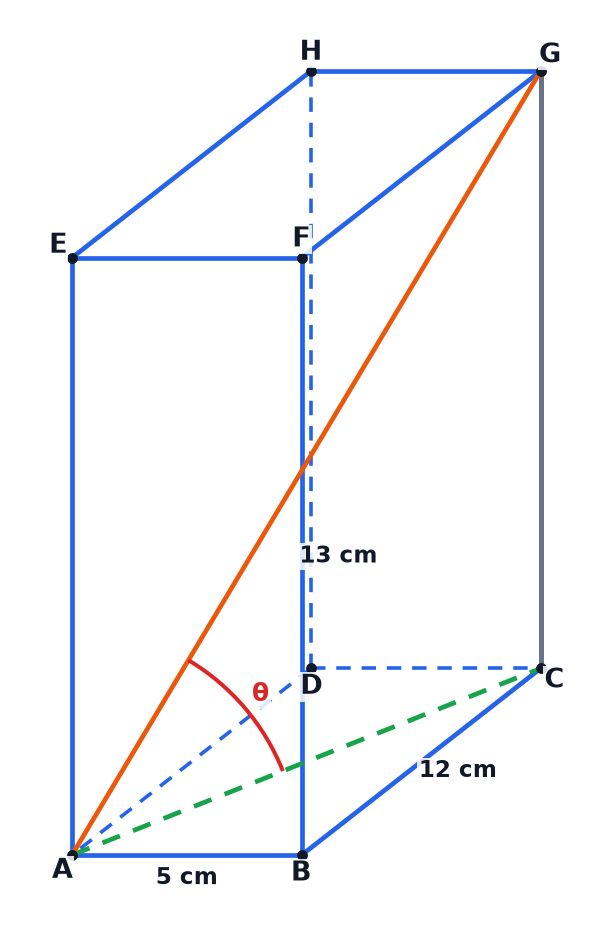
Not drawn accurately. The diagram shows a cuboid. Work out the size of angle \(\theta\), the angle between \(AG\) and the base \(ABCD\). [4 marks]
Show answerHide answer
Model answer
\(AC^2 = 5^2 + 12^2 = 169\), so \(AC = 13\) cm. In the right-angled triangle \(ACG\), \(\tan\theta = \dfrac{CG}{AC} = \dfrac{13}{13} = 1\), so \(\theta = 45^\circ\).
Mark scheme
- \(AC = 13\) — B1
- \(\tan\theta = \dfrac{13}{13}\) — M1
- \(\tan\theta = 1\) — A1
- \(45\) — A1
-
3 Work out [5 marks]
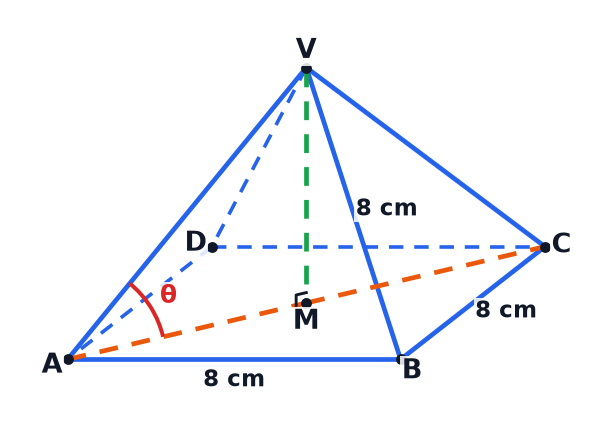
Not drawn accurately. The diagram shows a pyramid with a square base \(ABCD\). The apex \(V\) is directly above the centre \(M\) of the base. All the edges are 8 cm long. (a) Work out the exact height \(VM\) of the pyramid. [3 marks] (b) Work out the size of angle \(\theta\), the angle between \(VA\) and the base. [2 marks]
Show answerHide answer
Model answer
(a) \(AC^2 = 8^2 + 8^2 = 128\), so \(AM = \dfrac{1}{2}AC = 4\sqrt{2}\). \(VM^2 = 8^2 - (4\sqrt{2})^2 = 64 - 32 = 32\), so \(VM = 4\sqrt{2}\) cm. (b) \(\cos\theta = \dfrac{AM}{VA} = \dfrac{4\sqrt{2}}{8} = \dfrac{\sqrt{2}}{2}\), so \(\theta = 45^\circ\).
Mark scheme
- (a) \(AM = 4\sqrt{2}\) — M1
- (a) \(VM^2 = 8^2 - 32\) — M1
- (a) \(4\sqrt{2}\) — A1
- (b) \(\cos\theta = \dfrac{4\sqrt{2}}{8}\) or \(\tan\theta = 1\) — M1
- (b) \(45\) — A1
-
4 Work out [4 marks]
A boat sails 30 km from \(P\) to \(Q\) on a bearing of \(090^\circ\). It then sails 50 km from \(Q\) to \(R\) on a bearing of \(150^\circ\). Work out the distance \(PR\). [4 marks]
Show answerHide answer
Model answer
The bearing of \(P\) from \(Q\) is \(270^\circ\), so angle \(PQR = 270 - 150 = 120^\circ\). \(PR^2 = 30^2 + 50^2 - 2 \times 30 \times 50 \times \cos 120^\circ = 900 + 2500 + 1500 = 4900\), so \(PR = 70\) km.
Mark scheme
- Angle \(PQR = 120^\circ\) — M1
- \(PR^2 = 30^2 + 50^2 - 2 \times 30 \times 50 \times \cos 120^\circ\) — M1
- \(4900\) — A1
- \(70\) — A1
-
5 Work out [5 marks]
\(BT\) is a vertical tower on horizontal ground. The angle of elevation of \(T\) from a point \(A\) is \(30^\circ\), and from a point \(C\) is \(45^\circ\). Angle \(ABC = 90^\circ\) and \(AC = 60\) m. Work out the height of the tower. [5 marks]
Show answerHide answer
Model answer
Let \(BT = h\). \(BA = \dfrac{h}{\tan 30^\circ} = h\sqrt{3}\) and \(BC = \dfrac{h}{\tan 45^\circ} = h\). In the right-angled triangle \(ABC\), \(AC^2 = 3h^2 + h^2 = 4h^2 = 3600\), so \(h^2 = 900\) and \(h = 30\) m.
Mark scheme
- \(BA = h\sqrt{3}\), or \(\tan 30^\circ = \dfrac{h}{BA}\) — B1
- \(BC = h\) — B1
- \(AC^2 = BA^2 + BC^2 = 4h^2\) — M1
- \(4h^2 = 3600\) — M1
- \(30\) — A1
-
6 Show that [3 marks]
\(ABCDEFGH\) is a cube with edges of length 6 cm. Show that triangle \(ACF\) is equilateral, and write down the size of angle \(CAF\). [3 marks]
Show answerHide answer
Model answer
\(AC\), \(AF\) and \(CF\) are diagonals of faces of the cube. \(AC^2 = 6^2 + 6^2 = 72\), so \(AC = 6\sqrt{2}\). The other two face diagonals are the same length, so the triangle is equilateral and angle \(CAF = 60^\circ\).
Mark scheme
- \(AC^2 = 6^2 + 6^2 = 72\), so \(AC = 6\sqrt{2}\) — M1
- \(AF\) and \(CF\) are also face diagonals, so all three sides are \(6\sqrt{2}\) — B1
- Equilateral, so angle \(CAF = 60^\circ\) — Q1
Quick check
-
1
What is the formula for the space diagonal of a cuboid?
Show answerHide answer
B: \(\sqrt{l^2 + w^2 + h^2}\)
Use Pythagoras' theorem twice.
-
2
A rectangle is 4 cm by 3 cm. What is the length of its diagonal?
Show answerHide answer
A: 5 cm
\(\sqrt{16 + 9} = 5\).
-
3
Where is the apex of a square-based pyramid?
Show answerHide answer
D: Directly above the centre of the base
For a right pyramid the apex is above the centre.
-
4
A cuboid has edges 2 cm, 3 cm and 6 cm. What is the length of the space diagonal?
Show answerHide answer
C: 7 cm
\(\sqrt{4 + 9 + 36} = \sqrt{49} = 7\).
-
5
What is the angle between a line and a plane?
Show answerHide answer
B: The angle between the line and its shadow on the plane
The shadow of the line on the plane is used.
-
6
A cuboid has a base 4 cm by 3 cm and a height of 5 cm. What is \(\tan\theta\), where \(\theta\) is the angle between the diagonal \(AG\) and the base?
Show answerHide answer
A: 1
The base diagonal is 5 cm and the height is 5 cm, so \(\tan\theta = \dfrac{5}{5} = 1\).
-
7
A cube has edges of length 2 cm. What is the length of its space diagonal?
Show answerHide answer
D: \(2\sqrt{3}\) cm
\(\sqrt{4 + 4 + 4} = \sqrt{12} = 2\sqrt{3}\).
-
8
A square-based pyramid has a base with side 6 cm and a height of \(3\sqrt{2}\) cm. What is the angle between a sloping edge and the base?
Show answerHide answer
C: \(45^\circ\)
Half the base diagonal is \(3\sqrt{2}\), the same as the height, so \(\tan\theta = 1\).
-
9
In a 3D problem, which triangle contains the angle between the space diagonal of a cuboid and the base?
Show answerHide answer
B: A right-angled triangle with the base diagonal, the vertical edge and the space diagonal
The vertical edge is perpendicular to the base, so the triangle is right-angled.