Exam questions · Maths · Further Trigonometry
The Cosine Rule
- 6 exam questions
- 20 marks
- 9 quick checks
-
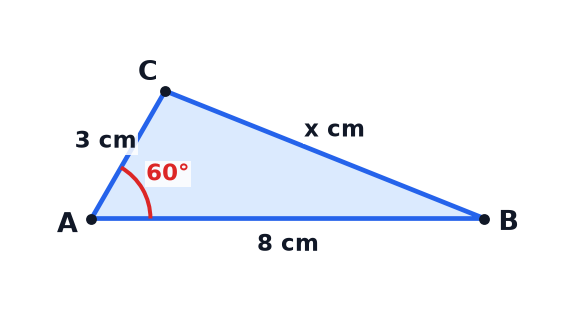
1 Work out [3 marks]
Not drawn accurately. Work out the length of \(BC\). [3 marks]
Show answerHide answer
Model answer
\(x^2 = 3^2 + 8^2 - 2 \times 3 \times 8 \times \cos 60^\circ = 9 + 64 - 24 = 49\), so \(x = 7\) cm.
Mark scheme
- \(x^2 = 3^2 + 8^2 - 2 \times 3 \times 8 \times \cos 60^\circ\) — M1
- \(9 + 64 - 24 = 49\) — M1
- \(7\) — A1
-
2 Work out [3 marks]
A triangle has sides of length 3 cm, 5 cm and 7 cm. Work out the size of the largest angle. [3 marks]
Show answerHide answer
Model answer
\(\cos A = \dfrac{3^2 + 5^2 - 7^2}{2 \times 3 \times 5} = \dfrac{-15}{30} = -\dfrac{1}{2}\), so \(A = 120^\circ\).
Mark scheme
- \(\cos A = \dfrac{3^2 + 5^2 - 7^2}{2 \times 3 \times 5}\) — M1
- \(-\dfrac{1}{2}\) — A1
- \(120\) — A1
-
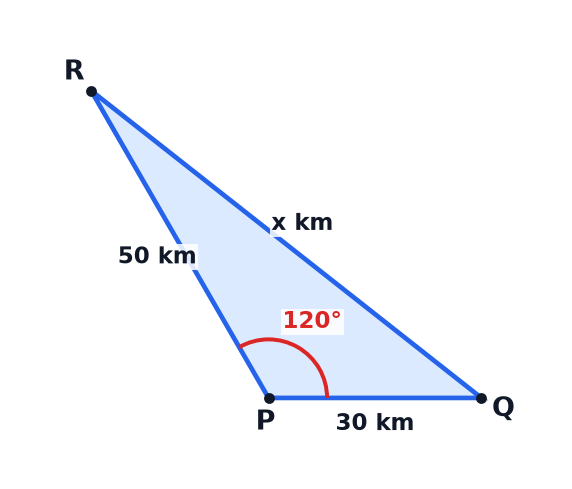
3 Work out [3 marks]
Not drawn accurately. Two ships leave a port \(P\) at the same time. Ship \(Q\) sails 30 km and ship \(R\) sails 50 km. The angle between their paths is \(120^\circ\). Work out the distance \(QR\) between the ships. [3 marks]
Show answerHide answer
Model answer
\(x^2 = 30^2 + 50^2 - 2 \times 30 \times 50 \times \cos 120^\circ = 900 + 2500 + 1500 = 4900\), so \(x = 70\) km.
Mark scheme
- \(x^2 = 30^2 + 50^2 - 2 \times 30 \times 50 \times \cos 120^\circ\) — M1
- \(900 + 2500 + 1500 = 4900\) — M1
- \(70\) — A1
-
4 Work out [3 marks]
In triangle \(ABC\), \(AB = AC = 9\) cm and angle \(A = 120^\circ\). Work out the length of \(BC\). Give your answer as a surd in its simplest form. [3 marks]
Show answerHide answer
Model answer
\(BC^2 = 9^2 + 9^2 - 2 \times 9 \times 9 \times \cos 120^\circ = 81 + 81 + 81 = 243\), so \(BC = \sqrt{243} = 9\sqrt{3}\) cm.
Mark scheme
- \(BC^2 = 9^2 + 9^2 - 2 \times 9 \times 9 \times \cos 120^\circ\) — M1
- \(243\) — M1
- \(9\sqrt{3}\) — A1
-
5 Work out [5 marks]
A triangle has sides of length 7 cm, 8 cm and 13 cm. (a) Work out the size of the largest angle. [3 marks] (b) Work out the exact area of the triangle. [2 marks]
Show answerHide answer
Model answer
(a) \(\cos A = \dfrac{7^2 + 8^2 - 13^2}{2 \times 7 \times 8} = \dfrac{-56}{112} = -\dfrac{1}{2}\), so \(A = 120^\circ\). (b) Area \(= \dfrac{1}{2} \times 7 \times 8 \times \sin 120^\circ = 28 \times \dfrac{\sqrt{3}}{2} = 14\sqrt{3}\) cm\(^2\).
Mark scheme
- (a) \(\cos A = \dfrac{7^2 + 8^2 - 13^2}{2 \times 7 \times 8}\) — M1
- (a) \(-\dfrac{1}{2}\) — A1
- (a) \(120\) — A1
- (b) \(\dfrac{1}{2} \times 7 \times 8 \times \sin 120^\circ\) — M1
- (b) \(14\sqrt{3}\) — A1
-
6 Work out [3 marks]
A triangle has sides of length 5 cm, 5 cm and \(5\sqrt{3}\) cm. Work out the size of the largest angle. [3 marks]
Show answerHide answer
Model answer
\(\cos A = \dfrac{5^2 + 5^2 - (5\sqrt{3})^2}{2 \times 5 \times 5} = \dfrac{25 + 25 - 75}{50} = -\dfrac{1}{2}\), so \(A = 120^\circ\).
Mark scheme
- \(\cos A = \dfrac{5^2 + 5^2 - (5\sqrt{3})^2}{2 \times 5 \times 5}\) — M1
- \(-\dfrac{1}{2}\) — A1
- \(120\) — A1
Quick check
-
1
Which is the cosine rule for the side \(a\)?
Show answerHide answer
D: \(a^2 = b^2 + c^2 - 2bc\cos A\)
The cosine rule takes \(2bc\cos A\) away from the sum of the squares.
-
2
When do you use the cosine rule to find a side?
Show answerHide answer
C: When you know two sides and the angle between them
Two sides and the included angle is the cosine rule situation.
-
3
What is \(\cos 60^\circ\)?
Show answerHide answer
B: \(\dfrac{1}{2}\)
This is an exact value.
-
4
What does the cosine rule become when \(A = 90^\circ\)?
Show answerHide answer
A: Pythagoras' theorem
\(\cos 90^\circ = 0\), so \(a^2 = b^2 + c^2\).
-
5
In triangle \(ABC\), \(b = 3\), \(c = 8\) and \(A = 60^\circ\). What is \(a^2\)?
Show answerHide answer
D: 49
\(a^2 = 9 + 64 - 2 \times 3 \times 8 \times \frac{1}{2} = 73 - 24 = 49\).
-
6
In triangle \(ABC\), \(b = 6\), \(c = 10\) and \(A = 120^\circ\). What is \(a\)?
Show answerHide answer
C: 14
\(a^2 = 36 + 100 - 120 \times (-\frac{1}{2}) = 136 + 60 = 196\), so \(a = 14\).
-
7
A triangle has sides 5, 7 and 8. What is \(\cos\) of the angle opposite the side of length 7?
Show answerHide answer
B: \(\dfrac{1}{2}\)
\(\cos A = \dfrac{5^2 + 8^2 - 7^2}{2 \times 5 \times 8} = \dfrac{40}{80} = \dfrac{1}{2}\).
-
8
A triangle has sides 3, 5 and 7. What is the largest angle?
Show answerHide answer
A: \(120^\circ\)
\(\cos A = \dfrac{9 + 25 - 49}{30} = -\dfrac{1}{2}\), so \(A = 120^\circ\).
-
9
A triangle has sides 7, 8 and 13. What is the angle opposite the longest side?
Show answerHide answer
D: \(120^\circ\)
\(\cos A = \dfrac{49 + 64 - 169}{112} = \dfrac{-56}{112} = -\dfrac{1}{2}\), so \(A = 120^\circ\).