Exam questions · Maths · Probability
Frequency Trees and Two-Way Tables
- 6 exam questions
- 20 marks
- 9 quick checks
-
1 Work out [2 marks]
50 children visit a zoo. 30 of them are girls. 12 of the girls and 8 of the boys bring a camera. (a) Work out the number of boys. [1 mark] (b) Work out the number of children who bring a camera. [1 mark]
Show answerHide answer
Model answer
(a) \(50 - 30 = 20\). (b) \(12 + 8 = 20\).
Mark scheme
- (a) 20 — B1
- (b) 20 — B1
-
2 Work out [4 marks]
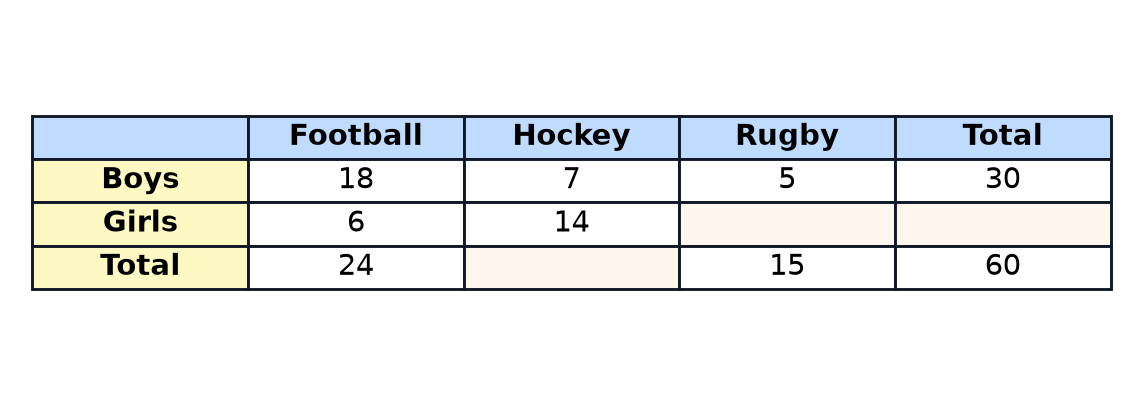
The two-way table shows the sports chosen by 60 pupils. Some numbers are missing. (a) Complete the two-way table. [3 marks] (b) A pupil is chosen at random. Work out the probability that the pupil is a girl who plays rugby. [1 mark]
Show answerHide answer
Model answer
(a) Girls who play rugby: \(15 - 5 = 10\). Total girls: \(30\) (as \(60 - 30\), or \(6 + 14 + 10\)). Hockey total: \(7 + 14 = 21\). (b) \(\dfrac{10}{60} = \dfrac{1}{6}\).
Mark scheme
- (a) At least one correct value — B1
- (a) At least two correct values — B1
- (a) 10, 30 and 21 all correct — B1
- (b) \(\dfrac{10}{60}\) or \(\dfrac{1}{6}\) — B1
-
3 Work out [3 marks]
There are 400 people at a concert. \(\dfrac{3}{8}\) of them are under 18. \(\dfrac{1}{3}\) of the people under 18 and \(\dfrac{3}{10}\) of the adults have a VIP ticket. Work out the total number of people with a VIP ticket. [3 marks]
Show answerHide answer
Model answer
Under 18: \(\dfrac{3}{8} \times 400 = 150\). Adults: \(400 - 150 = 250\). VIP: \(\dfrac{1}{3} \times 150 + \dfrac{3}{10} \times 250 = 50 + 75 = 125\).
Mark scheme
- 150 under 18 and 250 adults — M1
- 50 and 75 seen — M1
- 125 — A1
-
4 Work out [3 marks]
120 households were asked about pets. 70 have a dog. Of these 70, 20 also have a cat. Of the 50 households without a dog, 25 have a cat. (a) Work out the number of households with neither a dog nor a cat. [1 mark] (b) A household is chosen at random. Work out the probability that it has a cat. [2 marks]
Show answerHide answer
Model answer
(a) \(50 - 25 = 25\). (b) \(20 + 25 = 45\) households have a cat, so \(\dfrac{45}{120} = \dfrac{3}{8}\).
Mark scheme
- (a) 25 — B1
- (b) \(\dfrac{45}{120}\) — M1
- (b) \(\dfrac{3}{8}\) — A1
-
5 Work out [4 marks]
There are 200 pupils in a school. 55% of them are boys. 40% of the boys and 30% of the girls walk to school. Work out the number of pupils who walk to school. [4 marks]
Show answerHide answer
Model answer
Boys: \(0.55 \times 200 = 110\) and girls: \(200 - 110 = 90\). Walkers: \(0.4 \times 110 = 44\) and \(0.3 \times 90 = 27\). The total is \(44 + 27 = 71\).
Mark scheme
- 110 boys and 90 girls — M1
- \(0.4 \times 110 = 44\) — M1
- \(0.3 \times 90 = 27\) — M1
- 71 — A1
-
6 Work out [4 marks]
There are 240 passengers on a flight. The ratio of adults to children is \(5 : 1\). \(\dfrac{1}{4}\) of the adults and \(\dfrac{3}{5}\) of the children are on holiday. A passenger is chosen at random. Work out the probability that the passenger is on holiday. [4 marks]
Show answerHide answer
Model answer
Adults: \(240 \div 6 \times 5 = 200\) and children: 40. On holiday: \(\dfrac{1}{4} \times 200 = 50\) and \(\dfrac{3}{5} \times 40 = 24\), a total of 74. The probability is \(\dfrac{74}{240} = \dfrac{37}{120}\).
Mark scheme
- 200 adults and 40 children — M1
- 50 and 24 seen — M1
- \(\dfrac{74}{240}\) — A1
- \(\dfrac{37}{120}\) — A1
Quick check
-
1
A frequency tree starts with 100 pupils, and 60 are girls. How many are boys?
Show answerHide answer
A: \(40\)
\(100 - 60 = 40\).
-
2
40% of 60 girls walk to school. How many girls walk?
Show answerHide answer
D: \(24\)
\(0.4 \times 60 = 24\).
-
3
In a two-way table the Year 10 row total is 50. 24 take the bus and 18 walk. How many cycle?
Show answerHide answer
C: \(8\)
\(50 - 24 - 18 = 8\).
-
4
In a survey of 100 students, 24 are in Year 10 and take the bus. What is the probability that a student is in Year 10 and takes the bus?
Show answerHide answer
B: \(\dfrac{6}{25}\)
\(\dfrac{24}{100} = \dfrac{6}{25}\).
-
5
13 out of 100 students cycle to school. How many of 500 students would you expect to cycle?
Show answerHide answer
A: \(65\)
\(\dfrac{13}{100} \times 500 = 65\).
-
6
What is 25% of 120?
Show answerHide answer
D: \(30\)
\(0.25 \times 120 = 30\).
-
7
200 people go to a gym. 60% are women. 25% of the women and 40% of the men go in the morning. How many people go in the morning?
Show answerHide answer
C: \(62\)
120 women and 80 men. \(30 + 32 = 62\).
-
8
50 people were asked about pets. 28 have a cat, 20 have a dog and 6 have both. How many have neither?
Show answerHide answer
B: \(8\)
At least one: \(22 + 6 + 14 = 42\). \(50 - 42 = 8\).
-
9
In a frequency tree, the branches after “60 girls” show 24 who walk and some who take the bus. How many take the bus?
Show answerHide answer
A: \(36\)
The branches add up to the number they came from: \(60 - 24 = 36\).