Exam questions · Maths
Probability
- 30 exam questions
- 97 marks
- 45 quick checks
Probability Basics and Relative Frequency
Just this lesson-
1 Write down [2 marks]
Ten cards are numbered 1 to 10. One card is picked at random. Work out the probability that the card shows (a) a prime number, (b) a multiple of 3. [2 marks]
Show answerHide answer
Model answer
(a) The primes are 2, 3, 5 and 7, so \(\dfrac{4}{10} = \dfrac{2}{5}\). (b) The multiples of 3 are 3, 6 and 9, so \(\dfrac{3}{10}\).
Mark scheme
- (a) \(\dfrac{4}{10}\) or \(\dfrac{2}{5}\) or 0.4 — B1
- (b) \(\dfrac{3}{10}\) or 0.3 — B1
-
2 Choose [3 marks]
Here are five words: impossible, unlikely, even chance, likely, certain. Choose the best word to describe each event. (a) A fair coin lands on heads. [1 mark] (b) A normal dice lands on 7. [1 mark] (c) A fair dice lands on a number less than 6. [1 mark]
Show answerHide answer
Model answer
(a) Even chance. (b) Impossible. (c) Likely, because the probability is \(\dfrac{5}{6}\).
Mark scheme
- (a) Even chance — B1
- (b) Impossible — B1
- (c) Likely — B1
-
3 Work out [4 marks]
Jack spins a spinner 80 times. It lands on green 28 times. (a) Work out the relative frequency of green. Give your answer as a fraction in its simplest form. [2 marks] (b) Jack spins the spinner 200 more times. Estimate the number of times it lands on green. [2 marks]
Show answerHide answer
Model answer
(a) \(\dfrac{28}{80} = \dfrac{7}{20}\). (b) \(\dfrac{7}{20} \times 200 = 70\).
Mark scheme
- (a) \(\dfrac{28}{80}\) — M1
- (a) \(\dfrac{7}{20}\) — A1
- (b) \(\dfrac{7}{20} \times 200\) — M1
- (b) 70 — A1
-
4 Work out [3 marks]
A bag contains only red, blue and yellow counters. The probability of picking a red counter is 0.3. The probability of picking a blue counter is 0.45. There are 40 counters in the bag. Work out the number of yellow counters. [3 marks]
Show answerHide answer
Model answer
\(P(\text{yellow}) = 1 - 0.3 - 0.45 = 0.25\). Then \(0.25 \times 40 = 10\) yellow counters.
Mark scheme
- \(1 - 0.3 - 0.45\) — M1
- \(0.25\) — A1
- 10 — A1
-
5 Work out [2 marks]
The probability that a seed grows is 0.9. Ella plants 300 seeds. Work out an estimate for the number of seeds that grow. [2 marks]
Show answerHide answer
Model answer
\(0.9 \times 300 = 270\).
Mark scheme
- \(0.9 \times 300\) — M1
- 270 — A1
-
6 Work out [3 marks]
\(A\) and \(B\) are events. \(P(A) = 0.5\), \(P(B) = 0.4\) and \(P(A \text{ or } B) = 0.7\). Work out \(P(A \text{ and } B)\). [3 marks]
Show answerHide answer
Model answer
\(P(A \text{ or } B) = P(A) + P(B) - P(A \text{ and } B)\), so \(0.7 = 0.9 - P(A \text{ and } B)\). Then \(P(A \text{ and } B) = 0.9 - 0.7 = 0.2\).
Mark scheme
- \(0.5 + 0.4 = 0.9\) — M1
- \(0.9 - 0.7\) — M1
- \(0.2\) — A1
Quick check
-
1
What is the probability of an impossible event?
Show answerHide answer
B: \(0\)
An impossible event has probability 0.
-
2
A bag has 3 red, 5 blue and 2 green counters. One is taken at random. What is the probability it is blue?
Show answerHide answer
A: \(\dfrac{1}{2}\)
There are 10 counters and 5 are blue, so \(\dfrac{5}{10} = \dfrac{1}{2}\).
-
3
A bag has 3 red, 5 blue and 2 green counters. What is the probability that a counter taken at random is not green?
Show answerHide answer
D: \(\dfrac{4}{5}\)
\(1 - \dfrac{2}{10} = \dfrac{8}{10} = \dfrac{4}{5}\).
-
4
A dice is thrown 120 times and a 6 comes up 30 times. What is the relative frequency of a 6?
Show answerHide answer
C: \(\dfrac{1}{4}\)
\(\dfrac{30}{120} = \dfrac{1}{4}\).
-
5
A fair dice is thrown 600 times. How many sixes are expected?
Show answerHide answer
B: \(100\)
\(\dfrac{1}{6} \times 600 = 100\).
-
6
Two fair dice are thrown. What is the probability that the total score is 7?
Show answerHide answer
A: \(\dfrac{1}{6}\)
There are 6 ways to make 7 out of 36, so \(\dfrac{6}{36} = \dfrac{1}{6}\).
-
7
A bag has 3 red, 5 blue and 2 green counters. What is the probability of taking a red or a green counter?
Show answerHide answer
D: \(\dfrac{1}{2}\)
The events are mutually exclusive, so \(\dfrac{3}{10} + \dfrac{2}{10} = \dfrac{1}{2}\).
-
8
A spinner is spun 200 times and lands on red 74 times. How many reds would be expected if the probability of red were \(\dfrac{1}{4}\)?
Show answerHide answer
C: \(50\)
\(\dfrac{1}{4} \times 200 = 50\). The result of 74 suggests the spinner may be biased.
-
9
A card is taken from a pack of 52. What is the probability that it is a heart or a king?
Show answerHide answer
B: \(\dfrac{4}{13}\)
\(\dfrac{13}{52} + \dfrac{4}{52} - \dfrac{1}{52} = \dfrac{16}{52} = \dfrac{4}{13}\).
Tree Diagrams
Just this lesson-
1 Work out [2 marks]
A fair dice is rolled and a fair coin is flipped. Work out the probability of getting a 6 and a head. [2 marks]
Show answerHide answer
Model answer
\(\dfrac{1}{6} \times \dfrac{1}{2} = \dfrac{1}{12}\).
Mark scheme
- \(\dfrac{1}{6} \times \dfrac{1}{2}\) — M1
- \(\dfrac{1}{12}\) — A1
-
2 Work out [4 marks]
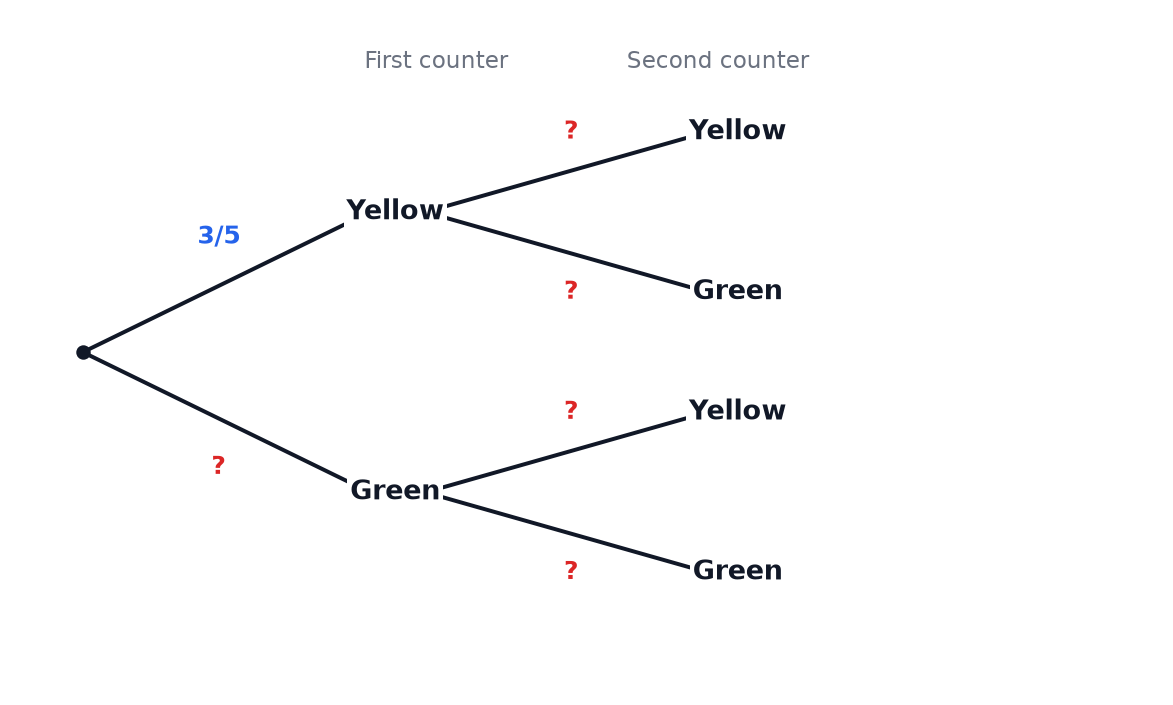
A bag contains 3 yellow counters and 2 green counters. A counter is taken at random, and its colour is recorded. The counter is put back in the bag. A second counter is then taken. The incomplete tree diagram shows the first counter and the second counter. (a) Complete the tree diagram. [2 marks] (b) Work out the probability that the two counters are the same colour. [2 marks]
Show answerHide answer
Model answer
(a) Green on the first counter is \(\dfrac{2}{5}\). All the second-counter branches are \(\dfrac{3}{5}\) for yellow and \(\dfrac{2}{5}\) for green, because the counter is replaced. (b) \(\dfrac{3}{5} \times \dfrac{3}{5} + \dfrac{2}{5} \times \dfrac{2}{5} = \dfrac{9}{25} + \dfrac{4}{25} = \dfrac{13}{25}\).
Mark scheme
- (a) \(\dfrac{2}{5}\) on the first green branch — B1
- (a) \(\dfrac{3}{5}\) and \(\dfrac{2}{5}\) on all second-counter branches — B1
- (b) \(\dfrac{3}{5} \times \dfrac{3}{5}\) and \(\dfrac{2}{5} \times \dfrac{2}{5}\) added — M1
- (b) \(\dfrac{13}{25}\) — A1
-
3 Work out [3 marks]
A box contains 8 chocolates. 5 are milk and 3 are plain. Bea takes two chocolates at random without replacement. Work out the probability that both are plain. [3 marks]
Show answerHide answer
Model answer
\(\dfrac{3}{8} \times \dfrac{2}{7} = \dfrac{6}{56} = \dfrac{3}{28}\).
Mark scheme
- \(\dfrac{3}{8}\) and \(\dfrac{2}{7}\) seen — M1
- \(\dfrac{3}{8} \times \dfrac{2}{7}\) — M1
- \(\dfrac{3}{28}\) or \(\dfrac{6}{56}\) — A1
-
4 Work out [4 marks]
The probability that it rains on Saturday is 0.3. If it rains on Saturday, the probability that it rains on Sunday is 0.6. If it does not rain on Saturday, the probability that it rains on Sunday is 0.2. Work out the probability that it rains on at least one of the two days. [4 marks]
Show answerHide answer
Model answer
No rain on either day: \(0.7 \times 0.8 = 0.56\). So the probability of rain on at least one day is \(1 - 0.56 = 0.44\).
Mark scheme
- \(0.7\) and \(0.8\) seen — M1
- \(0.7 \times 0.8 = 0.56\) — A1
- \(1 - 0.56\) — M1
- \(0.44\) — A1
-
5 Work out [3 marks]
The probability that Raj is late for school on any day is 0.1. The days are independent. Work out the probability that he is late on exactly one of two days. [3 marks]
Show answerHide answer
Model answer
Late then on time: \(0.1 \times 0.9 = 0.09\). On time then late: \(0.9 \times 0.1 = 0.09\). The total is \(0.09 + 0.09 = 0.18\).
Mark scheme
- \(0.1 \times 0.9\) — M1
- \(0.1 \times 0.9 + 0.9 \times 0.1\) — M1
- \(0.18\) — A1
-
6 Work out [3 marks]
A bag contains 4 red counters and 2 blue counters. Three counters are taken at random without replacement. Work out the probability that exactly one of them is blue. [3 marks]
Show answerHide answer
Model answer
One product is \(\dfrac{2}{6} \times \dfrac{4}{5} \times \dfrac{3}{4} = \dfrac{24}{120} = \dfrac{1}{5}\). There are three orders for the blue counter, and each has the same probability, so the total is \(3 \times \dfrac{1}{5} = \dfrac{3}{5}\).
Mark scheme
- One correct product such as \(\dfrac{2}{6} \times \dfrac{4}{5} \times \dfrac{3}{4}\) — M1
- All three arrangements added or multiplied by 3 — M1
- \(\dfrac{3}{5}\) — A1
Quick check
-
1
The probability of rain on any day is 0.3, and days are independent. What is the probability of rain on both of two days?
Show answerHide answer
C: \(0.09\)
\(0.3 \times 0.3 = 0.09\).
-
2
The probability of rain on any day is 0.3, and days are independent. What is the probability of rain on at least one of two days?
Show answerHide answer
B: \(0.51\)
\(1 - 0.7 \times 0.7 = 1 - 0.49 = 0.51\).
-
3
Two fair coins are tossed. What is the probability of two heads?
Show answerHide answer
A: \(\dfrac{1}{4}\)
\(\dfrac{1}{2} \times \dfrac{1}{2} = \dfrac{1}{4}\).
-
4
A bag has 3 red and 2 blue counters. Two are taken without replacement. What is the probability that both are red?
Show answerHide answer
D: \(\dfrac{3}{10}\)
\(\dfrac{3}{5} \times \dfrac{2}{4} = \dfrac{6}{20} = \dfrac{3}{10}\).
-
5
A bag has 3 red and 2 blue counters. Two are taken without replacement. What is the probability that they are different colours?
Show answerHide answer
C: \(\dfrac{3}{5}\)
\(\dfrac{3}{5} \times \dfrac{2}{4} + \dfrac{2}{5} \times \dfrac{3}{4} = \dfrac{12}{20} = \dfrac{3}{5}\).
-
6
A bag has 3 red and 2 blue counters. Two are taken without replacement. What is the probability that they are the same colour?
Show answerHide answer
B: \(\dfrac{2}{5}\)
\(\dfrac{6}{20} + \dfrac{2}{20} = \dfrac{8}{20} = \dfrac{2}{5}\).
-
7
On a tree diagram, one branch has probability 0.6. What is the other branch from the same point?
Show answerHide answer
A: \(0.4\)
The branches from one point add up to 1.
-
8
A bag has 4 red and 6 blue counters. Two are taken without replacement. What is the probability that both are blue?
Show answerHide answer
D: \(\dfrac{1}{3}\)
\(\dfrac{6}{10} \times \dfrac{5}{9} = \dfrac{30}{90} = \dfrac{1}{3}\).
-
9
A bag has 4 red counters and some blue counters, \(n\) in all. Two are taken without replacement and \(P(\text{two reds}) = \dfrac{2}{15}\). How many counters are in the bag?
Show answerHide answer
C: \(10\)
\(\dfrac{4}{10} \times \dfrac{3}{9} = \dfrac{12}{90} = \dfrac{2}{15}\), so \(n = 10\).
Venn Diagrams and Set Notation
Just this lesson-
1 Write down [2 marks]
\(\xi = \{1, 2, 3, 4, 5, 6, 7, 8, 9\}\). \(A\) is the set of odd numbers and \(B\) is the set of square numbers. (a) Write down \(A \cap B\). [1 mark] (b) Work out \(n(A \cup B)\). [1 mark]
Show answerHide answer
Model answer
(a) \(A = \{1, 3, 5, 7, 9\}\) and \(B = \{1, 4, 9\}\), so \(A \cap B = \{1, 9\}\). (b) \(A \cup B = \{1, 3, 4, 5, 7, 9\}\), so \(n(A \cup B) = 6\).
Mark scheme
- (a) \(\{1, 9\}\) — B1
- (b) 6 — B1
-
2 Work out [4 marks]
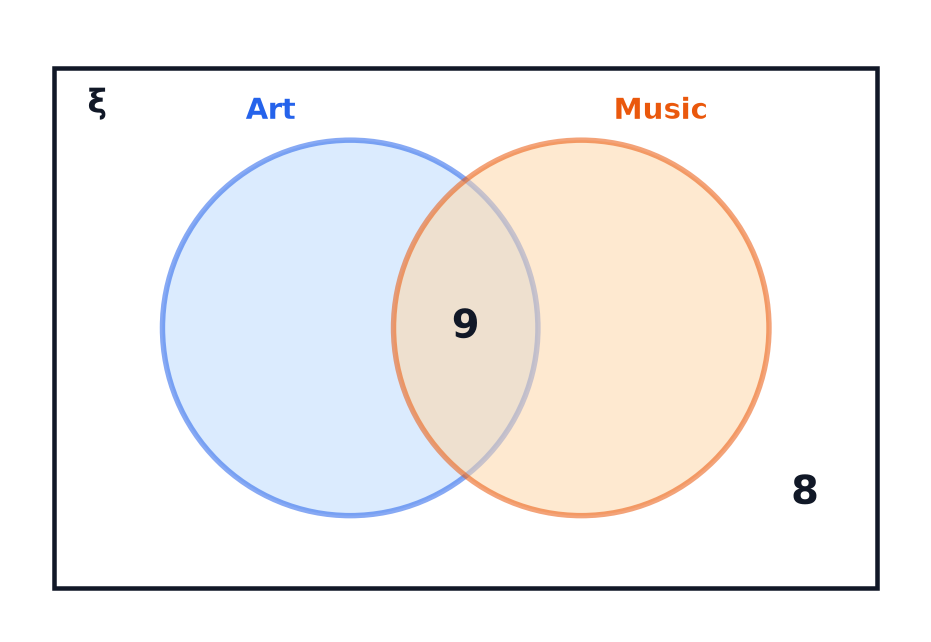
44 pupils each choose art, music, both or neither. 25 choose art and 20 choose music. The incomplete Venn diagram shows 9 pupils in both and 8 in neither. (a) Complete the Venn diagram. [2 marks] (b) A pupil is chosen at random. Work out the probability that the pupil chose music but not art. [2 marks]
Show answerHide answer
Model answer
(a) Art only is \(25 - 9 = 16\) and music only is \(20 - 9 = 11\). Check: \(16 + 9 + 11 + 8 = 44\). (b) \(\dfrac{11}{44} = \dfrac{1}{4}\).
Mark scheme
- (a) 16 — B1
- (a) 11 — B1
- (b) \(\dfrac{11}{44}\) — M1
- (b) \(\dfrac{1}{4}\) — A1
-
3 Work out [3 marks]
\(\xi = \{1, 2, 3, \ldots, 15\}\). \(A\) is the set of multiples of 2 and \(B\) is the set of multiples of 5. (a) Write down \(A \cap B\). [1 mark] (b) A number is chosen at random from \(\xi\). Work out the probability that it is in \(A \cup B\). [2 marks]
Show answerHide answer
Model answer
(a) \(A \cap B = \{10\}\). (b) \(A \cup B = \{2, 4, 5, 6, 8, 10, 12, 14, 15\}\), which has 9 members, so the probability is \(\dfrac{9}{15} = \dfrac{3}{5}\).
Mark scheme
- (a) \(\{10\}\) — B1
- (b) 9 numbers in the union — M1
- (b) \(\dfrac{3}{5}\) — A1
-
4 Work out [3 marks]
In a survey of 60 people, 35 own a cat and 28 own a dog. 10 people own neither. Work out the number of people who own both a cat and a dog. [3 marks]
Show answerHide answer
Model answer
\(60 - 10 = 50\) own at least one pet. Then \(35 + 28 - 50 = 13\) own both.
Mark scheme
- \(60 - 10 = 50\) — M1
- \(35 + 28 - 50\) — M1
- 13 — A1
-
5 Work out [4 marks]
The Venn diagram for 49 people has \(3x\) in set \(A\) only, \(x\) in both sets, \(2x + 1\) in set \(B\) only, and 6 in neither set. (a) Work out the value of \(x\). [2 marks] (b) Work out the probability that a person chosen at random is in both sets. [2 marks]
Show answerHide answer
Model answer
(a) \(3x + x + 2x + 1 + 6 = 49\), so \(6x + 7 = 49\) and \(x = 7\). (b) \(\dfrac{7}{49} = \dfrac{1}{7}\).
Mark scheme
- (a) \(6x + 7 = 49\) — M1
- (a) \(x = 7\) — A1
- (b) \(\dfrac{7}{49}\) — M1
- (b) \(\dfrac{1}{7}\) — A1
-
6 Work out [3 marks]
\(P(A) = 0.6\), \(P(B) = 0.5\) and \(P(A \cap B) = 0.3\). (a) Work out \(P(A \cup B)\). [2 marks] (b) Work out the probability that neither \(A\) nor \(B\) happens. [1 mark]
Show answerHide answer
Model answer
(a) \(0.6 + 0.5 - 0.3 = 0.8\). (b) \(1 - 0.8 = 0.2\).
Mark scheme
- (a) \(0.6 + 0.5 - 0.3\) — M1
- (a) \(0.8\) — A1
- (b) \(0.2\) — B1
Quick check
-
1
What does \(A \cap B\) mean?
Show answerHide answer
D: The items in both \(A\) and \(B\)
\(\cap\) is the intersection, the overlap.
-
2
What does \(A \cup B\) mean?
Show answerHide answer
C: The items in \(A\) or \(B\) or both
\(\cup\) is the union, everything in either circle.
-
3
What does \(A'\) mean?
Show answerHide answer
B: The items not in \(A\)
\(A'\) is the complement of \(A\).
-
4
\(A = \{2, 4, 6, 8, 10\}\) and \(B = \{3, 6, 9\}\). What is \(A \cap B\)?
Show answerHide answer
A: \(\{6\}\)
Only 6 is in both sets.
-
5
18 students play football and 6 of them also play tennis. How many play football only?
Show answerHide answer
D: \(12\)
\(18 - 6 = 12\).
-
6
30 students: 18 play football, 14 play tennis and 6 play both. How many play neither?
Show answerHide answer
C: \(4\)
\(12 + 6 + 8 = 26\) play at least one, so \(30 - 26 = 4\).
-
7
In the same survey, what is the probability that a student chosen at random plays football only?
Show answerHide answer
B: \(\dfrac{2}{5}\)
\(\dfrac{12}{30} = \dfrac{2}{5}\). The fraction \(\dfrac{18}{30}\) would include those who play both.
-
8
In a class of 40, 22 play football, 19 play tennis and 5 play neither. How many play both?
Show answerHide answer
A: \(6\)
\(40 - 5 = 35\) play at least one, and \(22 + 19 - 35 = 6\).
-
9
\(n(A) = 15\), \(n(B) = 12\) and \(n(A \cap B) = 5\). What is \(n(A \cup B)\)?
Show answerHide answer
D: \(22\)
\(15 + 12 - 5 = 22\).
Frequency Trees and Two-Way Tables
Just this lesson-
1 Work out [2 marks]
50 children visit a zoo. 30 of them are girls. 12 of the girls and 8 of the boys bring a camera. (a) Work out the number of boys. [1 mark] (b) Work out the number of children who bring a camera. [1 mark]
Show answerHide answer
Model answer
(a) \(50 - 30 = 20\). (b) \(12 + 8 = 20\).
Mark scheme
- (a) 20 — B1
- (b) 20 — B1
-
2 Work out [4 marks]
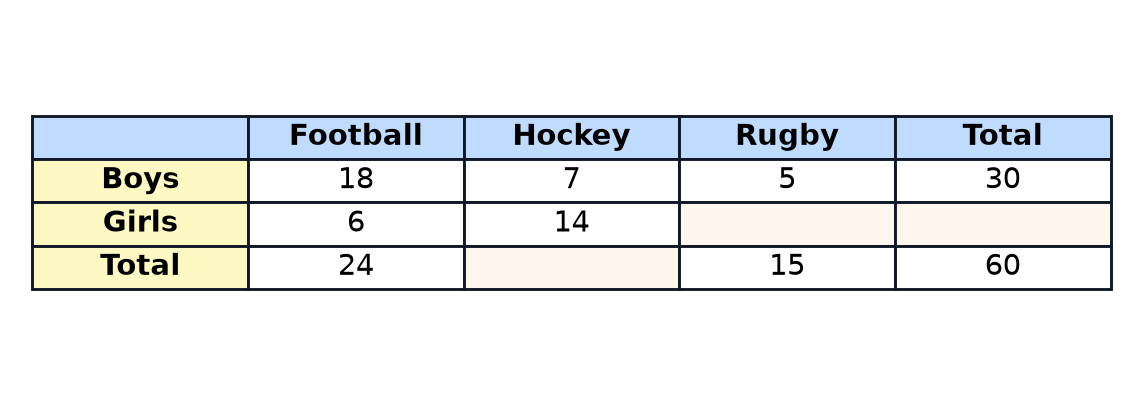
The two-way table shows the sports chosen by 60 pupils. Some numbers are missing. (a) Complete the two-way table. [3 marks] (b) A pupil is chosen at random. Work out the probability that the pupil is a girl who plays rugby. [1 mark]
Show answerHide answer
Model answer
(a) Girls who play rugby: \(15 - 5 = 10\). Total girls: \(30\) (as \(60 - 30\), or \(6 + 14 + 10\)). Hockey total: \(7 + 14 = 21\). (b) \(\dfrac{10}{60} = \dfrac{1}{6}\).
Mark scheme
- (a) At least one correct value — B1
- (a) At least two correct values — B1
- (a) 10, 30 and 21 all correct — B1
- (b) \(\dfrac{10}{60}\) or \(\dfrac{1}{6}\) — B1
-
3 Work out [3 marks]
There are 400 people at a concert. \(\dfrac{3}{8}\) of them are under 18. \(\dfrac{1}{3}\) of the people under 18 and \(\dfrac{3}{10}\) of the adults have a VIP ticket. Work out the total number of people with a VIP ticket. [3 marks]
Show answerHide answer
Model answer
Under 18: \(\dfrac{3}{8} \times 400 = 150\). Adults: \(400 - 150 = 250\). VIP: \(\dfrac{1}{3} \times 150 + \dfrac{3}{10} \times 250 = 50 + 75 = 125\).
Mark scheme
- 150 under 18 and 250 adults — M1
- 50 and 75 seen — M1
- 125 — A1
-
4 Work out [3 marks]
120 households were asked about pets. 70 have a dog. Of these 70, 20 also have a cat. Of the 50 households without a dog, 25 have a cat. (a) Work out the number of households with neither a dog nor a cat. [1 mark] (b) A household is chosen at random. Work out the probability that it has a cat. [2 marks]
Show answerHide answer
Model answer
(a) \(50 - 25 = 25\). (b) \(20 + 25 = 45\) households have a cat, so \(\dfrac{45}{120} = \dfrac{3}{8}\).
Mark scheme
- (a) 25 — B1
- (b) \(\dfrac{45}{120}\) — M1
- (b) \(\dfrac{3}{8}\) — A1
-
5 Work out [4 marks]
There are 200 pupils in a school. 55% of them are boys. 40% of the boys and 30% of the girls walk to school. Work out the number of pupils who walk to school. [4 marks]
Show answerHide answer
Model answer
Boys: \(0.55 \times 200 = 110\) and girls: \(200 - 110 = 90\). Walkers: \(0.4 \times 110 = 44\) and \(0.3 \times 90 = 27\). The total is \(44 + 27 = 71\).
Mark scheme
- 110 boys and 90 girls — M1
- \(0.4 \times 110 = 44\) — M1
- \(0.3 \times 90 = 27\) — M1
- 71 — A1
-
6 Work out [4 marks]
There are 240 passengers on a flight. The ratio of adults to children is \(5 : 1\). \(\dfrac{1}{4}\) of the adults and \(\dfrac{3}{5}\) of the children are on holiday. A passenger is chosen at random. Work out the probability that the passenger is on holiday. [4 marks]
Show answerHide answer
Model answer
Adults: \(240 \div 6 \times 5 = 200\) and children: 40. On holiday: \(\dfrac{1}{4} \times 200 = 50\) and \(\dfrac{3}{5} \times 40 = 24\), a total of 74. The probability is \(\dfrac{74}{240} = \dfrac{37}{120}\).
Mark scheme
- 200 adults and 40 children — M1
- 50 and 24 seen — M1
- \(\dfrac{74}{240}\) — A1
- \(\dfrac{37}{120}\) — A1
Quick check
-
1
A frequency tree starts with 100 pupils, and 60 are girls. How many are boys?
Show answerHide answer
A: \(40\)
\(100 - 60 = 40\).
-
2
40% of 60 girls walk to school. How many girls walk?
Show answerHide answer
D: \(24\)
\(0.4 \times 60 = 24\).
-
3
In a two-way table the Year 10 row total is 50. 24 take the bus and 18 walk. How many cycle?
Show answerHide answer
C: \(8\)
\(50 - 24 - 18 = 8\).
-
4
In a survey of 100 students, 24 are in Year 10 and take the bus. What is the probability that a student is in Year 10 and takes the bus?
Show answerHide answer
B: \(\dfrac{6}{25}\)
\(\dfrac{24}{100} = \dfrac{6}{25}\).
-
5
13 out of 100 students cycle to school. How many of 500 students would you expect to cycle?
Show answerHide answer
A: \(65\)
\(\dfrac{13}{100} \times 500 = 65\).
-
6
What is 25% of 120?
Show answerHide answer
D: \(30\)
\(0.25 \times 120 = 30\).
-
7
200 people go to a gym. 60% are women. 25% of the women and 40% of the men go in the morning. How many people go in the morning?
Show answerHide answer
C: \(62\)
120 women and 80 men. \(30 + 32 = 62\).
-
8
50 people were asked about pets. 28 have a cat, 20 have a dog and 6 have both. How many have neither?
Show answerHide answer
B: \(8\)
At least one: \(22 + 6 + 14 = 42\). \(50 - 42 = 8\).
-
9
In a frequency tree, the branches after “60 girls” show 24 who walk and some who take the bus. How many take the bus?
Show answerHide answer
A: \(36\)
The branches add up to the number they came from: \(60 - 24 = 36\).
Conditional Probability
Just this lesson-
1 Work out [2 marks]
A bag contains 4 yellow counters and 6 green counters. One counter is taken at random and not replaced. Another counter is then taken. Given that the first counter is yellow, work out the probability that the second counter is yellow. [2 marks]
Show answerHide answer
Model answer
After the first counter is taken there are 9 left, 3 of them yellow, so \(\dfrac{3}{9} = \dfrac{1}{3}\).
Mark scheme
- 3 yellow out of 9 remaining — M1
- \(\dfrac{1}{3}\) — A1
-
2 Work out [5 marks]
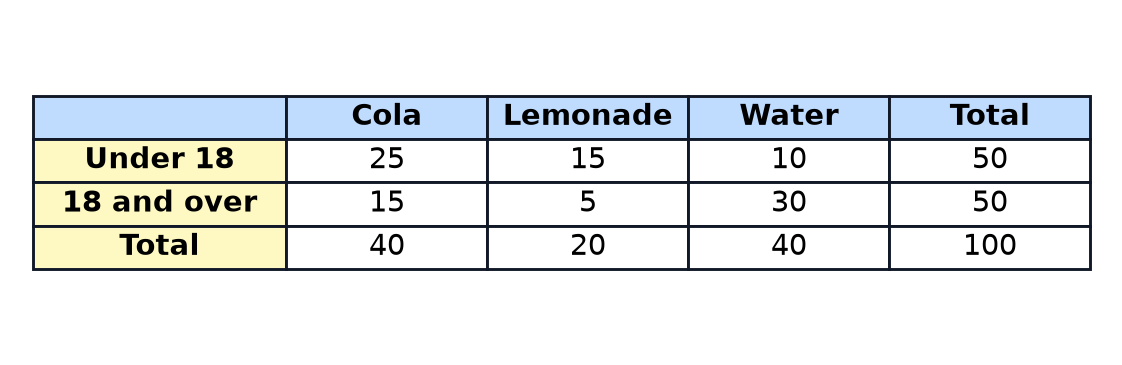
The table shows the drinks chosen by 100 people. (a) A person is chosen at random. Work out the probability that the person chose lemonade. [1 mark] (b) A person under 18 is chosen at random. Work out the probability that the person chose cola. [2 marks] (c) A person who chose water is chosen at random. Work out the probability that the person is aged 18 or over. [2 marks]
Show answerHide answer
Model answer
(a) \(\dfrac{20}{100} = \dfrac{1}{5}\). (b) \(\dfrac{25}{50} = \dfrac{1}{2}\). (c) 40 people chose water and 30 of them are 18 or over, so \(\dfrac{30}{40} = \dfrac{3}{4}\).
Mark scheme
- (a) \(\dfrac{1}{5}\) or \(\dfrac{20}{100}\) — B1
- (b) \(\dfrac{25}{50}\) — M1
- (b) \(\dfrac{1}{2}\) — A1
- (c) \(\dfrac{30}{40}\) — M1
- (c) \(\dfrac{3}{4}\) — A1
-
3 Work out [3 marks]
\(P(A) = 0.6\), \(P(B) = 0.5\) and \(P(A \text{ and } B) = 0.3\). (a) Work out \(P(B \text{ given } A)\). [2 marks] (b) Are \(A\) and \(B\) independent? Give a reason. [1 mark]
Show answerHide answer
Model answer
(a) \(P(B \text{ given } A) = \dfrac{0.3}{0.6} = 0.5\). (b) Yes, because \(P(B \text{ given } A) = 0.5 = P(B)\).
Mark scheme
- (a) \(\dfrac{0.3}{0.6}\) — M1
- (a) \(0.5\) — A1
- (b) Yes, because \(P(B \text{ given } A) = P(B)\) — Q1
-
4 Work out [4 marks]
In a group of 50 students, 30 study Spanish, 25 study French and 10 study both. (a) A student who studies French is chosen at random. Work out the probability that the student also studies Spanish. [2 marks] (b) A student who does not study Spanish is chosen at random. Work out the probability that the student studies French. [2 marks]
Show answerHide answer
Model answer
(a) \(\dfrac{10}{25} = \dfrac{2}{5}\). (b) \(50 - 30 = 20\) do not study Spanish. French only is \(25 - 10 = 15\), so the probability is \(\dfrac{15}{20} = \dfrac{3}{4}\).
Mark scheme
- (a) \(\dfrac{10}{25}\) — M1
- (a) \(\dfrac{2}{5}\) — A1
- (b) \(\dfrac{15}{20}\) — M1
- (b) \(\dfrac{3}{4}\) — A1
-
5 Work out [4 marks]
A bag contains 6 red counters and 4 white counters. Two counters are taken at random without replacement. Given that the second counter is white, work out the probability that the first counter is also white. [4 marks]
Show answerHide answer
Model answer
\(P(\text{red then white}) = \dfrac{6}{10} \times \dfrac{4}{9} = \dfrac{24}{90}\) and \(P(\text{white then white}) = \dfrac{4}{10} \times \dfrac{3}{9} = \dfrac{12}{90}\). The probability that the second is white is \(\dfrac{36}{90}\). So the answer is \(\dfrac{12}{36} = \dfrac{1}{3}\).
Mark scheme
- \(\dfrac{6}{10} \times \dfrac{4}{9} = \dfrac{24}{90}\) — M1
- \(\dfrac{4}{10} \times \dfrac{3}{9} = \dfrac{12}{90}\) — M1
- \(\dfrac{12}{36}\) or \(\dfrac{12}{90} \div \dfrac{36}{90}\) — M1
- \(\dfrac{1}{3}\) — A1
-
6 Work out [4 marks]
1 in 10 people have a medical condition. A test gives a positive result for 90% of the people who have the condition. The test also gives a positive result for 20% of the people who do not have it. A person is chosen at random and has a positive result. Work out the probability that the person has the condition. [4 marks]
Show answerHide answer
Model answer
Has the condition and positive: \(0.1 \times 0.9 = 0.09\). Does not have it and positive: \(0.9 \times 0.2 = 0.18\). All positives: \(0.27\). The probability is \(\dfrac{0.09}{0.27} = \dfrac{1}{3}\).
Mark scheme
- \(0.1 \times 0.9 = 0.09\) — M1
- \(0.9 \times 0.2 = 0.18\) — M1
- \(\dfrac{0.09}{0.27}\) — M1
- \(\dfrac{1}{3}\) — A1
Quick check
-
1
What does \(P(A \mid B)\) mean?
Show answerHide answer
B: The probability of \(A\) given that \(B\) has happened
The vertical line means “given that”.
-
2
14 students play tennis, and 6 of them also play football. What is the probability that a tennis player also plays football?
Show answerHide answer
A: \(\dfrac{3}{7}\)
The group is the 14 tennis players: \(\dfrac{6}{14} = \dfrac{3}{7}\).
-
3
Of 50 people who drive to work, 20 are female. A driver is chosen at random. What is the probability that the person is male?
Show answerHide answer
D: \(\dfrac{3}{5}\)
\(\dfrac{30}{50} = \dfrac{3}{5}\). The group is the 50 drivers.
-
4
Of 100 people, 36 male drivers and 24 female drivers drive to work. A driver is chosen at random. What is the probability that the driver is female?
Show answerHide answer
C: \(\dfrac{2}{5}\)
The group is \(36 + 24 = 60\) drivers, and \(\dfrac{24}{60} = \dfrac{2}{5}\).
-
5
A bag has 3 red and 2 blue counters. One red counter is taken and not replaced. What is the probability that the next counter is red?
Show answerHide answer
B: \(\dfrac{1}{2}\)
2 red counters are left among 4, so \(\dfrac{2}{4} = \dfrac{1}{2}\).
-
6
Is \(P(A \mid B)\) always equal to \(P(B \mid A)\)?
Show answerHide answer
A: No, because they use different groups
The group on the bottom is different in each.
-
7
\(P(A) = 0.5\), \(P(B) = 0.4\) and \(P(A \text{ and } B) = 0.2\). Are \(A\) and \(B\) independent?
Show answerHide answer
D: Yes, because \(0.5 \times 0.4 = 0.2\)
Independent events have \(P(A \text{ and } B) = P(A) \times P(B)\).
-
8
\(P(A \text{ and } B) = 0.1\) and \(P(B) = 0.4\). What is \(P(A \mid B)\)?
Show answerHide answer
C: \(0.25\)
\(\dfrac{0.1}{0.4} = 0.25\).
-
9
\(P(A \mid B) = 0.5\) and \(P(B) = 0.6\). What is \(P(A \text{ and } B)\)?
Show answerHide answer
B: \(0.3\)
\(P(A \text{ and } B) = P(A \mid B) \times P(B) = 0.5 \times 0.6 = 0.3\).