Exam questions · Maths · Probability
Venn Diagrams and Set Notation
- 6 exam questions
- 19 marks
- 9 quick checks
-
1 Write down [2 marks]
\(\xi = \{1, 2, 3, 4, 5, 6, 7, 8, 9\}\). \(A\) is the set of odd numbers and \(B\) is the set of square numbers. (a) Write down \(A \cap B\). [1 mark] (b) Work out \(n(A \cup B)\). [1 mark]
Show answerHide answer
Model answer
(a) \(A = \{1, 3, 5, 7, 9\}\) and \(B = \{1, 4, 9\}\), so \(A \cap B = \{1, 9\}\). (b) \(A \cup B = \{1, 3, 4, 5, 7, 9\}\), so \(n(A \cup B) = 6\).
Mark scheme
- (a) \(\{1, 9\}\) — B1
- (b) 6 — B1
-
2 Work out [4 marks]
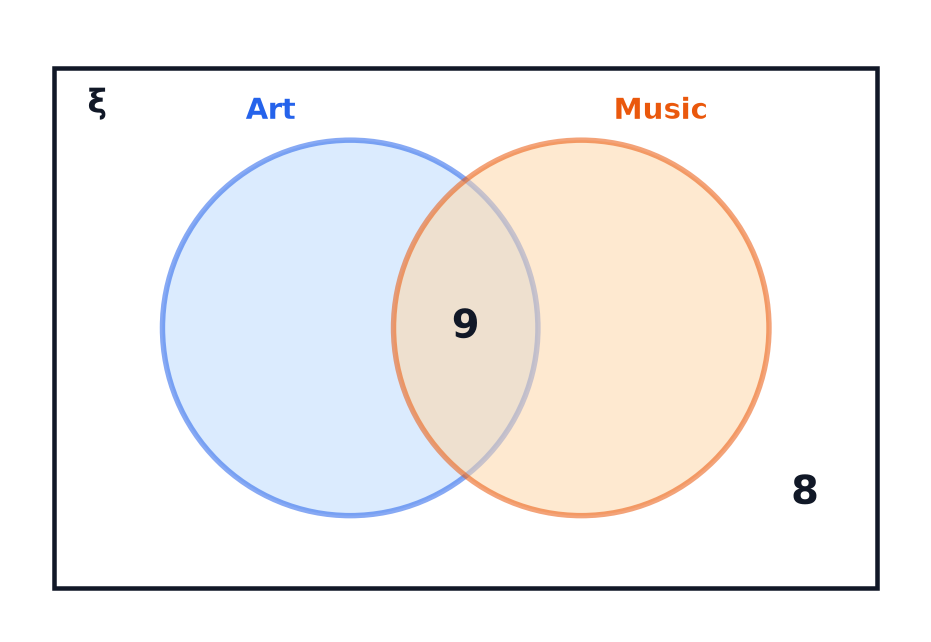
44 pupils each choose art, music, both or neither. 25 choose art and 20 choose music. The incomplete Venn diagram shows 9 pupils in both and 8 in neither. (a) Complete the Venn diagram. [2 marks] (b) A pupil is chosen at random. Work out the probability that the pupil chose music but not art. [2 marks]
Show answerHide answer
Model answer
(a) Art only is \(25 - 9 = 16\) and music only is \(20 - 9 = 11\). Check: \(16 + 9 + 11 + 8 = 44\). (b) \(\dfrac{11}{44} = \dfrac{1}{4}\).
Mark scheme
- (a) 16 — B1
- (a) 11 — B1
- (b) \(\dfrac{11}{44}\) — M1
- (b) \(\dfrac{1}{4}\) — A1
-
3 Work out [3 marks]
\(\xi = \{1, 2, 3, \ldots, 15\}\). \(A\) is the set of multiples of 2 and \(B\) is the set of multiples of 5. (a) Write down \(A \cap B\). [1 mark] (b) A number is chosen at random from \(\xi\). Work out the probability that it is in \(A \cup B\). [2 marks]
Show answerHide answer
Model answer
(a) \(A \cap B = \{10\}\). (b) \(A \cup B = \{2, 4, 5, 6, 8, 10, 12, 14, 15\}\), which has 9 members, so the probability is \(\dfrac{9}{15} = \dfrac{3}{5}\).
Mark scheme
- (a) \(\{10\}\) — B1
- (b) 9 numbers in the union — M1
- (b) \(\dfrac{3}{5}\) — A1
-
4 Work out [3 marks]
In a survey of 60 people, 35 own a cat and 28 own a dog. 10 people own neither. Work out the number of people who own both a cat and a dog. [3 marks]
Show answerHide answer
Model answer
\(60 - 10 = 50\) own at least one pet. Then \(35 + 28 - 50 = 13\) own both.
Mark scheme
- \(60 - 10 = 50\) — M1
- \(35 + 28 - 50\) — M1
- 13 — A1
-
5 Work out [4 marks]
The Venn diagram for 49 people has \(3x\) in set \(A\) only, \(x\) in both sets, \(2x + 1\) in set \(B\) only, and 6 in neither set. (a) Work out the value of \(x\). [2 marks] (b) Work out the probability that a person chosen at random is in both sets. [2 marks]
Show answerHide answer
Model answer
(a) \(3x + x + 2x + 1 + 6 = 49\), so \(6x + 7 = 49\) and \(x = 7\). (b) \(\dfrac{7}{49} = \dfrac{1}{7}\).
Mark scheme
- (a) \(6x + 7 = 49\) — M1
- (a) \(x = 7\) — A1
- (b) \(\dfrac{7}{49}\) — M1
- (b) \(\dfrac{1}{7}\) — A1
-
6 Work out [3 marks]
\(P(A) = 0.6\), \(P(B) = 0.5\) and \(P(A \cap B) = 0.3\). (a) Work out \(P(A \cup B)\). [2 marks] (b) Work out the probability that neither \(A\) nor \(B\) happens. [1 mark]
Show answerHide answer
Model answer
(a) \(0.6 + 0.5 - 0.3 = 0.8\). (b) \(1 - 0.8 = 0.2\).
Mark scheme
- (a) \(0.6 + 0.5 - 0.3\) — M1
- (a) \(0.8\) — A1
- (b) \(0.2\) — B1
Quick check
-
1
What does \(A \cap B\) mean?
Show answerHide answer
D: The items in both \(A\) and \(B\)
\(\cap\) is the intersection, the overlap.
-
2
What does \(A \cup B\) mean?
Show answerHide answer
C: The items in \(A\) or \(B\) or both
\(\cup\) is the union, everything in either circle.
-
3
What does \(A'\) mean?
Show answerHide answer
B: The items not in \(A\)
\(A'\) is the complement of \(A\).
-
4
\(A = \{2, 4, 6, 8, 10\}\) and \(B = \{3, 6, 9\}\). What is \(A \cap B\)?
Show answerHide answer
A: \(\{6\}\)
Only 6 is in both sets.
-
5
18 students play football and 6 of them also play tennis. How many play football only?
Show answerHide answer
D: \(12\)
\(18 - 6 = 12\).
-
6
30 students: 18 play football, 14 play tennis and 6 play both. How many play neither?
Show answerHide answer
C: \(4\)
\(12 + 6 + 8 = 26\) play at least one, so \(30 - 26 = 4\).
-
7
In the same survey, what is the probability that a student chosen at random plays football only?
Show answerHide answer
B: \(\dfrac{2}{5}\)
\(\dfrac{12}{30} = \dfrac{2}{5}\). The fraction \(\dfrac{18}{30}\) would include those who play both.
-
8
In a class of 40, 22 play football, 19 play tennis and 5 play neither. How many play both?
Show answerHide answer
A: \(6\)
\(40 - 5 = 35\) play at least one, and \(22 + 19 - 35 = 6\).
-
9
\(n(A) = 15\), \(n(B) = 12\) and \(n(A \cap B) = 5\). What is \(n(A \cup B)\)?
Show answerHide answer
D: \(22\)
\(15 + 12 - 5 = 22\).