Exam questions · Maths · Ratio and Proportion
Units, Conversions and Scale
- 6 exam questions
- 17 marks
- 9 quick checks
-
1 Change [2 marks]
(a) Change 6.5 m to centimetres. [1 mark] (b) Change 3200 g to kilograms. [1 mark]
Show answerHide answer
Model answer
(a) \(6.5 \times 100 = 650\) cm. (b) \(3200 \div 1000 = 3.2\) kg.
Mark scheme
- (a) 650 cm — B1
- (b) 3.2 kg — B1
-
2 Work out [2 marks]
A bottle holds 1.5 litres of juice. How many 250 ml glasses can be completely filled from the bottle?
Show answerHide answer
Model answer
\(1.5\text{ litres} = 1500\) ml, and \(1500 \div 250 = 6\) glasses.
Mark scheme
- 1500 ml seen, or \(1500 \div 250\) — M1
- 6 — A1
-
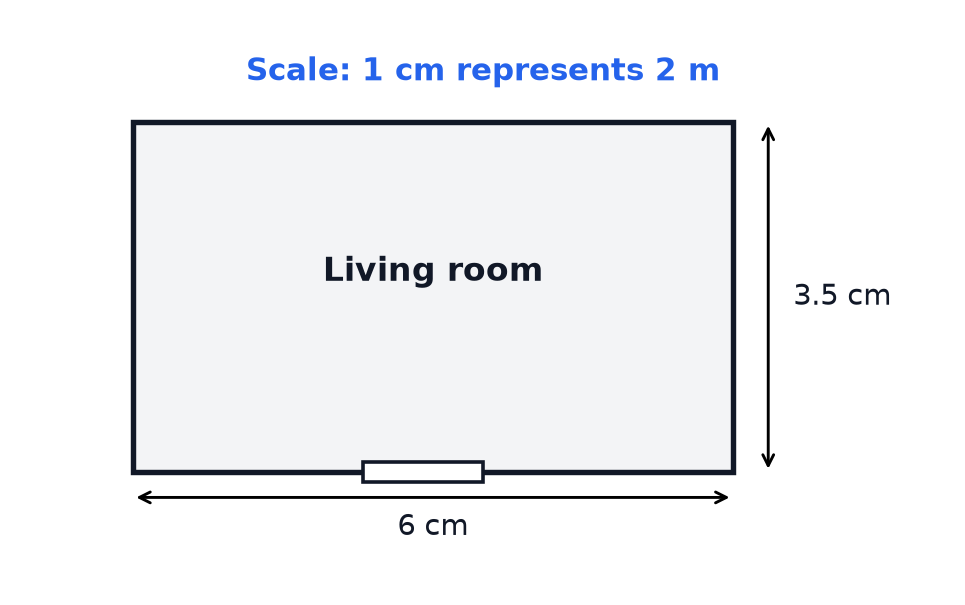
3 Work out [5 marks]
The diagram shows a scale drawing of a living room. The scale is 1 cm to 2 m. (a) Work out the real length of the room. [1 mark] (b) Work out the real perimeter of the room. [2 marks] (c) Work out the real area of the room. [2 marks]
Show answerHide answer
Model answer
(a) \(6 \times 2 = 12\) m. (b) The real width is \(3.5 \times 2 = 7\) m, so the perimeter is \(2 \times (12 + 7) = 38\) m. (c) The area is \(12 \times 7 = 84\) m\(^2\).
Mark scheme
- (a) 12 m — B1
- (b) Real width 7 m, or \(12 + 7 + 12 + 7\) — M1
- (b) 38 m — A1
- (c) \(12 \times 7\) — M1
- (c) 84 m\(^2\) — A1
-
4 Work out [3 marks]
A map has a scale of \(1 : 20\,000\). A path is 9 cm long on the map. Work out the real length of the path in kilometres.
Show answerHide answer
Model answer
\(9 \times 20\,000 = 180\,000\) cm. This is 1800 m, which is 1.8 km.
Mark scheme
- \(9 \times 20\,000\) — M1
- \(180\,000\) cm or \(1800\) m — M1
- 1.8 km — A1
-
5 Work out [2 marks]
1 gallon is approximately 4.5 litres. A tank holds 36 litres of water. Approximately how many gallons does it hold?
Show answerHide answer
Model answer
\(36 \div 4.5 = 8\) gallons.
Mark scheme
- \(36 \div 4.5\) — M1
- 8 gallons — A1
-
6 Change [3 marks]
(a) Change 0.2 m\(^2\) to cm\(^2\). [2 marks] (b) Change \(3\,000\,000\) cm\(^3\) to m\(^3\). [1 mark]
Show answerHide answer
Model answer
(a) \(1\text{ m}^2 = 10\,000\) cm\(^2\), so \(0.2 \times 10\,000 = 2000\) cm\(^2\). (b) \(3\,000\,000 \div 1\,000\,000 = 3\) m\(^3\).
Mark scheme
- (a) \(0.2 \times 10\,000\) or \(20 \times 100\) — M1
- (a) 2000 — A1
- (b) 3 — B1
Quick check
-
1
Change 3.6 km to metres.
Show answerHide answer
A: 3600 m
Multiply by 1000: \(3.6 \times 1000 = 3600\).
-
2
Change 2450 g to kilograms.
Show answerHide answer
D: 2.45 kg
Divide by 1000: \(2450 \div 1000 = 2.45\).
-
3
Change 0.75 litres to millilitres.
Show answerHide answer
C: 750 ml
Multiply by 1000: \(0.75 \times 1000 = 750\).
-
4
Change 250 cm to metres.
Show answerHide answer
B: 2.5 m
Divide by 100: \(250 \div 100 = 2.5\).
-
5
A map has a scale of \(1 : 50\,000\). Two towns are 4 cm apart on the map. What is the real distance?
Show answerHide answer
A: 2 km
\(4 \times 50\,000 = 200\,000\) cm. Divide by 100 to get 2000 m, then by 1000 to get 2 km.
-
6
A scale drawing uses 1 cm to represent 2 m. A line on the drawing is 7 cm. How long is it in real life?
Show answerHide answer
D: 14 m
Multiply by the scale: \(7 \times 2 = 14\) m.
-
7
A cake uses 250 g of flour. How many cakes can be made from a 2 kg bag?
Show answerHide answer
C: 8
\(2\text{ kg} = 2000\) g, and \(2000 \div 250 = 8\).
-
8
How many cm\(^2\) are in 1 m\(^2\)?
Show answerHide answer
B: 10 000
A square metre is a square of side 100 cm, so its area is \(100 \times 100 = 10\,000\) cm\(^2\).
-
9
Change 5 m\(^3\) to cm\(^3\).
Show answerHide answer
A: 5 000 000 cm\(^3\)
\(1\text{ m}^3 = 100^3 = 1\,000\,000\) cm\(^3\), so \(5\text{ m}^3 = 5\,000\,000\) cm\(^3\).