Maths · Ratio and Proportion
Viewing as
Teaching this? The teacher view opens every answer and mark scheme.
Units, Conversions and Scale
Converting between metric units, using scales on maps and drawings, and changing units of area and volume.
Learning Objectives
- 1Convert between metric units of length, mass, capacity and time without a calculator.
- 2Convert between units of area and volume (Higher tier).
- 3Use a scale such as 1 cm to 2 m, or a map ratio such as 1 : 50 000, to find real lengths and drawing lengths.
- 4Solve problems that need a conversion before the main calculation.
Why units matter
Many marks in this topic are lost before any real maths starts, by mixing centimetres with metres or grams with kilograms. On a non-calculator paper the conversions are always multiplications or divisions by 10, 100 or 1000, so they are quick once you know which way to go. The golden rule is to decide whether the number should get bigger or smaller before you move the decimal point.
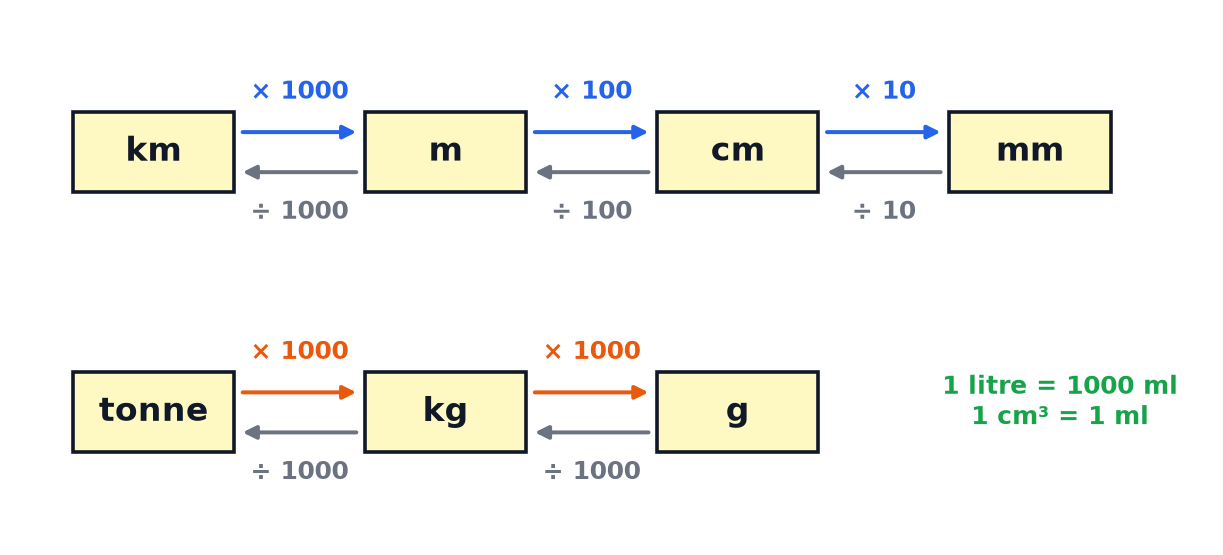
The metric conversion ladder
Going from a big unit to a smaller unit means there are more of them, so you multiply. Going from a small unit to a bigger unit means there are fewer, so you divide.
Using the ladder
- Big to small Multiply. 3 km is \(3 \times 1000 = 3000\) m, because a metre is a small unit and you need many of them.
- Small to big Divide. 450 cm is \(450 \div 100 = 4.5\) m.
- Two steps Do them one at a time. 2.5 km in centimetres is \(2.5 \times 1000 = 2500\) m, then \(2500 \times 100 = 250\,000\) cm.
Facts you must know
These are never given on the formula sheet, so they have to be learned.
-
Length
10 mm \(=\) 1 cm, 100 cm \(=\) 1 m, 1000 m \(=\) 1 km.
-
Mass
1000 g \(=\) 1 kg, 1000 kg \(=\) 1 tonne.
-
Capacity
1000 ml \(=\) 1 litre, 100 cl \(=\) 1 litre, and 1 cm\(^3\) \(=\) 1 ml.
-
Time
60 seconds in a minute, 60 minutes in an hour, 24 hours in a day. Time is not decimal, so 1.5 hours is 90 minutes, not 150.
-
Imperial units
Edexcel, AQA and OCR expect you to know rough equivalents only when they are given in the question, such as 1 inch \(\approx\) 2.5 cm, 1 kg \(\approx\) 2.2 pounds, 1 gallon \(\approx\) 4.5 litres. Learn the common ones in case they are not.
Converting units
(a) Change 3.6 km to metres. (b) Change 2450 g to kilograms. (c) Change 0.75 litres to millilitres.
Show the solutionHide the solution
- 1 (a) Big to small, so multiply \(3.6 \times 1000 = 3600\) m.
- 2 (b) Small to big, so divide \(2450 \div 1000 = 2.45\) kg.
- 3 (c) Big to small, so multiply \(0.75 \times 1000 = 750\) ml.
- 4 Check the size A kilometre is much longer than a metre, so there should be many more metres than kilometres.
Answer(a) 3600 m (b) 2.45 kg (c) 750 ml
Problems with mixed units
A question will often give one quantity in one unit and another in a different unit. Put them in the same unit before doing anything else.
-
Make the units match first
Do the conversion as its own line of working so the method mark is easy to see.
-
Choose the easier unit
Work in whichever unit leads to whole numbers. Changing 2.5 m to 250 cm is usually easier than changing 80 cm to 0.8 m.
-
Convert the answer back
If the question asks for the answer in kilograms, finish in kilograms.
-
Check with common sense
A bag of sugar does not weigh 2500 kg.
Using two different units
A recipe needs 250 g of flour for one cake. Mia has a 2 kg bag of flour. How many cakes can she make?
Show the solutionHide the solution
- 1 Make the units match \(2\text{ kg} = 2 \times 1000 = 2000\) g.
- 2 Divide the flour by the amount for one cake \(2000 \div 250\).
- 3 Calculate \(2000 \div 250 = 8\).
- 4 Write the answer 8 cakes.
Answer8 cakes
Scale drawings and maps
A scale tells you how a length on a drawing or map is linked to the real length.
-
Written as a statement
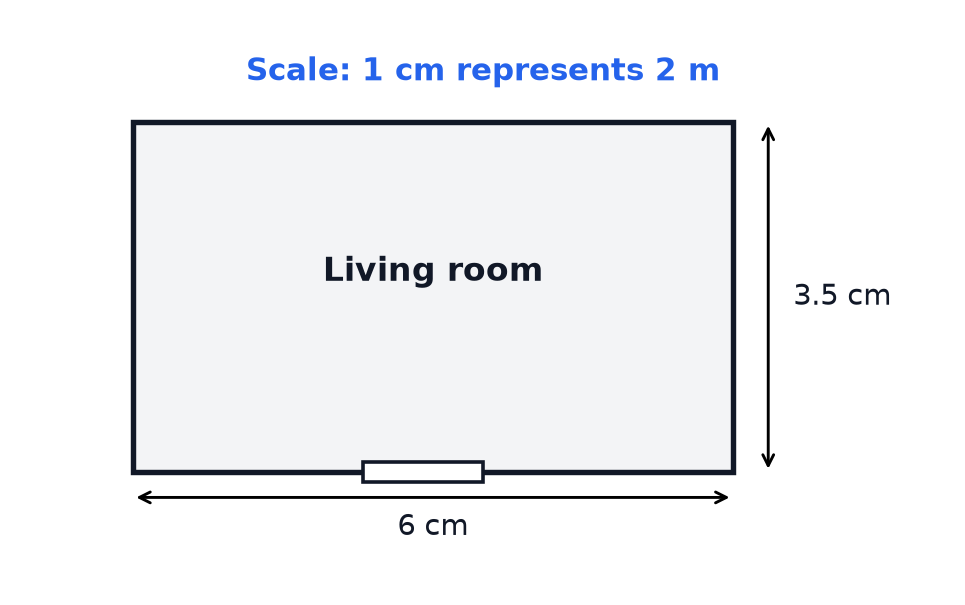
"1 cm represents 2 m" means every centimetre on the drawing is 2 metres in real life.
-
Written as a ratio
A scale of \(1 : 50\,000\) means 1 unit on the map is 50 000 of the same unit in real life. The units on both sides are the same, so 1 cm on the map is 50 000 cm, which is 500 m or 0.5 km.
-
Drawing to real life
Multiply the drawing length by the scale factor.
-
Real life to drawing
Divide the real length by the scale factor.
A scale drawing of a room
Every length on the drawing is multiplied by the scale to give the real length. The room is 6 cm long on the plan, so in real life it is \(6 \times 2 = 12\) m long.
Reading the plan
- Real length \(6 \text{ cm} \times 2 = 12\) m.
- Real width \(3.5 \text{ cm} \times 2 = 7\) m.
- Real area \(12 \times 7 = 84\) m\(^2\). The area is not \(6 \times 3.5 \times 2\), which is a common mistake.
Maps with a ratio scale
A map has a scale of \(1 : 25\,000\). Two towns are 8 cm apart on the map. Work out the real distance in kilometres.
Show the solutionHide the solution
- 1 Multiply by the scale \(8 \times 25\,000 = 200\,000\) cm.
- 2 Centimetres to metres \(200\,000 \div 100 = 2000\) m.
- 3 Metres to kilometres \(2000 \div 1000 = 2\) km.
- 4 Write the answer 2 km.
Answer2 km
Units of area and volume (Higher tier)
When the unit is squared or cubed, the conversion factor is squared or cubed too. This is a Higher tier skill that catches out many students.
-
Why it is different
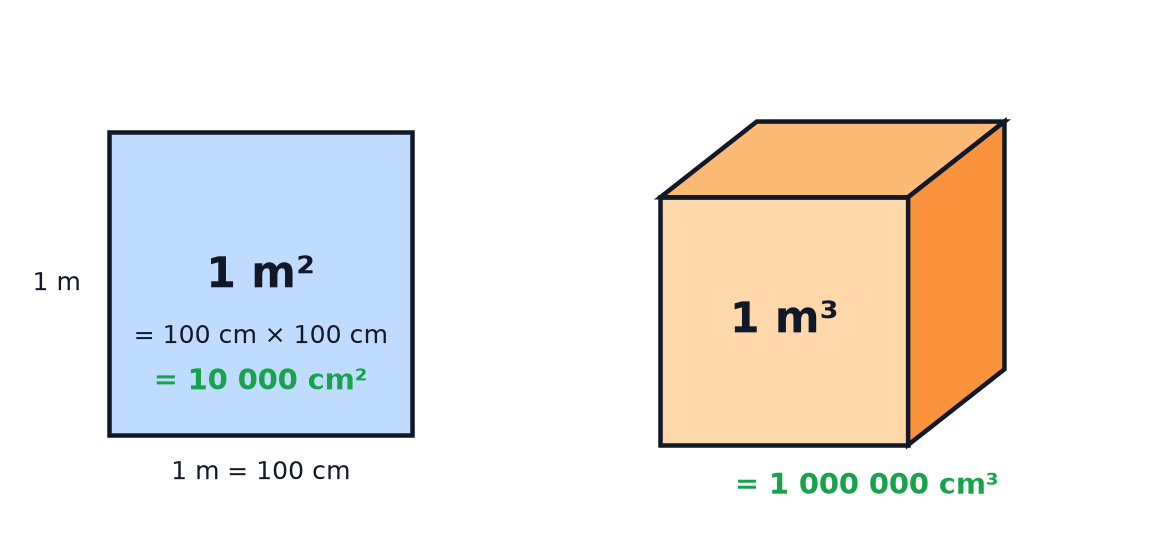
1 m \(=\) 100 cm, but 1 m\(^2\) is a square of side 100 cm, so it is \(100 \times 100 = 10\,000\) cm\(^2\).
-
Volume
1 m\(^3\) is a cube of side 100 cm, so it is \(100 \times 100 \times 100 = 1\,000\,000\) cm\(^3\).
-
Square millimetres
1 cm\(^2\) \(= 10 \times 10 = 100\) mm\(^2\).
-
Quick check
Draw a unit square on the diagram above and label its sides. It is much safer than trying to remember the number.
Converting areas and volumes
Because every side is converted, you multiply by the conversion factor once for each dimension. Two dimensions for area, and three for volume.
Remember the pattern
- Area Multiply the length conversion by itself: \(100^2 = 10\,000\), \(10^2 = 100\), \(1000^2 = 1\,000\,000\).
- Volume Cube the length conversion: \(100^3 = 1\,000\,000\), \(10^3 = 1000\).
- Going back Divide instead of multiplying.
Changing an area
(Higher tier) Change 3.2 m\(^2\) to cm\(^2\).
Show the solutionHide the solution
- 1 Find the conversion for area \(1\text{ m}^2 = 100 \times 100 = 10\,000\text{ cm}^2\).
- 2 Multiply \(3.2 \times 10\,000 = 32\,000\).
- 3 Write the answer 32 000 cm\(^2\).
Answer32 000 cm\(^2\)
What the AQA exam gives you
AQA's specification says some conversions will be given.
-
Metric conversions are not given
Know that 10 mm \(=\) 1 cm, 100 cm \(=\) 1 m, 1000 m \(=\) 1 km, 1000 g \(=\) 1 kg and 1000 ml \(=\) 1 litre, and how they change for areas and volumes.
-
Imperial to metric is given
If a question needs, say, 1 gallon \(\approx\) 4.5 litres, the question tells you the conversion.
Test yourself
-
1
How many metres are in a kilometre?
Show answerHide answer
1000.
-
2
How many grams are in a kilogram?
Show answerHide answer
1000.
-
3
How many millilitres are in a litre?
Show answerHide answer
1000.
-
4
A map scale is \(1 : 50\,000\). What does 1 cm on the map represent in real life?
Show answerHide answer
50 000 cm, which is 500 m.
-
5
How many square centimetres are in a square metre?
Show answerHide answer
10 000.
Exam technique: units and scale
These questions look easy, which is why a careless slip costs marks.
-
Say which way you are going
Write "\(\times 100\)" next to a conversion so you can check it.
-
Write the units on each line
A number with no unit is easy to misuse.
-
Do not convert the area by the length
4 m\(^2\) is not 400 cm\(^2\).
-
Read the scale carefully
"1 cm represents 2 m" and "1 : 2" are very different scales.
Summary and exam focus
- Big unit to small unit means multiply, and small to big means divide.
- Know 10, 100 and 1000 for length, mass and capacity, and that 1 cm\(^3\) is 1 ml.
- Put every quantity in the same unit before calculating.
- Multiply by the scale for real lengths and divide by it to draw.
- Area and volume conversions use the square and cube of the length conversion (Higher tier).
Exam focus
A map has a scale of 1 cm to 5 km. Two towns are 7.5 cm apart on the map. Work out the real distance between them. (2 marks) (2 marks)
Multiply \(7.5 \times 5\) to get 37.5 km. Decimals are likely here, so write \(7 \times 5 = 35\) and \(0.5 \times 5 = 2.5\) separately and add them. Always put the unit in your answer.
Key terms
The words this lesson expects you to use. Each one is linked from the first place it appears above.
- Metric units
- Units based on powers of ten, such as millimetres, centimetres, metres and kilometres.
- Conversion factor
- The number you multiply or divide by to change from one unit to another.
- Capacity
- The amount a container can hold, measured in litres or millilitres.
- Tonne
- A unit of mass equal to 1000 kilograms.
- Scale
- The ratio between a length on a drawing or map and the real length.
- Scale factor
- The number you multiply by to turn a drawing length into a real length.
- Map
- A scale drawing of an area, where lengths on the paper represent real distances.
- Area
- The amount of surface a shape covers, measured in square units.
- Volume
- The amount of space a solid takes up, measured in cubic units.
You've finished the notes
Check your understanding
Test yourself while it is fresh. Start with the flashcards, then try the exam questions.
Something here looks wrong?
Tell us what and we will go and look. It goes to whoever writes these pages, nobody else, and we do not ask who you are — so there is nothing to sign and nothing comes back to you.