Exam questions · Maths · Statistics
Averages and Range
- 6 exam questions
- 21 marks
- 9 quick checks
-
1 Work out [3 marks]
Here are the ages, in years, of seven children: 14, 11, 15, 11, 13, 17, 11. Work out (a) the mode, (b) the median, (c) the range. [3 marks]
Show answerHide answer
Model answer
(a) 11 appears three times, so the mode is 11. (b) In order: 11, 11, 11, 13, 14, 15, 17, so the median is 13. (c) \(17 - 11 = 6\).
Mark scheme
- (a) 11 — B1
- (b) 13 — B1
- (c) 6 — B1
-
2 Work out [6 marks]
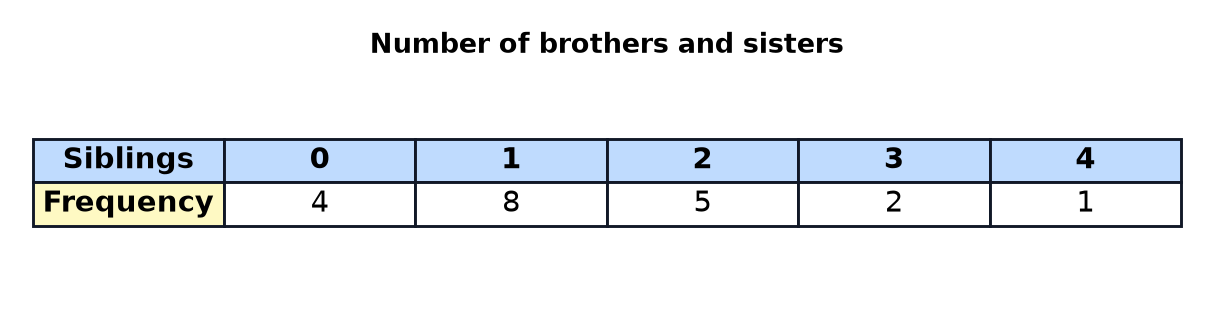
The table shows the number of brothers and sisters that each of 20 pupils has. (a) Write down the mode. [1 mark] (b) Work out the mean. [3 marks] (c) Work out the median. [2 marks]
Show answerHide answer
Model answer
(a) The highest frequency is 8, so the mode is 1. (b) \(0 \times 4 + 1 \times 8 + 2 \times 5 + 3 \times 2 + 4 \times 1 = 0 + 8 + 10 + 6 + 4 = 28\). The mean is \(\dfrac{28}{20} = 1.4\). (c) The cumulative frequencies are 4, 12, 17, 19, 20, so the 10th and 11th values are both 1. The median is 1.
Mark scheme
- (a) 1 — B1
- (b) Products \(f \times x\) with at least 4 correct — M1
- (b) \(\dfrac{28}{20}\) or total 28 — M1
- (b) 1.4 — A1
- (c) Cumulative frequencies, or the 10th and 11th values — M1
- (c) 1 — A1
-
3 Compare [2 marks]
Team A scored a mean of 24 points in a game and the range was 10. Team B scored a mean of 27 points and the range was 18. Compare the points scored by the two teams. [2 marks]
Show answerHide answer
Model answer
On average Team B scored more points, with a mean of 27 compared with 24. Team A was more consistent, because its range of 10 is smaller than 18.
Mark scheme
- A comparison of the means, in context — Q1
- A comparison of the ranges, in context — Q1
-
4 Work out [3 marks]
The mean of six numbers is 9. Five of the numbers are 4, 8, 10, 11 and 13. Work out the sixth number. [3 marks]
Show answerHide answer
Model answer
The total of six numbers is \(6 \times 9 = 54\). The five known numbers add up to \(4 + 8 + 10 + 11 + 13 = 46\). The sixth number is \(54 - 46 = 8\).
Mark scheme
- \(6 \times 9 = 54\) — M1
- \(54 - 46\) — M1
- 8 — A1
-
5 Work out [4 marks]
The table shows the heights of 40 plants. For the classes \(0 < h \leq 10\), \(10 < h \leq 20\), \(20 < h \leq 30\) and \(30 < h \leq 40\) the frequencies are 6, 14, 12 and 8. (a) Write down the modal class. [1 mark] (b) Work out an estimate for the mean height. [3 marks]
Show answerHide answer
Model answer
(a) The highest frequency is 14, so the modal class is \(10 < h \leq 20\). (b) The mid-points are 5, 15, 25 and 35. \(5 \times 6 + 15 \times 14 + 25 \times 12 + 35 \times 8 = 30 + 210 + 300 + 280 = 820\). The estimate of the mean is \(\dfrac{820}{40} = 20.5\).
Mark scheme
- (a) \(10 < h \leq 20\) — B1
- (b) Mid-points 5, 15, 25, 35 used — M1
- (b) \(\dfrac{820}{40}\) or total 820 — M1
- (b) 20.5 — A1
-
6 Work out [3 marks]
The mean of 3 numbers is 5. The mean of 7 other numbers is 9. Work out the mean of all 10 numbers. [3 marks]
Show answerHide answer
Model answer
The total of the first 3 numbers is \(3 \times 5 = 15\) and of the other 7 is \(7 \times 9 = 63\). The mean of all 10 is \(\dfrac{15 + 63}{10} = \dfrac{78}{10} = 7.8\).
Mark scheme
- \(3 \times 5 = 15\) or \(7 \times 9 = 63\) — M1
- \(\dfrac{15 + 63}{10}\) — M1
- 7.8 — A1
Quick check
-
1
What is the median of 3, 5, 6, 8, 9, 12?
Show answerHide answer
B: \(7\)
With 6 values, take the mean of the 3rd and 4th: \(\dfrac{6 + 8}{2} = 7\).
-
2
What is the range of 3, 8, 11, 20?
Show answerHide answer
A: \(17\)
\(20 - 3 = 17\).
-
3
What is the mean of 4, 6, 8, 10, 12?
Show answerHide answer
D: \(8\)
\(\dfrac{40}{5} = 8\).
-
4
Which average is least affected by an outlier?
Show answerHide answer
C: The median
The median depends only on the middle value.
-
5
The numbers 0, 1, 2, 3, 4 have frequencies 4, 4, 6, 4, 2. What is the mean?
Show answerHide answer
B: \(1.8\)
\(\dfrac{0 + 4 + 12 + 12 + 8}{20} = \dfrac{36}{20} = 1.8\).
-
6
What is the mode of the numbers 0, 1, 2, 3, 4 with frequencies 4, 4, 6, 4, 2?
Show answerHide answer
A: \(2\)
The highest frequency, 6, is for the value 2.
-
7
What is the mid-point of the class \(20 < w \leq 40\)?
Show answerHide answer
D: \(30\)
\(\dfrac{20 + 40}{2} = 30\).
-
8
Classes \(0 < w \leq 20\), \(20 < w \leq 40\) and \(40 < w \leq 60\) have frequencies 5, 10 and 5. What is the estimated mean?
Show answerHide answer
C: \(30\)
Using mid-points: \(\dfrac{10 \times 5 + 30 \times 10 + 50 \times 5}{20} = \dfrac{600}{20} = 30\).
-
9
The mean of five numbers is 8. Four of them are 5, 7, 9 and 10. What is the fifth?
Show answerHide answer
B: \(9\)
The total is \(5 \times 8 = 40\), and \(40 - 31 = 9\).