Exam questions · Maths
Vectors, Constructions and Loci
- 30 exam questions
- 89 marks
- 45 quick checks
Column Vectors and Vector Arithmetic
Just this lesson-
1 Work out [2 marks]
Work out \(\begin{pmatrix} 3 \\ 1 \end{pmatrix} + \begin{pmatrix} 2 \\ 4 \end{pmatrix}\). [2 marks]
Show answerHide answer
Model answer
\(\begin{pmatrix} 5 \\ 5 \end{pmatrix} = \begin{pmatrix} 5 \\ 5 \end{pmatrix}\).
Mark scheme
- Adds the top numbers or the bottom numbers — M1
- \(\begin{pmatrix} 5 \\ 5 \end{pmatrix}\) — A1
-
2 Work out [4 marks]
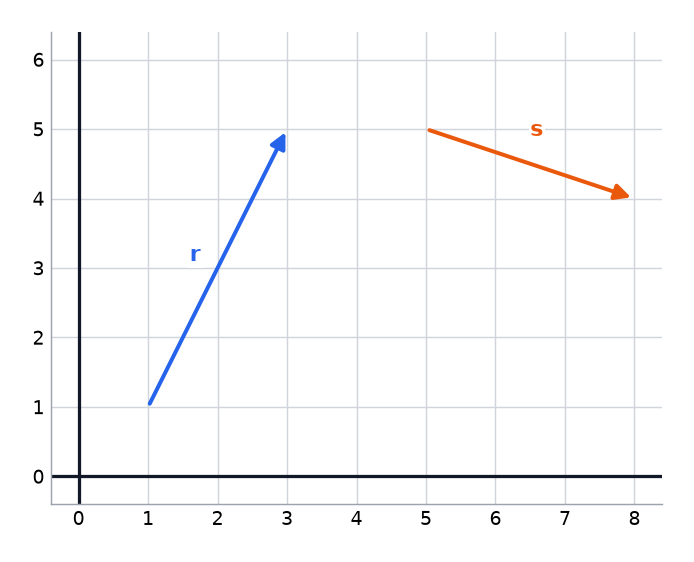
The vectors \(\mathbf{r}\) and \(\mathbf{s}\) are drawn on the grid. (a) Write \(\mathbf{r}\) and \(\mathbf{s}\) as column vectors. [2 marks] (b) Work out \(3\mathbf{r} - \mathbf{s}\). [2 marks]
Show answerHide answer
Model answer
(a) \(\mathbf{r}\) goes 2 right and 4 up, so \(\mathbf{r} = \begin{pmatrix} 2 \\ 4 \end{pmatrix}\). \(\mathbf{s}\) goes 3 right and 1 down, so \(\mathbf{s} = \begin{pmatrix} 3 \\ -1 \end{pmatrix}\). (b) \(3\mathbf{r} = \begin{pmatrix} 6 \\ 12 \end{pmatrix}\), so \(3\mathbf{r} - \mathbf{s} = \begin{pmatrix} 3 \\ 13 \end{pmatrix}\).
Mark scheme
- (a) \(\mathbf{r} = \begin{pmatrix} 2 \\ 4 \end{pmatrix}\) — B1
- (a) \(\mathbf{s} = \begin{pmatrix} 3 \\ -1 \end{pmatrix}\) — B1
- (b) \(3\mathbf{r} = \begin{pmatrix} 6 \\ 12 \end{pmatrix}\) or a correct method — M1
- (b) \(\begin{pmatrix} 3 \\ 13 \end{pmatrix}\) — A1 (follow through from (a))
-
3 Work out [3 marks]
\(P\) is the point \((2, -1)\) and \(Q\) is the point \((-3, 4)\). (a) Write \(\overrightarrow{PQ}\) as a column vector. [2 marks] (b) Write \(\overrightarrow{QP}\) as a column vector. [1 mark]
Show answerHide answer
Model answer
(a) \((-3 - 2, 4 - (-1)) = (-5, 5)\), so \(\overrightarrow{PQ} = \begin{pmatrix} -5 \\ 5 \end{pmatrix}\). (b) \(\overrightarrow{QP} = \begin{pmatrix} 5 \\ -5 \end{pmatrix}\).
Mark scheme
- (a) \(-3 - 2\) or \(4 - (-1)\) — M1
- (a) \(\begin{pmatrix} -5 \\ 5 \end{pmatrix}\) — A1
- (b) \(\begin{pmatrix} 5 \\ -5 \end{pmatrix}\) — B1 (follow through from (a))
-
4 Work out [3 marks]
\(\mathbf{a} = \begin{pmatrix} -2 \\ 5 \end{pmatrix}\) and \(\mathbf{b} = \begin{pmatrix} 4 \\ 1 \end{pmatrix}\). (a) Work out \(2\mathbf{a} - \mathbf{b}\). [2 marks] (b) Work out \(\mathbf{a} + \mathbf{b}\). [1 mark]
Show answerHide answer
Model answer
(a) \(2\mathbf{a} = \begin{pmatrix} -4 \\ 10 \end{pmatrix}\), so \(2\mathbf{a} - \mathbf{b} = \begin{pmatrix} -8 \\ 9 \end{pmatrix}\). (b) \(\begin{pmatrix} 2 \\ 6 \end{pmatrix}\).
Mark scheme
- (a) \(2\mathbf{a} = \begin{pmatrix} -4 \\ 10 \end{pmatrix}\) or a correct method — M1
- (a) \(\begin{pmatrix} -8 \\ 9 \end{pmatrix}\) — A1
- (b) \(\begin{pmatrix} 2 \\ 6 \end{pmatrix}\) — B1
-
5 Write down [2 marks]
Write down a vector that is parallel to \(\begin{pmatrix} 1 \\ -3 \end{pmatrix}\) and four times as long. [2 marks]
Show answerHide answer
Model answer
Multiply by 4: \(4 \times \begin{pmatrix} 1 \\ -3 \end{pmatrix} = \begin{pmatrix} 4 \\ -12 \end{pmatrix}\).
Mark scheme
- Multiplies both numbers by 4 — M1
- \(\begin{pmatrix} 4 \\ -12 \end{pmatrix}\) — A1
-
6 Show that [3 marks]
\(\overrightarrow{AB} = \begin{pmatrix} 2 \\ 3 \end{pmatrix}\) and \(\overrightarrow{BC} = \begin{pmatrix} 4 \\ 6 \end{pmatrix}\). Show that \(A\), \(B\) and \(C\) lie on a straight line. [3 marks]
Show answerHide answer
Model answer
\(\overrightarrow{BC} = \begin{pmatrix} 4 \\ 6 \end{pmatrix} = 2 \times \begin{pmatrix} 2 \\ 3 \end{pmatrix} = 2\overrightarrow{AB}\). The vectors are parallel and share the point \(B\), so \(A\), \(B\) and \(C\) are on a straight line.
Mark scheme
- \(\overrightarrow{BC} = 2\overrightarrow{AB}\) — M1
- Parallel — A1
- Common point \(B\), so collinear — Q1
Quick check
-
1
What does the column vector \(\begin{pmatrix} -2 \\ 5 \end{pmatrix}\) mean?
Show answerHide answer
B: 2 left and 5 up
The top number is the horizontal move, and the bottom number is the vertical move.
-
2
\(A\) is \((2, 5)\) and \(B\) is \((6, 2)\). What is \(\overrightarrow{AB}\)?
Show answerHide answer
A: \(\begin{pmatrix} 4 \\ -3 \end{pmatrix}\)
Subtract the start from the end: \((6 - 2, 2 - 5) = (4, -3)\).
-
3
What is \(\begin{pmatrix} 3 \\ 2 \end{pmatrix} + \begin{pmatrix} 1 \\ 4 \end{pmatrix}\)?
Show answerHide answer
D: \(\begin{pmatrix} 4 \\ 6 \end{pmatrix}\)
Add the top numbers and add the bottom numbers.
-
4
What is \(\begin{pmatrix} 3 \\ 2 \end{pmatrix} - \begin{pmatrix} 1 \\ 4 \end{pmatrix}\)?
Show answerHide answer
C: \(\begin{pmatrix} 2 \\ -2 \end{pmatrix}\)
\((3 - 1, 2 - 4) = (2, -2)\).
-
5
What is \(3\begin{pmatrix} 2 \\ -1 \end{pmatrix}\)?
Show answerHide answer
B: \(\begin{pmatrix} 6 \\ -3 \end{pmatrix}\)
Multiply both numbers by 3.
-
6
\(\mathbf{p} = \begin{pmatrix} 2 \\ 3 \end{pmatrix}\) and \(\mathbf{q} = \begin{pmatrix} -1 \\ 4 \end{pmatrix}\). What is \(2\mathbf{p} - \mathbf{q}\)?
Show answerHide answer
A: \(\begin{pmatrix} 5 \\ 2 \end{pmatrix}\)
\(2\mathbf{p} = \begin{pmatrix} 4 \\ 6 \end{pmatrix}\), then \((4 - (-1), 6 - 4) = (5, 2)\).
-
7
Which vector is parallel to \(\begin{pmatrix} 2 \\ 3 \end{pmatrix}\)?
Show answerHide answer
D: \(\begin{pmatrix} 6 \\ 9 \end{pmatrix}\)
\(\begin{pmatrix} 6 \\ 9 \end{pmatrix} = 3\begin{pmatrix} 2 \\ 3 \end{pmatrix}\), so it is parallel.
-
8
\(\overrightarrow{AB} = \begin{pmatrix} 4 \\ -3 \end{pmatrix}\). What is \(\overrightarrow{BA}\)?
Show answerHide answer
C: \(\begin{pmatrix} -4 \\ 3 \end{pmatrix}\)
\(\overrightarrow{BA} = -\overrightarrow{AB}\), so both signs change.
-
9
What is the length of the vector \(\begin{pmatrix} 3 \\ 4 \end{pmatrix}\)?
Show answerHide answer
B: \(5\)
The length is \(\sqrt{3^2 + 4^2} = \sqrt{25} = 5\).
Vector Geometry and Proof
Just this lesson-
1 Write down [2 marks]
\(OABC\) is a parallelogram. \(\overrightarrow{OA} = \mathbf{a}\) and \(\overrightarrow{OC} = \mathbf{c}\). Write down (a) \(\overrightarrow{AB}\), (b) \(\overrightarrow{OB}\). [2 marks]
Show answerHide answer
Model answer
(a) \(AB\) is parallel and equal to \(OC\), so \(\overrightarrow{AB} = \mathbf{c}\). (b) \(\overrightarrow{OB} = \overrightarrow{OA} + \overrightarrow{AB} = \mathbf{a} + \mathbf{c}\).
Mark scheme
- (a) \(\mathbf{c}\) — B1
- (b) \(\mathbf{a} + \mathbf{c}\) — B1
-
2 Find [4 marks]
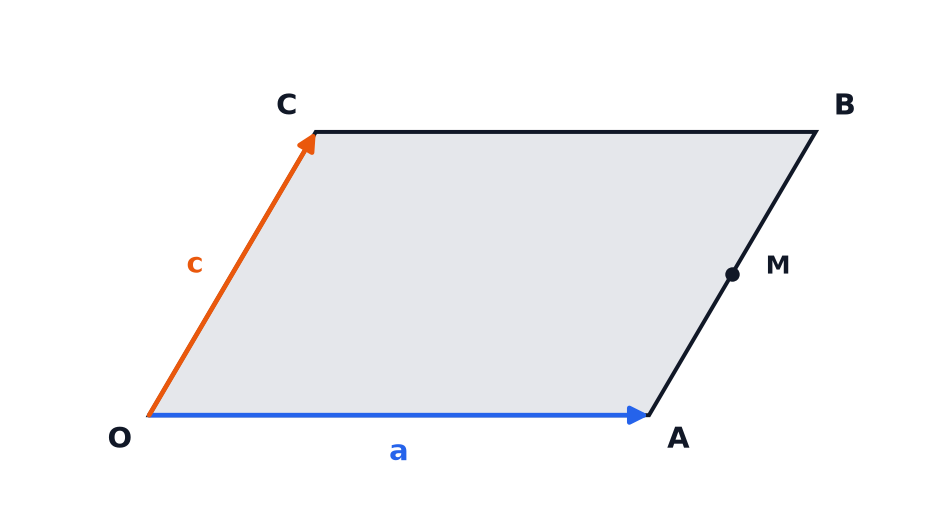
\(OABC\) is a parallelogram with \(\overrightarrow{OA} = \mathbf{a}\) and \(\overrightarrow{OC} = \mathbf{c}\). \(M\) is the midpoint of \(AB\). (a) Find \(\overrightarrow{AC}\) in terms of \(\mathbf{a}\) and \(\mathbf{c}\). [1 mark] (b) Find \(\overrightarrow{OM}\) in terms of \(\mathbf{a}\) and \(\mathbf{c}\). [2 marks] (c) Find \(\overrightarrow{CM}\) in terms of \(\mathbf{a}\) and \(\mathbf{c}\). [1 mark]
Show answerHide answer
Model answer
(a) \(\overrightarrow{AC} = -\mathbf{a} + \mathbf{c} = \mathbf{c} - \mathbf{a}\). (b) \(\overrightarrow{AM} = \dfrac{1}{2}\overrightarrow{AB} = \dfrac{1}{2}\mathbf{c}\), so \(\overrightarrow{OM} = \mathbf{a} + \dfrac{1}{2}\mathbf{c}\). (c) \(\overrightarrow{CM} = \overrightarrow{OM} - \overrightarrow{OC} = \mathbf{a} + \dfrac{1}{2}\mathbf{c} - \mathbf{c} = \mathbf{a} - \dfrac{1}{2}\mathbf{c}\).
Mark scheme
- (a) \(\mathbf{c} - \mathbf{a}\) — B1
- (b) \(\overrightarrow{OA} + \dfrac{1}{2}\overrightarrow{AB}\) or \(\mathbf{a} + \dfrac{1}{2}\mathbf{c}\) seen — M1
- (b) \(\mathbf{a} + \dfrac{1}{2}\mathbf{c}\) — A1
- (c) \(\mathbf{a} - \dfrac{1}{2}\mathbf{c}\) — B1
-
3 Prove [3 marks]
\(\overrightarrow{OP} = \mathbf{p}\), \(\overrightarrow{OQ} = \mathbf{q}\) and \(\overrightarrow{OR} = 2\mathbf{q} - \mathbf{p}\). Prove that \(P\), \(Q\) and \(R\) lie on a straight line. [3 marks]
Show answerHide answer
Model answer
\(\overrightarrow{PQ} = \mathbf{q} - \mathbf{p}\) and \(\overrightarrow{QR} = -\mathbf{q} + 2\mathbf{q} - \mathbf{p} = \mathbf{q} - \mathbf{p}\). So \(\overrightarrow{PQ} = \overrightarrow{QR}\). The vectors are parallel and share the point \(Q\), so \(P\), \(Q\) and \(R\) are on a straight line.
Mark scheme
- \(\overrightarrow{PQ} = \mathbf{q} - \mathbf{p}\) — M1
- \(\overrightarrow{QR} = \mathbf{q} - \mathbf{p}\) — M1
- Equal, so parallel, with a common point, so collinear — Q1
-
4 Find [3 marks]
\(\overrightarrow{OA} = \mathbf{a}\) and \(\overrightarrow{OB} = \mathbf{b}\). \(P\) is the point on \(AB\) such that \(AP : PB = 1 : 2\). Find \(\overrightarrow{OP}\) in terms of \(\mathbf{a}\) and \(\mathbf{b}\). [3 marks]
Show answerHide answer
Model answer
\(\overrightarrow{AP} = \dfrac{1}{3}(\mathbf{b} - \mathbf{a})\). So \(\overrightarrow{OP} = \mathbf{a} + \dfrac{1}{3}(\mathbf{b} - \mathbf{a}) = \dfrac{2}{3}\mathbf{a} + \dfrac{1}{3}\mathbf{b}\).
Mark scheme
- \(\overrightarrow{AP} = \dfrac{1}{3}\overrightarrow{AB}\) — M1
- \(\mathbf{a} + \dfrac{1}{3}(\mathbf{b} - \mathbf{a})\) — M1
- \(\dfrac{2}{3}\mathbf{a} + \dfrac{1}{3}\mathbf{b}\) — A1
-
5 Show that [3 marks]
\(\overrightarrow{OA} = \mathbf{a}\) and \(\overrightarrow{OB} = \mathbf{b}\). \(M\) is the midpoint of \(OA\) and \(N\) is the midpoint of \(OB\). Show that \(MN\) is parallel to \(AB\). [3 marks]
Show answerHide answer
Model answer
\(\overrightarrow{OM} = \dfrac{1}{2}\mathbf{a}\) and \(\overrightarrow{ON} = \dfrac{1}{2}\mathbf{b}\), so \(\overrightarrow{MN} = \dfrac{1}{2}\mathbf{b} - \dfrac{1}{2}\mathbf{a} = \dfrac{1}{2}(\mathbf{b} - \mathbf{a}) = \dfrac{1}{2}\overrightarrow{AB}\). It is a multiple of \(\overrightarrow{AB}\), so the lines are parallel.
Mark scheme
- \(\overrightarrow{OM} = \dfrac{1}{2}\mathbf{a}\) and \(\overrightarrow{ON} = \dfrac{1}{2}\mathbf{b}\) — M1
- \(\overrightarrow{MN} = \dfrac{1}{2}\overrightarrow{AB}\) — M1
- A multiple, so parallel — Q1
-
6 Show that [3 marks]
\(\overrightarrow{PQ} = \begin{pmatrix} 3 \\ -1 \end{pmatrix}\) and \(\overrightarrow{QR} = \begin{pmatrix} 9 \\ -3 \end{pmatrix}\). Show that \(P\), \(Q\) and \(R\) lie on a straight line. [3 marks]
Show answerHide answer
Model answer
\(\begin{pmatrix} 9 \\ -3 \end{pmatrix} = 3 \times \begin{pmatrix} 3 \\ -1 \end{pmatrix}\), so \(\overrightarrow{QR} = 3\overrightarrow{PQ}\). The vectors are parallel and share the point \(Q\), so the points are collinear.
Mark scheme
- \(\overrightarrow{QR} = 3\overrightarrow{PQ}\) — M1
- Parallel — A1
- Common point \(Q\), so collinear — Q1
Quick check
-
1
\(\overrightarrow{OA} = \mathbf{a}\) and \(\overrightarrow{OB} = \mathbf{b}\). What is \(\overrightarrow{AB}\)?
Show answerHide answer
C: \(\mathbf{b} - \mathbf{a}\)
Go from \(A\) to \(O\) (\(-\mathbf{a}\)) and then to \(B\) (\(\mathbf{b}\)).
-
2
\(\overrightarrow{OA} = \mathbf{a}\). What is \(\overrightarrow{AO}\)?
Show answerHide answer
B: \(-\mathbf{a}\)
Going backwards reverses the vector.
-
3
\(\overrightarrow{OA} = \mathbf{a}\) and \(\overrightarrow{OB} = \mathbf{b}\). \(M\) is the midpoint of \(AB\). What is \(\overrightarrow{OM}\)?
Show answerHide answer
A: \(\dfrac{1}{2}(\mathbf{a} + \mathbf{b})\)
\(\overrightarrow{OM} = \mathbf{a} + \dfrac{1}{2}(\mathbf{b} - \mathbf{a}) = \dfrac{1}{2}(\mathbf{a} + \mathbf{b})\).
-
4
\(P\) is on \(AB\) with \(AP : PB = 1 : 2\). What fraction of \(AB\) is \(AP\)?
Show answerHide answer
D: \(\dfrac{1}{3}\)
There are \(1 + 2 = 3\) parts, and \(AP\) is 1 of them.
-
5
\(\overrightarrow{OA} = \mathbf{a}\), \(\overrightarrow{OB} = \mathbf{b}\), and \(P\) is on \(AB\) with \(AP : PB = 1 : 2\). What is \(\overrightarrow{OP}\)?
Show answerHide answer
C: \(\dfrac{2}{3}\mathbf{a} + \dfrac{1}{3}\mathbf{b}\)
\(\overrightarrow{OP} = \mathbf{a} + \dfrac{1}{3}(\mathbf{b} - \mathbf{a}) = \dfrac{2}{3}\mathbf{a} + \dfrac{1}{3}\mathbf{b}\).
-
6
How do you show that two lines are parallel using vectors?
Show answerHide answer
B: Show that one vector is a multiple of the other
Parallel vectors are scalar multiples of each other.
-
7
\(\overrightarrow{AB} = 2\overrightarrow{BC}\). What does this show?
Show answerHide answer
A: \(A\), \(B\) and \(C\) are on a straight line
The vectors are parallel and share the point \(B\), so the three points are collinear.
-
8
\(\overrightarrow{OA} = \mathbf{a}\), \(\overrightarrow{OB} = \mathbf{b}\) and \(\overrightarrow{OC} = 3\mathbf{b} - 2\mathbf{a}\). What is \(\overrightarrow{BC}\)?
Show answerHide answer
D: \(2\mathbf{b} - 2\mathbf{a}\)
\(\overrightarrow{BC} = -\mathbf{b} + 3\mathbf{b} - 2\mathbf{a} = 2\mathbf{b} - 2\mathbf{a}\).
-
9
What is the length of the vector \(\begin{pmatrix} 5 \\ 12 \end{pmatrix}\)?
Show answerHide answer
C: \(13\)
\(\sqrt{5^2 + 12^2} = \sqrt{169} = 13\).
Ruler-and-Compass Constructions
Just this lesson-
1 Construct [3 marks]
Use ruler and compasses to construct an equilateral triangle with sides of 5 cm. You must show all your construction lines. [3 marks]
Show answerHide answer
Model answer
Draw a line \(AB\) of 5 cm. With the compasses set to 5 cm, draw an arc from \(A\) and an arc from \(B\) that cross at \(C\). Join \(C\) to \(A\) and to \(B\).
Mark scheme
- A line of 5 cm drawn accurately — B1
- Two arcs of radius 5 cm from the ends — M1
- Triangle completed — A1
-
2 Construct [3 marks]
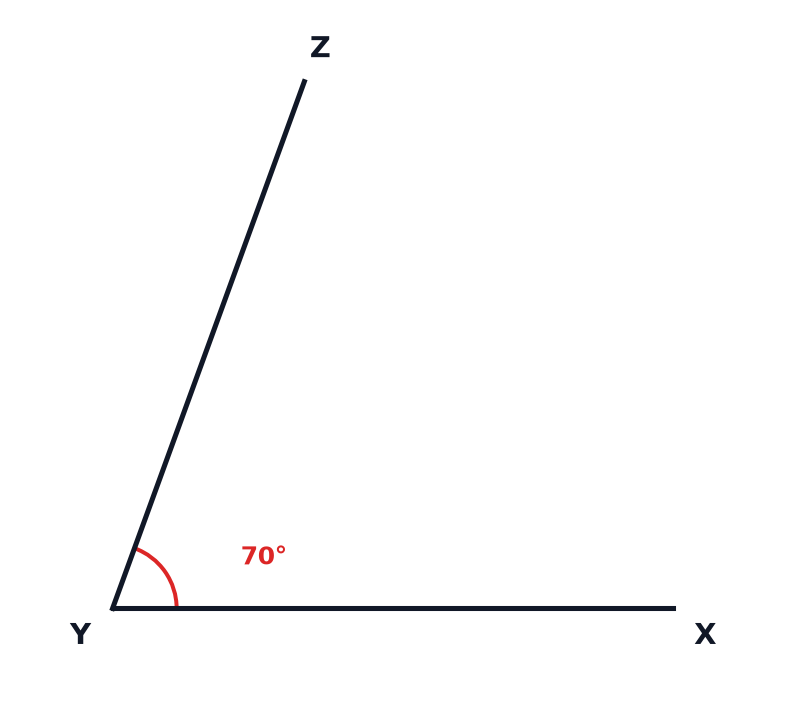
The diagram shows an angle \(XYZ\) of \(70^\circ\). (a) Use ruler and compasses to construct the bisector of angle \(XYZ\). You must show all your construction lines. [2 marks] (b) Write down the size of each of the two equal angles. [1 mark]
Show answerHide answer
Model answer
(a) Draw an arc centred on \(Y\) that crosses both arms. From each crossing point draw arcs of the same radius that cross inside the angle. Draw a line from \(Y\) through the crossing. (b) \(70 \div 2 = 35^\circ\).
Mark scheme
- (a) Arc on both arms, then matching arcs that cross — M1
- (a) A straight line from \(Y\) through the crossing, with the arcs left on — A1
- (b) \(35^\circ\) — B1
-
3 Construct [3 marks]
\(PQ\) is a line of length 7 cm. Use ruler and compasses to construct the perpendicular bisector of \(PQ\). You must show all your construction lines. [3 marks]
Show answerHide answer
Model answer
Open the compasses to more than 3.5 cm. Draw arcs of equal radius from \(P\) and \(Q\) that cross above and below the line, and join the crossing points with a straight line.
Mark scheme
- Line \(PQ\) drawn accurately — B1
- Arcs of equal radius from both ends, crossing twice — M1
- A straight line through the crossing points — A1
-
4 Explain [2 marks]
Explain why every point on the bisector of an angle is the same distance from both arms of the angle. [2 marks]
Show answerHide answer
Model answer
The bisector splits the angle into two equal angles. The shortest distances from a point on the bisector to the two arms form two right-angled triangles with an equal angle and a common side, so they are congruent and the distances are equal.
Mark scheme
- The bisector makes two equal angles — B1
- Congruent triangles with a common side, so equal distances — B1
-
5 Construct [3 marks]
The line \(AB\) is drawn, and \(P\) is a point on it. Use ruler and compasses to construct the perpendicular to \(AB\) at \(P\). You must show all your construction lines. [3 marks]
Show answerHide answer
Model answer
With the point of the compasses on \(P\), draw arcs that cut \(AB\) on both sides of \(P\), at \(X\) and \(Y\). Then bisect \(XY\) by drawing arcs of equal radius from \(X\) and \(Y\) that cross above, and join the crossing point to \(P\).
Mark scheme
- Arcs on both sides of \(P\) on the line — M1
- Arcs of equal radius from \(X\) and \(Y\) that cross — M1
- A straight line through \(P\) and the crossing — A1
-
6 Construct [3 marks]
Use ruler and compasses to construct an angle of \(45^\circ\). You must show all your construction lines. [3 marks]
Show answerHide answer
Model answer
Construct a \(90^\circ\) angle by making a perpendicular on a line, and then bisect it, which gives two angles of \(45^\circ\).
Mark scheme
- A construction of \(90^\circ\) — M1
- A bisector construction with arcs — M1
- A \(45^\circ\) angle completed — A1
Quick check
-
1
What does the perpendicular bisector of a line do?
Show answerHide answer
D: Cuts it in half at right angles
Perpendicular means at right angles, and bisector means cuts in half.
-
2
What must you leave on your drawing in a construction?
Show answerHide answer
C: The construction arcs
The arcs show the method, and earn the marks.
-
3
Which instruments do you use for a construction?
Show answerHide answer
B: A ruler and compasses
Constructions use a ruler and a pair of compasses.
-
4
Which angle is constructed using two arcs of the same radius, as in an equilateral triangle?
Show answerHide answer
A: \(60^\circ\)
The triangle with three equal sides has three angles of \(60^\circ\).
-
5
A \(60^\circ\) angle is bisected. What is the size of each part?
Show answerHide answer
D: \(30^\circ\)
\(60 \div 2 = 30\).
-
6
Why must the compasses be opened to more than half the length of the line when constructing a perpendicular bisector?
Show answerHide answer
C: So that the arcs from both ends cross
If the radius is too small the arcs do not meet.
-
7
What is true of every point on an angle bisector?
Show answerHide answer
B: It is the same distance from both arms
The bisector is equidistant from the two arms.
-
8
A triangle has sides 6 cm, 5 cm and 4 cm. After drawing the 6 cm side \(AB\), how do you find \(C\) if \(AC = 4\) cm and \(BC = 5\) cm?
Show answerHide answer
A: Arc of radius 4 cm from \(A\) and arc of radius 5 cm from \(B\), where they cross
The third corner is the point 4 cm from \(A\) and 5 cm from \(B\).
-
9
What is the shortest distance from a point to a line?
Show answerHide answer
D: The perpendicular distance
The shortest path to a line meets it at a right angle.
Loci
Just this lesson-
1 Draw [2 marks]
Draw the locus of all the points that are 4 cm from a point \(P\). [2 marks]
Show answerHide answer
Model answer
The locus is a circle with centre \(P\) and radius 4 cm.
Mark scheme
- A circle — M1
- With centre \(P\) and radius 4 cm — A1
-
2 Shade [4 marks]
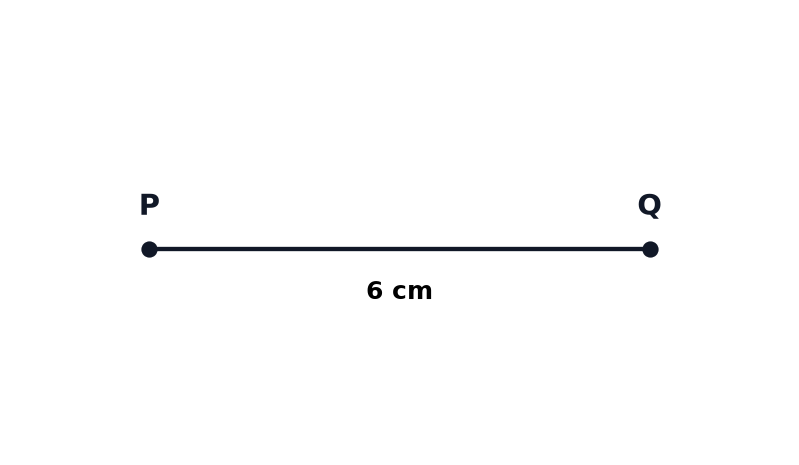
The diagram shows two points \(P\) and \(Q\) that are 6 cm apart. Shade the region of points that are closer to \(P\) than to \(Q\) and are less than 4 cm from \(Q\). [4 marks]
Show answerHide answer
Model answer
Construct the perpendicular bisector of \(PQ\), which is 3 cm from each point, and draw a circle of radius 4 cm around \(Q\). The region is inside the circle and on the \(P\) side of the bisector.
Mark scheme
- Perpendicular bisector of PQ with arcs — M1
- The \(P\) side chosen — A1
- Circle of radius 4 cm centred on \(Q\) — M1
- The correct region shaded — A1
-
3 Draw [3 marks]
A rectangle \(ABCD\) has \(AB = 8\) cm and \(AD = 5\) cm. Describe the locus of points inside the rectangle that are the same distance from \(AB\) and from \(AD\). [3 marks]
Show answerHide answer
Model answer
The locus is the bisector of angle \(A\). It is a straight line from \(A\) at \(45^\circ\) to both sides, up to where it meets \(DC\) at 5 cm along.
Mark scheme
- The bisector of the angle at A — M1
- At \(45^\circ\) to \(AB\) and \(AD\) — A1
- Stopping at the side DC, 5 cm along — B1
-
4 Draw [3 marks]
A tree is at the point \(T\). A scale drawing uses 1 cm to 1 m. Describe the locus of all the points that are exactly 2 m from the tree, and say how it is drawn. [3 marks]
Show answerHide answer
Model answer
The locus is a circle with centre \(T\). On the drawing the radius is 2 cm.
Mark scheme
- A circle — M1
- Centre \(T\) — A1
- Radius 2 cm on the drawing — B1
-
5 Shade [4 marks]
\(A\) and \(B\) are two points 10 cm apart. Show how to find the region of points that are less than 6 cm from \(A\) and less than 6 cm from \(B\). [4 marks]
Show answerHide answer
Model answer
Draw a circle of radius 6 cm around \(A\) and a circle of radius 6 cm around \(B\). The region is where the two circles overlap, which is a lens-shaped region centred on the perpendicular bisector of \(AB\), which is 5 cm from each.
Mark scheme
- Circle of radius 6 cm centred on \(A\) — M1
- Circle of radius 6 cm centred on \(B\) — M1
- The overlap shaded — A1
- Symmetrical about the perpendicular bisector — B1
-
6 Work out [3 marks]
\(P\) and \(Q\) are 10 cm apart. Is there a point that is closer to \(Q\) than to \(P\) and less than 4 cm from \(P\)? Explain your answer. [3 marks]
Show answerHide answer
Model answer
No. The perpendicular bisector is 5 cm from \(P\), and the points closer to \(Q\) are on the far side of it. A point less than 4 cm from \(P\) is inside a circle that does not reach the bisector.
Mark scheme
- No — B1
- The bisector is 5 cm from \(P\) — M1
- The circle of radius 4 cm does not reach it — A1
Quick check
-
1
What is the locus of points 3 cm from a point \(P\)?
Show answerHide answer
A: A circle with centre \(P\) and radius 3 cm
All points the same distance from \(P\) form a circle.
-
2
What is the locus of points that are the same distance from two points \(A\) and \(B\)?
Show answerHide answer
D: The perpendicular bisector of \(AB\)
Every point on the perpendicular bisector is equidistant from \(A\) and \(B\).
-
3
What is the locus of points that are the same distance from two lines that meet at a point?
Show answerHide answer
C: The bisector of the angle between the lines
The angle bisector is equidistant from both arms.
-
4
On a drawing, which region is “less than 3 cm from \(P\)”?
Show answerHide answer
B: Inside the circle of radius 3 cm around \(P\)
Less than 3 cm means closer than the circle, so inside it.
-
5
What is the locus of points 2 cm from a line segment?
Show answerHide answer
A: Parallel lines 2 cm on each side with semicircular ends
Near the ends, the points 2 cm away form semicircles.
-
6
\(A\) and \(B\) are two points. Which side of the perpendicular bisector is “closer to \(A\) than \(B\)”?
Show answerHide answer
D: The side containing \(A\)
Points nearer to \(A\) are on \(A\)'s side of the bisector.
-
7
On a scale drawing with 1 cm for 1 m, a tree must be within 4 m of a post. What do you draw?
Show answerHide answer
C: A circle of radius 4 cm around the post
4 m is 4 cm on the drawing.
-
8
A rectangle \(ABCD\) has \(A\) at the bottom left and \(B\) to its right. Which line separates the points closer to \(AB\) from those closer to \(AD\)?
Show answerHide answer
B: The bisector of angle \(A\)
The angle bisector at \(A\) is the same distance from \(AB\) and \(AD\).
-
9
\(A\) and \(B\) are 8 cm apart. Is there a point closer to \(B\) than \(A\) that is less than 3 cm from \(A\)?
Show answerHide answer
A: No
The bisector is 4 cm from \(A\), and a circle of radius 3 cm around \(A\) does not reach it.
Bearings, Scale Drawings, Plans and Elevations
Just this lesson-
1 Write down [2 marks]
Write down the three-figure bearing of (a) south, (b) north-west. [2 marks]
Show answerHide answer
Model answer
(a) \(180^\circ\). (b) North is \(000^\circ\) (or \(360^\circ\)) and west is \(270^\circ\), so north-west is \(315^\circ\).
Mark scheme
- (a) \(180^\circ\) — B1
- (b) \(315^\circ\) — B1
-
2 Work out [4 marks]
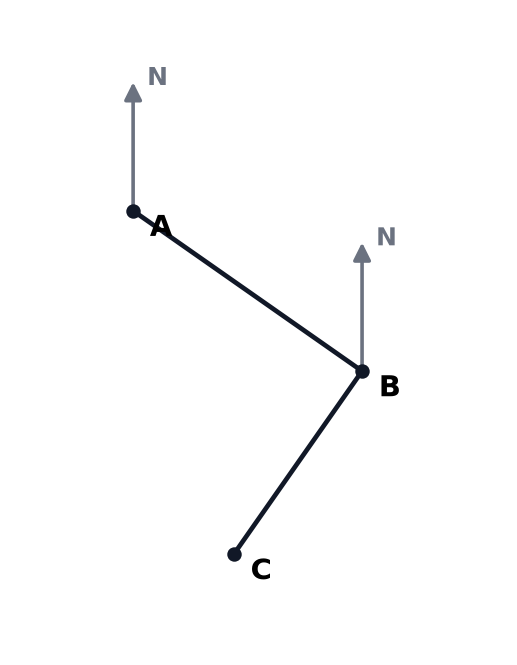
The diagram shows three towns \(A\), \(B\) and \(C\). The bearing of \(B\) from \(A\) is \(125^\circ\). The bearing of \(C\) from \(B\) is \(215^\circ\). (a) Work out the bearing of \(A\) from \(B\). [2 marks] (b) Work out the size of angle \(ABC\). [2 marks]
Show answerHide answer
Model answer
(a) \(125 + 180 = 305\), so the bearing is \(305^\circ\). (b) The bearing of \(A\) from \(B\) is \(305^\circ\) and the bearing of \(C\) from \(B\) is \(215^\circ\), so angle \(ABC = 305 - 215 = 90^\circ\).
Mark scheme
- (a) \(125 + 180\) — M1
- (a) \(305^\circ\) — A1
- (b) \(305 - 215\) — M1
- (b) \(90^\circ\) — A1
-
3 Work out [2 marks]
The bearing of \(Q\) from \(P\) is \(072^\circ\). Work out the bearing of \(P\) from \(Q\). [2 marks]
Show answerHide answer
Model answer
\(072 + 180 = 252\), so the bearing is \(252^\circ\).
Mark scheme
- \(072 + 180\) — M1
- \(252^\circ\) — A1
-
4 Work out [3 marks]
A scale drawing has a scale of 1 : 25 000. [3 marks] (a) Two points are 6 cm apart on the drawing. Work out the real distance in kilometres. [2 marks] (b) A real distance is 3 km. How long is it on the drawing? [1 mark]
Show answerHide answer
Model answer
(a) \(6 \times 25\,000 = 150\,000\) cm \(= 1.5\) km. (b) \(3\) km \(= 300\,000\) cm, and \(300\,000 \div 25\,000 = 12\) cm.
Mark scheme
- (a) \(6 \times 25\,000\) — M1
- (a) 1.5 km — A1
- (b) 12 cm — B1
-
5 Write down [3 marks]
A cuboid is 5 cm long, 2 cm wide and 3 cm high. Write down the dimensions of (a) its plan, (b) its front elevation, looking along the 2 cm width, (c) its side elevation, looking along the 5 cm length. [3 marks]
Show answerHide answer
Model answer
(a) The plan is 5 cm by 2 cm. (b) The front elevation is 5 cm by 3 cm. (c) The side elevation is 2 cm by 3 cm.
Mark scheme
- (a) 5 cm by 2 cm — B1
- (b) 5 cm by 3 cm — B1
- (c) 2 cm by 3 cm — B1
-
6 Work out [4 marks]
A ship sails 10 km from \(P\) to \(Q\) on a bearing of \(060^\circ\). It then sails 10 km from \(Q\) to \(R\) on a bearing of \(180^\circ\). (a) Work out the size of angle \(PQR\). [2 marks] (b) Work out the bearing of \(P\) from \(R\), given that triangle \(PQR\) is isosceles. [2 marks]
Show answerHide answer
Model answer
(a) The bearing of \(P\) from \(Q\) is \(060 + 180 = 240^\circ\), and the bearing of \(R\) from \(Q\) is \(180^\circ\), so angle \(PQR = 240 - 180 = 60^\circ\). (b) With \(QP = QR\) and a \(60^\circ\) angle, the triangle is equilateral, so angle \(QRP = 60^\circ\). From \(R\), \(Q\) is due north (\(000^\circ\)) and \(P\) is \(60^\circ\) to the west of north, so the bearing of \(P\) from \(R\) is \(360 - 60 = 300^\circ\).
Mark scheme
- (a) \(240\) seen — M1
- (a) \(60^\circ\) — A1
- (b) Equilateral, so angle \(QRP = 60^\circ\) — M1
- (b) \(300^\circ\) — A1
Quick check
-
1
What is the bearing of east?
Show answerHide answer
B: \(090^\circ\)
North is 000, east is 090, south is 180 and west is 270.
-
2
What is the bearing of south?
Show answerHide answer
A: \(180^\circ\)
South is half a turn from north.
-
3
The bearing of \(B\) from \(A\) is \(130^\circ\). What is the bearing of \(A\) from \(B\)?
Show answerHide answer
D: \(310^\circ\)
Add \(180^\circ\): \(130 + 180 = 310\).
-
4
The bearing of \(B\) from \(A\) is \(072^\circ\). What is the bearing of \(A\) from \(B\)?
Show answerHide answer
C: \(252^\circ\)
Add \(180^\circ\): \(072 + 180 = 252\).
-
5
The bearing of \(B\) from \(A\) is \(250^\circ\). What is the bearing of \(A\) from \(B\)?
Show answerHide answer
B: \(070^\circ\)
Subtract \(180^\circ\): \(250 - 180 = 70\), written as 070.
-
6
From where, and in which direction, is a bearing measured?
Show answerHide answer
A: Clockwise from the north line
Bearings are measured clockwise from north.
-
7
A map has a scale of \(1 : 25\,000\). Two towns are 6 cm apart on the map. What is the real distance?
Show answerHide answer
D: 1.5 km
\(6 \times 25\,000 = 150\,000\) cm \(= 1.5\) km.
-
8
A plan has a scale of \(1 : 1000\). A length of 5 cm on the plan is how long in real life?
Show answerHide answer
C: 50 m
\(5 \times 1000 = 5000\) cm \(= 50\) m.
-
9
What is the plan of a solid?
Show answerHide answer
B: The view from above
A plan is a view looking straight down.