Exam questions · Maths · Vectors, Constructions and Loci
Ruler-and-Compass Constructions
- 6 exam questions
- 17 marks
- 9 quick checks
-
1 Construct [3 marks]
Use ruler and compasses to construct an equilateral triangle with sides of 5 cm. You must show all your construction lines. [3 marks]
Show answerHide answer
Model answer
Draw a line \(AB\) of 5 cm. With the compasses set to 5 cm, draw an arc from \(A\) and an arc from \(B\) that cross at \(C\). Join \(C\) to \(A\) and to \(B\).
Mark scheme
- A line of 5 cm drawn accurately — B1
- Two arcs of radius 5 cm from the ends — M1
- Triangle completed — A1
-
2 Construct [3 marks]
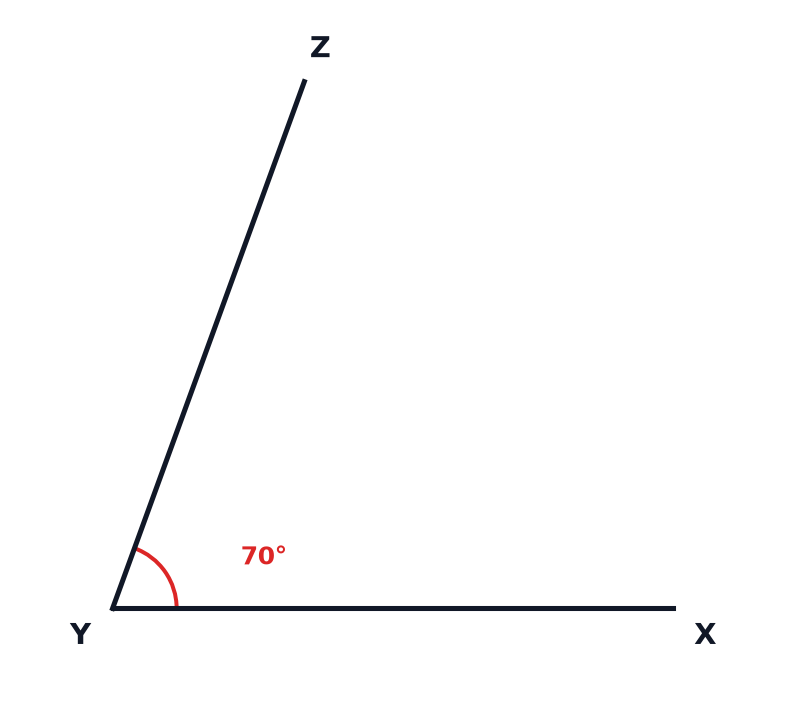
The diagram shows an angle \(XYZ\) of \(70^\circ\). (a) Use ruler and compasses to construct the bisector of angle \(XYZ\). You must show all your construction lines. [2 marks] (b) Write down the size of each of the two equal angles. [1 mark]
Show answerHide answer
Model answer
(a) Draw an arc centred on \(Y\) that crosses both arms. From each crossing point draw arcs of the same radius that cross inside the angle. Draw a line from \(Y\) through the crossing. (b) \(70 \div 2 = 35^\circ\).
Mark scheme
- (a) Arc on both arms, then matching arcs that cross — M1
- (a) A straight line from \(Y\) through the crossing, with the arcs left on — A1
- (b) \(35^\circ\) — B1
-
3 Construct [3 marks]
\(PQ\) is a line of length 7 cm. Use ruler and compasses to construct the perpendicular bisector of \(PQ\). You must show all your construction lines. [3 marks]
Show answerHide answer
Model answer
Open the compasses to more than 3.5 cm. Draw arcs of equal radius from \(P\) and \(Q\) that cross above and below the line, and join the crossing points with a straight line.
Mark scheme
- Line \(PQ\) drawn accurately — B1
- Arcs of equal radius from both ends, crossing twice — M1
- A straight line through the crossing points — A1
-
4 Explain [2 marks]
Explain why every point on the bisector of an angle is the same distance from both arms of the angle. [2 marks]
Show answerHide answer
Model answer
The bisector splits the angle into two equal angles. The shortest distances from a point on the bisector to the two arms form two right-angled triangles with an equal angle and a common side, so they are congruent and the distances are equal.
Mark scheme
- The bisector makes two equal angles — B1
- Congruent triangles with a common side, so equal distances — B1
-
5 Construct [3 marks]
The line \(AB\) is drawn, and \(P\) is a point on it. Use ruler and compasses to construct the perpendicular to \(AB\) at \(P\). You must show all your construction lines. [3 marks]
Show answerHide answer
Model answer
With the point of the compasses on \(P\), draw arcs that cut \(AB\) on both sides of \(P\), at \(X\) and \(Y\). Then bisect \(XY\) by drawing arcs of equal radius from \(X\) and \(Y\) that cross above, and join the crossing point to \(P\).
Mark scheme
- Arcs on both sides of \(P\) on the line — M1
- Arcs of equal radius from \(X\) and \(Y\) that cross — M1
- A straight line through \(P\) and the crossing — A1
-
6 Construct [3 marks]
Use ruler and compasses to construct an angle of \(45^\circ\). You must show all your construction lines. [3 marks]
Show answerHide answer
Model answer
Construct a \(90^\circ\) angle by making a perpendicular on a line, and then bisect it, which gives two angles of \(45^\circ\).
Mark scheme
- A construction of \(90^\circ\) — M1
- A bisector construction with arcs — M1
- A \(45^\circ\) angle completed — A1
Quick check
-
1
What does the perpendicular bisector of a line do?
Show answerHide answer
D: Cuts it in half at right angles
Perpendicular means at right angles, and bisector means cuts in half.
-
2
What must you leave on your drawing in a construction?
Show answerHide answer
C: The construction arcs
The arcs show the method, and earn the marks.
-
3
Which instruments do you use for a construction?
Show answerHide answer
B: A ruler and compasses
Constructions use a ruler and a pair of compasses.
-
4
Which angle is constructed using two arcs of the same radius, as in an equilateral triangle?
Show answerHide answer
A: \(60^\circ\)
The triangle with three equal sides has three angles of \(60^\circ\).
-
5
A \(60^\circ\) angle is bisected. What is the size of each part?
Show answerHide answer
D: \(30^\circ\)
\(60 \div 2 = 30\).
-
6
Why must the compasses be opened to more than half the length of the line when constructing a perpendicular bisector?
Show answerHide answer
C: So that the arcs from both ends cross
If the radius is too small the arcs do not meet.
-
7
What is true of every point on an angle bisector?
Show answerHide answer
B: It is the same distance from both arms
The bisector is equidistant from the two arms.
-
8
A triangle has sides 6 cm, 5 cm and 4 cm. After drawing the 6 cm side \(AB\), how do you find \(C\) if \(AC = 4\) cm and \(BC = 5\) cm?
Show answerHide answer
A: Arc of radius 4 cm from \(A\) and arc of radius 5 cm from \(B\), where they cross
The third corner is the point 4 cm from \(A\) and 5 cm from \(B\).
-
9
What is the shortest distance from a point to a line?
Show answerHide answer
D: The perpendicular distance
The shortest path to a line meets it at a right angle.