Exam questions · Maths · Circle Theorems
Same Segment and Cyclic Quadrilaterals
- 6 exam questions
- 18 marks
- 9 quick checks
-
1 Work out [2 marks]
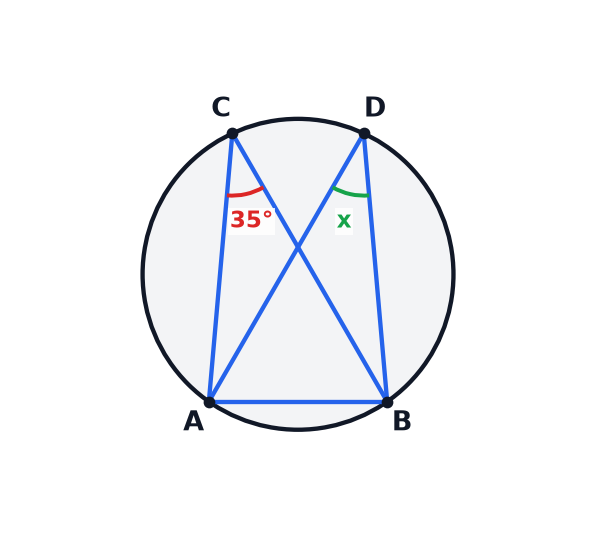
Diagram NOT accurately drawn. \(A\), \(B\), \(C\) and \(D\) are points on a circle. Angle \(ACB = 35^\circ\). Work out the size of angle \(ADB\). Give a reason for your answer. (2 marks)
Show answerHide answer
Model answer
Angle \(ADB = 35^\circ\), because angles in the same segment are equal.
Mark scheme
- \(35\) — B1
- Angles in the same segment are equal — C1
-
2 Work out [4 marks]
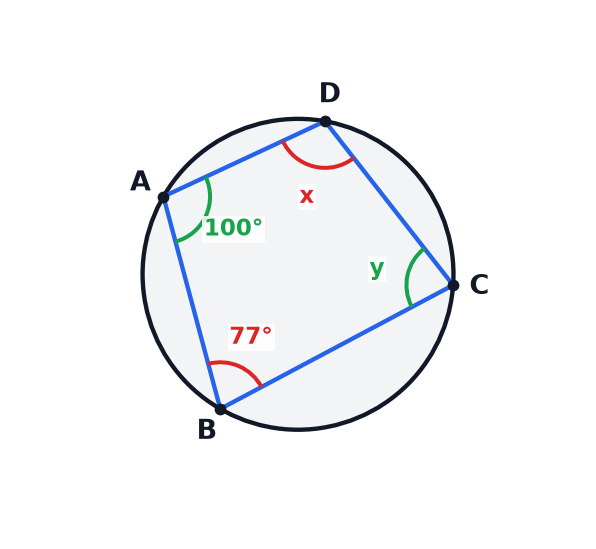
Diagram NOT accurately drawn. \(ABCD\) is a cyclic quadrilateral. Angle \(ABC = 77^\circ\) and angle \(BAD = 100^\circ\). (a) Work out the size of angle \(ADC\). Give a reason for your answer. (2 marks) (b) Work out the size of angle \(BCD\). Give a reason for your answer. (2 marks)
Show answerHide answer
Model answer
(a) \(ADC = 180 - 77 = 103^\circ\), because opposite angles of a cyclic quadrilateral add up to \(180^\circ\). (b) \(BCD = 180 - 100 = 80^\circ\), for the same reason.
Mark scheme
- (a) \(103\) — B1
- (a) Opposite angles of a cyclic quadrilateral add up to 180 degrees — C1
- (b) \(80\) — B1
- (b) The same reason given — C1
-
3 Work out [3 marks]
\(ABCD\) is a cyclic quadrilateral. Angle \(A = 3x + 5\) and angle \(C = 2x + 25\). Work out the value of \(x\). (3 marks)
Show answerHide answer
Model answer
Opposite angles add up to \(180^\circ\), so \(3x + 5 + 2x + 25 = 180\). Then \(5x = 150\) and \(x = 30\).
Mark scheme
- \((3x + 5) + (2x + 25) = 180\) — M1
- \(5x + 30 = 180\) or \(5x = 150\) — M1
- \(30\) — A1
-
4 Work out [3 marks]
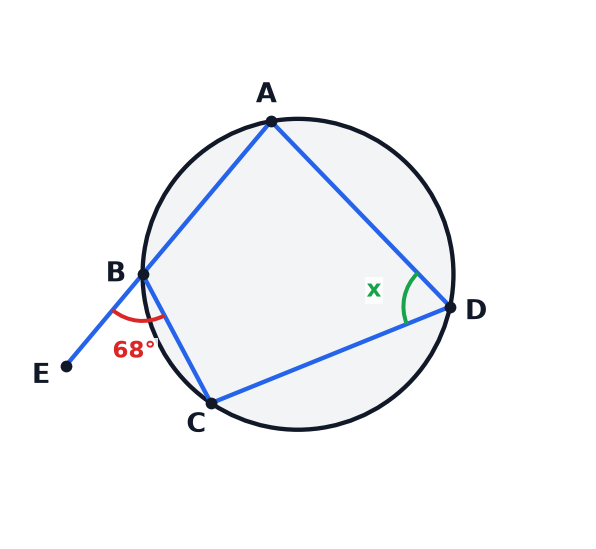
Diagram NOT accurately drawn. \(ABCD\) is a cyclic quadrilateral. The side \(AB\) is extended to the point \(E\). Angle \(CBE = 68^\circ\). (a) Work out the size of angle \(ABC\). (1 mark) (b) Work out the size of angle \(ADC\). Give a reason for your answer. (2 marks)
Show answerHide answer
Model answer
(a) Angles on a straight line add up to \(180^\circ\), so \(ABC = 180 - 68 = 112^\circ\). (b) \(ADC = 180 - 112 = 68^\circ\), because opposite angles of a cyclic quadrilateral add up to \(180^\circ\).
Mark scheme
- (a) \(112\) — B1
- (b) \(68\) — B1
- (b) Opposite angles of a cyclic quadrilateral add up to 180 degrees — C1
-
5 Work out [4 marks]
\(A\), \(B\), \(C\) and \(D\) are points on a circle. The lines \(AC\) and \(BD\) cross at \(E\). Angle \(CAD = 35^\circ\) and angle \(ABC = 100^\circ\). (a) Work out the size of angle \(CBD\). Give a reason for your answer. (2 marks) (b) Work out the size of angle \(ADC\). Give a reason for your answer. (2 marks)
Show answerHide answer
Model answer
(a) \(CBD = 35^\circ\), because angles in the same segment are equal. (b) \(ADC = 180 - 100 = 80^\circ\), because opposite angles of a cyclic quadrilateral add up to \(180^\circ\).
Mark scheme
- (a) \(35\) — B1
- (a) Angles in the same segment are equal — C1
- (b) \(80\) — B1
- (b) Opposite angles of a cyclic quadrilateral add up to 180 degrees — C1
-
6 Show that [2 marks]
\(PQRS\) is a quadrilateral. Angle \(P = 105^\circ\) and angle \(R = 80^\circ\). Show that \(PQRS\) cannot be a cyclic quadrilateral. (2 marks)
Show answerHide answer
Model answer
\(105 + 80 = 185\), which is not \(180^\circ\). The opposite angles of a cyclic quadrilateral add up to \(180^\circ\), so \(PQRS\) cannot be cyclic.
Mark scheme
- \(105 + 80 = 185\) — M1
- States that this is not 180 degrees, so the quadrilateral cannot be cyclic — C1
Quick check
-
1
Two angles are in the same segment of a circle. One is \(47^\circ\). What is the other?
Show answerHide answer
C: \(47^\circ\)
Angles in the same segment are equal.
-
2
What do opposite angles of a cyclic quadrilateral add up to?
Show answerHide answer
B: \(180^\circ\)
This is the cyclic quadrilateral theorem.
-
3
A cyclic quadrilateral has an angle of \(112^\circ\). What is the opposite angle?
Show answerHide answer
A: \(68^\circ\)
\(180 - 112 = 68\).
-
4
What is a cyclic quadrilateral?
Show answerHide answer
D: A quadrilateral with all four corners on a circle
“Cyclic” means all the corners lie on one circle.
-
5
In a cyclic quadrilateral \(ABCD\), \(\angle A = 2x + 10\) and \(\angle C = 3x + 20\). What is \(x\)?
Show answerHide answer
C: \(30\)
\(5x + 30 = 180\), so \(5x = 150\) and \(x = 30\).
-
6
\(ABCD\) is cyclic and the side \(AB\) is extended to \(E\). Angle \(CBE = 70^\circ\). What is angle \(ADC\)?
Show answerHide answer
B: \(70^\circ\)
An exterior angle of a cyclic quadrilateral equals the interior opposite angle.
-
7
Which of these must be true for the angles \(ACB\) and \(ADB\) to be equal?
Show answerHide answer
A: \(C\) and \(D\) are on the same side of the chord \(AB\)
Angles in the same segment are made on the same side of a chord.
-
8
A quadrilateral has opposite angles of \(95^\circ\) and \(80^\circ\). Can it be cyclic?
Show answerHide answer
D: No, because \(95 + 80 \ne 180\)
Opposite angles of a cyclic quadrilateral must add up to \(180^\circ\), and \(95 + 80 = 175\).
-
9
\(A\), \(B\), \(C\) and \(D\) are on a circle, with \(AC\) and \(BD\) meeting at \(E\). Angle \(CAD = 36^\circ\). What is angle \(CBD\)?
Show answerHide answer
C: \(36^\circ\)
Angles \(CAD\) and \(CBD\) are made by the chord \(CD\) on the same side, so they are equal.