Exam questions · Maths · Further Algebra
Solving Quadratic Equations
- 6 exam questions
- 20 marks
- 9 quick checks
-
1 Solve [3 marks]
Solve \(x^2 + 7x + 12 = 0\).
Show answerHide answer
Model answer
\(x^2 + 7x + 12 = (x + 3)(x + 4) = 0\), so \(x = -3\) or \(x = -4\).
Mark scheme
- \((x + 3)(x + 4)\) — M1
- \(x = -3\) — A1
- \(x = -4\) — A1
-
2 Solve [3 marks]
Solve \(x^2 = 6x - 8\).
Show answerHide answer
Model answer
Rearrange to \(x^2 - 6x + 8 = 0\). Factorising gives \((x - 2)(x - 4) = 0\), so \(x = 2\) or \(x = 4\).
Mark scheme
- \(x^2 - 6x + 8 = 0\) — M1
- \((x - 2)(x - 4)\) — M1
- \(x = 2\) and \(x = 4\) — A1
-
3 Show that [4 marks]
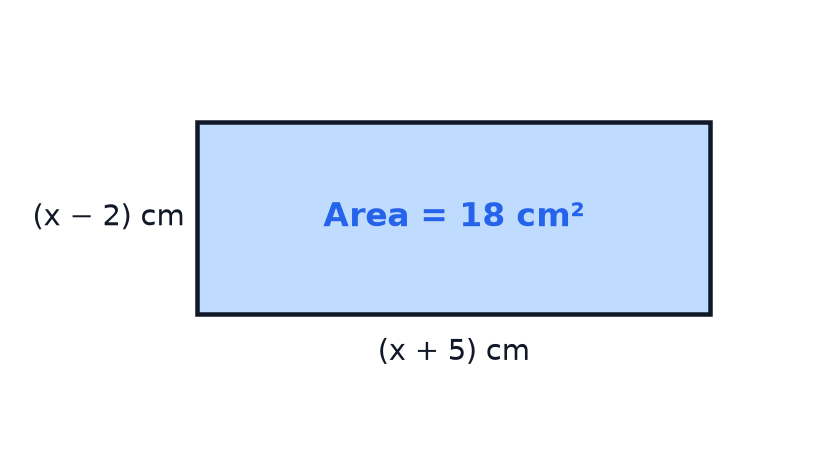
The diagram shows a rectangle. The area of the rectangle is 18 cm\(^2\). (a) Show that \(x^2 + 3x - 28 = 0\). (2 marks) (b) Hence work out the value of \(x\). (2 marks)
Show answerHide answer
Model answer
(a) \((x + 5)(x - 2) = 18\), so \(x^2 + 3x - 10 = 18\) and \(x^2 + 3x - 28 = 0\). (b) \((x + 7)(x - 4) = 0\), so \(x = -7\) or \(x = 4\). A length cannot be negative, so \(x = 4\).
Mark scheme
- (a) \((x + 5)(x - 2) = 18\) or \(x^2 + 3x - 10 = 18\) — M1
- (a) \(x^2 + 3x - 28 = 0\) shown — C1
- (b) \((x + 7)(x - 4)\) — M1
- (b) \(x = 4\) with \(x = -7\) rejected — A1
-
4 Solve [4 marks]
(a) Solve \(x^2 - 36 = 0\). (2 marks) (b) Solve \(x^2 - 5x = 0\). (2 marks)
Show answerHide answer
Model answer
(a) \(x^2 = 36\), so \(x = 6\) or \(x = -6\). (b) \(x(x - 5) = 0\), so \(x = 0\) or \(x = 5\).
Mark scheme
- (a) \(x^2 = 36\) or \((x - 6)(x + 6)\) — M1
- (a) \(x = 6\) and \(x = -6\) — A1
- (b) \(x(x - 5)\) — M1
- (b) \(x = 0\) and \(x = 5\) — A1
-
5 Solve [3 marks]
Solve \(2x^2 - 5x - 3 = 0\).
Show answerHide answer
Model answer
\(2x^2 - 6x + x - 3 = 2x(x - 3) + (x - 3) = (2x + 1)(x - 3) = 0\), so \(x = -\dfrac{1}{2}\) or \(x = 3\).
Mark scheme
- \(2x^2 - 6x + x - 3\) or \((2x + 1)(x - 3)\) — M1
- \(x = -\dfrac{1}{2}\) — A1
- \(x = 3\) — A1
-
6 Solve [3 marks]
Solve \(x^2 + 4x - 3 = 0\). Give your solutions in the form \(p \pm \sqrt{q}\), where \(p\) and \(q\) are integers.
Show answerHide answer
Model answer
Using the formula, \(x = \dfrac{-4 \pm \sqrt{16 + 12}}{2} = \dfrac{-4 \pm \sqrt{28}}{2} = \dfrac{-4 \pm 2\sqrt{7}}{2} = -2 \pm \sqrt{7}\).
Mark scheme
- \(\dfrac{-4 \pm \sqrt{4^2 - 4 \times 1 \times (-3)}}{2}\) or \((x + 2)^2 - 7\) — M1
- \(\sqrt{28} = 2\sqrt{7}\) seen — M1
- \(-2 \pm \sqrt{7}\) — A1
Quick check
-
1
Solve \((x - 2)(x - 3) = 0\).
Show answerHide answer
B: \(x = 2\) or \(x = 3\)
Each bracket can be zero: \(x - 2 = 0\) or \(x - 3 = 0\).
-
2
Solve \(x^2 - 49 = 0\).
Show answerHide answer
A: \(x = 7\) or \(x = -7\)
\(x^2 = 49\) has two square roots.
-
3
Solve \(x^2 - 6x = 0\).
Show answerHide answer
D: \(x = 0\) or \(x = 6\)
\(x(x - 6) = 0\), so \(x = 0\) or \(x = 6\).
-
4
Factorise \(x^2 - 5x + 6\).
Show answerHide answer
C: \((x - 2)(x - 3)\)
The numbers multiply to 6 and add to \(-5\): \(-2\) and \(-3\).
-
5
What is the first step in solving \(x^2 = 3x + 10\) by factorising?
Show answerHide answer
B: Rearrange to \(x^2 - 3x - 10 = 0\)
One side must be zero before you factorise.
-
6
Solve \(x^2 + 5x + 6 = 0\).
Show answerHide answer
A: \(x = -2\) or \(x = -3\)
\((x + 2)(x + 3) = 0\).
-
7
Solve \(2x^2 + 7x + 3 = 0\).
Show answerHide answer
D: \(x = -\dfrac{1}{2}\) or \(x = -3\)
\((2x + 1)(x + 3) = 0\).
-
8
What is the value of \(b^2 - 4ac\) for \(x^2 + 2x - 8 = 0\)?
Show answerHide answer
C: \(36\)
\(4 - 4 \times 1 \times (-8) = 4 + 32 = 36\).
-
9
Use the quadratic formula to solve \(2x^2 + 5x - 3 = 0\).
Show answerHide answer
B: \(x = \dfrac{1}{2}\) or \(x = -3\)
\(x = \dfrac{-5 \pm \sqrt{49}}{4} = \dfrac{-5 \pm 7}{4}\).