Maths · Further Algebra
Viewing as
Teaching this? The teacher view opens every answer and mark scheme.
Solving Quadratic Equations
Solving quadratics by factorising, with the formula and by completing the square, and forming them from problems.
Learning Objectives
- 1Solve quadratic equations by factorising, including when the coefficient of \(x^2\) is not 1.
- 2Link the solutions of a quadratic equation to the roots of its graph.
- 3Solve quadratics using the quadratic formula and by completing the square (Higher tier).
- 4Form and solve quadratic equations from a problem, and reject answers that do not fit.
Two answers from one equation
A quadratic equation has an \(x^2\) term, and it usually has two solutions. The method that works every time on a non-calculator paper is factorising: get one side to zero, break the quadratic into two brackets, and set each bracket equal to zero. The numbers are always chosen to factorise neatly, so if yours do not, check your arithmetic. Harder questions, such as problems set in a context, use the same method after you have formed the equation yourself.
Solving by factorising
This method rests on one fact: if two things multiply to give zero, one of them must be zero.
-
Step 1: make one side zero
Rearrange so the equation is \(ax^2 + bx + c = 0\). Solve \(x^2 = 5x - 6\) by rewriting it as \(x^2 - 5x + 6 = 0\).
-
Step 2: factorise
\(x^2 - 5x + 6 = (x - 2)(x - 3)\).
-
Step 3: set each bracket to zero
\(x - 2 = 0\) or \(x - 3 = 0\), so \(x = 2\) or \(x = 3\).
-
Step 4: check
Put each answer back in: \(2^2 - 10 + 6 = 0\) and \(3^2 - 15 + 6 = 0\).
Solutions and roots
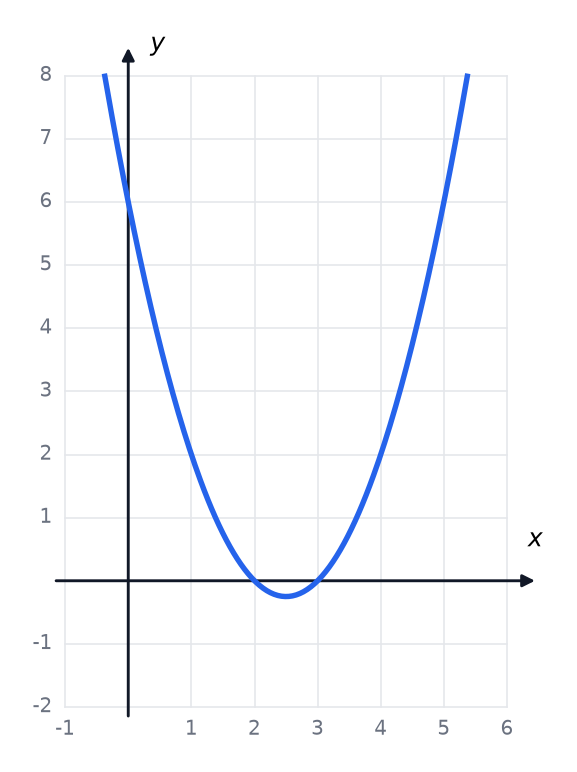
The solutions of \(x^2 - 5x + 6 = 0\) are the \(x\)-values where the curve \(y = x^2 - 5x + 6\) crosses the \(x\)-axis. Factorising finds them exactly, and the graph shows them as the roots.
Linking algebra and graph
- Solutions are roots \(x = 2\) and \(x = 3\) are the roots of \(y = x^2 - 5x + 6\).
- Factorised form \(y = (x - 2)(x - 3)\) shows the roots straight away, because each bracket is zero at its root.
- Turning point It is halfway between the roots, at \(x = 2.5\).
- No real solutions If the curve does not reach the \(x\)-axis, the equation has no real solutions.
Factorising with a coefficient
Solve \(2x^2 + 7x + 3 = 0\).
Show the solutionHide the solution
- 1 Multiply a and c \(2 \times 3 = 6\). Find two numbers that multiply to 6 and add to 7: 6 and 1.
- 2 Split the middle term \(2x^2 + 6x + x + 3 = 0\).
- 3 Factorise in pairs \(2x(x + 3) + 1(x + 3) = (2x + 1)(x + 3) = 0\).
- 4 Solve each bracket \(2x + 1 = 0\) gives \(x = -\dfrac{1}{2}\), and \(x + 3 = 0\) gives \(x = -3\).
Answer\(x = -\dfrac{1}{2}\) or \(x = -3\)
Special cases
Some quadratics are quicker to solve without a full factorisation.
-
No x term
\(x^2 - 49 = 0\) gives \(x^2 = 49\), so \(x = 7\) or \(x = -7\). Never forget the negative root.
-
No constant term
\(x^2 - 6x = 0\) factorises as \(x(x - 6) = 0\), so \(x = 0\) or \(x = 6\). Do not divide by \(x\), or a solution is lost.
-
Difference of two squares
\(x^2 - 25 = (x - 5)(x + 5)\), so \(x = \pm 5\).
-
A repeated root
\(x^2 - 6x + 9 = (x - 3)^2 = 0\) gives just \(x = 3\).
The quadratic formula (Higher tier)
When a quadratic will not factorise easily, the formula always works. On Paper 1 the numbers are chosen so that the square root is exact.
-
The formula
For \(ax^2 + bx + c = 0\), \(x = \dfrac{-b \pm \sqrt{b^2 - 4ac}}{2a}\).
-
Substitute carefully
Put brackets round negative numbers, such as \((-3)^2 = 9\).
-
Two answers
The \(\pm\) gives the two solutions, one with plus and one with minus.
-
Check the number under the root
If \(b^2 - 4ac\) is negative, there are no real solutions.
Using the formula
(Higher tier) Solve \(2x^2 + 5x - 3 = 0\).
Show the solutionHide the solution
- 1 Identify a, b and c \(a = 2\), \(b = 5\), \(c = -3\).
- 2 Work out the discriminant \(b^2 - 4ac = 25 - 4 \times 2 \times (-3) = 25 + 24 = 49\).
- 3 Substitute \(x = \dfrac{-5 \pm \sqrt{49}}{4} = \dfrac{-5 \pm 7}{4}\).
- 4 Two solutions \(x = \dfrac{2}{4} = \dfrac{1}{2}\) or \(x = \dfrac{-12}{4} = -3\).
Answer\(x = \dfrac{1}{2}\) or \(x = -3\)
Completing the square (Higher tier)
Writing a quadratic as a bracket squared plus a number solves it and gives the turning point.
-
The pattern
\(x^2 + bx = \left(x + \dfrac{b}{2}\right)^2 - \left(\dfrac{b}{2}\right)^2\).
-
Example
\(x^2 + 6x - 7 = (x + 3)^2 - 9 - 7 = (x + 3)^2 - 16\).
-
Solve
\((x + 3)^2 = 16\), so \(x + 3 = \pm 4\), giving \(x = 1\) or \(x = -7\).
-
Turning point
\((x + 3)^2 - 16\) has its minimum at \((-3, -16)\).
Quadratics from problems
Many exam questions build a quadratic from a shape or a number story.
-
Form the equation
A rectangle with sides \((x + 5)\) and \((x - 2)\) and area 18 gives \((x + 5)(x - 2) = 18\).
-
Expand and rearrange
\(x^2 + 3x - 10 = 18\), so \(x^2 + 3x - 28 = 0\).
-
Solve
\((x + 7)(x - 4) = 0\), so \(x = -7\) or \(x = 4\).
-
Reject answers that do not fit
A length cannot be negative, so \(x = 4\). The sides are 9 cm and 2 cm, and \(9 \times 2 = 18\).
What the Edexcel exam gives you
Edexcel prints an exam aid in the Higher paper, so the quadratic formula is given to you.
-
Given at Higher tier
The formula \(x = \dfrac{-b \pm \sqrt{b^2 - 4ac}}{2a}\) is on the Higher tier formulae page, so you do not have to memorise it, but you must know how to use it.
-
Not given
Factorising, completing the square and the rule \(b^2 - 4ac\) for the number of solutions are not on the page.
Test yourself
-
1
What does \((x - 4)(x + 2) = 0\) tell you?
Show answerHide answer
\(x = 4\) or \(x = -2\).
-
2
What are the solutions of \(x^2 - 49 = 0\)?
Show answerHide answer
\(x = 7\) or \(x = -7\).
-
3
What is the first step in solving \(x^2 = 3x + 10\)?
Show answerHide answer
Rearrange to \(x^2 - 3x - 10 = 0\).
-
4
What is the discriminant \(b^2 - 4ac\) for \(x^2 + 2x - 8\) (Higher tier)?
Show answerHide answer
\(4 + 32 = 36\).
-
5
What do the solutions of a quadratic equation look like on its graph?
Show answerHide answer
The points where the curve crosses the \(x\)-axis.
Exam technique: solving quadratics
Method marks are easy to collect if the working is laid out.
-
Zero on one side
Always rearrange first, because factorising only works when one side is 0.
-
Write the brackets
The factorised form earns a mark even if you slip afterwards.
-
Give both solutions
Missing the second solution loses the final mark.
-
Check by substituting
It takes seconds and catches most sign errors.
Summary and exam focus
- Rearrange to \(ax^2 + bx + c = 0\), factorise, and set each bracket equal to zero.
- The solutions are the roots of the graph, where it crosses the \(x\)-axis.
- Remember the negative root in \(x^2 = k\), and never divide by \(x\).
- The formula and completing the square (Higher tier) solve quadratics that do not factorise easily.
Exam focus
Solve \(x^2 + 5x + 6 = 0\). (3 marks) (3 marks)
Factorise as \((x + 2)(x + 3) = 0\) to get one mark, and then write \(x = -2\) and \(x = -3\) for the others. If you write only one solution, you lose a mark.
Key terms
The words this lesson expects you to use. Each one is linked from the first place it appears above.
- Quadratic equation
- An equation whose highest power of \(x\) is \(x^2\), usually with two solutions.
- Factorise
- Write an expression as a product of brackets.
- Root
- A solution of an equation, shown where its graph crosses the \(x\)-axis.
- Discriminant
- The expression \(b^2 - 4ac\) from the quadratic formula.
- Quadratic formula
- A formula that gives the solutions of any quadratic equation.
- Completing the square
- Rewriting \(x^2 + bx + c\) as \((x + p)^2 + q\).
- Repeated root
- A root that comes from a bracket squared, such as \((x - 3)^2 = 0\).
- Coefficient
- The number multiplying a letter, such as 2 in \(2x^2\).
- Substitute
- Replace a letter with its value.
You've finished the notes
Check your understanding
Test yourself while it is fresh. Start with the flashcards, then try the exam questions.
Something here looks wrong?
Tell us what and we will go and look. It goes to whoever writes these pages, nobody else, and we do not ask who you are — so there is nothing to sign and nothing comes back to you.