Exam questions · Maths
Functions, Sequences and Rates of Change
- 30 exam questions
- 94 marks
- 45 quick checks
Functions and Function Notation
Just this lesson-
1 Work out [3 marks]
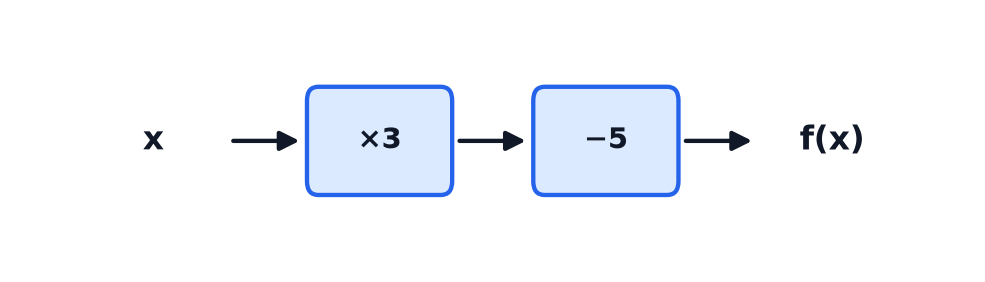
The diagram shows a function machine for \(f\). (a) Write down an expression for \(f(x)\). (1 mark) (b) Work out \(f(4)\). (1 mark) (c) Solve \(f(x) = 16\). (1 mark)
Show answerHide answer
Model answer
(a) \(f(x) = 3x - 5\). (b) \(f(4) = 3 \times 4 - 5 = 7\). (c) \(3x - 5 = 16\), so \(x = 7\).
Mark scheme
- (a) \(3x - 5\) — B1
- (b) \(7\) — B1
- (c) \(7\) — B1
-
2 Work out [4 marks]
\(f(x) = 2x - 1\) and \(g(x) = x^2\) (a) Work out \(fg(3)\). (2 marks) (b) Find \(gf(x)\), giving your answer in the form \(ax^2 + bx + c\). (2 marks)
Show answerHide answer
Model answer
(a) \(g(3) = 9\), then \(f(9) = 2 \times 9 - 1 = 17\). (b) \(gf(x) = (2x - 1)^2 = 4x^2 - 4x + 1\).
Mark scheme
- (a) \(g(3) = 9\) — M1
- (a) \(17\) — A1
- (b) \((2x - 1)^2\) — M1
- (b) \(4x^2 - 4x + 1\) — A1
-
3 Find [3 marks]
\(f(x) = \dfrac{x + 4}{3}\) (a) Find \(f^{-1}(x)\). (2 marks) (b) Work out \(f^{-1}(5)\). (1 mark)
Show answerHide answer
Model answer
(a) \(y = \dfrac{x + 4}{3}\), so \(3y = x + 4\) and \(x = 3y - 4\). So \(f^{-1}(x) = 3x - 4\). (b) \(f^{-1}(5) = 3 \times 5 - 4 = 11\).
Mark scheme
- (a) \(3y = x + 4\) or equivalent — M1
- (a) \(f^{-1}(x) = 3x - 4\) — A1
- (b) \(11\) — B1
-
4 Solve [4 marks]
\(f(x) = 2x + 1\) (a) Find \(f^{-1}(x)\). (2 marks) (b) Solve \(f^{-1}(x) = f(x)\). (2 marks)
Show answerHide answer
Model answer
(a) \(f^{-1}(x) = \dfrac{x - 1}{2}\). (b) \(\dfrac{x - 1}{2} = 2x + 1\), so \(x - 1 = 4x + 2\), \(-3 = 3x\) and \(x = -1\).
Mark scheme
- (a) \(x = \dfrac{y - 1}{2}\) or equivalent — M1
- (a) \(f^{-1}(x) = \dfrac{x - 1}{2}\) — A1
- (b) \(\dfrac{x - 1}{2} = 2x + 1\) — M1
- (b) \(-1\) — A1
-
5 Find [4 marks]
\(f(x) = \dfrac{3}{x + 2}\) where \(x \ne -2\) (a) Find \(f^{-1}(x)\). (3 marks) (b) Explain why \(f^{-1}(0)\) cannot be worked out. (1 mark)
Show answerHide answer
Model answer
(a) \(y(x + 2) = 3\), so \(x + 2 = \dfrac{3}{y}\) and \(x = \dfrac{3}{y} - 2\). So \(f^{-1}(x) = \dfrac{3}{x} - 2\). (b) \(\dfrac{3}{0}\) is not defined, because you cannot divide by zero.
Mark scheme
- (a) \(y(x + 2) = 3\) — M1
- (a) \(x = \dfrac{3}{y} - 2\) — M1
- (a) \(f^{-1}(x) = \dfrac{3}{x} - 2\) — A1
- (b) You cannot divide by zero — C1
-
6 Work out [4 marks]
\(f(x) = 3x + 2\) and \(g(x) = ax - 4\), where \(a\) is a constant. \(fg(x) = gf(x)\). Work out the value of \(a\). (4 marks)
Show answerHide answer
Model answer
\(fg(x) = 3(ax - 4) + 2 = 3ax - 10\) and \(gf(x) = a(3x + 2) - 4 = 3ax + 2a - 4\). So \(-10 = 2a - 4\), which gives \(a = -3\).
Mark scheme
- \(fg(x) = 3ax - 10\) — M1
- \(gf(x) = 3ax + 2a - 4\) — M1
- \(-10 = 2a - 4\) — M1
- \(-3\) — A1
Quick check
-
1
\(f(x) = 3x - 5\). What is \(f(4)\)?
Show answerHide answer
B: 7
\(3 \times 4 - 5 = 7\).
-
2
\(f(x) = 2x + 1\). What is \(f(-3)\)?
Show answerHide answer
A: \(-5\)
\(2 \times (-3) + 1 = -5\).
-
3
\(f(x) = x^2 + 1\) and \(g(x) = 2x\). What is \(fg(2)\)?
Show answerHide answer
D: 17
\(g(2) = 4\), then \(f(4) = 16 + 1 = 17\).
-
4
\(f(x) = x + 3\) and \(g(x) = x^2\). What is \(gf(x)\)?
Show answerHide answer
C: \((x + 3)^2\)
\(gf(x) = g(f(x)) = (x + 3)^2\).
-
5
\(f(x) = 2x + 1\). What is \(ff(x)\)?
Show answerHide answer
B: \(4x + 3\)
\(ff(x) = 2(2x + 1) + 1 = 4x + 3\).
-
6
What is the inverse of \(f(x) = x + 7\)?
Show answerHide answer
A: \(f^{-1}(x) = x - 7\)
The inverse reverses the rule, so you subtract 7.
-
7
What is the inverse of \(f(x) = 3x - 5\)?
Show answerHide answer
D: \(\dfrac{x + 5}{3}\)
\(y = 3x - 5\) gives \(x = \dfrac{y + 5}{3}\).
-
8
\(f(x) = 5x - 4\). Solve \(f^{-1}(x) = f(x)\).
Show answerHide answer
C: \(x = 1\)
\(f^{-1}(x) = \dfrac{x + 4}{5}\), so \(\dfrac{x + 4}{5} = 5x - 4\), which gives \(24x = 24\).
-
9
\(f(x) = 2x - 1\) and \(g(x) = ax + 3\), and \(fg(x) = gf(x)\). What is \(a\)?
Show answerHide answer
B: \(a = -2\)
\(fg(x) = 2(ax + 3) - 1 = 2ax + 5\) and \(gf(x) = a(2x - 1) + 3 = 2ax - a + 3\), so \(5 = 3 - a\) and \(a = -2\).
Geometric and Special Sequences
Just this lesson-
1 Work out [3 marks]
Here are the first four terms of a geometric sequence: \(2, 6, 18, 54\) (a) Write down the common ratio. (1 mark) (b) Write down the next two terms. (2 marks)
Show answerHide answer
Model answer
(a) \(6 \div 2 = 3\). (b) \(54 \times 3 = 162\) and \(162 \times 3 = 486\).
Mark scheme
- (a) \(3\) — B1
- (b) \(162\) — B1
- (b) \(486\) — B1
-
2 Work out [2 marks]
The first two terms of a sequence are 3 and 5. Each term after that is the sum of the two terms before it. Work out the 6th term. (2 marks)
Show answerHide answer
Model answer
The terms are \(3, 5, 8, 13, 21, 34\), so the 6th term is 34.
Mark scheme
- Continues the sequence, \(8, 13, 21\) — M1
- \(34\) — A1
-
3 Work out [2 marks]
The first term of a geometric sequence is 5 and the common ratio is 2. Work out the 6th term. (2 marks)
Show answerHide answer
Model answer
\(5 \times 2^5 = 5 \times 32 = 160\).
Mark scheme
- \(5 \times 2^5\) or \(5, 10, 20, 40, 80\) — M1
- \(160\) — A1
-
4 Work out [3 marks]
The 2nd term of a geometric sequence is 6 and the 5th term is 48. Work out the first term. (3 marks)
Show answerHide answer
Model answer
There are 3 steps from the 2nd to the 5th term, so \(r^3 = \dfrac{48}{6} = 8\) and \(r = 2\). The first term is \(6 \div 2 = 3\).
Mark scheme
- \(r^3 = \dfrac{48}{6} = 8\) — M1
- \(r = 2\) — A1
- \(3\) — A1
-
5 Work out [3 marks]
The first four terms of a geometric sequence are \(2, 2\sqrt{3}, 6, 6\sqrt{3}\). Work out the 7th term. (3 marks)
Show answerHide answer
Model answer
The common ratio is \(\sqrt{3}\). The terms continue \(18, 18\sqrt{3}, 54\), so the 7th term is 54.
Mark scheme
- Common ratio \(\sqrt{3}\) — B1
- \(2 \times (\sqrt{3})^6\) or continues to \(18, 18\sqrt{3}\) — M1
- \(54\) — A1
-
6 Work out [3 marks]
\(4, x, 36\) are three consecutive terms of a geometric sequence. All the terms are positive. Work out the value of \(x\). (3 marks)
Show answerHide answer
Model answer
\(\dfrac{x}{4} = \dfrac{36}{x}\), so \(x^2 = 144\) and \(x = 12\).
Mark scheme
- \(\dfrac{x}{4} = \dfrac{36}{x}\) — M1
- \(x^2 = 144\) — M1
- \(12\) — A1
Quick check
-
1
What is the common ratio of \(3, 12, 48, 192\)?
Show answerHide answer
C: 4
\(12 \div 3 = 4\).
-
2
What is the next term of \(2, 6, 18, 54\)?
Show answerHide answer
B: 162
Multiply by 3: \(54 \times 3 = 162\).
-
3
What is the next term in the Fibonacci-type sequence \(3, 5, 8, 13\)?
Show answerHide answer
A: 21
\(8 + 13 = 21\).
-
4
What is the common ratio of \(80, 40, 20, 10\)?
Show answerHide answer
D: \(\dfrac{1}{2}\)
\(40 \div 80 = \dfrac{1}{2}\).
-
5
What is the 5th term of the geometric sequence \(2, 6, 18, \ldots\)?
Show answerHide answer
C: 162
\(2 \times 3^4 = 162\).
-
6
Which of these sequences is geometric?
Show answerHide answer
B: \(1, 3, 9, 27\)
Each term is multiplied by 3.
-
7
The 2nd term of a geometric sequence is 6 and the 5th term is 48. What is the common ratio?
Show answerHide answer
A: 2
\(r^3 = \dfrac{48}{6} = 8\), so \(r = 2\).
-
8
What is the common ratio of \(2, 2\sqrt{3}, 6, 6\sqrt{3}\)?
Show answerHide answer
D: \(\sqrt{3}\)
\(\dfrac{2\sqrt{3}}{2} = \sqrt{3}\).
-
9
A geometric sequence has first term 3 and common ratio 2. What is the \(n\)th term?
Show answerHide answer
C: \(3 \times 2^{n-1}\)
The \(n\)th term is \(ar^{n-1}\).
Iteration
Just this lesson-
1 Work out [2 marks]
\(x_{n+1} = 3 - \dfrac{2}{x_n}\) and \(x_0 = 4\). Work out \(x_1\) and \(x_2\). (2 marks)
Show answerHide answer
Model answer
\(x_1 = 3 - \dfrac{2}{4} = 2.5\) and \(x_2 = 3 - \dfrac{2}{2.5} = 3 - 0.8 = 2.2\).
Mark scheme
- \(x_1 = 2.5\) — B1
- \(x_2 = 2.2\) — B1
-
2 Show that [2 marks]
Show that the equation \(x^2 - 3x + 2 = 0\) can be rearranged to give \(x = 3 - \dfrac{2}{x}\). (2 marks)
Show answerHide answer
Model answer
Divide every term by \(x\): \(x - 3 + \dfrac{2}{x} = 0\). Then \(x = 3 - \dfrac{2}{x}\).
Mark scheme
- Divides by \(x\), giving \(x - 3 + \dfrac{2}{x} = 0\) — M1
- \(x = 3 - \dfrac{2}{x}\) — C1
-
3 Work out [4 marks]
\(x_{n+1} = 2 + \dfrac{3}{x_n}\). The values \(x_n\) tend to a positive limit \(a\). Show that \(a^2 - 2a - 3 = 0\), and find the value of \(a\). (4 marks)
Show answerHide answer
Model answer
At the limit, \(a = 2 + \dfrac{3}{a}\), so \(a^2 = 2a + 3\) and \(a^2 - 2a - 3 = 0\). Then \((a - 3)(a + 1) = 0\), and \(a\) is positive, so \(a = 3\).
Mark scheme
- \(a = 2 + \dfrac{3}{a}\) — M1
- \(a^2 - 2a - 3 = 0\) — M1
- \((a - 3)(a + 1) = 0\) — M1
- \(3\) — A1
-
4 Show that [4 marks]
\(f(x) = x^3 + x - 3\) (a) Show that the equation \(f(x) = 0\) has a root between 1 and 2. (2 marks) (b) Find this root to 1 decimal place. You must show your working. (2 marks)
Show answerHide answer
Model answer
(a) \(f(1) = -1\) and \(f(2) = 7\). The sign changes, so there is a root between 1 and 2. (b) \(f(1.2) = -0.072\) and \(f(1.3) = 0.497\), and \(f(1.25) = 0.203\ldots\), which is positive, so the root is between 1.2 and 1.25, which is 1.2 to 1 decimal place.
Mark scheme
- (a) \(f(1) = -1\) and \(f(2) = 7\) — M1
- (a) A change of sign, so there is a root — C1
- (b) \(f(1.2) < 0\), \(f(1.3) > 0\) and a test of 1.25 — M1
- (b) \(1.2\) — A1
-
5 Find [4 marks]
Use trial and improvement to find the value of \(\sqrt{7}\) correct to 1 decimal place. You must show all your working. (4 marks)
Show answerHide answer
Model answer
\(2.6^2 = 6.76\) and \(2.7^2 = 7.29\), so \(\sqrt{7}\) is between 2.6 and 2.7. \(2.65^2 = 7.0225\), which is more than 7, so \(\sqrt{7}\) is below 2.65. So \(\sqrt{7} = 2.6\) to 1 decimal place.
Mark scheme
- \(2.6^2 = 6.76\) and \(2.7^2 = 7.29\) — B1
- Tests \(2.65\) — M1
- \(2.65^2 = 7.0225\) — A1
- \(2.6\) — A1
-
6 Explain [2 marks]
\(x_{n+1} = 3 - \dfrac{2}{x_n}\). Explain what happens to the values of \(x_n\) if \(x_0 = 1\). (2 marks)
Show answerHide answer
Model answer
\(x_1 = 3 - \dfrac{2}{1} = 1\), so every term is 1. The sequence stays at 1.
Mark scheme
- \(x_1 = 3 - 2 = 1\) — M1
- States that every term is 1, because the value does not change — C1
Quick check
-
1
\(x_{n+1} = 3 - \dfrac{2}{x_n}\) and \(x_0 = 4\). What is \(x_1\)?
Show answerHide answer
D: 2.5
\(3 - \dfrac{2}{4} = 3 - 0.5 = 2.5\).
-
2
What does \(x_0\) mean in an iteration?
Show answerHide answer
C: The starting value
\(x_0\) is where the iteration starts.
-
3
At the limit of an iteration, which statement is true?
Show answerHide answer
B: \(x_{n+1} = x_n\)
At the limit the values stop changing.
-
4
\(x_{n+1} = 3 - \dfrac{2}{x_n}\) and \(x_1 = 2.5\). What is \(x_2\)?
Show answerHide answer
A: 2.2
\(3 - \dfrac{2}{2.5} = 3 - 0.8 = 2.2\).
-
5
Which equation can be rearranged to \(x = 3 - \dfrac{2}{x}\)?
Show answerHide answer
D: \(x^2 - 3x + 2 = 0\)
Divide \(x^2 - 3x + 2 = 0\) by \(x\) to get \(x - 3 + \dfrac{2}{x} = 0\).
-
6
\(f(x) = x^3 + x - 3\). What does \(f(1) = -1\) and \(f(2) = 7\) show?
Show answerHide answer
C: A root lies between 1 and 2
The sign changes, so a root lies between them.
-
7
\(x_{n+1} = 1 + \dfrac{6}{x_n}\) converges to a positive number \(a\). Which equation does \(a\) satisfy?
Show answerHide answer
B: \(a^2 - a - 6 = 0\)
\(a = 1 + \dfrac{6}{a}\), so \(a^2 = a + 6\).
-
8
What is the value of \(a\) in the previous question?
Show answerHide answer
A: 3
\((a - 3)(a + 2) = 0\) and \(a\) is positive.
-
9
\(f(x) = x^2 - 7\). \(f(2.6) = -0.24\) and \(f(2.7) = 0.29\). Why is the root 2.6 to 1 decimal place, given \(f(2.65) = 0.0225\)?
Show answerHide answer
D: The root is below 2.65, so it rounds down to 2.6
\(f(2.65) > 0\) means the root is between 2.6 and 2.65.
Rates of Change and Areas Under Graphs
Just this lesson-
1 Work out [3 marks]
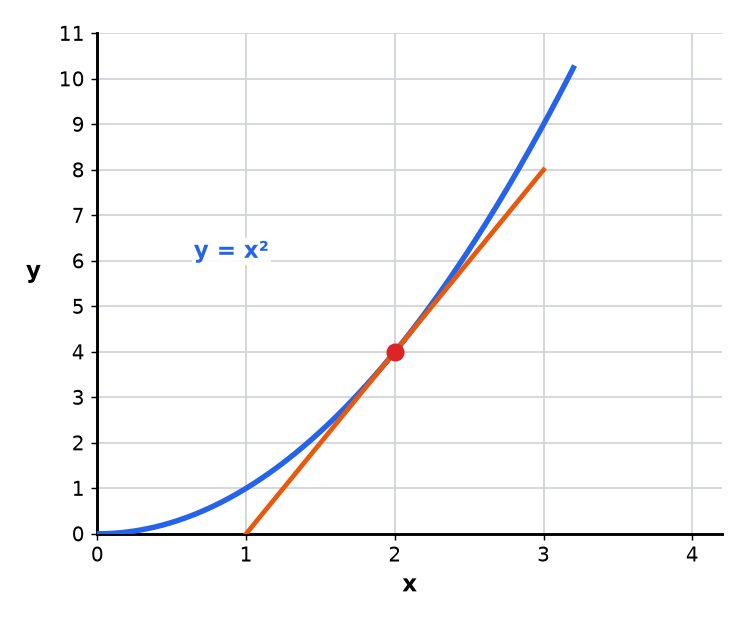
The diagram shows the graph of \(y = x^2\) and the tangent to the curve at the point \((2, 4)\). Work out the gradient of the curve at the point \((2, 4)\). (3 marks)
Show answerHide answer
Model answer
The tangent passes through \((1, 0)\) and \((3, 8)\). Gradient \(= \dfrac{8 - 0}{3 - 1} = 4\).
Mark scheme
- Two points read from the tangent, such as \((1, 0)\) and \((3, 8)\) — M1
- \(\dfrac{8 - 0}{3 - 1}\) — M1
- \(4\) — A1
-
2 Work out [3 marks]
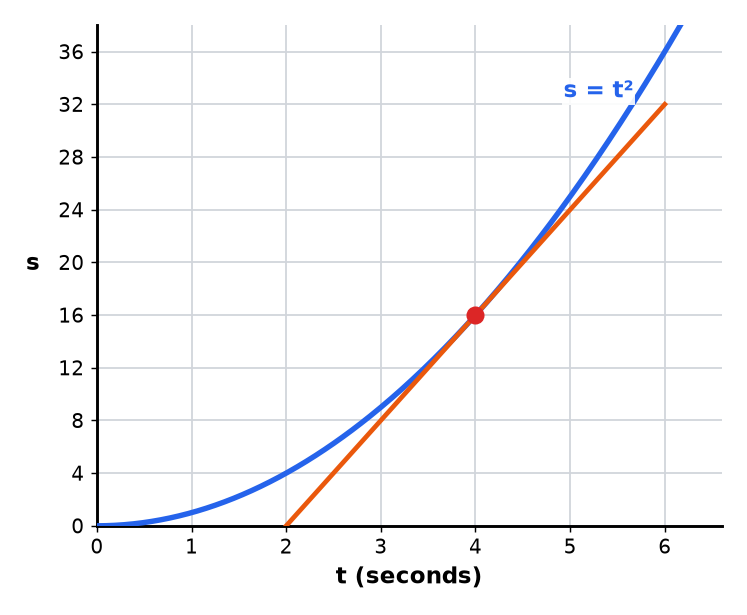
The graph shows the distance, \(s\) metres, travelled by a runner after \(t\) seconds. The line is the tangent to the curve at \(t = 4\). Work out the speed of the runner at \(t = 4\). (3 marks)
Show answerHide answer
Model answer
The tangent passes through \((2, 0)\) and \((6, 32)\). Gradient \(= \dfrac{32}{4} = 8\), so the speed is 8 m/s.
Mark scheme
- Two points read from the tangent, such as \((2, 0)\) and \((6, 32)\) — M1
- \(\dfrac{32 - 0}{6 - 2}\) — M1
- \(8\) m/s — A1
-
3 Work out [2 marks]
The distance, \(s\) metres, travelled by a car after \(t\) seconds is given by \(s = t^2\). Work out the average speed of the car between \(t = 1\) and \(t = 4\). (2 marks)
Show answerHide answer
Model answer
\(s = 1\) when \(t = 1\) and \(s = 16\) when \(t = 4\). Average speed \(= \dfrac{16 - 1}{4 - 1} = 5\) m/s.
Mark scheme
- \(\dfrac{16 - 1}{4 - 1}\) — M1
- \(5\) m/s — A1
-
4 Work out [5 marks]
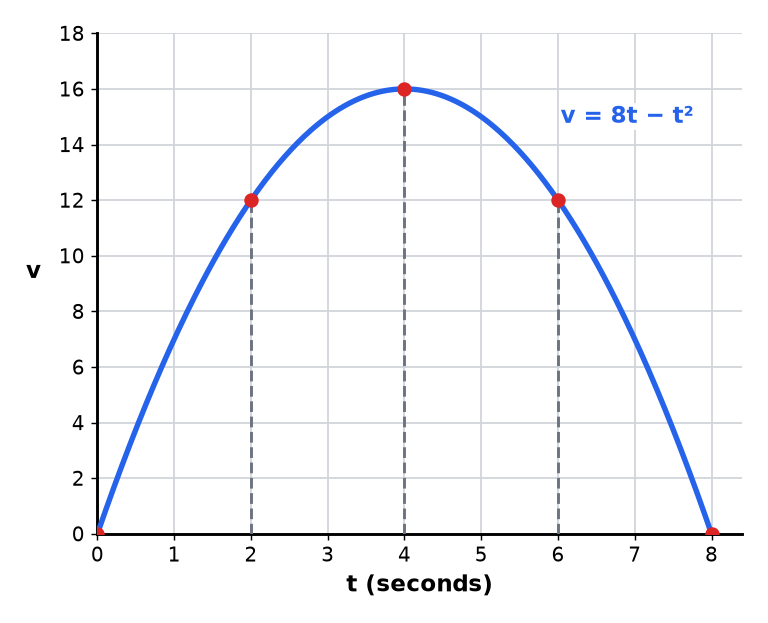
The graph shows the velocity, \(v\) m/s, of a particle at time \(t\) seconds. (a) Use 4 strips of equal width to estimate the distance travelled between \(t = 0\) and \(t = 8\). (3 marks) (b) Is your answer an underestimate or an overestimate? Give a reason for your answer. (2 marks)
Show answerHide answer
Model answer
(a) The heights are 0, 12, 16, 12 and 0. Area \(= \dfrac{1}{2} \times 2 \times (0 + 12) + \dfrac{1}{2} \times 2 \times (12 + 16) + \dfrac{1}{2} \times 2 \times (16 + 12) + \dfrac{1}{2} \times 2 \times (12 + 0) = 12 + 28 + 28 + 12 = 80\) m. (b) An underestimate, because the curve bends downwards and the straight tops of the trapezia are below the curve.
Mark scheme
- (a) Reads the heights 12, 16 and 12 — B1
- (a) Uses \(\dfrac{1}{2}(a + b)h\) for each strip — M1
- (a) \(80\) — A1
- (b) Underestimate — B1
- (b) The curve is above the straight tops of the trapezia — C1
-
5 Work out [3 marks]
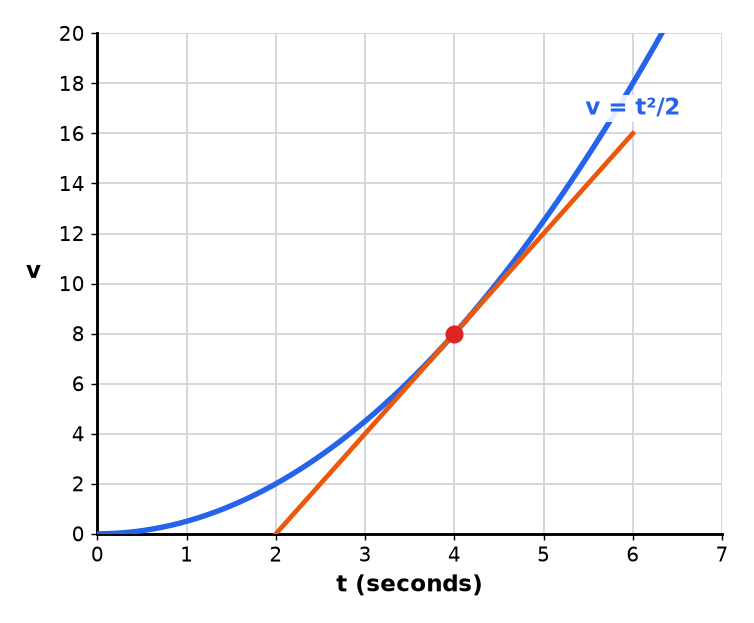
The graph shows the velocity, \(v\) m/s, of a car at time \(t\) seconds. The line is the tangent to the curve at \(t = 4\). Work out an estimate of the acceleration of the car at \(t = 4\). (3 marks)
Show answerHide answer
Model answer
The tangent passes through \((2, 0)\) and \((6, 16)\). Gradient \(= \dfrac{16}{4} = 4\), so the acceleration is 4 m/s\(^2\).
Mark scheme
- Two points read from the tangent, such as \((2, 0)\) and \((6, 16)\) — M1
- \(\dfrac{16 - 0}{6 - 2}\) — M1
- \(4\) m/s\(^2\) — A1
-
6 Work out [4 marks]
The velocity of a particle was measured every second. \(t\) (s): 0, 1, 2, 3, 4 \(v\) (m/s): 0, 3, 8, 15, 24 Use trapezia to estimate the distance travelled in the first 4 seconds. State whether your answer is an underestimate or an overestimate. Give a reason. (4 marks)
Show answerHide answer
Model answer
Area \(= \dfrac{1}{2}(0 + 3) + \dfrac{1}{2}(3 + 8) + \dfrac{1}{2}(8 + 15) + \dfrac{1}{2}(15 + 24) = 1.5 + 5.5 + 11.5 + 19.5 = 38\) m. It is an overestimate, because the velocity curve bends upwards, so the straight tops of the trapezia are above the curve.
Mark scheme
- \(\dfrac{1}{2}(0 + 3) + \dfrac{1}{2}(3 + 8) + \ldots\), with strips of width 1 — M1
- \(38\) — A1
- Overestimate — B1
- The curve bends upwards, so the straight tops are above the curve — C1
Quick check
-
1
What do you draw to find the gradient of a curve at a point?
Show answerHide answer
A: A tangent
A tangent touches the curve at that point.
-
2
What is a chord?
Show answerHide answer
D: A straight line joining two points on a curve
The chord joins two points on the curve.
-
3
What does the gradient of a distance-time graph represent?
Show answerHide answer
C: Speed
Distance divided by time is speed.
-
4
What does the area under a velocity-time graph represent?
Show answerHide answer
B: Distance travelled
Velocity multiplied by time is distance.
-
5
A tangent passes through \((1, 0)\) and \((3, 8)\). What is its gradient?
Show answerHide answer
A: 4
\(\dfrac{8 - 0}{3 - 1} = 4\).
-
6
What is the average rate of change of \(y = x^2\) between \(x = 1\) and \(x = 4\)?
Show answerHide answer
D: 5
\(\dfrac{16 - 1}{4 - 1} = 5\).
-
7
What is the area of a trapezium with parallel sides 4 and 6 and width 2?
Show answerHide answer
C: 10
\(\dfrac{1}{2}(4 + 6) \times 2 = 10\).
-
8
A velocity-time curve bends downwards. Is a trapezium estimate of the area an over- or underestimate?
Show answerHide answer
B: An underestimate
The straight tops lie below the curve.
-
9
A velocity-time graph has heights 0, 8, 8, 0 at times 0, 2, 4, 6. What is the trapezium estimate of the distance?
Show answerHide answer
A: 32
\(8 + 16 + 8 = 32\).
Transformations of Graphs
Just this lesson-
1 Write down [2 marks]
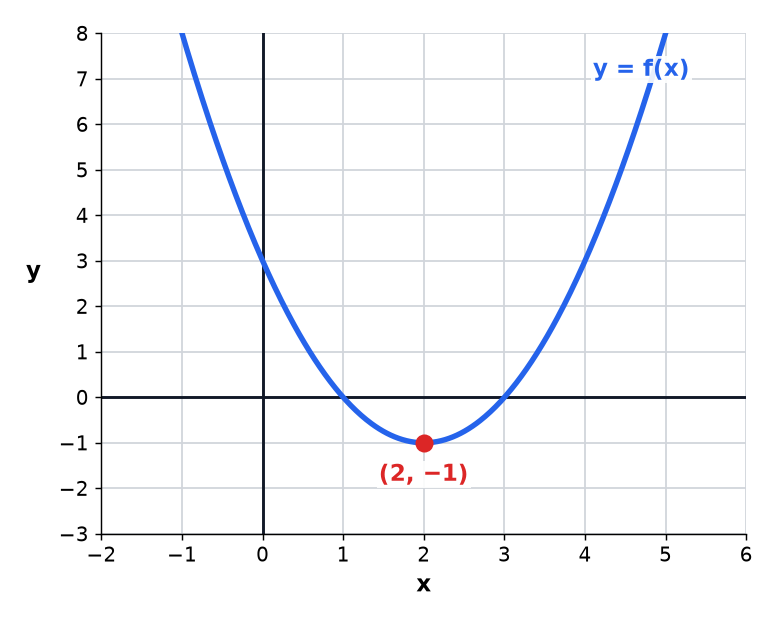
The graph of \(y = f(x)\) is shown. The turning point is \((2, -1)\). (a) Write down the coordinates of the turning point of the graph of \(y = f(x) + 2\). (1 mark) (b) Write down the coordinates of the turning point of the graph of \(y = f(x + 1)\). (1 mark)
Show answerHide answer
Model answer
(a) \((2, 1)\). (b) \((1, -1)\).
Mark scheme
- (a) \((2, 1)\) — B1
- (b) \((1, -1)\) — B1
-
2 Write down [2 marks]
The graph of \(y = g(x)\) has a minimum point at \((-1, -3)\). (a) Write down the coordinates of the minimum point of \(y = g(x) + 4\). (1 mark) (b) Write down the coordinates of the maximum point of \(y = -g(x)\). (1 mark)
Show answerHide answer
Model answer
(a) \((-1, 1)\). (b) \((-1, 3)\).
Mark scheme
- (a) \((-1, 1)\) — B1
- (b) \((-1, 3)\) — B1
-
3 Write down [3 marks]
The graph of \(y = x^2\) is transformed. Write down the equation of the new graph after (a) a translation of 3 units to the right, (1 mark) (b) a translation of 2 units up, (1 mark) (c) a reflection in the \(x\)-axis. (1 mark)
Show answerHide answer
Model answer
(a) \(y = (x - 3)^2\). (b) \(y = x^2 + 2\). (c) \(y = -x^2\).
Mark scheme
- (a) \(y = (x - 3)^2\) — B1
- (b) \(y = x^2 + 2\) — B1
- (c) \(y = -x^2\) — B1
-
4 Write down [4 marks]
The graph of \(y = f(x)\) has a maximum point at \((3, 5)\). Write down the coordinates of the maximum point of the graph of (a) \(y = f(x - 2)\) (1 mark) (b) \(y = f(x) - 4\) (1 mark) (c) \(y = -f(x)\) (1 mark) (d) \(y = f(-x)\) (1 mark)
Show answerHide answer
Model answer
(a) \((5, 5)\). (b) \((3, 1)\). (c) \((3, -5)\), which is now a minimum. (d) \((-3, 5)\).
Mark scheme
- (a) \((5, 5)\) — B1
- (b) \((3, 1)\) — B1
- (c) \((3, -5)\) — B1
- (d) \((-3, 5)\) — B1
-
5 Write down [3 marks]
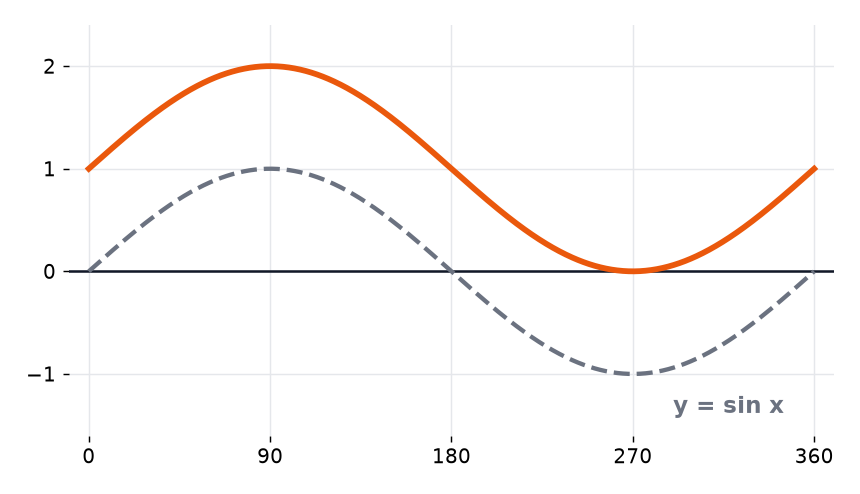
The diagram shows the graph of \(y = \sin x\) and a transformation of it, for \(0^\circ \le x \le 360^\circ\). (a) Write down the equation of the transformed graph. (1 mark) (b) Describe fully the single transformation. (2 marks)
Show answerHide answer
Model answer
(a) \(y = \sin x + 1\). (b) A translation by the vector \(\begin{pmatrix} 0 \\ 1 \end{pmatrix}\), which is 1 unit up.
Mark scheme
- (a) \(y = \sin x + 1\) — B1
- (b) Translation — B1
- (b) Vector \(\begin{pmatrix} 0 \\ 1 \end{pmatrix}\), or 1 unit up — B1
-
6 Show that [4 marks]
\(f(x) = x^2 - 4x + 3\). Show that \(f(x + 1) = x^2 - 2x\), and hence solve \(f(x + 1) = 0\). (4 marks)
Show answerHide answer
Model answer
\(f(x + 1) = (x + 1)^2 - 4(x + 1) + 3 = x^2 + 2x + 1 - 4x - 4 + 3 = x^2 - 2x\). Then \(x(x - 2) = 0\), so \(x = 0\) or \(x = 2\).
Mark scheme
- \((x + 1)^2 - 4(x + 1) + 3\) — M1
- \(x^2 - 2x\) with the working shown — A1
- \(x(x - 2) = 0\) — M1
- \(x = 0\) and \(x = 2\) — A1
Quick check
-
1
What does \(y = f(x) + 3\) do to the graph of \(y = f(x)\)?
Show answerHide answer
B: Moves it up 3
Adding to the function moves the graph up.
-
2
What does \(y = f(x + 2)\) do to the graph of \(y = f(x)\)?
Show answerHide answer
A: Moves it left 2
A plus inside the bracket moves the graph left.
-
3
What does \(y = -f(x)\) do to the graph of \(y = f(x)\)?
Show answerHide answer
D: Reflects it in the \(x\)-axis
A minus outside changes the \(y\)-values.
-
4
What does \(y = f(-x)\) do to the graph of \(y = f(x)\)?
Show answerHide answer
C: Reflects it in the \(y\)-axis
A minus inside changes the \(x\)-values.
-
5
The maximum of \(y = f(x)\) is at \((3, 5)\). Where is the maximum of \(y = f(x - 2)\)?
Show answerHide answer
B: \((5, 5)\)
The graph moves right 2.
-
6
The maximum of \(y = f(x)\) is at \((3, 5)\). Where is the turning point of \(y = -f(x)\)?
Show answerHide answer
A: \((3, -5)\)
The \(y\)-coordinate changes sign.
-
7
What is the equation of \(y = x^2\) after a translation of 3 units to the right?
Show answerHide answer
D: \(y = (x - 3)^2\)
Moving right replaces \(x\) with \(x - 3\).
-
8
What is the maximum value of \(y = \sin x + 1\)?
Show answerHide answer
C: 2
The sine graph is moved up by 1, so its maximum is \(1 + 1 = 2\).
-
9
Which equation gives the same graph as \(y = \cos x\)?
Show answerHide answer
B: \(y = \sin(x + 90^\circ)\)
Moving the sine graph left by \(90^\circ\) gives the cosine graph.