Exam questions · Maths · Functions, Sequences and Rates of Change
Rates of Change and Areas Under Graphs
- 6 exam questions
- 20 marks
- 9 quick checks
-
1 Work out [3 marks]
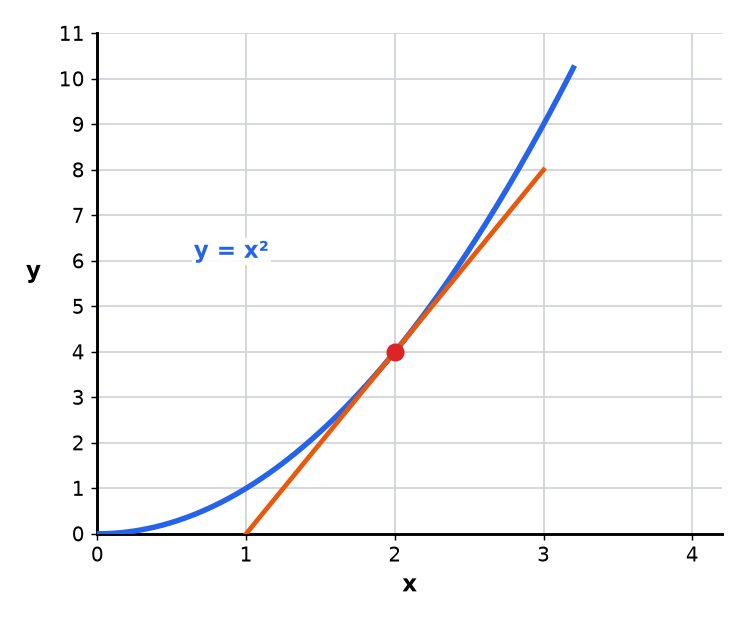
The diagram shows the graph of \(y = x^2\) and the tangent to the curve at the point \((2, 4)\). Work out the gradient of the curve at the point \((2, 4)\). (3 marks)
Show answerHide answer
Model answer
The tangent passes through \((1, 0)\) and \((3, 8)\). Gradient \(= \dfrac{8 - 0}{3 - 1} = 4\).
Mark scheme
- Two points read from the tangent, such as \((1, 0)\) and \((3, 8)\) — M1
- \(\dfrac{8 - 0}{3 - 1}\) — M1
- \(4\) — A1
-
2 Work out [3 marks]
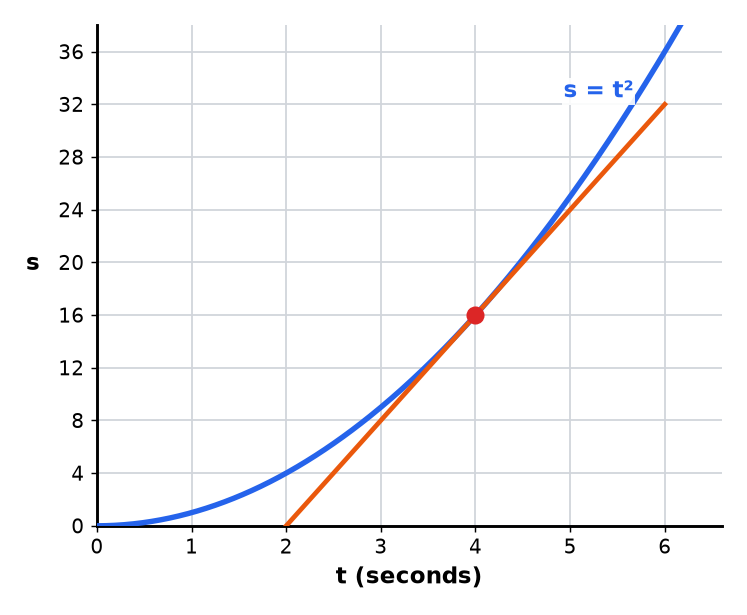
The graph shows the distance, \(s\) metres, travelled by a runner after \(t\) seconds. The line is the tangent to the curve at \(t = 4\). Work out the speed of the runner at \(t = 4\). (3 marks)
Show answerHide answer
Model answer
The tangent passes through \((2, 0)\) and \((6, 32)\). Gradient \(= \dfrac{32}{4} = 8\), so the speed is 8 m/s.
Mark scheme
- Two points read from the tangent, such as \((2, 0)\) and \((6, 32)\) — M1
- \(\dfrac{32 - 0}{6 - 2}\) — M1
- \(8\) m/s — A1
-
3 Work out [2 marks]
The distance, \(s\) metres, travelled by a car after \(t\) seconds is given by \(s = t^2\). Work out the average speed of the car between \(t = 1\) and \(t = 4\). (2 marks)
Show answerHide answer
Model answer
\(s = 1\) when \(t = 1\) and \(s = 16\) when \(t = 4\). Average speed \(= \dfrac{16 - 1}{4 - 1} = 5\) m/s.
Mark scheme
- \(\dfrac{16 - 1}{4 - 1}\) — M1
- \(5\) m/s — A1
-
4 Work out [5 marks]
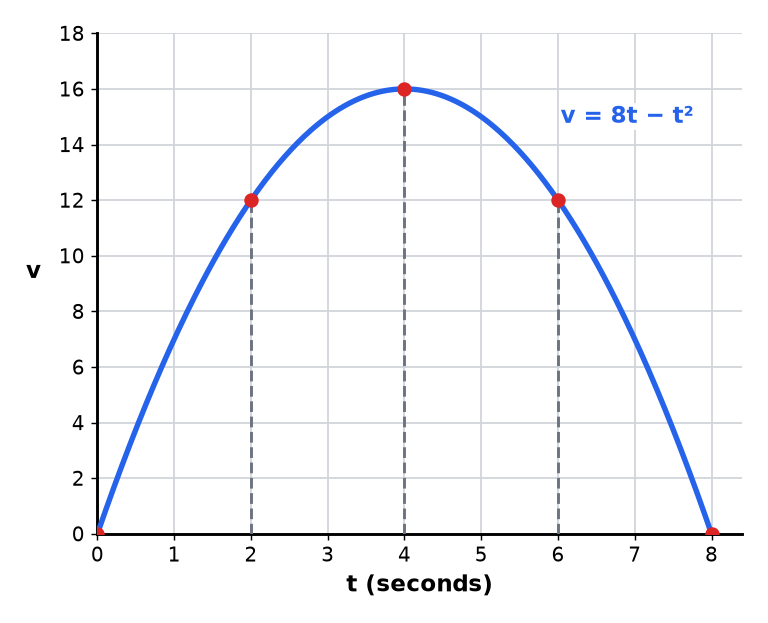
The graph shows the velocity, \(v\) m/s, of a particle at time \(t\) seconds. (a) Use 4 strips of equal width to estimate the distance travelled between \(t = 0\) and \(t = 8\). (3 marks) (b) Is your answer an underestimate or an overestimate? Give a reason for your answer. (2 marks)
Show answerHide answer
Model answer
(a) The heights are 0, 12, 16, 12 and 0. Area \(= \dfrac{1}{2} \times 2 \times (0 + 12) + \dfrac{1}{2} \times 2 \times (12 + 16) + \dfrac{1}{2} \times 2 \times (16 + 12) + \dfrac{1}{2} \times 2 \times (12 + 0) = 12 + 28 + 28 + 12 = 80\) m. (b) An underestimate, because the curve bends downwards and the straight tops of the trapezia are below the curve.
Mark scheme
- (a) Reads the heights 12, 16 and 12 — B1
- (a) Uses \(\dfrac{1}{2}(a + b)h\) for each strip — M1
- (a) \(80\) — A1
- (b) Underestimate — B1
- (b) The curve is above the straight tops of the trapezia — C1
-
5 Work out [3 marks]
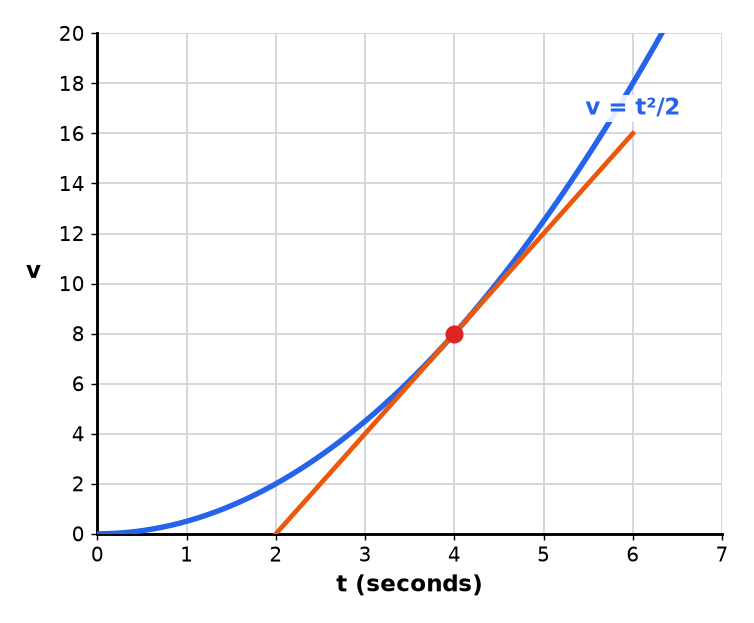
The graph shows the velocity, \(v\) m/s, of a car at time \(t\) seconds. The line is the tangent to the curve at \(t = 4\). Work out an estimate of the acceleration of the car at \(t = 4\). (3 marks)
Show answerHide answer
Model answer
The tangent passes through \((2, 0)\) and \((6, 16)\). Gradient \(= \dfrac{16}{4} = 4\), so the acceleration is 4 m/s\(^2\).
Mark scheme
- Two points read from the tangent, such as \((2, 0)\) and \((6, 16)\) — M1
- \(\dfrac{16 - 0}{6 - 2}\) — M1
- \(4\) m/s\(^2\) — A1
-
6 Work out [4 marks]
The velocity of a particle was measured every second. \(t\) (s): 0, 1, 2, 3, 4 \(v\) (m/s): 0, 3, 8, 15, 24 Use trapezia to estimate the distance travelled in the first 4 seconds. State whether your answer is an underestimate or an overestimate. Give a reason. (4 marks)
Show answerHide answer
Model answer
Area \(= \dfrac{1}{2}(0 + 3) + \dfrac{1}{2}(3 + 8) + \dfrac{1}{2}(8 + 15) + \dfrac{1}{2}(15 + 24) = 1.5 + 5.5 + 11.5 + 19.5 = 38\) m. It is an overestimate, because the velocity curve bends upwards, so the straight tops of the trapezia are above the curve.
Mark scheme
- \(\dfrac{1}{2}(0 + 3) + \dfrac{1}{2}(3 + 8) + \ldots\), with strips of width 1 — M1
- \(38\) — A1
- Overestimate — B1
- The curve bends upwards, so the straight tops are above the curve — C1
Quick check
-
1
What do you draw to find the gradient of a curve at a point?
Show answerHide answer
A: A tangent
A tangent touches the curve at that point.
-
2
What is a chord?
Show answerHide answer
D: A straight line joining two points on a curve
The chord joins two points on the curve.
-
3
What does the gradient of a distance-time graph represent?
Show answerHide answer
C: Speed
Distance divided by time is speed.
-
4
What does the area under a velocity-time graph represent?
Show answerHide answer
B: Distance travelled
Velocity multiplied by time is distance.
-
5
A tangent passes through \((1, 0)\) and \((3, 8)\). What is its gradient?
Show answerHide answer
A: 4
\(\dfrac{8 - 0}{3 - 1} = 4\).
-
6
What is the average rate of change of \(y = x^2\) between \(x = 1\) and \(x = 4\)?
Show answerHide answer
D: 5
\(\dfrac{16 - 1}{4 - 1} = 5\).
-
7
What is the area of a trapezium with parallel sides 4 and 6 and width 2?
Show answerHide answer
C: 10
\(\dfrac{1}{2}(4 + 6) \times 2 = 10\).
-
8
A velocity-time curve bends downwards. Is a trapezium estimate of the area an over- or underestimate?
Show answerHide answer
B: An underestimate
The straight tops lie below the curve.
-
9
A velocity-time graph has heights 0, 8, 8, 0 at times 0, 2, 4, 6. What is the trapezium estimate of the distance?
Show answerHide answer
A: 32
\(8 + 16 + 8 = 32\).