Exam questions · Maths · Statistics
Averages and Range
- 6 exam questions
- 20 marks
- 9 quick checks
-
1 Calculate [3 marks]
Here are five numbers: 4, 6, 6, 7, 12. Calculate (a) the mean, (b) the median, (c) the range. [3 marks]
Show answerHide answer
Model answer
(a) \(\dfrac{4 + 6 + 6 + 7 + 12}{5} = \dfrac{35}{5} = 7\). (b) The numbers are in order, so the median is 6. (c) \(12 - 4 = 8\).
Mark scheme
- (a) 7 — B1
- (b) 6 — B1
- (c) 8 — B1
-
2 Calculate [5 marks]
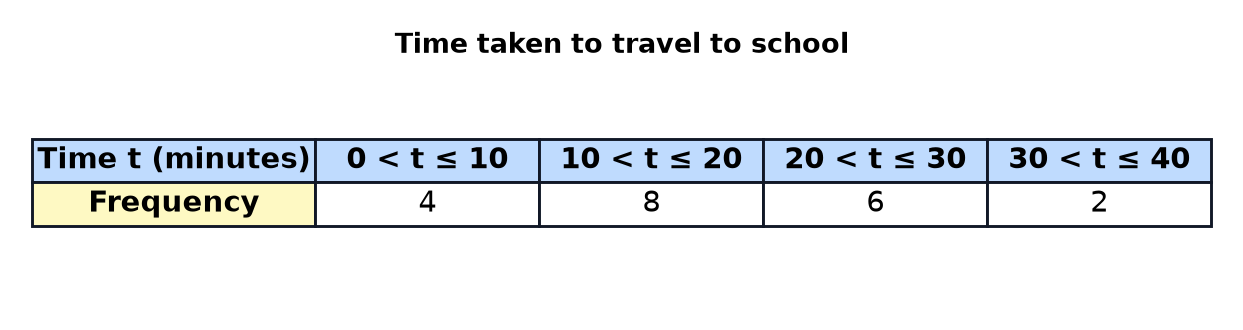
The table shows the times, \(t\) minutes, taken by 20 people to travel to school. (a) Write down the modal class. [1 mark] (b) Which class contains the median? [1 mark] (c) Calculate an estimate of the mean time. [3 marks]
Show answerHide answer
Model answer
(a) The highest frequency is 8, so the modal class is \(10 < t \leq 20\). (b) The median is halfway between the 10th and 11th values. The cumulative frequencies are 4, 12, 18, 20, so the median is in the class \(10 < t \leq 20\). (c) The mid-points are 5, 15, 25 and 35. \(5 \times 4 + 15 \times 8 + 25 \times 6 + 35 \times 2 = 20 + 120 + 150 + 70 = 360\). The estimate is \(\dfrac{360}{20} = 18\) minutes.
Mark scheme
- (a) \(10 < t \leq 20\) — B1
- (b) \(10 < t \leq 20\) — B1
- (c) Mid-points 5, 15, 25, 35 used — M1
- (c) \(\dfrac{360}{20}\) or total 360 — M1
- (c) 18 — A1
-
3 Calculate [3 marks]
Here are five numbers: 3, 5, 6, 7, 39. (a) Calculate the mean. [1 mark] (b) Find the median. [1 mark] (c) Which average is a better description of the typical number? Give a reason. [1 mark]
Show answerHide answer
Model answer
(a) \(\dfrac{3 + 5 + 6 + 7 + 39}{5} = \dfrac{60}{5} = 12\). (b) 6. (c) The median, because the mean is pulled up by the very large value 39, an outlier.
Mark scheme
- (a) 12 — B1
- (b) 6 — B1
- (c) The median, because the mean is affected by the outlier — B1
-
4 Calculate [3 marks]
10 pupils have a mean mark of 14. 30 other pupils have a mean mark of 18. Calculate the mean mark of all 40 pupils. [3 marks]
Show answerHide answer
Model answer
The total of the first group is \(10 \times 14 = 140\) and of the second is \(30 \times 18 = 540\). The mean is \(\dfrac{140 + 540}{40} = \dfrac{680}{40} = 17\).
Mark scheme
- \(10 \times 14 = 140\) or \(30 \times 18 = 540\) — M1
- \(\dfrac{140 + 540}{40}\) — M1
- 17 — A1
-
5 Calculate [3 marks]
The table shows the number of pets owned by 20 students. The numbers of pets 0, 1, 2 and 3 have the frequencies 5, 9, 4 and 2. Calculate the mean number of pets. [3 marks]
Show answerHide answer
Model answer
\(0 \times 5 + 1 \times 9 + 2 \times 4 + 3 \times 2 = 0 + 9 + 8 + 6 = 23\). The mean is \(\dfrac{23}{20} = 1.15\).
Mark scheme
- Products \(f \times x\) with at least 3 correct — M1
- \(\dfrac{23}{20}\) or total 23 — M1
- 1.15 — A1
-
6 Calculate [3 marks]
The mean of 5 numbers is 14. One of the numbers, 20, is removed. Calculate the mean of the remaining 4 numbers. [3 marks]
Show answerHide answer
Model answer
The total of the 5 numbers is \(5 \times 14 = 70\). After removing 20 the total is \(70 - 20 = 50\). The mean of the 4 numbers is \(\dfrac{50}{4} = 12.5\).
Mark scheme
- \(5 \times 14 = 70\) — M1
- \(\dfrac{70 - 20}{4}\) — M1
- 12.5 — A1
Quick check
-
1
What is the median of 3, 5, 6, 8, 9, 12?
Show answerHide answer
B: \(7\)
With 6 values, take the mean of the 3rd and 4th: \(\dfrac{6 + 8}{2} = 7\).
-
2
What is the range of 3, 8, 11, 20?
Show answerHide answer
A: \(17\)
\(20 - 3 = 17\).
-
3
What is the mean of 4, 6, 8, 10, 12?
Show answerHide answer
D: \(8\)
\(\dfrac{40}{5} = 8\).
-
4
Which average is least affected by an outlier?
Show answerHide answer
C: The median
The median depends only on the middle value.
-
5
The numbers 0, 1, 2, 3, 4 have frequencies 4, 4, 6, 4, 2. What is the mean?
Show answerHide answer
B: \(1.8\)
\(\dfrac{0 + 4 + 12 + 12 + 8}{20} = \dfrac{36}{20} = 1.8\).
-
6
What is the mode of the numbers 0, 1, 2, 3, 4 with frequencies 4, 4, 6, 4, 2?
Show answerHide answer
A: \(2\)
The highest frequency, 6, is for the value 2.
-
7
What is the mid-point of the class \(20 < w \leq 40\)?
Show answerHide answer
D: \(30\)
\(\dfrac{20 + 40}{2} = 30\).
-
8
Classes \(0 < w \leq 20\), \(20 < w \leq 40\) and \(40 < w \leq 60\) have frequencies 5, 10 and 5. What is the estimated mean?
Show answerHide answer
C: \(30\)
Using mid-points: \(\dfrac{10 \times 5 + 30 \times 10 + 50 \times 5}{20} = \dfrac{600}{20} = 30\).
-
9
The mean of five numbers is 8. Four of them are 5, 7, 9 and 10. What is the fifth?
Show answerHide answer
B: \(9\)
The total is \(5 \times 8 = 40\), and \(40 - 31 = 9\).