Slides · PPTX · 280 KB · 29 slides
Experimental probability - Teacher Slides.pptx
The lesson slides with the teacher's notes on each slide, and every question and mark scheme built in. Built from the lesson script on 30 September 2026.
EDEXCEL GCSE MATHS · FOUNDATION & HIGHER
Experimental probability
Probability
Lesson 3 of 6
openrevise.com
EDEXCEL GCSE MATHS · FOUNDATION & HIGHER
Warm-up
Probability
Lesson 3 of 6
Answer each one, then check.
1
Simplify 30/120.
2
Write 18/60 as a decimal.
3
What is the theoretical probability of heads on a fair coin?
4
Work out 500 × 0.3.
5
What is 1/6 as a decimal, to 2 decimal places?
openrevise.com
EDEXCEL GCSE MATHS · FOUNDATION & HIGHER
Warm-up - Answers
Probability
Lesson 3 of 6
1
Simplify 30/120.
¼
2
Write 18/60 as a decimal.
0.3
3
What is the theoretical probability of heads on a fair coin?
½
4
Work out 500 × 0.3.
150
5
What is 1/6 as a decimal, to 2 decimal places?
0.17
openrevise.com
EDEXCEL GCSE MATHS · FOUNDATION & HIGHER
Learning Objectives
Probability
Lesson 3 of 6
1
Work out relative frequency.
2
Use relative frequency to estimate probability.
3
Predict how many times an event will happen.
4
Decide whether a coin, dice or spinner is fair.
openrevise.com
EDEXCEL GCSE MATHS · FOUNDATION & HIGHER
Probability
Lesson 3 of 6
RELATIVE FREQUENCY
Relative frequency is the number of times an event happens divided by the total number of trials.
relative frequency = (frequency of the event)/(total number of trials)
openrevise.com
EDEXCEL GCSE MATHS · FOUNDATION & HIGHER
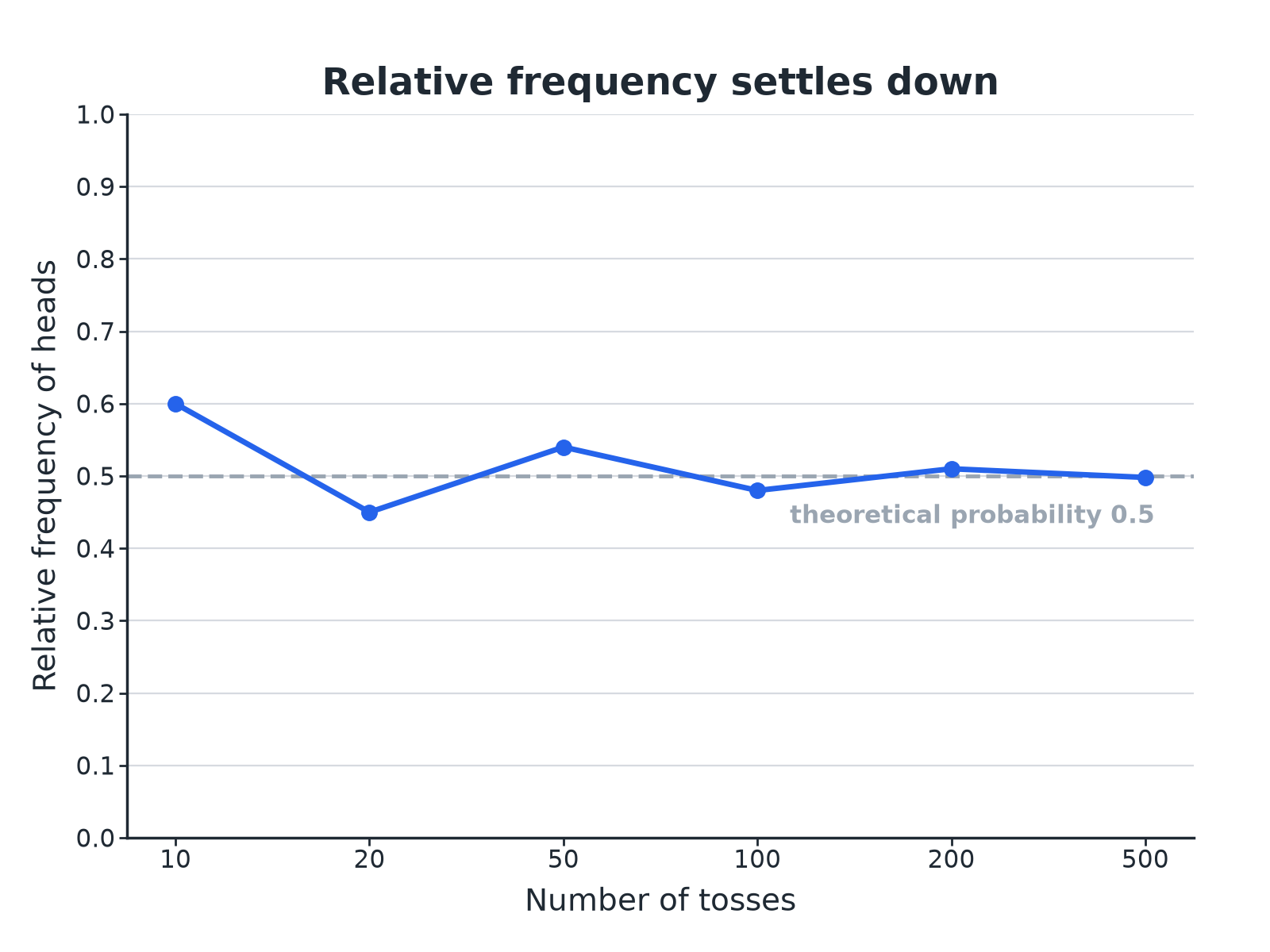
Relative Frequency Settles Down
Probability
Lesson 3 of 6

The more trials, the closer the relative frequency gets to the true probability.
openrevise.com
EDEXCEL GCSE MATHS · FOUNDATION & HIGHER
Relative Frequency
Probability
Lesson 3 of 6
A spinner is spun 60 times. It lands on red 18 times, blue 30 times and green 12 times. Find the relative frequency of each colour.
1
Red
18/60 = 0.3
2
Blue
30/60 = 0.5
3
Green
12/60 = 0.2
ANSWER
Red 0.3, blue 0.5, green 0.2. These add up to 1.
openrevise.com
EDEXCEL GCSE MATHS · FOUNDATION & HIGHER
Predicting Outcomes
Probability
Lesson 3 of 6
Use the spinner results to estimate how many times you would expect blue in 500 spins.
1
Estimated probability of blue
0.5
2
Multiply by the number of spins
0.5 × 500 = 250
ANSWER
About 250 blues.
openrevise.com
EDEXCEL GCSE MATHS · FOUNDATION & HIGHER
Is the Dice Fair?
Probability
Lesson 3 of 6
A dice is rolled 120 times and lands on 6 a total of 30 times. Does this suggest the dice is biased?
1
Relative frequency of a 6
30/120 = 0.25
2
Expected for a fair dice
1/6 = 0.167, so about 20 sixes
3
Compare
30 is much bigger than 20
ANSWER
The relative frequency 0.25 is well above 1/6, which suggests the dice may be biased, but more trials would give a more reliable conclusion.
openrevise.com
EDEXCEL GCSE MATHS · FOUNDATION & HIGHER
Theoretical or Experimental?
Probability
Lesson 3 of 6
THEORETICAL PROBABILITY
• Worked out from equally likely outcomes.
• Example: P(head) = ½.
• Does not change.
EXPERIMENTAL PROBABILITY
• Estimated from the results of trials.
• Example: 18 heads in 40 tosses gives 0.45.
• Changes as you do more trials.
openrevise.com
EDEXCEL GCSE MATHS · FOUNDATION & HIGHER
How Reliable Is an Estimate?
Probability
Lesson 3 of 6
More trials give better estimates.
Small samples
10 tosses might give 7 heads: 0.7 is a poor estimate of 0.5.
Large samples
1000 tosses will usually give a relative frequency very close to 0.5.
Fair
A fair dice or coin should give relative frequencies close to the theoretical values.
openrevise.com
EDEXCEL GCSE MATHS · FOUNDATION & HIGHER
Key Terms
Probability
Lesson 3 of 6
Trial
One repeat of an experiment.
Frequency
How many times an outcome happens.
Relative frequency
Frequency divided by the number of trials.
Theoretical probability
The probability worked out from equally likely outcomes.
Expected number
Probability multiplied by the number of trials.
Fair
Every outcome is equally likely.
openrevise.com
EDEXCEL GCSE MATHS · FOUNDATION & HIGHER
Probability
Lesson 3 of 6
YOUR TASK
Coin Toss Experiment
15 minutes
Toss a coin 10 times and record the number of heads. Combine class results in groups of 10, 50 and 100 tosses. Work out the relative frequency of heads for each total and comment on how close each is to 0.5.
1
Collect results.
2
Combine.
3
Compare.
WHAT A GOOD ANSWER SHOWS
Small groups vary widely (for example 3 or 7 heads out of 10), while the combined class total is very close to 0.5. This shows that relative frequency settles as the number of trials grows.
openrevise.com
EDEXCEL GCSE MATHS · FOUNDATION & HIGHER
Can I...?
Probability
Lesson 3 of 6
Work out relative frequency.
Use it as an estimate of probability.
Work out an expected number.
Compare experimental and theoretical results.
Say whether a dice looks fair.
Explain why more trials are better.
Show relative frequencies add to 1.
Draw a relative frequency graph.
openrevise.com
EDEXCEL GCSE MATHS · FOUNDATION & HIGHER
Summary & Exam Focus
Relative frequency = frequency/trials.
Expected number = probability × trials.
More trials give a more reliable estimate.
Compare with the theoretical probability to test fairness.
EXAM FOCUS
A spinner is spun 200 times. It lands on red 62 times. Work out an estimate for the probability that it lands on red, and how many reds you expect in 500 spins. (3 marks)
Relative frequency is frequency divided by the number of trials. Multiply by the number of spins for the expected number.
openrevise.com
EDEXCEL GCSE MATHS · FOUNDATION & HIGHER
Exam Practice: Experimental Probability
Probability
Lesson 3 of 6
Answer all questions. Show your working. · 25 minutes
Question 1 · 2 marks · Calculator
A spinner is spun 60 times. It lands on red 18 times. Work out the relative frequency of red.
Question 2 · 3 marks · Calculator
A spinner is spun 200 times. It lands on red 62 times. Work out an estimate for the number of times it will land on red in 500 spins.
Question 3 · 3 marks · Calculator
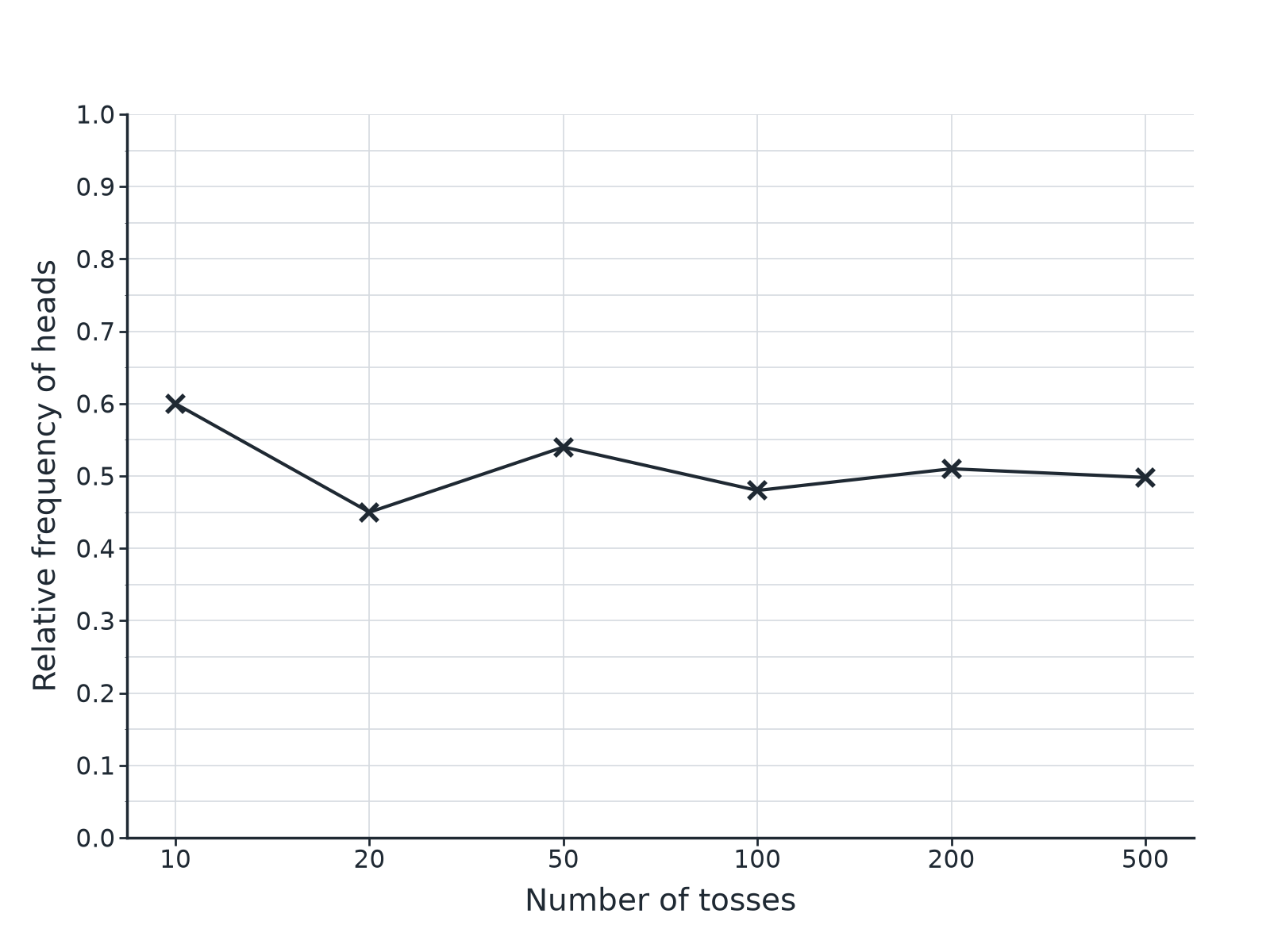
The graph shows the relative frequency of heads as a coin is tossed more and more times. Use it to explain whether the coin is likely to be…
openrevise.com
EDEXCEL GCSE MATHS · FOUNDATION & HIGHER
Exam Practice: Experimental Probability (cont.)
Probability
Lesson 3 of 6
Question 4 · 3 marks · Calculator
A dice is rolled 120 times. It lands on 6 a total of 30 times. Kim says the dice is biased. Is she right? You must show working.
Question 5 · 3 marks · Calculator
The probability that a bus is late is 0.15. Work out the expected number of late buses in 200 journeys.
Question 6 · 2 marks · Explain
Amy tosses a coin 10 times and gets 7 heads. Ben tosses the same coin 1000 times and gets 505 heads. Whose result gives a better estimate…
openrevise.com
EDEXCEL GCSE MATHS · FOUNDATION & HIGHER
Question 1 · 2 marks · Calculator
Probability
Lesson 3 of 6
“
A spinner is spun 60 times. It lands on red 18 times. Work out the relative frequency of red.
HOW TO ANSWER IT
Command word: Calculator. Worth 2 marks, so plan before writing.
openrevise.com
EDEXCEL GCSE MATHS · FOUNDATION & HIGHER
Question 1 · mark scheme
Probability
Lesson 3 of 6
2 marks available. Award a mark for each point made.
18/60
M1
0.3
A1
openrevise.com
EDEXCEL GCSE MATHS · FOUNDATION & HIGHER
Question 2 · 3 marks · Calculator
Probability
Lesson 3 of 6
“
A spinner is spun 200 times. It lands on red 62 times. Work out an estimate for the number of times it will land on red in 500 spins.
HOW TO ANSWER IT
Command word: Calculator. Worth 3 marks, so plan before writing.
openrevise.com
EDEXCEL GCSE MATHS · FOUNDATION & HIGHER
Question 2 · mark scheme
Probability
Lesson 3 of 6
3 marks available. Award a mark for each point made.
62/200
M1
0.31 × 500
M1
155
A1
openrevise.com
EDEXCEL GCSE MATHS · FOUNDATION & HIGHER
Question 3 · 3 marks · Calculator
Probability
Lesson 3 of 6

The graph shows the relative frequency of heads as a coin is tossed more and more times. Use it to explain whether the coin is likely to be fair. (3 marks)
openrevise.com
EDEXCEL GCSE MATHS · FOUNDATION & HIGHER
Question 3 · mark scheme
Probability
Lesson 3 of 6
3 marks available. Award a mark for each point made.
The relative frequency settles
M1
It is near 0.5
M1
Conclusion that the coin is likely to be fair
C1
openrevise.com
EDEXCEL GCSE MATHS · FOUNDATION & HIGHER
Question 4 · 3 marks · Calculator
Probability
Lesson 3 of 6
“
A dice is rolled 120 times. It lands on 6 a total of 30 times. Kim says the dice is biased. Is she right? You must show working.
HOW TO ANSWER IT
Command word: Calculator. Worth 3 marks, so plan before writing.
openrevise.com
EDEXCEL GCSE MATHS · FOUNDATION & HIGHER
Question 4 · mark scheme
Probability
Lesson 3 of 6
3 marks available. Award a mark for each point made.
30/120 = 0.25 or expected 20
M1
Comparison with 1/6 or 20
M1
A conclusion with a reason
C1
openrevise.com
EDEXCEL GCSE MATHS · FOUNDATION & HIGHER
Question 5 · 3 marks · Calculator
Probability
Lesson 3 of 6
“
The probability that a bus is late is 0.15. Work out the expected number of late buses in 200 journeys.
HOW TO ANSWER IT
Command word: Calculator. Worth 3 marks, so plan before writing.
openrevise.com
EDEXCEL GCSE MATHS · FOUNDATION & HIGHER
Question 5 · mark scheme
Probability
Lesson 3 of 6
3 marks available. Award a mark for each point made.
0.15 × 200
M1
30
A1
A sensible unit or statement
B1
openrevise.com
EDEXCEL GCSE MATHS · FOUNDATION & HIGHER
Question 6 · 2 marks · Explain
Probability
Lesson 3 of 6
“
Amy tosses a coin 10 times and gets 7 heads. Ben tosses the same coin 1000 times and gets 505 heads. Whose result gives a better estimate of the probability of a head? Give a reason.
HOW TO ANSWER IT
Command word: Explain. Worth 2 marks, so plan before writing.
openrevise.com
EDEXCEL GCSE MATHS · FOUNDATION & HIGHER
Question 6 · mark scheme
Probability
Lesson 3 of 6
2 marks available. Award a mark for each point made.
Ben
B1
More trials give a more reliable estimate
C1
openrevise.com
← → to move, F to present full screen, G for every slide at once.