Slides · PPTX · 917 KB · 18 slides
The Role of the Church in Crime and Punishment - Teacher Slides.pptx
The lesson slides with the teacher's notes on each slide, and every question and mark scheme built in. Built from the lesson script on 23 September 2026.
EDEXCEL GCSE HISTORY · PAPER 1 · CRIME & PUNISHMENT

The Role of the Church in Crime and Punishment
c1000-c1500
Chapter 1: Crime and punishment in medieval England, c1000-c1500
Lesson 3 of 4
openrevise.com
EDEXCEL GCSE HISTORY · PAPER 1 · CRIME & PUNISHMENT

Learning Objectives
Chapter 1: Crime and punishment in medieval England, c1000-c1500
Lesson 3 of 4
1
Describe the work of Church courts and the punishments they gave.
2
Explain how sanctuary and benefit of clergy worked, and why they caused conflict.
3
Explain why trial by ordeal ended in 1215, and assess the significance of the Church's influence.
openrevise.com
EDEXCEL GCSE HISTORY · PAPER 1 · CRIME & PUNISHMENT

Setting the Scene
Chapter 1: Crime and punishment in medieval England, c1000-c1500
Lesson 3 of 4
In medieval England the Church was as powerful as the king. Almost everyone believed in Heaven and Hell, and the Church owned land, collected taxes and ran its own courts. The Church saw crime as sin, and it believed sinners should have the chance to repent - which meant its justice was often gentler than the king's.
1070s
William I sets up separate Church courts.
1164
Henry II's Constitutions of Clarendon try to limit Church courts.
1170
Archbishop Thomas Becket is murdered in Canterbury Cathedral.
1215
The Pope bans priests from taking part in trials by ordeal.
openrevise.com
EDEXCEL GCSE HISTORY · PAPER 1 · CRIME & PUNISHMENT

Church Courts
Chapter 1: Crime and punishment in medieval England, c1000-c1500
Lesson 3 of 4
The Church dealt with its own - and with sins as well as crimes.
Who they tried
Members of the clergy - priests, monks and nuns - for any crime, and anyone for moral crimes such as adultery, drunkenness or failing to go to church.
Punishments
Church courts never sentenced anyone to death. They used penance, fines, public shaming and, at worst, excommunication.
Why gentler
The Church believed punishment should give sinners the chance to repent and save their souls.
Criticism
Many people thought Church courts let criminal clergy off too lightly.
openrevise.com
EDEXCEL GCSE HISTORY · PAPER 1 · CRIME & PUNISHMENT

Sanctuary and Benefit of Clergy
Chapter 1: Crime and punishment in medieval England, c1000-c1500
Lesson 3 of 4
Two ways the Church protected people from the king's courts.
Sanctuary
A person accused of a crime could claim protection in a church. After 40 days they had to face trial or leave England.
Abjuring the realm
Leaving England: the fugitive walked to a named port, barefoot and carrying a cross, and took the first ship.
Benefit of clergy
Clergy accused of a crime could be tried in a Church court, where there was no death penalty.
The neck verse
To prove they were clergy, the accused read a passage from the Bible - later Psalm 51. People learned it by heart to escape hanging.
openrevise.com
EDEXCEL GCSE HISTORY · PAPER 1 · CRIME & PUNISHMENT

Church Against Crown: Thomas Becket
Chapter 1: Crime and punishment in medieval England, c1000-c1500
Lesson 3 of 4
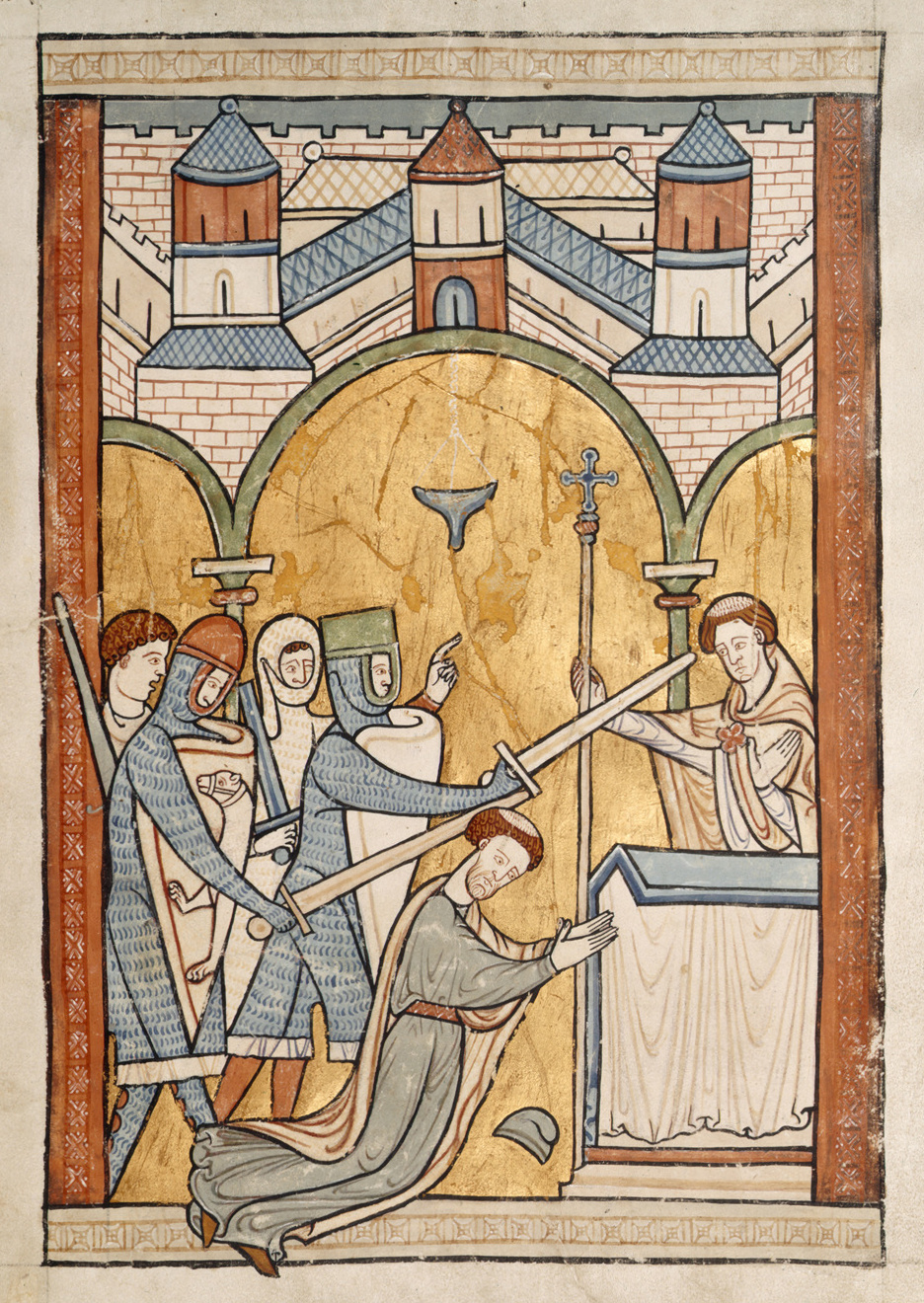
The murder of Thomas Becket, 1170.
Medieval manuscript illustration; public domain copies on Wikimedia Commons.
Henry II wanted clergy who committed serious crimes to be punished in the king's courts. His Archbishop of Canterbury, Thomas Becket, refused. In 1170 four of Henry's knights murdered Becket in his own cathedral.
WHY IT MATTERED
Martyr
Becket was made a saint and Canterbury became a place of pilgrimage.
Henry backs down
Henry did public penance, and benefit of clergy survived for the rest of the Middle Ages.
Church and crown
The case shows the Church's power over justice - even against a strong king.
openrevise.com
EDEXCEL GCSE HISTORY · PAPER 1 · CRIME & PUNISHMENT

The End of Trial by Ordeal
Chapter 1: Crime and punishment in medieval England, c1000-c1500
Lesson 3 of 4
The Church had run the ordeals - and in 1215 it stopped.
The decision
In 1215 Pope Innocent III's Fourth Lateran Council banned priests from taking part in trials by ordeal.
Why
Many churchmen doubted that God should be asked to perform a miracle to decide a court case, and ordeals were open to trickery.
The effect
Without priests, ordeals could not work. By the 1220s trial by jury replaced them in the king's courts.
Significance
A decision made by the Church changed how guilt was decided in England.
openrevise.com
EDEXCEL GCSE HISTORY · PAPER 1 · CRIME & PUNISHMENT

Did the Church Help or Hinder Justice?
Chapter 1: Crime and punishment in medieval England, c1000-c1500
Lesson 3 of 4
IT HELPED
• Gave accused people protection from hasty punishment through sanctuary.
• Offered a chance to repent instead of death.
• Its decision in 1215 led to trial by jury - a fairer system.
IT HINDERED
• Benefit of clergy let criminal clergy escape hanging.
• Sanctuary could let the guilty escape justice.
• It clashed with the king over who had authority.
openrevise.com
EDEXCEL GCSE HISTORY · PAPER 1 · CRIME & PUNISHMENT

Key Terms
Chapter 1: Crime and punishment in medieval England, c1000-c1500
Lesson 3 of 4
Church courts
Courts run by the Church for clergy and moral crimes; never gave the death penalty.
Sanctuary
Protection given to an accused person who took refuge in a church.
Abjuring the realm
Leaving England for ever instead of facing trial.
Benefit of clergy
The right of clergy to be tried in Church courts.
Neck verse
Psalm 51, read to prove you were clergy and escape hanging.
Excommunication
Being cut off from the Church - believed to mean going to Hell.
Fourth Lateran Council
The Church meeting of 1215 that ended priests' part in trial by ordeal.
openrevise.com
EDEXCEL GCSE HISTORY · PAPER 1 · CRIME & PUNISHMENT
Summary & Exam Focus
Church courts tried clergy and moral crimes, and never used the death penalty.
Sanctuary gave fugitives 40 days' protection before trial or leaving England.
Benefit of clergy let the clergy - and later anyone who could read - escape hanging.
In 1215 the Church ended trial by ordeal, leading to trial by jury.
EXAM FOCUS
Explain why the Church had an important influence on crime and punishment in the early thirteenth century. (12 marks)
Explain each factor - sanctuary, benefit of clergy, the end of the ordeal - and say why it mattered, not just what it was.
openrevise.com
EDEXCEL GCSE HISTORY · PAPER 1 · CRIME & PUNISHMENT

Exam Practice - The Role of the Church
Chapter 1: Crime and punishment in medieval England, c1000-c1500
Lesson 3 of 4
Answer all questions. Use specific names, dates and examples in every answer. · 35 minutes
Question 1 · 4 marks · Explain one way
Explain one way in which the way guilt was decided in the period c1000-c1200 was different from the way guilt was decided in the period…
Question 2 · 12 marks · Explain why
Explain why the Church had an important influence on crime and punishment in the early thirteenth century. You may use the following in…
Question 3 · 16 marks · How far do you agree?
"The Church was the most important influence on crime and punishment in the period c1000-c1500." How far do you agree? Explain your answer…
openrevise.com
EDEXCEL GCSE HISTORY · PAPER 1 · CRIME & PUNISHMENT

Question 1 · 4 marks · Explain one way
Chapter 1: Crime and punishment in medieval England, c1000-c1500
Lesson 3 of 4
“
Explain one way in which the way guilt was decided in the period c1000-c1200 was different from the way guilt was decided in the period c1200-c1500.
HOW TO ANSWER IT
Command word: Explain one way. Worth 4 marks, so plan before writing.
openrevise.com
EDEXCEL GCSE HISTORY · PAPER 1 · CRIME & PUNISHMENT

Question 1 · mark scheme
Chapter 1: Crime and punishment in medieval England, c1000-c1500
Lesson 3 of 4
4 marks available. Award a mark for each point made.
A valid difference identified
1-2 marks
Supported with specific knowledge of both periods
3-4 marks
openrevise.com
EDEXCEL GCSE HISTORY · PAPER 1 · CRIME & PUNISHMENT

Question 2 · 12 marks · Explain why
Chapter 1: Crime and punishment in medieval England, c1000-c1500
Lesson 3 of 4
“
Explain why the Church had an important influence on crime and punishment in the early thirteenth century. You may use the following in your answer: sanctuary; trial by ordeal. You must also use information of your own.
HOW TO ANSWER IT
Command word: Explain why. Worth 12 marks, so plan before writing.
openrevise.com
EDEXCEL GCSE HISTORY · PAPER 1 · CRIME & PUNISHMENT

Question 2 · mark scheme
Chapter 1: Crime and punishment in medieval England, c1000-c1500
Lesson 3 of 4
12 marks available. Award a mark for each point made.
Level 1 (1-3)
A simple or general answer
Level 2 (4-6)
Some explanation of one or more reasons, with some knowledge
Level 3 (7-9)
A developed explanation linked to the question, with accurate knowledge
Level 4 (10-12)
An analytical explanation of several reasons, with knowledge that goes beyond the stimulus points
openrevise.com
EDEXCEL GCSE HISTORY · PAPER 1 · CRIME & PUNISHMENT

Question 3 · 16 marks · How far do you agree?
Chapter 1: Crime and punishment in medieval England, c1000-c1500
Lesson 3 of 4
“
"The Church was the most important influence on crime and punishment in the period c1000-c1500." How far do you agree? Explain your answer. You may use the following in your answer: benefit of clergy; the Statute of Labourers (1351). You must also use information of your own. (16 marks, plus 4 for…
HOW TO ANSWER IT
Command word: How far do you agree?. Worth 16 marks, so plan before writing.
openrevise.com
EDEXCEL GCSE HISTORY · PAPER 1 · CRIME & PUNISHMENT

Question 3 · mark scheme
Chapter 1: Crime and punishment in medieval England, c1000-c1500
Lesson 3 of 4
16 marks available. Award a mark for each point made.
Level 1 (1-4)
A simple or generalised answer
Level 2 (5-8)
Some analysis, with a judgement that is asserted
Level 3 (9-12)
Analysis of both sides with accurate knowledge and a supported judgement
openrevise.com
EDEXCEL GCSE HISTORY · PAPER 1 · CRIME & PUNISHMENT

Question 3 · mark scheme (cont.)
Chapter 1: Crime and punishment in medieval England, c1000-c1500
Lesson 3 of 4
Level 4 (13-16)
Sustained analysis, knowledge beyond the stimulus, and a clear, justified judgement
SPaG (4)
Accurate spelling, punctuation and grammar, with specialist terms such as sanctuary and benefit of clergy
openrevise.com
← → to move, F to present full screen, G for every slide at once.