Slides · PPTX · 1.1 MB · 19 slides
Heresy and its Punishment - Teacher Slides.pptx
The lesson slides with the teacher's notes on each slide, and every question and mark scheme built in. Built from the lesson script on 23 September 2026.
EDEXCEL GCSE HISTORY · PAPER 1 · CRIME & PUNISHMENT

Heresy and its Punishment
c1500-c1700
Chapter 2: Crime and punishment in early modern England, c1500-c1700
Lesson 2 of 5
openrevise.com
EDEXCEL GCSE HISTORY · PAPER 1 · CRIME & PUNISHMENT

Learning Objectives
Chapter 2: Crime and punishment in early modern England, c1500-c1700
Lesson 2 of 5
1
Define heresy and explain why it was seen as such a serious crime.
2
Describe how heretics were tried and punished, including burning at the stake.
3
Explain how and why the treatment of heresy changed between 1500 and 1700.
openrevise.com
EDEXCEL GCSE HISTORY · PAPER 1 · CRIME & PUNISHMENT

Setting the Scene
Chapter 2: Crime and punishment in early modern England, c1500-c1700
Lesson 2 of 5
Heresy meant holding religious beliefs that went against the official teaching of the Church. People believed a heretic's soul was damned - and that a heretic could lead others to damnation too. Because the official religion kept changing, the same belief could be heresy under one monarch and the law under the next.
1530s
Henry VIII burns Protestants who deny Catholic beliefs about the Mass.
1547
Edward VI repeals the old heresy laws.
1555
Mary I begins burning Protestants; Bishops Latimer and Ridley burned at Oxford.
1556
Archbishop Thomas Cranmer is burned.
openrevise.com
EDEXCEL GCSE HISTORY · PAPER 1 · CRIME & PUNISHMENT

Setting the Scene (cont.)
Chapter 2: Crime and punishment in early modern England, c1500-c1700
Lesson 2 of 5
1563
John Foxe publishes his Book of Martyrs.
1612
The last burnings for heresy in England.
openrevise.com
EDEXCEL GCSE HISTORY · PAPER 1 · CRIME & PUNISHMENT

Why Heresy Was So Serious
Chapter 2: Crime and punishment in early modern England, c1500-c1700
Lesson 2 of 5
To people at the time, heresy was worse than murder: it killed the soul, not just the body.
Damnation
People believed heretics would go to Hell, and that heresy could spread and damn whole communities.
Order
The Church taught obedience; rejecting its teaching seemed to threaten order and the authority of the monarch.
Example
Punishment was public so that others would be frightened away from the heretic's ideas.
Chance to recant
Accused heretics were urged to recant - take back their beliefs - and many who did were spared.
openrevise.com
EDEXCEL GCSE HISTORY · PAPER 1 · CRIME & PUNISHMENT

How a Heretic Was Dealt With
Chapter 2: Crime and punishment in early modern England, c1500-c1700
Lesson 2 of 5
Church and state worked together.
1
Accused
A suspect was reported to the Church authorities.
2
Questioned
Church officials examined their beliefs, often over weeks or months.
3
Urged to recant
They were given the chance to take back their beliefs publicly.
4
Condemned
If they refused, the Church handed them to the state.
5
Burned
The state carried out the sentence: burning at the stake in public.
openrevise.com
EDEXCEL GCSE HISTORY · PAPER 1 · CRIME & PUNISHMENT

Foxe's Book of Martyrs
Chapter 2: Crime and punishment in early modern England, c1500-c1700
Lesson 2 of 5
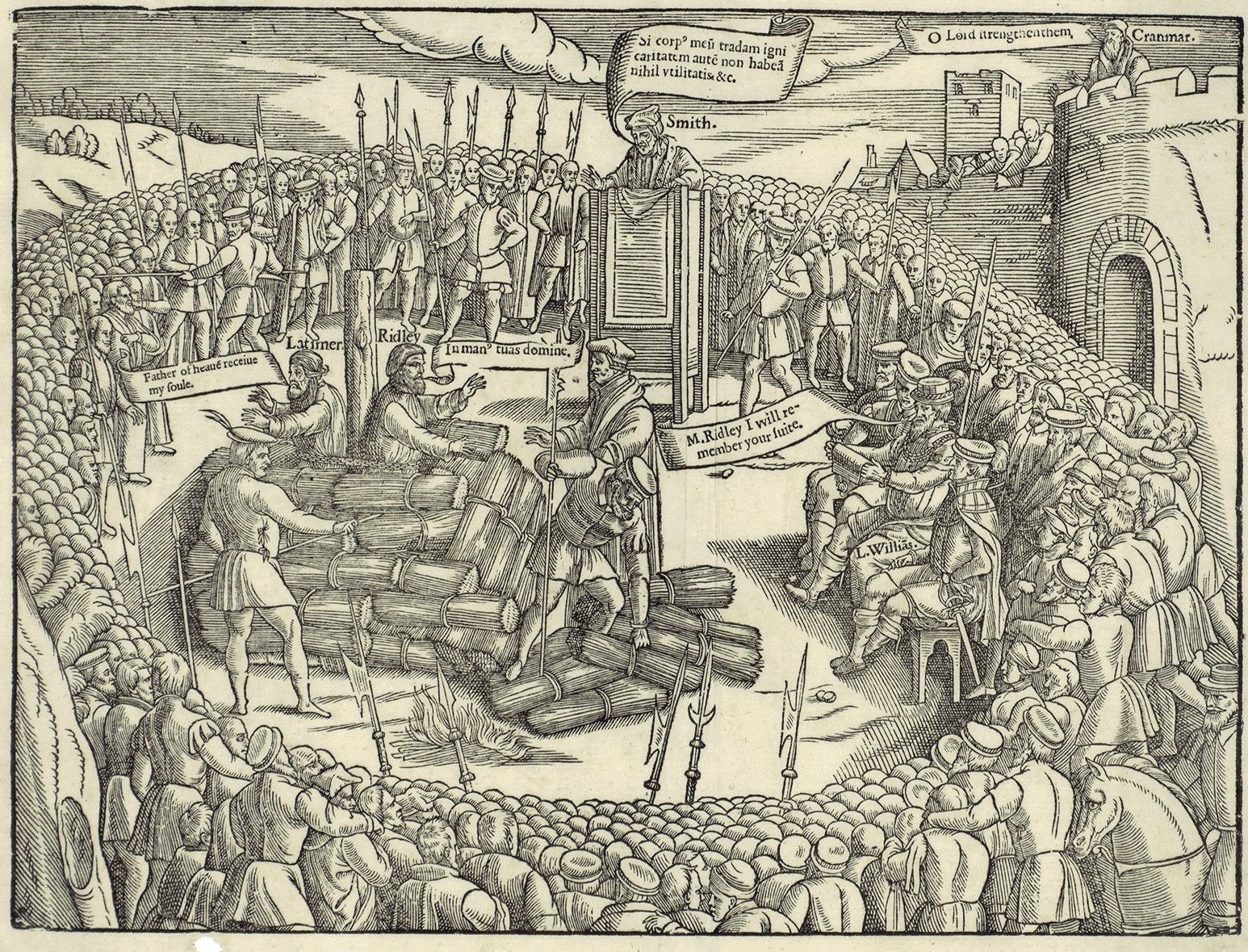
Protestant martyrs, as shown by John Foxe.
John Foxe, Actes and Monuments (1563); public domain copies on Wikimedia Commons.
John Foxe's Book of Martyrs described the Protestants burned under Mary I in vivid detail. It was placed in many churches and shaped how English Protestants remembered her reign.
WHY IT MATTERS AS A SOURCE
Detailed
Names, places and dates for hundreds of executions.
Biased
Written by a Protestant to show Catholics as cruel.
Influential
Helped create the name "Bloody Mary".
openrevise.com
EDEXCEL GCSE HISTORY · PAPER 1 · CRIME & PUNISHMENT

How Heresy Changed, 1500-1700
Chapter 2: Crime and punishment in early modern England, c1500-c1700
Lesson 2 of 5
Heresy did not disappear - but it was increasingly replaced by treason as the way to punish religious opponents.
Henry VIII
Burned both Protestants who denied Catholic teaching and Catholics who denied his supremacy - the second as traitors.
Mary I
Revived the heresy laws in 1554 and burned around 280 Protestants in under four years.
Elizabeth I
Burned only a handful of heretics; she mainly punished Catholics for treason instead.
James I
The last burnings for heresy in England took place in 1612.
openrevise.com
EDEXCEL GCSE HISTORY · PAPER 1 · CRIME & PUNISHMENT

Latimer at the Stake
Chapter 2: Crime and punishment in early modern England, c1500-c1700
Lesson 2 of 5
“
Be of good comfort, Master Ridley, and play the man. We shall this day light such a candle, by God's grace, in England, as I trust shall never be put out.
— Hugh Latimer to Nicholas Ridley as they were burned at Oxford, 1555, as reported by John Foxe
WHAT IT SHOWS
Burning heretics was meant to stamp out their ideas - but the martyrs' courage, retold by Foxe, helped spread Protestantism instead.
openrevise.com
EDEXCEL GCSE HISTORY · PAPER 1 · CRIME & PUNISHMENT

Key Terms
Chapter 2: Crime and punishment in early modern England, c1500-c1700
Lesson 2 of 5
Heresy
Holding religious beliefs that go against the official teaching of the Church.
Heretic
A person found guilty of heresy.
Recant
To take back your beliefs publicly.
Martyr
Someone who dies for their beliefs.
Burning at the stake
The punishment for heresy: death by fire in public.
Book of Martyrs
John Foxe's 1563 account of Protestants burned under Mary I.
openrevise.com
EDEXCEL GCSE HISTORY · PAPER 1 · CRIME & PUNISHMENT
Summary & Exam Focus
Heresy was seen as a threat to people's souls and to order.
Heretics were questioned by the Church and burned by the state.
Mary I burned around 280 Protestants; Elizabeth mostly used treason instead.
The last heresy burnings in England were in 1612.
EXAM FOCUS
Explain why heresy was punished so severely in the period c1500-c1700. (12 marks)
Explain the religious reasons (souls, damnation) and the political reasons (the monarch's authority), then support each with a specific example.
openrevise.com
EDEXCEL GCSE HISTORY · PAPER 1 · CRIME & PUNISHMENT

Exam Practice - Heresy
Chapter 2: Crime and punishment in early modern England, c1500-c1700
Lesson 2 of 5
Answer all questions. Use specific names, dates and examples in every answer. · 35 minutes
Question 1 · 4 marks · Explain one way
Explain one way in which the punishment of heresy under Henry VIII was similar to the punishment of heresy under Mary I.
Question 2 · 12 marks · Explain why
Explain why heresy was punished so severely in the period c1500-c1700. You may use the following in your answer: the burnings under Mary I…
Question 3 · 16 marks · How far do you agree?
"The main reason religious opponents were punished in the period c1500-c1700 was to protect the authority of the monarch." How far do you…
openrevise.com
EDEXCEL GCSE HISTORY · PAPER 1 · CRIME & PUNISHMENT

Question 1 · 4 marks · Explain one way
Chapter 2: Crime and punishment in early modern England, c1500-c1700
Lesson 2 of 5
“
Explain one way in which the punishment of heresy under Henry VIII was similar to the punishment of heresy under Mary I.
HOW TO ANSWER IT
Command word: Explain one way. Worth 4 marks, so plan before writing.
openrevise.com
EDEXCEL GCSE HISTORY · PAPER 1 · CRIME & PUNISHMENT

Question 1 · mark scheme
Chapter 2: Crime and punishment in early modern England, c1500-c1700
Lesson 2 of 5
4 marks available. Award a mark for each point made.
A valid similarity identified
1-2 marks
Supported with specific knowledge of both reigns
3-4 marks
openrevise.com
EDEXCEL GCSE HISTORY · PAPER 1 · CRIME & PUNISHMENT

Question 2 · 12 marks · Explain why
Chapter 2: Crime and punishment in early modern England, c1500-c1700
Lesson 2 of 5
“
Explain why heresy was punished so severely in the period c1500-c1700. You may use the following in your answer: the burnings under Mary I; the authority of the monarch. You must also use information of your own.
HOW TO ANSWER IT
Command word: Explain why. Worth 12 marks, so plan before writing.
openrevise.com
EDEXCEL GCSE HISTORY · PAPER 1 · CRIME & PUNISHMENT

Question 2 · mark scheme
Chapter 2: Crime and punishment in early modern England, c1500-c1700
Lesson 2 of 5
12 marks available. Award a mark for each point made.
Level 1 (1-3)
A simple or general answer
Level 2 (4-6)
Some explanation of one or more reasons, with some knowledge
Level 3 (7-9)
A developed explanation linked to the question, with accurate knowledge
Level 4 (10-12)
An analytical explanation of several reasons, with knowledge that goes beyond the stimulus points
openrevise.com
EDEXCEL GCSE HISTORY · PAPER 1 · CRIME & PUNISHMENT

Question 3 · 16 marks · How far do you agree?
Chapter 2: Crime and punishment in early modern England, c1500-c1700
Lesson 2 of 5
“
"The main reason religious opponents were punished in the period c1500-c1700 was to protect the authority of the monarch." How far do you agree? Explain your answer. You may use the following in your answer: Mary I; recusancy. You must also use information of your own. (16 marks, plus 4 for…
HOW TO ANSWER IT
Command word: How far do you agree?. Worth 16 marks, so plan before writing.
openrevise.com
EDEXCEL GCSE HISTORY · PAPER 1 · CRIME & PUNISHMENT

Question 3 · mark scheme
Chapter 2: Crime and punishment in early modern England, c1500-c1700
Lesson 2 of 5
16 marks available. Award a mark for each point made.
Level 1 (1-4)
A simple or generalised answer
Level 2 (5-8)
Some analysis, with a judgement that is asserted
Level 3 (9-12)
Analysis of both sides with accurate knowledge and a supported judgement
openrevise.com
EDEXCEL GCSE HISTORY · PAPER 1 · CRIME & PUNISHMENT

Question 3 · mark scheme (cont.)
Chapter 2: Crime and punishment in early modern England, c1500-c1700
Lesson 2 of 5
Level 4 (13-16)
Sustained analysis, knowledge beyond the stimulus, and a clear, justified judgement
SPaG (4)
Accurate spelling, punctuation and grammar, with specialist terms such as heresy and recusancy
openrevise.com
← → to move, F to present full screen, G for every slide at once.