Slides · PPTX · 179 KB · 19 slides
Witchcraft and the Witch-Hunts of 1645-47 - Teacher Slides.pptx
The lesson slides with the teacher's notes on each slide, and every question and mark scheme built in. Built from the lesson script on 23 September 2026.
EDEXCEL GCSE HISTORY · PAPER 1 · CRIME & PUNISHMENT

Witchcraft and the Witch-Hunts of 1645-47
c1500-c1700
Chapter 2: Crime and punishment in early modern England, c1500-c1700
Lesson 4 of 5
openrevise.com
EDEXCEL GCSE HISTORY · PAPER 1 · CRIME & PUNISHMENT

Learning Objectives
Chapter 2: Crime and punishment in early modern England, c1500-c1700
Lesson 4 of 5
1
Describe the laws that made witchcraft a crime, and how they changed.
2
Explain why accusations of witchcraft increased, especially in the 1640s.
3
Explain the role of Matthew Hopkins in the witch-hunts of 1645-47.
openrevise.com
EDEXCEL GCSE HISTORY · PAPER 1 · CRIME & PUNISHMENT

Setting the Scene
Chapter 2: Crime and punishment in early modern England, c1500-c1700
Lesson 4 of 5
In the 1500s and 1600s almost everyone believed the Devil was real and that witches could use his power to harm people, animals and crops. When something went wrong - a sick child, a dead cow, a failed harvest - neighbours looked for someone to blame. Witchcraft became a crime that could be punished by death.
1542
Henry VIII's Witchcraft Act makes witchcraft punishable by death.
1547
The 1542 Act is repealed under Edward VI.
1563
Elizabeth I's Witchcraft Act: death for killing someone by witchcraft.
1597
James VI of Scotland publishes Daemonologie, a book about witches.
openrevise.com
EDEXCEL GCSE HISTORY · PAPER 1 · CRIME & PUNISHMENT

Setting the Scene (cont.)
Chapter 2: Crime and punishment in early modern England, c1500-c1700
Lesson 4 of 5
1604
James I's Witchcraft Act: death for a first offence of calling up evil spirits.
1645-47
Matthew Hopkins leads a witch-hunt in East Anglia.
openrevise.com
EDEXCEL GCSE HISTORY · PAPER 1 · CRIME & PUNISHMENT

The Witchcraft Acts
Chapter 2: Crime and punishment in early modern England, c1500-c1700
Lesson 4 of 5
Each Act made witchcraft more clearly a crime.
Act
Monarch
What it said
1542
Henry VIII
Witchcraft punishable by death; repealed in 1547
1563
Elizabeth I
Death for causing a death by witchcraft; lesser harm punished by the pillory and prison
1604
James I
Death for a first offence of invoking evil spirits, even if no one was harmed
openrevise.com
EDEXCEL GCSE HISTORY · PAPER 1 · CRIME & PUNISHMENT

Why Were People Accused?
Chapter 2: Crime and punishment in early modern England, c1500-c1700
Lesson 4 of 5
Accusations grew out of belief, fear and hardship.
Religious belief
Belief in the Devil was universal, and Puritans stressed his power.
Hard times
Bad harvests, disease and poverty made people look for someone to blame.
Who was accused
Most were poor, elderly women, often living alone or dependent on neighbours.
Tension
A woman refused charity who then cursed her neighbour might be blamed for any bad luck that followed.
The king's example
James I believed strongly in witches and wrote Daemonologie (1597).
Evidence
"Proof" included a witch's mark, a familiar such as a pet cat, or a neighbour's word.
openrevise.com
EDEXCEL GCSE HISTORY · PAPER 1 · CRIME & PUNISHMENT

The Witchfinder General
Chapter 2: Crime and punishment in early modern England, c1500-c1700
Lesson 4 of 5
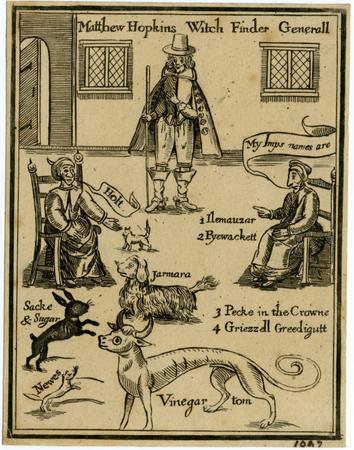
Frontispiece of The Discovery of Witches, 1647.
Matthew Hopkins, The Discovery of Witches (1647); public domain copies on Wikimedia Commons.
Matthew Hopkins called himself the Witchfinder General. With John Stearne he travelled through Essex, Suffolk and Norfolk in 1645-47, and more than 100 people were executed as a result - more than in any other English witch-hunt.
HIS METHODS
Watching
Suspects were kept awake for days until they "confessed".
Searching
Their bodies were searched for a devil's mark.
Swimming
Suspects were tied and thrown in water; floating meant guilt.
Payment
Towns paid him fees, so he had a reason to find witches.
openrevise.com
EDEXCEL GCSE HISTORY · PAPER 1 · CRIME & PUNISHMENT

Why the Witch-Hunts of 1645-47 Happened
Chapter 2: Crime and punishment in early modern England, c1500-c1700
Lesson 4 of 5
Hopkins was important - but he could only work because of the circumstances around him.
The Civil War
The Civil War (1642-51) disrupted normal government, and the usual assize courts were not held regularly, so local courts acted with less control.
Puritanism
East Anglia was strongly Puritan, and Puritans saw the Devil at work everywhere.
Hardship
War, bad harvests and disease left people anxious and looking for someone to blame.
Hopkins himself
His methods produced confessions, and his fame spread through his 1647 pamphlet The Discovery of Witches.
openrevise.com
EDEXCEL GCSE HISTORY · PAPER 1 · CRIME & PUNISHMENT
Chapter 2: Crime and punishment in early modern England, c1500-c1700
Lesson 4 of 5
CASE STUDY

The End of the Hunt
Hopkins's witch-hunt ended almost as quickly as it had begun. Some ministers, such as John Gaule, openly criticised his methods, and people began to question whether confessions made after days without sleep could be trusted. By 1647 the witch-hunt had collapsed, and Hopkins died that same year. The hunt shows how belief, fear and a breakdown of normal authority could combine with one determined man to cause a wave of accusations.
100+
People executed as a result of the witch-hunt, 1645-47
1647
Hopkins publishes The Discovery of Witches, and dies
openrevise.com
EDEXCEL GCSE HISTORY · PAPER 1 · CRIME & PUNISHMENT

Key Terms
Chapter 2: Crime and punishment in early modern England, c1500-c1700
Lesson 4 of 5
Witchcraft
Using supernatural power, believed to come from the Devil, to cause harm.
Witchcraft Act
Laws of 1542, 1563 and 1604 that made witchcraft a crime.
Familiar
An animal believed to be a witch's helper from the Devil.
Devil's mark
A mark on the body believed to show a pact with the Devil.
Swimming test
Throwing a suspect into water: floating meant guilt.
Puritan
A strict Protestant who wanted a simpler, purer Church.
Witchfinder General
The title Matthew Hopkins gave himself.
openrevise.com
EDEXCEL GCSE HISTORY · PAPER 1 · CRIME & PUNISHMENT
Summary & Exam Focus
Witchcraft Acts in 1542, 1563 and 1604 made witchcraft a crime punishable by death.
Most accused were poor, elderly women.
The Civil War, Puritanism and hardship made the 1645-47 witch-hunt possible.
Matthew Hopkins's methods led to more than 100 executions.
EXAM FOCUS
Explain why there was an increase in accusations of witchcraft in the period c1500-c1700. (12 marks)
Explain several causes - belief, the law, hardship, the Civil War - and do not let Hopkins be your only reason.
openrevise.com
EDEXCEL GCSE HISTORY · PAPER 1 · CRIME & PUNISHMENT

Exam Practice - Witchcraft
Chapter 2: Crime and punishment in early modern England, c1500-c1700
Lesson 4 of 5
Answer all questions. Use specific names, dates and examples in every answer. · 35 minutes
Question 1 · 4 marks · Explain one way
Explain one way in which the Witchcraft Act of 1563 was different from the Witchcraft Act of 1604.
Question 2 · 12 marks · Explain why
Explain why there was an increase in accusations of witchcraft in the period c1500-c1700. You may use the following in your answer: the…
Question 3 · 16 marks · How far do you agree?
"The main reason for the witch-hunts of 1645-47 was the work of Matthew Hopkins." How far do you agree? Explain your answer. You may use…
openrevise.com
EDEXCEL GCSE HISTORY · PAPER 1 · CRIME & PUNISHMENT

Question 1 · 4 marks · Explain one way
Chapter 2: Crime and punishment in early modern England, c1500-c1700
Lesson 4 of 5
“
Explain one way in which the Witchcraft Act of 1563 was different from the Witchcraft Act of 1604.
HOW TO ANSWER IT
Command word: Explain one way. Worth 4 marks, so plan before writing.
openrevise.com
EDEXCEL GCSE HISTORY · PAPER 1 · CRIME & PUNISHMENT

Question 1 · mark scheme
Chapter 2: Crime and punishment in early modern England, c1500-c1700
Lesson 4 of 5
4 marks available. Award a mark for each point made.
A valid difference identified
1-2 marks
Supported with specific knowledge of both Acts
3-4 marks
openrevise.com
EDEXCEL GCSE HISTORY · PAPER 1 · CRIME & PUNISHMENT

Question 2 · 12 marks · Explain why
Chapter 2: Crime and punishment in early modern England, c1500-c1700
Lesson 4 of 5
“
Explain why there was an increase in accusations of witchcraft in the period c1500-c1700. You may use the following in your answer: the Witchcraft Act (1604); Matthew Hopkins. You must also use information of your own.
HOW TO ANSWER IT
Command word: Explain why. Worth 12 marks, so plan before writing.
openrevise.com
EDEXCEL GCSE HISTORY · PAPER 1 · CRIME & PUNISHMENT

Question 2 · mark scheme
Chapter 2: Crime and punishment in early modern England, c1500-c1700
Lesson 4 of 5
12 marks available. Award a mark for each point made.
Level 1 (1-3)
A simple or general answer
Level 2 (4-6)
Some explanation of one or more reasons, with some knowledge
Level 3 (7-9)
A developed explanation linked to the question, with accurate knowledge
Level 4 (10-12)
An analytical explanation of several reasons, with knowledge that goes beyond the stimulus points
openrevise.com
EDEXCEL GCSE HISTORY · PAPER 1 · CRIME & PUNISHMENT

Question 3 · 16 marks · How far do you agree?
Chapter 2: Crime and punishment in early modern England, c1500-c1700
Lesson 4 of 5
“
"The main reason for the witch-hunts of 1645-47 was the work of Matthew Hopkins." How far do you agree? Explain your answer. You may use the following in your answer: the Civil War; The Discovery of Witches (1647). You must also use information of your own. (16 marks, plus 4 for spelling…
HOW TO ANSWER IT
Command word: How far do you agree?. Worth 16 marks, so plan before writing.
openrevise.com
EDEXCEL GCSE HISTORY · PAPER 1 · CRIME & PUNISHMENT

Question 3 · mark scheme
Chapter 2: Crime and punishment in early modern England, c1500-c1700
Lesson 4 of 5
16 marks available. Award a mark for each point made.
Level 1 (1-4)
A simple or generalised answer
Level 2 (5-8)
Some analysis, with a judgement that is asserted
Level 3 (9-12)
Analysis of both sides with accurate knowledge and a supported judgement
openrevise.com
EDEXCEL GCSE HISTORY · PAPER 1 · CRIME & PUNISHMENT

Question 3 · mark scheme (cont.)
Chapter 2: Crime and punishment in early modern England, c1500-c1700
Lesson 4 of 5
Level 4 (13-16)
Sustained analysis, knowledge beyond the stimulus, and a clear, justified judgement
SPaG (4)
Accurate spelling, punctuation and grammar, with specialist terms such as familiar and Puritan
openrevise.com
← → to move, F to present full screen, G for every slide at once.