Slides · PPTX · 168 KB · 18 slides
The Abolition of the Death Penalty - Teacher Slides.pptx
The lesson slides with the teacher's notes on each slide, and every question and mark scheme built in. Built from the lesson script on 23 September 2026.
EDEXCEL GCSE HISTORY · PAPER 1 · CRIME & PUNISHMENT

The Abolition of the Death Penalty
c1900-present
Chapter 4: Crime, punishment and law enforcement in recent times, c1900-present
Lesson 4 of 4
openrevise.com
EDEXCEL GCSE HISTORY · PAPER 1 · CRIME & PUNISHMENT

Learning Objectives
Chapter 4: Crime, punishment and law enforcement in recent times, c1900-present
Lesson 4 of 4
1
Describe the cases of Timothy Evans, Derek Bentley and Ruth Ellis.
2
Explain why the death penalty was abolished in 1965.
3
Assess the arguments for and against the death penalty.
openrevise.com
EDEXCEL GCSE HISTORY · PAPER 1 · CRIME & PUNISHMENT

Setting the Scene
Chapter 4: Crime, punishment and law enforcement in recent times, c1900-present
Lesson 4 of 4
In 1900 murder was still punishable by hanging. By the 1950s a series of controversial cases had convinced many people that innocent or undeserving people were being executed. In 1965 Parliament suspended the death penalty for murder, and it was abolished permanently in 1969.
1950
Timothy Evans is hanged for the murder of his daughter.
1953
Derek Bentley, aged 19, is hanged; John Christie is revealed as a serial killer.
1955
Ruth Ellis becomes the last woman hanged in Britain.
1957
The Homicide Act limits the death penalty to certain types of murder.
openrevise.com
EDEXCEL GCSE HISTORY · PAPER 1 · CRIME & PUNISHMENT

Setting the Scene (cont.)
Chapter 4: Crime, punishment and law enforcement in recent times, c1900-present
Lesson 4 of 4
1964
The last executions in Britain take place.
1965
The death penalty for murder is suspended for five years.
1969
Abolition is made permanent.
openrevise.com
EDEXCEL GCSE HISTORY · PAPER 1 · CRIME & PUNISHMENT

Three Cases That Changed Opinion
Chapter 4: Crime, punishment and law enforcement in recent times, c1900-present
Lesson 4 of 4
Each raised serious doubts about hanging.
Timothy Evans
Hanged in 1950 for murdering his daughter. In 1953 his landlord, John Christie, was found to be a serial killer. Evans was pardoned in 1966.
Derek Bentley
Aged 19 with learning difficulties, hanged in 1953 for a murder committed by his 16-year-old friend, who was too young to hang. Pardoned in 1993.
Ruth Ellis
Shot her abusive lover in 1955 and became the last woman hanged in Britain, despite great public sympathy.
The problem
An innocent man had been hanged, and an execution cannot be undone.
Fairness
Bentley did not fire the gun, but he hanged while the killer lived.
Sympathy
Many felt Ellis's circumstances should have been taken into account.
openrevise.com
EDEXCEL GCSE HISTORY · PAPER 1 · CRIME & PUNISHMENT

Protests Against Hanging
Chapter 4: Crime, punishment and law enforcement in recent times, c1900-present
Lesson 4 of 4
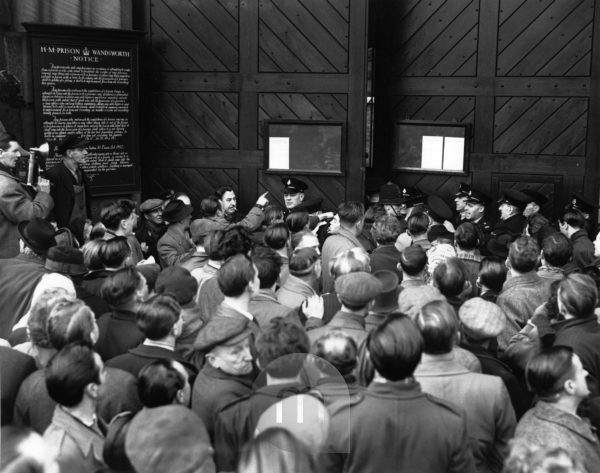
Crowds outside Wandsworth Prison on the morning of Derek Bentley's execution, 1953.
Press photograph, 1953; check the licence before use (for example via a newspaper or library archive).
The execution of Derek Bentley in 1953 caused public outrage. Crowds gathered outside the prison, and the case became a symbol of the campaign against hanging.
THE CASE
"Let him have it"
Words Bentley was said to have shouted before his friend fired.
Not the killer
His friend Christopher Craig fired the shot but was too young to be hanged.
Pardoned
Bentley received a partial pardon in 1993, and his conviction was quashed in 1998.
openrevise.com
EDEXCEL GCSE HISTORY · PAPER 1 · CRIME & PUNISHMENT

Why the Death Penalty Was Abolished
Chapter 4: Crime, punishment and law enforcement in recent times, c1900-present
Lesson 4 of 4
Several factors came together in the 1950s and 1960s.
Miscarriages of justice
The Evans case proved that an innocent person could be hanged.
Changing attitudes
Society became more concerned with human rights and the rehabilitation of offenders.
Campaigners
MPs such as Sydney Silverman campaigned for years to end hanging.
Deterrence doubted
There was little evidence that hanging deterred murderers more than life imprisonment.
openrevise.com
EDEXCEL GCSE HISTORY · PAPER 1 · CRIME & PUNISHMENT

For and Against the Death Penalty
Chapter 4: Crime, punishment and law enforcement in recent times, c1900-present
Lesson 4 of 4
ARGUMENTS FOR
• Retribution: a life for a life.
• May deter other murderers.
• Protects the public permanently.
ARGUMENTS AGAINST
• An innocent person could be executed, and it cannot be undone.
• Little evidence it deters murder.
• It is cruel and against human rights.
openrevise.com
EDEXCEL GCSE HISTORY · PAPER 1 · CRIME & PUNISHMENT

Key Terms
Chapter 4: Crime, punishment and law enforcement in recent times, c1900-present
Lesson 4 of 4
Capital punishment
Execution as a punishment for crime.
Abolition
Ending something completely, such as the death penalty.
Miscarriage of justice
When an innocent person is convicted of a crime.
Pardon
Official forgiveness, which can be given after death.
Homicide Act
The 1957 law limiting the death penalty to certain types of murder.
Retribution
Punishment as revenge for the harm done.
openrevise.com
EDEXCEL GCSE HISTORY · PAPER 1 · CRIME & PUNISHMENT
Summary & Exam Focus
The cases of Evans, Bentley and Ellis turned public opinion against hanging.
Evans's case proved that an innocent man could be executed.
The death penalty for murder was suspended in 1965 and abolished permanently in 1969.
Changing attitudes and campaigners such as Sydney Silverman drove the change.
EXAM FOCUS
Explain why the death penalty was abolished in 1965. (12 marks)
Use the three cases as evidence, and explain wider reasons too - changing attitudes, campaigners, doubts about deterrence.
openrevise.com
EDEXCEL GCSE HISTORY · PAPER 1 · CRIME & PUNISHMENT

Exam Practice - The Death Penalty
Chapter 4: Crime, punishment and law enforcement in recent times, c1900-present
Lesson 4 of 4
Answer all questions. Use specific names, dates and examples in every answer. · 35 minutes
Question 1 · 4 marks · Explain one way
Explain one way in which the case of Timothy Evans was different from the case of Derek Bentley.
Question 2 · 12 marks · Explain why
Explain why the death penalty was abolished in 1965. You may use the following in your answer: Timothy Evans; Ruth Ellis. You must also use…
Question 3 · 16 marks · How far do you agree?
"The case of Derek Bentley was the main reason the death penalty was abolished in 1965." How far do you agree? Explain your answer. You may…
openrevise.com
EDEXCEL GCSE HISTORY · PAPER 1 · CRIME & PUNISHMENT

Question 1 · 4 marks · Explain one way
Chapter 4: Crime, punishment and law enforcement in recent times, c1900-present
Lesson 4 of 4
“
Explain one way in which the case of Timothy Evans was different from the case of Derek Bentley.
HOW TO ANSWER IT
Command word: Explain one way. Worth 4 marks, so plan before writing.
openrevise.com
EDEXCEL GCSE HISTORY · PAPER 1 · CRIME & PUNISHMENT

Question 1 · mark scheme
Chapter 4: Crime, punishment and law enforcement in recent times, c1900-present
Lesson 4 of 4
4 marks available. Award a mark for each point made.
A valid difference identified
1-2 marks
Supported with specific knowledge of both cases
3-4 marks
openrevise.com
EDEXCEL GCSE HISTORY · PAPER 1 · CRIME & PUNISHMENT

Question 2 · 12 marks · Explain why
Chapter 4: Crime, punishment and law enforcement in recent times, c1900-present
Lesson 4 of 4
“
Explain why the death penalty was abolished in 1965. You may use the following in your answer: Timothy Evans; Ruth Ellis. You must also use information of your own.
HOW TO ANSWER IT
Command word: Explain why. Worth 12 marks, so plan before writing.
openrevise.com
EDEXCEL GCSE HISTORY · PAPER 1 · CRIME & PUNISHMENT

Question 2 · mark scheme
Chapter 4: Crime, punishment and law enforcement in recent times, c1900-present
Lesson 4 of 4
12 marks available. Award a mark for each point made.
Level 1 (1-3)
A simple or general answer
Level 2 (4-6)
Some explanation of one or more reasons, with some knowledge
Level 3 (7-9)
A developed explanation linked to the question, with accurate knowledge
Level 4 (10-12)
An analytical explanation of several reasons, with knowledge that goes beyond the stimulus points
openrevise.com
EDEXCEL GCSE HISTORY · PAPER 1 · CRIME & PUNISHMENT

Question 3 · 16 marks · How far do you agree?
Chapter 4: Crime, punishment and law enforcement in recent times, c1900-present
Lesson 4 of 4
“
"The case of Derek Bentley was the main reason the death penalty was abolished in 1965." How far do you agree? Explain your answer. You may use the following in your answer: Derek Bentley; changing attitudes. You must also use information of your own. (16 marks, plus 4 for spelling, punctuation…
HOW TO ANSWER IT
Command word: How far do you agree?. Worth 16 marks, so plan before writing.
openrevise.com
EDEXCEL GCSE HISTORY · PAPER 1 · CRIME & PUNISHMENT

Question 3 · mark scheme
Chapter 4: Crime, punishment and law enforcement in recent times, c1900-present
Lesson 4 of 4
16 marks available. Award a mark for each point made.
Level 1 (1-4)
A simple or generalised answer
Level 2 (5-8)
Some analysis, with a judgement that is asserted
Level 3 (9-12)
Analysis of both sides with accurate knowledge and a supported judgement
openrevise.com
EDEXCEL GCSE HISTORY · PAPER 1 · CRIME & PUNISHMENT

Question 3 · mark scheme (cont.)
Chapter 4: Crime, punishment and law enforcement in recent times, c1900-present
Lesson 4 of 4
Level 4 (13-16)
Sustained analysis, knowledge beyond the stimulus, and a clear, justified judgement
SPaG (4)
Accurate spelling, punctuation and grammar, with specialist terms such as capital punishment and miscarriage of justice
openrevise.com
← → to move, F to present full screen, G for every slide at once.