Slides · PPTX · 235 KB · 31 slides
Break-even analysis - Teacher Slides.pptx
The lesson slides with the teacher's notes on each slide, and every question and mark scheme built in. Built from the lesson script on 25 September 2026.
EDEXCEL GCSE BUSINESS · PAPER 1

Break-even analysis
Putting a business idea into practice
Lesson 3 of 5
openrevise.com
EDEXCEL GCSE BUSINESS · PAPER 1

Last Lesson
Putting a business idea into practice
Lesson 3 of 5
Answer from memory before the answers appear.
1
How do you calculate revenue?
2
How do you calculate total costs?
3
How do you calculate profit?
4
Give one example each of a fixed and a variable cost.
openrevise.com
EDEXCEL GCSE BUSINESS · PAPER 1

Last Lesson - Answers
Putting a business idea into practice
Lesson 3 of 5
1
How do you calculate revenue?
Price × quantity sold.
2
How do you calculate total costs?
Fixed costs + (variable cost per unit × quantity).
3
How do you calculate profit?
Total revenue - total costs.
4
Give one example each of a fixed and a variable cost.
Fixed: rent, salaries, insurance. Variable: raw materials, packaging, stock.
openrevise.com
EDEXCEL GCSE BUSINESS · PAPER 1

Learning Objectives
Putting a business idea into practice
Lesson 3 of 5
1
Explain what is meant by break-even.
2
Calculate the break-even level of output.
3
Calculate and explain the margin of safety.
4
Read profit, loss and break-even from a break-even diagram.
5
Explain the impact of changes in revenue and costs on break-even.
openrevise.com
EDEXCEL GCSE BUSINESS · PAPER 1

What Is Break-Even?
Putting a business idea into practice
Lesson 3 of 5
Break-even is the point where total revenue equals total costs - no profit and no loss.
Break-even output
The number of units a business must sell to cover all its costs.
Below break-even
Every unit short of break-even means the business makes a loss.
Above break-even
Every unit sold beyond break-even adds to profit.
Why it matters
It tells a new business how much it must sell before it makes any money, and helps owners and banks judge whether an idea is realistic.
openrevise.com
EDEXCEL GCSE BUSINESS · PAPER 1

Calculating Break-Even
Putting a business idea into practice
Lesson 3 of 5
Break-even output = fixed costs ÷ (sales price - variable cost per unit).
Sales price - variable cost
The amount each unit contributes towards paying the fixed costs.
Fixed costs
The costs that must be covered before any profit is made.
The answer
Is always in units, not pounds. Round up to a whole unit if needed - you cannot sell part of a product.
openrevise.com
EDEXCEL GCSE BUSINESS · PAPER 1

The Café's Break-Even Point
Putting a business idea into practice
Lesson 3 of 5
Write the formula first, then put in the numbers.
The café sells coffee at £4. Each cup costs £1.50 to make, and fixed costs are £6,000 a month. Calculate how many cups it must sell to break even.
1
Write the formula
Break-even = fixed costs ÷ (sales price - variable cost per unit)
2
Price - variable cost
£4.00 - £1.50 = £2.50 per cup
3
Divide fixed costs
£6,000 ÷ £2.50 = 2,400
ANSWER
Break-even = 2,400 cups a month
openrevise.com
EDEXCEL GCSE BUSINESS · PAPER 1

The Margin of Safety
Putting a business idea into practice
Lesson 3 of 5
Margin of safety = actual (or budgeted) sales - break-even output.
What it means
How far sales could fall before the business starts to make a loss.
A big margin
Is safer: sales can drop a long way before the business is in trouble.
A small margin
Is risky: a small fall in sales could push the business into a loss.
Example
The café sells 3,000 cups and breaks even at 2,400, so its margin of safety = 3,000 - 2,400 = 600 cups.
openrevise.com
EDEXCEL GCSE BUSINESS · PAPER 1

PART TWO
The Break-Even Diagram
The same numbers, drawn as a graph.
openrevise.com
EDEXCEL GCSE BUSINESS · PAPER 1

Reading a Break-Even Diagram
Putting a business idea into practice
Lesson 3 of 5
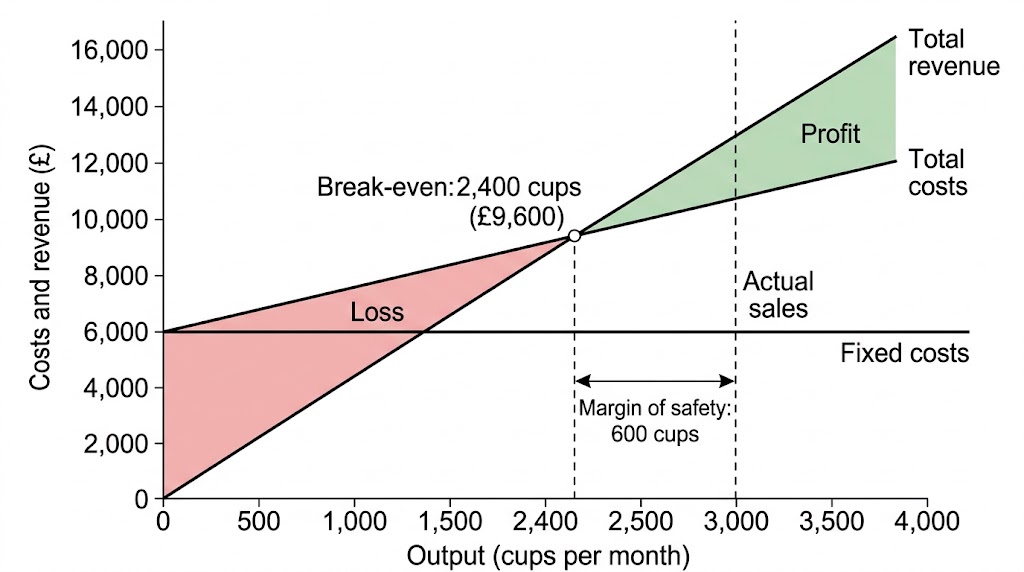
The café breaks even at 2,400 cups. At 3,000 cups its margin of safety is 600 cups.
On a break-even diagram, fixed costs are a flat line because they do not change with output. Total costs start at the fixed costs and rise with every cup made. Total revenue starts at zero and rises faster. Where revenue crosses total costs, the business breaks even.
openrevise.com
EDEXCEL GCSE BUSINESS · PAPER 1

What Each Part of the Diagram Shows
Putting a business idea into practice
Lesson 3 of 5
Part
What it shows
Where to find it
Fixed costs line
Costs that do not change with output
Flat, horizontal line
Total costs line
Fixed costs + variable costs
Starts at the fixed costs line, slopes up
Total revenue line
Money from sales
Starts at zero, slopes up more steeply
Break-even point
Revenue = total costs
Where the revenue and total costs lines cross
Loss
Costs are greater than revenue
Gap between the lines, left of break-even
Profit
Revenue is greater than costs
Gap between the lines, right of break-even
Margin of safety
How far sales can fall before a loss
Gap between actual sales and break-even output
openrevise.com
EDEXCEL GCSE BUSINESS · PAPER 1

PART THREE
When Things Change
A change in price or costs moves the break-even point.
openrevise.com
EDEXCEL GCSE BUSINESS · PAPER 1

How Changes Affect the Café's Break-Even
Putting a business idea into practice
Lesson 3 of 5
Change
New calculation
New break-even
Effect
Nothing changes
£6,000 ÷ (£4.00 - £1.50)
2,400 cups
The starting point
Price rises to £4.50
£6,000 ÷ (£4.50 - £1.50)
2,000 cups
Falls: better
Fixed costs rise to £7,500
£7,500 ÷ (£4.00 - £1.50)
3,000 cups
Rises: worse
Variable cost rises to £2.00
£6,000 ÷ (£4.00 - £2.00)
3,000 cups
Rises: worse
openrevise.com
EDEXCEL GCSE BUSINESS · PAPER 1

What Moves the Break-Even Point?
Putting a business idea into practice
Lesson 3 of 5
BREAK-EVEN FALLS (GOOD)
• Selling price rises.
• Fixed costs fall.
• Variable cost per unit falls.
• The business needs to sell fewer units to cover its costs.
• The margin of safety grows.
BREAK-EVEN RISES (BAD)
• Selling price falls.
• Fixed costs rise.
• Variable cost per unit rises.
• The business needs to sell more units to cover its costs.
• The margin of safety shrinks.
openrevise.com
EDEXCEL GCSE BUSINESS · PAPER 1

Limitations of Break-Even Analysis
Putting a business idea into practice
Lesson 3 of 5
Break-even is useful, but it rests on assumptions.
Assumes everything is sold
In reality some stock may be left unsold or wasted.
Assumes prices and costs stay the same
Suppliers raise prices, and businesses offer discounts.
Only as good as its figures
If the estimates of sales or costs are wrong, so is the break-even point.
Does not show cash
A business can be above break-even and still run out of cash.
openrevise.com
EDEXCEL GCSE BUSINESS · PAPER 1

Key Terms
Putting a business idea into practice
Lesson 3 of 5
Break-even
The point where total revenue equals total costs, so there is no profit and no loss.
Break-even output
The number of units a business must sell to cover its costs.
Margin of safety
The difference between actual sales and break-even output.
Break-even diagram
A graph showing fixed costs, total costs and total revenue, and where they cross.
openrevise.com
EDEXCEL GCSE BUSINESS · PAPER 1
Putting a business idea into practice
Lesson 3 of 5

YOUR TASK
Break-Even Challenge
15 minutes
A candle maker sells candles at £12. Each candle costs £4 in wax, wicks and jars, and fixed costs are £1,600 a month. Calculate the break-even output. She sells 300 candles a month - calculate her margin of safety. Then work out the new break-even output if she raises her price to £14.
1
Calculate price - variable cost.
2
Calculate break-even output.
3
Calculate the margin of safety.
4
Recalculate at the new price.
WHAT A GOOD ANSWER SHOWS
Break-even 200 candles; margin of safety 100 candles; new break-even 160 candles at £14.
openrevise.com
EDEXCEL GCSE BUSINESS · PAPER 1

Can I...?
Putting a business idea into practice
Lesson 3 of 5
Explain what break-even means.
Calculate break-even output.
Calculate the margin of safety.
Label a break-even diagram.
Read break-even, profit and loss from a diagram.
Explain the effect of a price change.
Explain the effect of a change in costs.
Explain the limitations of break-even.
openrevise.com
EDEXCEL GCSE BUSINESS · PAPER 1
Summary & Exam Focus
Break-even output = fixed costs ÷ (sales price - variable cost per unit).
Margin of safety = actual sales - break-even output.
On a diagram, break-even is where total revenue crosses total costs.
Higher prices or lower costs lower the break-even point; lower prices or higher costs raise it.
EXAM FOCUS
Calculate the break-even output for a business with fixed costs of £12,000, a selling price of £20 and variable costs of £8 per unit. (2 marks)
Always subtract the variable cost from the price before dividing. Your answer is in units, not pounds.
openrevise.com
EDEXCEL GCSE BUSINESS · PAPER 1

Exam Practice: Break-Even Analysis
Putting a business idea into practice
Lesson 3 of 5
Answer all questions. Show your working in calculations. · 25 minutes
Question 1 · 1 mark · Define
Define the term 'margin of safety'.
Question 2 · 2 marks · Calculate
A business has fixed costs of £12,000. It sells its product for £20 and the variable cost is £8 per unit. Calculate the break-even level of…
Question 3 · 2 marks · Calculate
The same business sells 1,300 units. Using your answer above, calculate its margin of safety. You are advised to show your working.
openrevise.com
EDEXCEL GCSE BUSINESS · PAPER 1

Exam Practice: Break-Even Analysis (cont.)
Putting a business idea into practice
Lesson 3 of 5
Question 4 · 2 marks · Outline
Outline one benefit to a new business of calculating its break-even output.
Question 5 · 3 marks · Explain
Explain one impact on a business's break-even output of an increase in the variable cost per unit.
openrevise.com
EDEXCEL GCSE BUSINESS · PAPER 1

Question 1 · 1 mark · Define
Putting a business idea into practice
Lesson 3 of 5
“
Define the term 'margin of safety'.
HOW TO ANSWER IT
Command word: Define. Worth 1 mark, so plan before writing.
openrevise.com
EDEXCEL GCSE BUSINESS · PAPER 1

Question 1 · mark scheme
Putting a business idea into practice
Lesson 3 of 5
1 mark available. Award a mark for each point made.
Actual / budgeted sales minus break-even output
1 mark
openrevise.com
EDEXCEL GCSE BUSINESS · PAPER 1

Question 2 · 2 marks · Calculate
Putting a business idea into practice
Lesson 3 of 5
“
A business has fixed costs of £12,000. It sells its product for £20 and the variable cost is £8 per unit. Calculate the break-even level of output. You are advised to show your working.
HOW TO ANSWER IT
Command word: Calculate. Worth 2 marks, so plan before writing.
openrevise.com
EDEXCEL GCSE BUSINESS · PAPER 1

Question 2 · mark scheme
Putting a business idea into practice
Lesson 3 of 5
2 marks available. Award a mark for each point made.
Correct method: fixed costs ÷ (price - variable cost per unit)
1 mark
Correct answer: 1,000 units
1 mark (award 2 marks for the correct answer with no working)
openrevise.com
EDEXCEL GCSE BUSINESS · PAPER 1

Question 3 · 2 marks · Calculate
Putting a business idea into practice
Lesson 3 of 5
“
The same business sells 1,300 units. Using your answer above, calculate its margin of safety. You are advised to show your working.
HOW TO ANSWER IT
Command word: Calculate. Worth 2 marks, so plan before writing.
openrevise.com
EDEXCEL GCSE BUSINESS · PAPER 1

Question 3 · mark scheme
Putting a business idea into practice
Lesson 3 of 5
2 marks available. Award a mark for each point made.
Correct method: actual sales - break-even output
1 mark
Correct answer: 300 units
1 mark (own figure rule applies)
openrevise.com
EDEXCEL GCSE BUSINESS · PAPER 1

Question 4 · 2 marks · Outline
Putting a business idea into practice
Lesson 3 of 5
“
Outline one benefit to a new business of calculating its break-even output.
HOW TO ANSWER IT
Command word: Outline. Worth 2 marks, so plan before writing.
openrevise.com
EDEXCEL GCSE BUSINESS · PAPER 1

Question 4 · mark scheme
Putting a business idea into practice
Lesson 3 of 5
2 marks available. Award a mark for each point made.
A benefit identified, e.g. sets a sales target / shows if the idea is viable / helps get a loan
1 mark
Developed: why this helps the business
1 mark
openrevise.com
EDEXCEL GCSE BUSINESS · PAPER 1

Question 5 · 3 marks · Explain
Putting a business idea into practice
Lesson 3 of 5
“
Explain one impact on a business's break-even output of an increase in the variable cost per unit.
HOW TO ANSWER IT
Command word: Explain. Worth 3 marks, so plan before writing.
openrevise.com
EDEXCEL GCSE BUSINESS · PAPER 1

Question 5 · mark scheme
Putting a business idea into practice
Lesson 3 of 5
3 marks available. Award a mark for each point made.
An impact identified: break-even output rises
1 mark
First linked point of explanation
1 mark
Second linked point of explanation
1 mark
openrevise.com
← → to move, F to present full screen, G for every slide at once.