4.2 Limiting factors and the rate of photosynthesis
6 exam questions worth 15 marks. Write your answer, open the mark scheme, then give yourself the marks you earned. Your answers are saved on this device.
0 / 15
Name three factors that can limit the rate of photosynthesis.
Mark scheme
Any three from:
- light intensity (1)
- carbon dioxide concentration (1)
- temperature (1)
- amount of chlorophyll (1)
Model answer
Light intensity, carbon dioxide concentration and temperature.
The rate of photosynthesis increases as light intensity increases, then levels off.
Explain why it levels off.
Mark scheme
- light is no longer the limiting factor (1)
- another factor, e.g. carbon dioxide concentration / temperature, is limiting (1)
Model answer
Light is no longer limiting the rate. Another factor, such as carbon dioxide concentration, is now in short supply and limits the rate.
Explain why the rate of photosynthesis falls at very high temperatures.
Mark scheme
- enzymes (controlling photosynthesis) are denatured (1)
- active sites change shape so the reactions slow / stop (1)
Model answer
Photosynthesis is controlled by enzymes. At high temperatures they are denatured, as their active sites change shape, so the reactions slow down.
A plant has yellow leaves because of a lack of magnesium. Explain why it photosynthesises more slowly.
Mark scheme
- less chlorophyll (1)
- so less light is absorbed (1)
Model answer
Magnesium is needed for chlorophyll. With less chlorophyll, less light is absorbed for photosynthesis.
Look at the graph of rate against light intensity at two carbon dioxide concentrations.
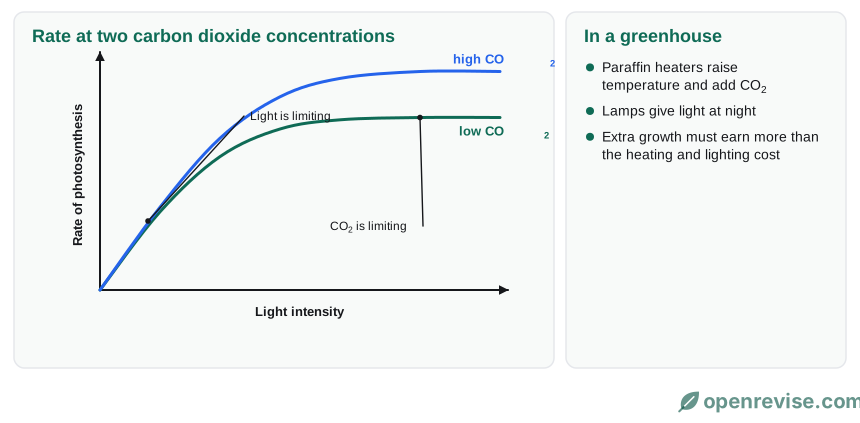
Which factor limits the rate on the low carbon dioxide line at high light intensity? Explain how the graph shows this.
Mark scheme
- carbon dioxide (concentration) (1)
- because increasing CO2 increases the rate / the high CO2 line is higher there (1)
Model answer
Carbon dioxide is limiting, because at the same high light intensity the rate is higher when there is more carbon dioxide.
A grower heats a greenhouse with paraffin heaters and lights it at night.
Explain how this increases the yield, and why the grower must think about costs.
Mark scheme
- heaters raise temperature so enzymes work faster / temperature not limiting (1)
- burning paraffin releases carbon dioxide (1)
- lighting allows photosynthesis to continue at night / more light (1)
- cost of fuel / electricity must be less than the value of extra crop (1)
Model answer
The heaters keep the temperature high so the enzymes work faster, and burning paraffin adds carbon dioxide. Lights let photosynthesis continue at night. Faster photosynthesis means faster growth and a bigger yield, but the grower must make sure the extra crop is worth more than the cost of the fuel and electricity.
Found a mistake?