4.3 Required practical: light intensity and photosynthesis
The required practical on how light intensity affects the rate of photosynthesis: counting oxygen bubbles from pondweed at different distances from a lamp, controlling variables, and (Higher) the inverse square law for light intensity.
The aim
To find out how light intensity affects the rate of photosynthesis. This is AQA required practical 6, Edexcel core practical 6.5 and part of OCR PAG B5.
Key terms
- Independent variable: light intensity, changed by moving the lamp.
- Dependent variable: the rate of photosynthesis, measured as the number of bubbles (or volume of oxygen) per minute.
- Control variables: temperature, carbon dioxide concentration, type and size of pondweed.
Method
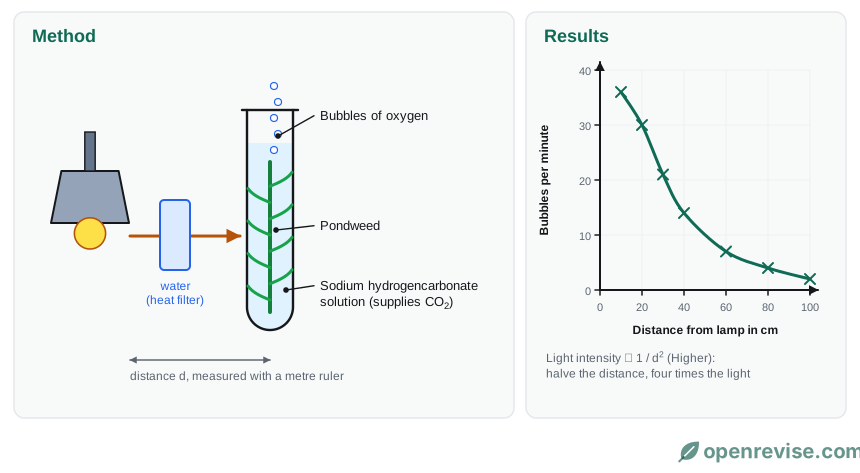
- Put a piece of pondweed, such as Elodea or Cabomba, into a boiling tube of sodium hydrogencarbonate solution. This gives the plant plenty of carbon dioxide.
- Place a lamp at a set distance, for example 10 cm, measured with a metre ruler.
- Leave the pondweed for 5 minutes to acclimatise to the new light.
- Count the number of oxygen bubbles given off in one minute. Repeat and find a mean.
- Move the lamp to 20, 30, 40 cm and so on, and repeat.
A more accurate method collects the gas in a gas syringe or an upturned measuring cylinder and measures its volume, because bubbles can be different sizes.
Controlling variables
- Temperature: a lamp gives out heat. Put a beaker of water or a glass tank between the lamp and the tube as a heat filter, or use an LED lamp that stays cool.
- Carbon dioxide: use the same concentration of sodium hydrogencarbonate each time.
- Do the experiment in a dark room, so the lamp is the only light source.
Results
The closer the lamp, the faster the bubbles are produced. At very short distances the rate levels off because another factor, such as carbon dioxide or temperature, becomes limiting.
The inverse square law (Higher)
Light intensity is inversely proportional to the square of the distance from the lamp:
So halving the distance makes the light four times as intense. To plot rate against light intensity, calculate 1 ÷ d2 for each distance.
Test yourself on this lesson
6 exam questions · 10 marks · with mark schemes and model answers
Found a mistake?