4.5 Aerobic and anaerobic respiration
Respiration as an exothermic reaction in every living cell: the equations for aerobic respiration, anaerobic respiration in muscles (lactic acid) and in plants and yeast (ethanol and carbon dioxide), fermentation, and why aerobic respiration releases more energy.
What respiration is
Key terms
- Respiration: an exothermic reaction in living cells that transfers energy from glucose.
- Aerobic respiration: respiration using oxygen.
- Anaerobic respiration: respiration without oxygen.
- Fermentation: anaerobic respiration in yeast, producing ethanol and carbon dioxide.
Respiration happens continuously in every living cell. It is exothermic: it transfers energy to the surroundings. Organisms need this energy for:
- chemical reactions to build larger molecules, such as proteins
- movement, such as muscle contraction
- keeping warm (in mammals and birds).
Do not confuse respiration with breathing: breathing moves air in and out of the lungs; respiration is a chemical reaction in cells.
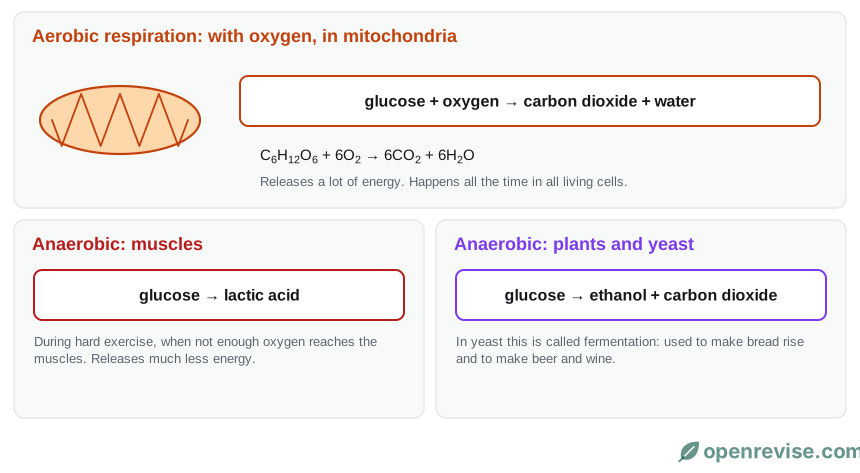
Aerobic respiration
Aerobic respiration happens in the mitochondria. It uses oxygen and releases a lot of energy.
Anaerobic respiration
When there is not enough oxygen, cells can respire anaerobically.
- In muscles: glucose → lactic acid. This happens during hard exercise.
- In plant cells and yeast: glucose → ethanol + carbon dioxide. In yeast this is fermentation, used to make bread (the carbon dioxide makes it rise) and alcoholic drinks (the ethanol).
Comparing them
| Feature | Aerobic | Anaerobic |
|---|---|---|
| Oxygen needed | Yes | No |
| Products | Carbon dioxide and water | Lactic acid (muscles), or ethanol and carbon dioxide (plants, yeast) |
| Energy released | A lot | Much less |
| Glucose broken down | Completely | Incompletely |
Anaerobic respiration releases much less energy because the oxidation of glucose is incomplete: lactic acid and ethanol still contain a lot of energy.
ATP (OCR)
The energy from respiration is used to make a molecule called ATP, which carries energy to where it is needed in the cell. Aerobic respiration makes far more ATP per glucose molecule than anaerobic respiration.
Test yourself on this lesson
6 exam questions · 10 marks · with mark schemes and model answers
Found a mistake?