4.6 Exercise and oxygen debt
AQA: how heart rate, breathing rate and breath volume change during exercise, why muscles respire anaerobically and become fatigued, lactic acid and oxygen debt, and (Higher) how the liver deals with lactic acid.
The body's response to exercise
Key terms
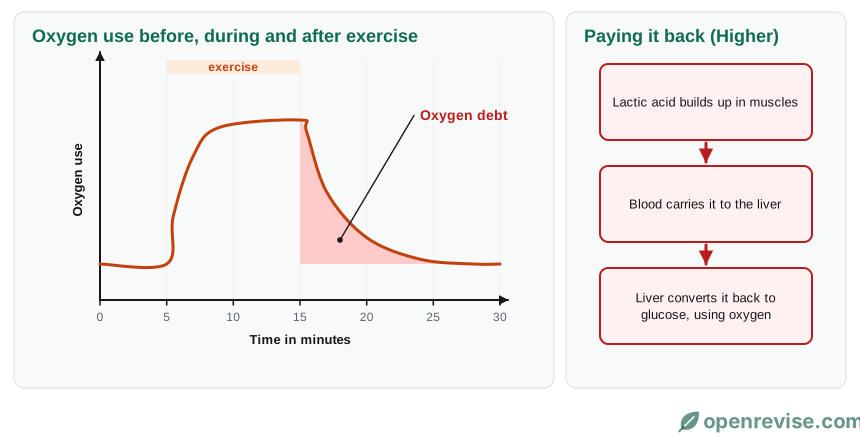
- Oxygen debt: the amount of extra oxygen the body needs after exercise to react with the lactic acid that has built up and remove it from cells.
- Muscle fatigue: when muscles stop contracting efficiently after long periods of activity.
- Lactic acid: the product of anaerobic respiration in muscles.
During exercise, muscles contract more, so they need more energy from respiration. The body responds:
- heart rate increases, so blood flows to the muscles faster
- breathing rate and breath volume increase, so more oxygen enters the blood and more carbon dioxide is removed.
This delivers more oxygen and glucose to the muscles and removes the extra carbon dioxide.
When oxygen runs short
During hard exercise, the heart and lungs cannot supply oxygen fast enough. The muscles respire anaerobically as well, producing lactic acid. Lactic acid builds up and the muscles become fatigued: they stop contracting efficiently and may ache.
Paying back the oxygen debt
After exercise you keep breathing hard and your heart keeps beating fast. The extra oxygen taken in is used to remove the lactic acid. This extra oxygen is the oxygen debt.
What happens to the lactic acid (Higher)
- Blood flowing through the muscles carries the lactic acid away.
- It is taken to the liver.
- The liver converts it back into glucose. This needs oxygen.
Test yourself on this lesson
6 exam questions · 12 marks · with mark schemes and model answers
Found a mistake?