4.6 Exercise and oxygen debt
6 exam questions worth 12 marks. Write your answer, open the mark scheme, then give yourself the marks you earned. Your answers are saved on this device.
0 / 12
Explain why heart rate and breathing rate increase during exercise.
Mark scheme
- muscles respire faster / need more energy (1)
- more oxygen / glucose delivered to muscles (1)
- more carbon dioxide removed (1)
Model answer
The muscles respire faster to release more energy. A faster heart rate and breathing rate supply more oxygen and glucose to the muscles and remove the extra carbon dioxide.
During a sprint, lactic acid builds up in the muscles. Explain why.
Mark scheme
- not enough oxygen reaches the muscles (1)
- so they respire anaerobically, producing lactic acid (1)
Model answer
The heart and lungs cannot supply oxygen fast enough, so the muscles respire anaerobically, which produces lactic acid.
What is meant by oxygen debt?
Mark scheme
- the (extra) oxygen needed after exercise (1)
- to react with / remove the lactic acid (1)
Model answer
The oxygen debt is the extra oxygen needed after exercise to react with the lactic acid that has built up and remove it.
What happens to muscles that become fatigued?
Mark scheme
they stop contracting efficiently
Model answer
They stop contracting efficiently.
Describe how the body removes lactic acid after exercise.
Mark scheme
- blood carries lactic acid from the muscles (1)
- to the liver (1)
- (liver) converts it back to glucose (using oxygen) (1)
Model answer
Blood flowing through the muscles carries the lactic acid to the liver, where it is converted back into glucose. This uses oxygen, which is why you keep breathing hard after exercise.
Look at the graph of oxygen use.
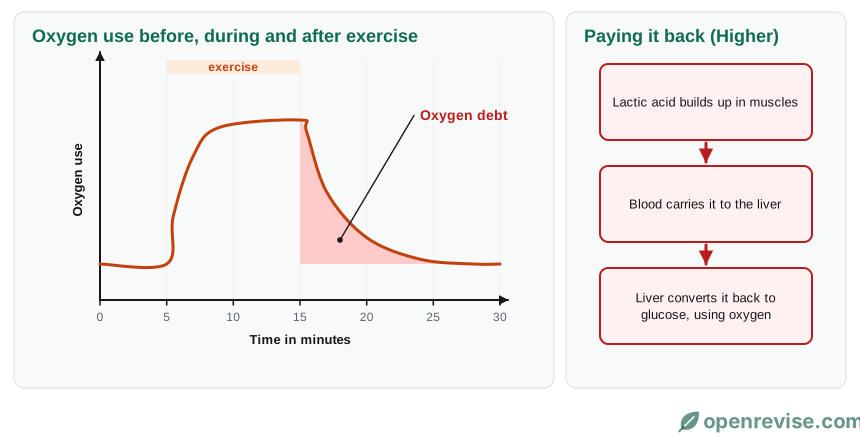
How long did it take for oxygen use to return to its resting level after exercise stopped?
Mark scheme
about 11-13 minutes (allow 10-15)
Model answer
Exercise stopped at 15 minutes and oxygen use returned to the resting level at about 27 minutes, so about 12 minutes.
Found a mistake?