4.8 Metabolism
Metabolism as the sum of all the reactions in a cell or body: building up starch, glycogen, cellulose, lipids and proteins, breaking down glucose in respiration and excess protein into urea, all controlled by enzymes using energy from respiration.
What metabolism is
Key terms
- Metabolism: the sum of all the reactions in a cell or the body.
- Glycogen: the storage carbohydrate in animals, made from glucose in the liver and muscles.
- Urea: a waste product made in the liver from excess amino acids.
Cells use the energy transferred by respiration to carry out reactions that make new molecules. These reactions, and the reactions that break molecules down, are all controlled by enzymes. Together they make up the organism's metabolism.
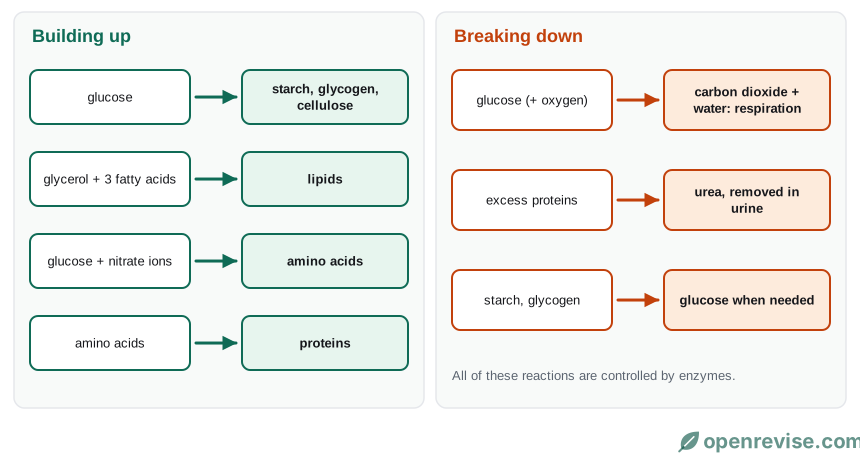
Building up (synthesis)
- Glucose → starch (plants), glycogen (animals) or cellulose (plant cell walls).
- One glycerol + three fatty acids → a lipid molecule.
- Glucose + nitrate ions → amino acids (plants), which are then joined to make proteins.
Breaking down
- Respiration: glucose is broken down to release energy.
- Excess proteins are broken down to amino acids, and in the liver excess amino acids are turned into urea, which is removed by the kidneys in urine.
- Stores such as starch and glycogen are broken down to glucose when needed.
Why the small molecules matter (OCR)
Sugars, amino acids, fatty acids and glycerol are the building blocks. Digestion breaks large food molecules into these small units, and cells use them to build the carbohydrates, proteins and lipids they need.
| Large molecule | Made from |
|---|---|
| Starch, glycogen, cellulose | Glucose |
| Protein | Amino acids |
| Lipid | Glycerol and fatty acids |
Test yourself on this lesson
6 exam questions · 10 marks · with mark schemes and model answers
Found a mistake?