5.1 Homeostasis and control systems
What homeostasis is, why cells need steady conditions, and how receptors, coordination centres and effectors use negative feedback to keep levels near their optimum.
What is homeostasis?
Key terms
- Homeostasis: the regulation of the internal conditions of a cell or organism to keep them at the optimum (best) level for function, in response to internal and external changes.
- Stimulus: a change in the environment, inside or outside the body, that can be detected.
- Receptor: a cell that detects a stimulus.
- Coordination centre: an organ that receives and processes information from receptors, such as the brain, the spinal cord or the pancreas.
- Effector: a muscle or gland that brings about a response.
- Negative feedback: a change away from the normal level triggers a response that reverses the change, bringing the level back to normal.
The cells in your body can only survive and work properly within narrow limits. They need the right temperature, the right pH, a steady supply of glucose and the right amount of water around them. Conditions outside your body change all the time (a cold day, a hot bath), and so do conditions inside it (a big meal, a long run). Homeostasis is the set of automatic control systems that keeps your internal environment steady despite these changes.
Why steady conditions matter
- Enzymes. Almost every reaction in a cell is controlled by an enzyme. Human enzymes work best at about 37 °C. If the body gets too hot, the active site changes shape and the enzyme is denatured, so the substrate no longer fits. If it gets too cold, molecules move slowly and reactions become too slow to keep the cell alive.
- Water and cells. If the water concentration of the blood and tissue fluid changes, water moves into or out of cells by osmosis. Animal cells can swell and burst, or shrink, and then they cannot work properly.
- Glucose. Cells need a constant supply of glucose for respiration, but too much glucose in the blood is also harmful.
So homeostasis keeps the conditions right for enzyme action and for all cell functions, which lets metabolic reactions happen at the right rate.
| Condition | Why it matters | Main control |
|---|---|---|
| Blood glucose concentration | Cells need glucose for respiration; too much in the blood damages organs | Pancreas (insulin and glucagon) |
| Body temperature | Enzymes work best at about 37 °C | Thermoregulatory centre in the brain, and the skin |
| Water levels | Stops cells gaining or losing too much water by osmosis | Kidneys, controlled by the hormone ADH |
Control systems
The body's automatic control systems can work through the nervous system (electrical impulses, fast) or through hormones (chemicals in the blood, slower). Many use both. Every control system has the same three parts:
- Receptors detect a stimulus: a change in the internal or external environment.
- A coordination centre (for example the brain, spinal cord or pancreas) receives the information from the receptors and processes it.
- Effectors (muscles or glands) carry out a response that brings conditions back to the optimum.
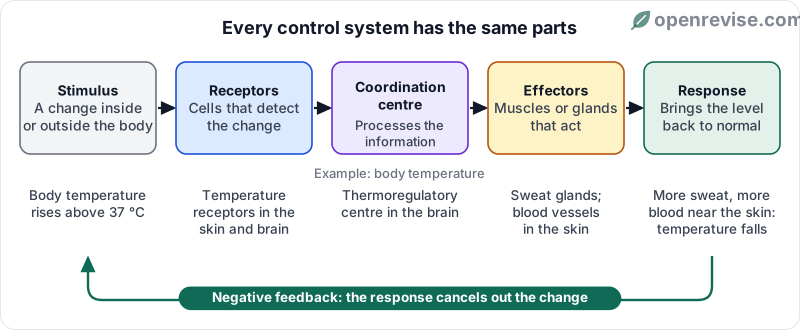
Effectors are always muscles or glands. Muscles respond by contracting (for example, muscles shivering). Glands respond by secreting (releasing) a substance, such as sweat or a hormone.
Negative feedback
Most homeostatic control systems work by negative feedback:
- If a level rises above normal, receptors detect the rise and effectors act to bring it down.
- If a level falls below normal, receptors detect the fall and effectors act to bring it up.
Because the response always works against the change, the level keeps moving back towards its optimum. It never stays perfectly still: it rises and falls a little, but stays within a narrow normal range.
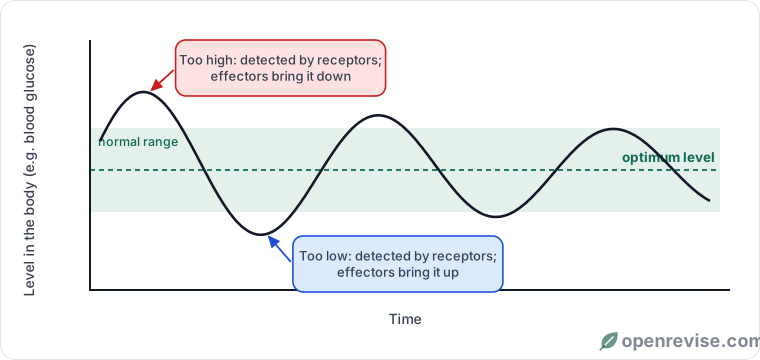
You will meet negative feedback again in this topic: in the control of blood glucose (insulin and glucagon), water (ADH) and metabolic rate (thyroxine).
Test yourself on this lesson
7 exam questions · 18 marks · with mark schemes and model answers
Found a mistake?