1.10 Chromosomes, mitosis and the cell cycle
Chromosomes, genes and DNA; the three stages of the cell cycle; how mitosis makes two genetically identical diploid cells, why it matters for growth, repair and asexual reproduction, and how to count cells after n divisions.
Chromosomes
Key terms
- Chromosome: a long molecule of DNA, found in the nucleus, that carries many genes.
- Gene: a short section of DNA that codes for a particular protein.
- Diploid: having two sets of chromosomes, one from each parent. Human body cells are diploid, with 46 chromosomes.
- Cell cycle: the series of stages a cell goes through as it grows and divides.
- Mitosis: cell division that produces two daughter cells that are genetically identical to the parent cell.
- Daughter cell: one of the new cells made when a cell divides.
The nucleus of a cell contains chromosomes, which are made of long DNA molecules. Each chromosome carries a large number of genes. In body cells the chromosomes are normally found in pairs: one chromosome of each pair came from the mother and one from the father. A human body cell has 23 pairs, which is 46 chromosomes.
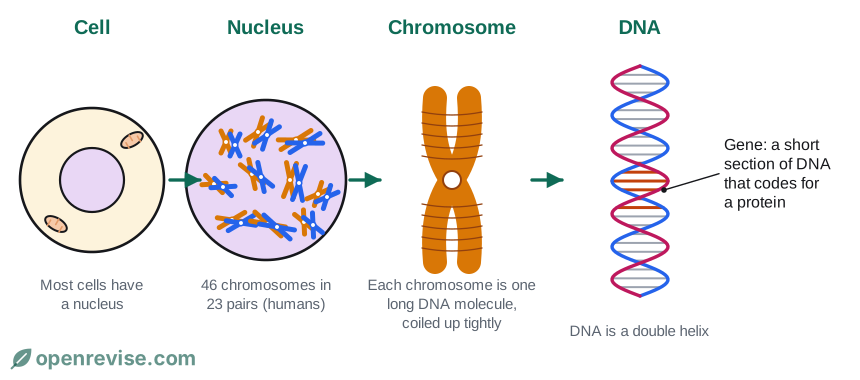
In a cell that is not dividing, the DNA is spread out in long, thin strands. When the cell gets ready to divide, the DNA is copied and the strands coil up into chromosomes.
The cell cycle
Cells divide to make new cells. Before a cell can divide, it has to grow and copy its contents. The series of events is called the cell cycle:
- Growth and DNA replication (interphase). The cell grows and makes more sub-cellular structures, such as ribosomes and mitochondria. The DNA is copied (replicated), so there are two copies of each chromosome.
- Mitosis. One set of chromosomes is pulled to each end of the cell, and the nucleus divides.
- Cytokinesis (cell division). The cytoplasm and cell membrane divide to form two identical daughter cells.
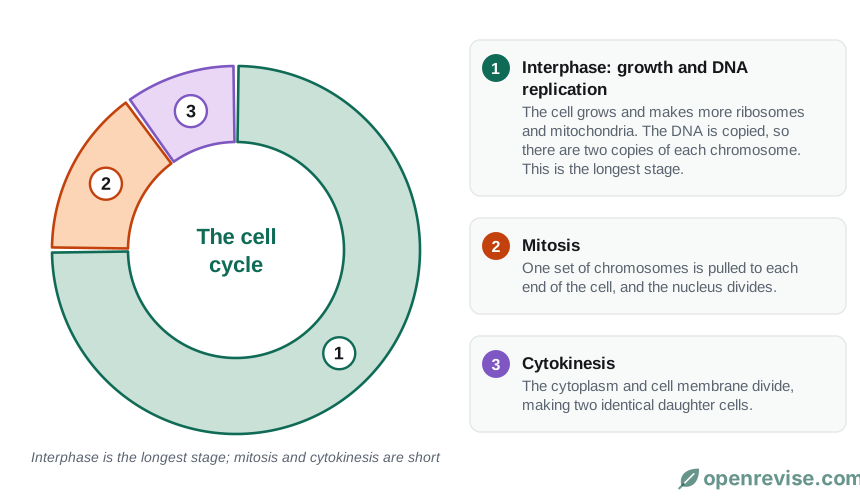
Because the DNA was copied exactly before mitosis, each daughter cell gets a full set of chromosomes. The two new cells are genetically identical to each other and to the parent cell, and they are diploid. Genetically identical cells are called clones.
Why mitosis is important
Mitosis is how multicellular organisms:
- grow and develop, by making more cells;
- repair damaged tissue, such as a cut in the skin;
- replace cells that are worn out or lost, such as skin cells and red blood cells;
- reproduce asexually, for example when a plant grows new shoots, so that the offspring are genetically identical to the parent.
Sometimes the control of cell division goes wrong and cells divide again and again. This can form a lump of cells called a tumour, which is how cancer starts.
Counting cells
Each mitosis doubles the number of cells. Starting from one cell, after n divisions there are 2n cells:
| Number of divisions | 0 | 1 | 2 | 3 | 4 | 5 |
|---|---|---|---|---|---|---|
| Number of cells | 1 | 2 | 4 | 8 | 16 | 32 |
Test yourself on this lesson
7 exam questions · 16 marks · with mark schemes and model answers
Found a mistake?